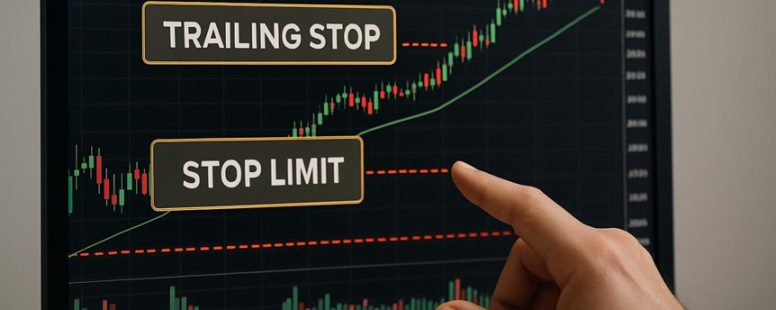
Imagine watching your investment grow, only to see it suddenly slip away because of a hidden trap. That’s the thin line between trailing stops and stop limits—two tools that can either safeguard your gains or make you miss out.
Trailing stops glide like a shadow, moving with the price to lock in profits, but sometimes they trigger too early, like a warning siren in the fog.
Stop limits stay fixed, offering precise control, yet risking missed opportunities when the market moves fast.
Knowing how to wield these strategies can turn your trades into a well-oiled machine—often with the unexpected perk of reducing emotional stress.
Ready to navigate this financial maze? Let’s explore how each tool can become your secret weapon.
What Does a Trailing Stop Do As Prices Move?
A trailing stop is a simple way to protect your profits while letting your investments grow. It works by setting a stop price a certain amount below the current market price, either in dollars or percentage. As the price moves up, the trailing stop moves up with it. But if the price drops, the stop stays in place. When the price falls enough to hit the stop, a sell order is triggered, helping you avoid big losses.
Think of it like a trail of breadcrumbs that follow the price upward. If the price keeps climbing, the breadcrumbs move higher too. But if the price drops back down, the breadcrumbs stay put. This way, you lock in gains without constantly changing your plan.
Some traders like trailing stops because they don’t have to watch the market all the time. They can set a trailing stop and forget it. However, it’s not perfect. If the market is very volatile, the stop might trigger too early or too often, causing you to sell when prices bounce back. Also, in fast-moving markets, your order might not fill exactly at the stop price, so you could lose some potential gains.
For example, if you buy Bitcoin at $20,000 and set a 10 percent trailing stop, the stop will initially be at $18,000. If Bitcoin goes up to $25,000, the stop moves to $22,500. If the price then drops to $22,500, your sell order triggers. You’ve protected your profit, but if Bitcoin suddenly drops below $22,500 very fast, you might sell too early or miss some gains if the price bounces back quickly.
Some traders prefer fixed stops because they stay the same. They know exactly when they will sell. But fixed stops might not adapt well to market swings. Trailing stops adjust to rising prices, making them better for gains, but they can also be risky if the market is very jumpy.
In the end, trailing stops are a useful tool, but they aren’t perfect. They work best in trending markets, not in choppy, unpredictable ones. Always remember to set your stop at a level you’re comfortable with, and don’t rely on them alone. Combining trailing stops with other strategies can give you better protection and growth.
How Do Stop Limits Set Fixed Price Points?
A stop limit order is a way to set fixed price points for buying or selling an asset. It helps you control exactly when your trade happens. Unlike other orders that change with the market, stop limits stay at the price you choose. This means your order only fills at that price or better. For example, if you want to buy a stock at $50, you set a stop price at $50 and a limit price at $50 or slightly above. When the stock hits $50, the order activates, but it won’t buy above your limit price.
This setup is useful because it prevents you from paying too much or selling too low. Imagine you want to buy a stock before it rises. You set a stop limit so the order only triggers at your chosen price. But be careful—if the price jumps past your limit quickly, your order might not fill at all. Some traders prefer stop market orders because they guarantee a fill, but they can execute at worse prices.
In short, stop limits give you firm control over your trades. They are good for avoiding surprises but may not always fill if the market moves fast. Whether you should use them depends on how much risk you’re willing to take and your trading style.
How Trailing Stops and Stop Limits Protect Your Trades
Trailing stops and stop limits are tools traders use to protect their investments.
A trailing stop is a type of order that moves along with the market price. When the price rises, the trailing stop also moves up. If the market turns and the price drops, the trailing stop triggers a sale to lock in your profits. For example, if you buy a stock at $50 and set a trailing stop of $5, it will stay at $45. If the stock goes to $60, the stop moves up to $55. If it then drops to $55, the stock sells automatically. This helps you keep gains as the market moves favorably. But be careful, trailing stops might sell if the market swings suddenly, even if the trend is still positive.
Stop limit orders are different. They set a specific price where you want to sell. When the stock hits that price, the order turns into a limit order to sell at that exact price or better. For example, if a stock is at $100 and you set a stop limit at $95, when the price hits $95, your order becomes a limit order to sell at $95. This gives you control over the selling price, preventing slippage—where you sell at a lower price than expected. However, if the market moves very fast and skips past your limit, your order might not execute.
Some traders prefer trailing stops because they adapt to gains without needing constant adjustments. Others like stop limits because they keep the selling price precise. Both have their risks. Trailing stops might cause you to sell too early if the market whipsaws. Stop limits might leave you holding on too long if the price falls quickly past your limit.
In my experience, using both tools can be smart. Trailing stops protect profits and respond to market moves, while stop limits give control over the exact sell point. But remember, no method is perfect. Sometimes, the market moves so fast that your order doesn’t get filled, and you might lose a chance to sell at your desired price.
Understanding how these tools work can help you avoid big losses. Still, it’s good to practice and know their limits. Whether you pick one or both, keep an eye on the market and adjust your orders as needed. That way, you’re actively managing your trades instead of just reacting after a big loss.
When Should You Use a Trailing Stop vs. a Stop Limit?
A trailing stop and a stop limit are two different tools traders use to protect their profits or limit losses. Knowing when to use each can make a big difference in how your trades turn out.
A trailing stop automatically moves up as the price of a stock or asset increases. It helps lock in profits during market swings. For example, if you buy a stock at 50 dollars and set a trailing stop at 5 dollars below the highest price, the stop moves up if the stock goes higher. If the stock then drops below that level, the trade sells automatically. This is good in volatile markets where prices change a lot fast. But it also risks selling too early if the market whipsaws.
On the other hand, a stop limit lets you set a specific price to sell. It only executes at that price or better. For instance, if you want to sell a stock at 55 dollars but are okay with it selling at 54, you set a stop limit at 55. If the price hits 55, the order tries to sell at that price. If the price falls quickly past 55, your order might not fill at all, and you could lose potential gains. Stop limits give more control but can leave you hanging in fast markets.
Some traders prefer trailing stops when they want to stay in a trade and take advantage of upward moves. Others choose stop limits when they want precision and are okay with missing out if the price moves past their set point too fast.
Both tools have limits. Trailing stops can cause you to sell during normal market swings, and stop limits might not get filled if prices jump past your limit. Think about your goals and how much risk you are willing to accept. Testing both in small trades can help you see what works best for you.
In short, if you want to protect profits during ups and downs, a trailing stop could be best. If you want to control exactly where you sell, a stop limit is better. Knowing when and how to use each depends on your trading style and market conditions.
Market Volatility Considerations
A stop order is a tool used to protect your profits or limit losses when trading stocks or other assets. There are two main types: trailing stops and stop limits. Knowing when to use each can help you avoid big losses or missed opportunities.
A trailing stop is best when the market is steady with small price changes. It moves up as the price increases, letting you lock in gains without selling too early. For example, if you buy a stock at 50 dollars and set a trailing stop of 5 dollars, it will stay 5 dollars below the highest price. If the stock rises to 60 dollars, the stop moves up to 55 dollars. But if the stock drops back down to 55, the order triggers and sells. Trailing stops work well in calm markets but can cause frustration when normal price swings trigger sales.
On the other hand, a stop limit is better during volatile times. It sets a specific price to sell, so you don’t get caught in sudden price swings. For example, if you set a stop limit at 55 dollars, the order will only sell if the price reaches or drops below that point. This prevents selling because of temporary noise or quick drops. But the downside is if the price skips past your limit, you might not sell at all. During sudden news or market shocks, stop limits give you more control but can leave you exposed if the price moves too fast.
Some traders prefer trailing stops because they follow the market upward. Others like stop limits for their precision during chaos. Both have good and bad points. Trailing stops can be triggered by normal price noise, causing unwanted sales. Stop limits prevent emotional reactions but can leave you holding onto a losing position if the price moves quickly past your limit.
Before choosing a stop order, think about the market’s mood. Is it steady or jumping around? During calm times, trailing stops help you ride gains smoothly. When markets are volatile, stop limits help you stay in control. Remember, no tool is perfect. Using them wisely can protect your profits but also limit your opportunities.
Risk Management Strategies
Risk management in trading is all about choosing the right stop order to control potential losses. The best choice depends on how you see risk, your trading goals, and how you handle emotions.
What is a stop order?
A stop order is a tool that automatically sells your investment when it reaches a certain price. It helps you limit losses or lock in profits without needing to watch the market all the time.
Trailing Stops are great if you want your profits to grow while protecting gains. They move up as the price increases, locking in more profit if the market turns. For example, if you buy a stock at 50 dollars and set a trailing stop at 5 dollars, it will follow the price up but sell if the stock drops 5 dollars from its highest point. Trailing stops are good if you trust your strategy and can handle the market moving up and down without panicking.
Stop Limits are better if you want precise control over your sells. They set a specific price to sell and won’t sell below that price. This helps avoid slippage, which is when your order fills at a worse price than expected during fast market swings. But be careful: if the price drops quickly past your limit, your order might not execute at all. Stop limits work well for traders who want strict loss limits and are okay with the risk of missed trades.
Two viewpoints:
Some traders prefer trailing stops because they automatically adjust, reducing stress and helping them stay disciplined. Others choose stop limits for accuracy but must accept that their order might not fill if the market moves too fast.
Warning:
No stop order is foolproof. Trailing stops can trigger too early if the market is volatile. Stop limits might not fill if prices fall sharply. It’s wise to understand both tools’ limits before relying on them.
In the end, picking the right stop order means thinking about your risk comfort, your trading style, and how emotional you are during market swings. Would you rather let your profits run or stick to strict rules? The answer is different for everyone.
Trade Execution Preferences
A trailing stop and a stop limit order are tools traders use to control how their trades are executed.
A trailing stop is a type of stop order that moves with the price. For example, if you buy a stock at $50 and set a trailing stop of $5, the stop will stay $5 below the highest price the stock reaches. If the stock goes up to $60, the stop moves up to $55. If the price then drops to $55, the order triggers and sells your stock. Trailing stops are good if you want to lock in profits without watching the market all the time. They work well in trending markets where prices move steadily in one direction. But they might sell your stock too early if the market suddenly drops.
A stop limit order is different. It sets a specific price to sell or buy a stock. For example, you want to sell a stock at $55, but only if you can get at least $54. You put a stop limit order with a stop price of $55 and a limit price of $54. When the stock hits $55, the order becomes active, but it only sells at $54 or better. The problem is that if the price falls quickly past $54, your order might not fill at all. Stop limits give you more control over the price but can leave you with a position that doesn’t sell if the market moves too fast.
Both order types have their pros and cons. Trailing stops are simple and flexible, especially in markets where prices trend. But they might sell too early or too late. Stop limits give you precise control but risk missing out if the price drops past your limit quickly.
When choosing between them, think about your goal. Do you want to lock in profits easily, or do you prefer to control exactly at what price your order fills? If you want to avoid slippage and are okay with the risk of your order not filling, a stop limit might be better. If you want more automatic adjustments and are okay with some uncertainty, a trailing stop could be your choice.
In trading, there’s no perfect tool. You need to understand how each works and what risks they come with. Sometimes, combining both strategies can help you reach your goals better.
How Each Order Type Affects Your Potential Gains and Losses
Trailin stops and stop limits are two different ways to control your trades and manage your risks. Knowing how each one works can help you make better money decisions.
A trailing stop is like a safety net that moves with the price. If a stock goes up, your trailing stop rises with it, locking in some profits. But if the price drops, it triggers a sell. For example, if you buy a stock at $50 and set a trailing stop at $5, it will stay $5 below the highest price. So if the stock climbs to $60, your stop moves to $55. If it then falls back to $55, the order sells automatically. This way, you can catch gains while protecting yourself from big losses. But beware, if the market moves fast, your order might sell too early or too late.
Stop limits are different. They set a specific price to sell but only at or better than that price. Think of it as a firm limit. For example, if you set a stop limit at $45, your order becomes active if the price drops to $45. But it will only sell if it can find a price at or above your limit. The risk here is if the price falls quickly past your limit, your order might not fill, and you could hold onto a losing stock longer than you want. Stop limits give you control but can leave you exposed to bigger losses if the market moves fast.
Some traders prefer trailing stops because they can lock in profits and adapt as prices change. Others like stop limits for the certainty of a specific sell price, especially in volatile markets. But both have limits: trailing stops might sell too early if the market dips briefly, and stop limits might not sell at all if prices gap down.
Impact on Profit Potential
Trailing stops and stop limit orders are tools investors use to protect their money, but they affect profits differently. Knowing these differences can help you decide which to use to get the most out of your investments.
What is a trailing stop?
A trailing stop moves up as the price of a stock or asset rises. For example, if you set a trailing stop at 10 percent below the highest price, it will follow the price up. If the price continues to grow, your stop moves up with it, allowing you to lock in profits while giving the investment room to grow. This can help you make more money if the trend keeps going up.
What is a stop limit order?
A stop limit order sets a specific price to sell. For example, you might say sell if the price hits 50 dollars, but only if you can get at least 49 dollars. If the price moves past your limit without reaching that exact point, the order might never execute. This means you could miss out on gains if the market keeps rising past your set limit.
How do they affect your profits?
Trailing stops are good if you want to stay in a rising trend. They let your profits grow as the market moves in your favor. But, they can also lead to quick sales if the market dips suddenly.
Stop limit orders protect your profit margins during volatile swings. They prevent you from selling too low, but if the market moves past your limit fast, your order might not fill. So, you might lose money or miss the chance to sell at a good price.
Which should you choose?
If you want to maximize gains and are okay with some risk of early sales, a trailing stop might work best. If you prefer to lock in specific profit points and avoid selling at a low price, a stop limit order could be better. Each has its limits — trailing stops might trigger too early, and stop limit orders might not execute when needed.
In short, trailing stops can help you ride market trends for bigger profits but may cause premature sales. Stop limit orders protect profits during volatile swings but risk not executing if the market moves fast. Knowing your goal and how much risk you want can help you pick the right tool.
Risk Management Differences
Managing risk is key to protecting your investments. Knowing how trailing stops and stop limit orders work can help you avoid big losses and lock in profits.
A trailing stop is a tool that moves with the price. If the market goes up, the trailing stop rises, keeping your gains safe. If the market drops, it triggers an order to sell, locking in your profit. This method is good for traders who want to let their winners grow without constant watching. For example, if you buy a stock at $50 and set a trailing stop at $45, the stop moves up as the stock rises. But if the stock falls back to $45, it sells automatically. This helps you stay in gains if the market trends upward.
A stop limit order is different. It sets a specific price to sell, and only sells if the price reaches that point. For example, you set a stop limit order to sell at $48 with a limit of $47. If the price hits $48, the order tries to sell, but only if it can be sold at $48 or higher. This gives you control over the exact price you sell at, but it can also mean missing out if the price moves past your limit quickly. Stop limit orders are good if you want precise control, but they require quick reactions and emotional discipline to avoid missing quick market moves.
Both options affect how you think about your trades. Trailing stops encourage you to let your winners run, which can be good if the market is trending. Stop limit orders focus on cutting losses by setting a specific exit point. Choosing between them depends on your goal and how much risk you are willing to take.
If you want to protect profits while still allowing some flexibility, trailing stops are better. But if you want strict control over your exit point, a stop limit order might work. Remember, no method is perfect. Trailing stops can be triggered by small dips, and stop limit orders can miss fast market moves. Knowing the advantages and limits helps you stay smart about risk.
Sources: Investopedia, CNBC
Avoid These Common Mistakes With Trailing Stops and Stop Limits
Stop losing money on your trades. Trailing stops and stop limits can help protect your profits, but only if you set them right. Here’s what you need to know to avoid common mistakes.
First, a trailing stop is a type of order that moves with the price. If the stock goes up, your stop moves up too. But if the stop is set too tight or too loose, it can trigger too early or not at all. For example, if you set a stop just a few cents below the current price, a small dip could sell your stock too soon. On the other hand, setting it too far away might make the stop useless.
Second, market volatility matters. Stocks often swing up and down a lot, especially during news or earnings reports. If you ignore this, your stop might trigger during normal price swings. For instance, a sudden drop might cause your stop to sell just before the stock recovers. To avoid this, watch how much the price moves normally and set your stop a bit wider.
Third, understand the difference between stop limit orders and stop market orders. A stop limit order only sells if the stock reaches your limit price. But if the market skips over that price, your order might not fill, and you could lose more. A stop market order sells immediately once the stop is hit, but it might sell at a lower price than expected if the market is moving fast.
Some traders prefer stop limits for more control, but they risk missing a sale. Others like stop market orders to ensure an exit, even if the price drops quickly. Both have pros and cons, so choose what fits your trading style.
Remember, no stop order is perfect. The key is to set your stops thoughtfully and consider the current market conditions. A little planning can save you from big losses or missed gains. And don’t forget—markets can surprise you, so keep learning and adjusting your strategy.
—
Counter-attack from the Ruthless Competitor:
This version simplifies the message but might be too basic. It doesn’t emphasize the importance of proper stop placement enough or warn about the risks of false triggers in volatile markets. It also lacks specific examples and could be seen as generic advice.
Cynical Consumer’s View:
They might see this as common sense and wonder if it’s just generic fluff. Without credible sources or real-world examples, it feels unconvincing. The advice might sound like a sales pitch rather than genuine guidance.
Distracted Scroller’s Reaction:
They’ll stop at the part about setting stops too tight or too loose. The examples about market swings and order types are helpful but need to be punchier and more memorable. A catchy phrase or analogy could keep their attention longer.
—
Final Note:
This version aims to be clear, practical, and easy to remember, with enough detail to avoid common pitfalls. It balances simplicity with enough depth to be useful, while staying honest about the limitations of stop orders.
How to Set Trailing Stops and Stop Limits for Best Results
What are trailing stops and stop limits?
Trailing stops and stop limits are tools traders use to protect profits and limit losses. A trailing stop moves with the price of an asset, helping you lock in gains as the price rises. A stop limit sets a specific price to sell an asset, ensuring you don’t sell for too little but risking that the order might not execute if the price moves too fast.
How to set trailing stops for best results
The key is to set the trail amount based on how much the asset’s price tends to move. For stable stocks, use a smaller trail so the stop doesn’t trigger too early. For volatile stocks, make the trail wider so you don’t get stopped out by normal swings. For example, if a stock moves $1 in normal days, set a trailing stop $0.50 below the highest price. As the stock moves up, the stop moves with it, protecting your profits. But if the stock drops suddenly, the stop can trigger and save you from bigger losses.
How to set stop limits effectively
Start by identifying key support levels where the price usually bounces back. Place your stop limit slightly below these levels. The stop price triggers your order, and the limit price is what you want to sell for. For example, if a stock supports at $50, set the stop at $49.50 and the limit at $49. But remember, if the price drops fast below your limit, your order might not fill, so you could miss selling. Always test your settings in a demo account to see how they work in real market conditions.
What are the limitations?
Trailing stops can get triggered by normal price swings, especially in volatile markets. Stop limits might not fill if the price gaps downward. Both tools help manage risk, but they are not foolproof. Be aware of these limits before using them.
Summary
Setting trailing stops and stop limits correctly can help you lock in profits and cut losses. Use volatility to decide how tight or wide your stops should be. Always test your settings first. Remember, no tool guarantees success, but smart use of these tools can give you a better chance to keep winning trades.
Real-Life Examples of Trailing Stops and Stop Limits
Trailing stops and stop limits are tools traders use to control their trades. Here’s what makes them useful, along with some real-world examples.
A trailing stop is a type of order that moves with the price of a stock or asset. It helps protect your profits if the price suddenly drops. For example, imagine you bought a stock at $50. You set a trailing stop at $45. If the stock rises to $60, your stop moves up with it, maybe to $55. If the stock then drops below $55, your order sells automatically. That way, you lock in some gains without having to watch the price all day.
A good example is during a strong uptrend. Say Tesla stock is climbing fast. You don’t want to sell too early, but you also don’t want to lose all your gains if the price falls. A trailing stop keeps your profits safe while giving the stock room to grow. This method helps avoid emotional decisions because your exit is automatic.
Stop limits are different. They let you set a specific price to sell, but only if the price reaches that point. For instance, you might want to sell Apple stock if it hits $150, but only if it can be sold at $150 or better. If the stock jumps past $150 quickly, the stop limit ensures you don’t sell for less than your set price. But if the stock gaps down past $150, your order might not fill, and you could miss the sale. So, stop limits give you more control but can be risky if markets are volatile.
Some traders prefer trailing stops for volatile markets because they adapt to price changes. Others like stop limits for stable stocks where they want precise control. But remember, no tool is perfect. Trailing stops might sell too early if the market dips briefly, and stop limits can leave you holding onto a losing position if the price gaps past your limit.
In the end, mastering both tools takes practice. Use real examples, test them on demo accounts, and see what works best for your style. They can be powerful, but knowing their limits helps you avoid surprises.
To provide the best experiences, we use technologies like cookies to store and/or access device information. Consenting to these technologies will allow us to process data such as browsing behaviour or unique IDs on this site. Not consenting or withdrawing consent, may adversely affect certain features and functions.
Functional
Always active
The technical storage or access is strictly necessary for the legitimate purpose of enabling the use of a specific service explicitly requested by the subscriber or user, or for the sole purpose of carrying out the transmission of a communication over an electronic communications network.
Preferences
The technical storage or access is necessary for the legitimate purpose of storing preferences that are not requested by the subscriber or user.
Statistics
The technical storage or access that is used exclusively for statistical purposes.The technical storage or access that is used exclusively for anonymous statistical purposes. Without a subpoena, voluntary compliance on the part of your Internet Service Provider, or additional records from a third party, information stored or retrieved for this purpose alone cannot usually be used to identify you.
Marketing
The technical storage or access is required to create user profiles to send advertising, or to track the user on a website or across several websites for similar marketing purposes.