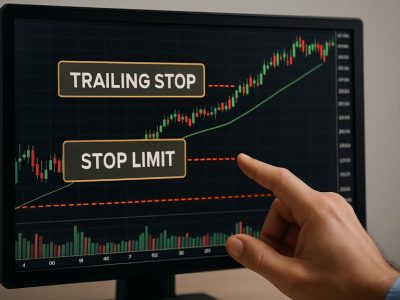
Imagine standing at the bustling crossroads of Wall Street, where every decision could lead to fortune or folly. As you navigate the intricate world of trading, understanding the tools at your disposal becomes crucial. Two such tools, stop orders and limit orders, might seem like mere jargon, yet they hold the power to shape your investment journey.
Picture this: you’re watching the stock market like a hawk, ready to swoop in for the perfect opportunity. Knowing when to place a stop order can protect your investments, acting like a safety net in volatile times. On the other hand, limit orders let you seize control, setting the stage for transactions only at your desired price, ensuring you don’t overpay or undersell.
These strategies, often overlooked by novices, are your keys to mastering the market’s ebb and flow. Investigate deeper to unlock their potential and elevate your trading prowess.
Understanding Order Types
Grasping the nuances of order types deepens your trading strategy. Among the most pivotal are stop orders and limit orders. These tools shape how you engage markets, dictating the conditions under which trades execute.
Stop Orders activate only when a stock reaches a specified price. Think of them as a protective barrier: they’re designed to limit losses or lock in profits amid fluctuating markets. If a stock dips to your stop price, the order converts to a market order and executes at the next available price. This mechanism offers financial safeguarding, especially during sudden market downturns.
Limit Orders give you control over the transaction price. You set the maximum you’re willing to pay for a stock or the minimum you’re willing to sell it for. This specificity protects you from overpaying or selling too cheaply. An order sits until someone accepts your price, granting a layer of strategic patience in your trading plan.
Incorporate stop and limit orders to refine your approach and navigate stock exchanges like a seasoned trader. Understanding how each order functions provides insights into market strategy and risk management.
What Is a Stop Order?
A stop order acts as a safeguard in trading, helping manage risk by executing only when a stock hits a designated price. By setting this threshold, you can curtail losses or ensure profits. It’s a powerful tool for exploring fluctuating markets.
Key Characteristics of Stop Orders
Stop orders dynamically become market orders upon reaching a specified price. This means they convert from a passive directive to an active transaction. Unlike limit orders, they don’t guarantee the execution price, only the execution itself. Traders use stop orders to automate trades, creating a non-emotional approach to investing. Also, stop orders remain invisible until triggered, maintaining privacy.
When to Use Stop Orders
Stop orders prove valuable during volatile market conditions. If you’re aiming to limit loss in a declining stock, a stop-loss order is beneficial. For instance, in a scenario where a stock is trading at $100, setting a stop order at $90 helps prevent steeper loss. They’re also useful for securing profits. Consider placing a stop order when you’ve purchased a stock that’s gained value; this locks in gains in case of abrupt downturns. Implementing stop orders assists in adhering to pre-determined strategies without emotional interference.
What Is a Limit Order?
A limit order lets you specify the price you want when buying or selling a stock. It’s precise, setting a price ceiling when buying or a price floor when selling. Control your transactions better, ensuring you don’t pay more nor sell for less than planned.
Key Characteristics of Limit Orders
Price Control: You have the power to set the exact price for the transaction, helping avoid overpayment or underselling.
Execution: It’s executed at the limit price or better, but the trade might not be fulfilled if the price doesn’t meet your terms.
Partial Fills: Limit orders can result in partial fills, occurring when the market has enough volume to fill only part of your order at your specified price.
Duration: Set to expire at the end of the trading day or left open as a “good till canceled” (GTC).
Visibility: Other market participants see your limit order, affecting trading behavior and offering opportunities for strategic placement.
Volatile Markets: Use limit orders in volatile conditions, controlling the price of entry or exit.
Specific Target Prices: Best when you aim for specific entry or exit points to further your trading strategy.
Illiquid Stocks: Ideal for stocks with low trading volumes. They ensure you hit your desired price without incurring large spreads—difference between the bid and ask price can be unfavorable in illiquid markets.
Time Constraints: Employ when you can’t monitor the stocks continuously, providing peace of mind that you’d sell or buy at acceptable prices.
By understanding limit orders, you can carry out strategies that align with your investment goals.
Key Differences Between Stop and Limit Orders
Understanding the key differences between stop and limit orders enhances your trading skills. Each type serves a distinct purpose and operates under different conditions.
Order Execution
Stop orders execute only when a stock price reaches a specific threshold, converting to market orders at that moment. This approach might lead to executions at a different price than expected due to market fluctuations. Limit orders, but, execute only at the specified price or better. They may not fulfill if the price criteria isn’t met. For example, if a stock trades at $50, a stop order activates automatically at a designated trigger, while a limit order waits for the exact order price or better to transact.
Risk Management
Stop orders help manage losses in volatile markets. They protect investments by executing once a price limit is crossed, yet they don’t guarantee execution at that price. Limit orders offer precise control over the transaction price, minimizing the risk of overpaying or underselling. For instance, setting a stop order at $45 on a stock valued at $50 ensures that you don’t ride the losses too far, whereas a limit order to buy at $48 implies you won’t pay more than that.
Benefits of Using Each Order Type
Understanding stop and limit orders can enhance your trading strategy by providing different levels of control and flexibility.
Benefits of Stop Orders
Stop orders offer protective measures in fluctuating markets. By setting a specific price point, you manage risk effectively without constant monitoring. For example, placing a stop order helps ensure that if stock prices drop, your holdings are automatically sold, limiting potential losses. This automation prevents emotional decisions during volatility. Also, stop orders convert to market orders, allowing timely execution once the trigger price is reached, safeguarding your investment. This approach reinforces disciplined trading by aligning actions with your pre-defined risk parameters.
Benefits of Limit Orders
Limit orders provide precise transaction control. By setting price thresholds, you target the desired buying or selling rate, so avoiding overspending or underselling. This function is crucial when dealing with illiquid stocks, where price gaps might be larger. Limit orders can fulfill partially, giving you opportunities to incrementally buy or sell as market conditions align with your set price. They’re visible to others, which could attract counterparties interested in similar price levels. For instance, if you aim to buy a stock at $50, setting a limit order at $50 means you won’t pay more, ensuring strict budget management in tumultuous markets. This order type promotes strategic execution, maximizing potential gains aligned with defined investment goals.
Common Mistakes to Avoid
Understanding the nuances between stop and limit orders is crucial, yet many traders fall into common traps. Avoid these mistakes to enhance your trading precision.
Using Incorrect Order Type: Many traders mistakenly use stop orders when limit orders are more appropriate and vice versa. Always align your order type with your trading strategy and market conditions to prevent unintended consequences. For example, a limit order suits situations where specific price targets exist.
Neglecting Market Conditions: Traders often ignore current market conditions, leading to improper order selection. In highly volatile markets, stop orders may protect against sudden losses. Limit orders, but, work well when you expect the market to fluctuate mildly or when dealing with illiquid stocks.
Ignoring Fees and Costs: Overlooking associated transaction fees and costs with different order types limits your profit potential. Evaluate the full cost of every trade, particularly for frequent trading, as excessive fees can eat into your returns.
Setting Unrealistic Price Levels: Setting stop or limit orders at unrealistic price levels is a common mistake. Ensure your set price points reflect actual market trajectories and your investment goals to enhance the likelihood of order execution.
Failing to Update Orders: Markets change rapidly, yet many traders neglect to update their stop and limit orders based on new data. Routinely review and adjust your orders to align with current market dynamics and your evolving financial goals.
By recognizing these common pitfalls, you can effectively use stop and limit orders to your advantage, optimizing your trading decisions and investment outcomes.
Conclusion
Mastering stop and limit orders can significantly enhance your trading strategy, offering you the tools to manage risk and control transaction prices effectively. By understanding their unique characteristics and knowing when to apply each order type, you can navigate market volatility with greater confidence. Avoid common mistakes by staying informed about market conditions and regularly updating your orders. Embrace these strategies to refine your approach and achieve your investment goals with precision.
To provide the best experiences, we use technologies like cookies to store and/or access device information. Consenting to these technologies will allow us to process data such as browsing behaviour or unique IDs on this site. Not consenting or withdrawing consent, may adversely affect certain features and functions.
Functional
Always active
The technical storage or access is strictly necessary for the legitimate purpose of enabling the use of a specific service explicitly requested by the subscriber or user, or for the sole purpose of carrying out the transmission of a communication over an electronic communications network.
Preferences
The technical storage or access is necessary for the legitimate purpose of storing preferences that are not requested by the subscriber or user.
Statistics
The technical storage or access that is used exclusively for statistical purposes.The technical storage or access that is used exclusively for anonymous statistical purposes. Without a subpoena, voluntary compliance on the part of your Internet Service Provider, or additional records from a third party, information stored or retrieved for this purpose alone cannot usually be used to identify you.
Marketing
The technical storage or access is required to create user profiles to send advertising, or to track the user on a website or across several websites for similar marketing purposes.