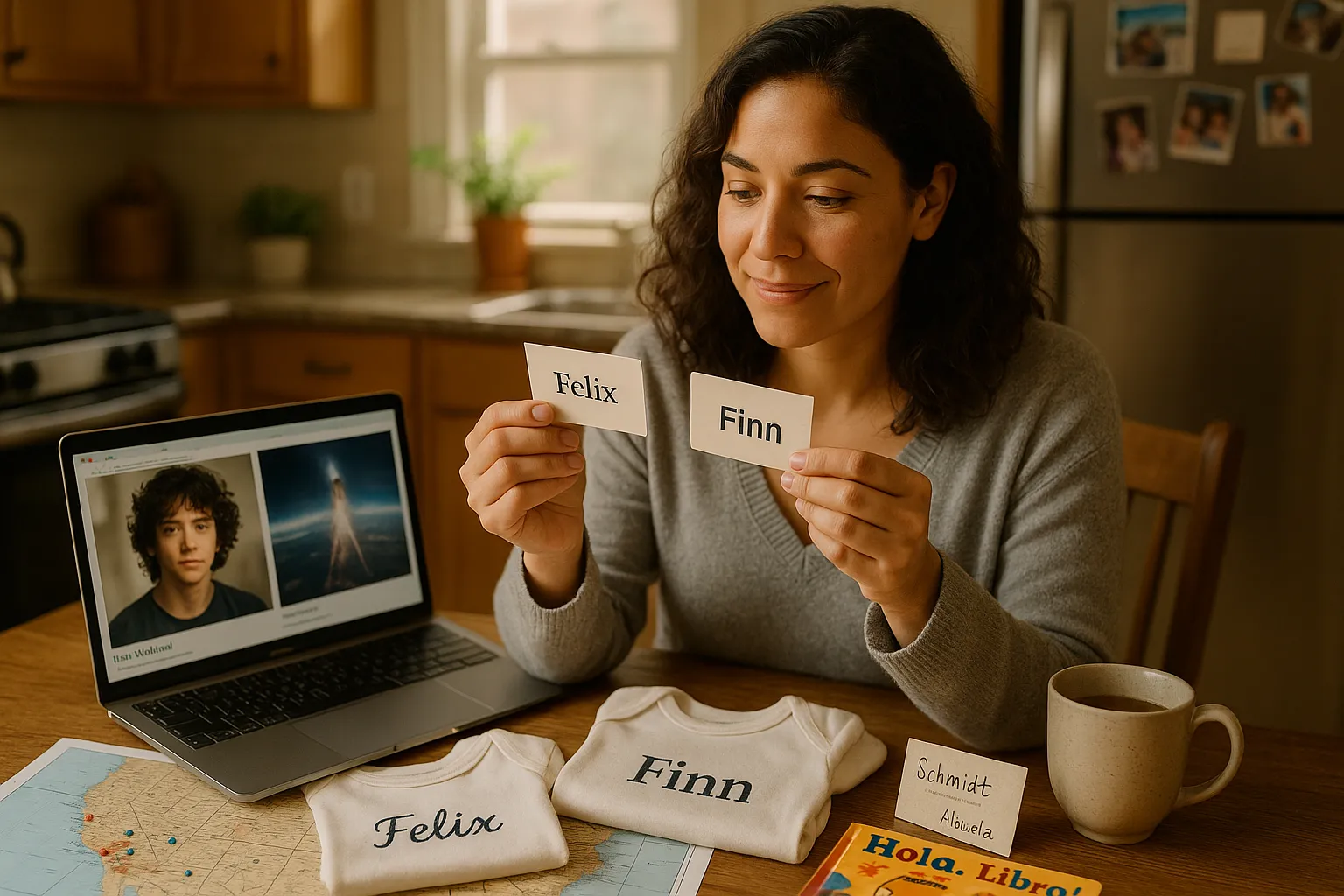
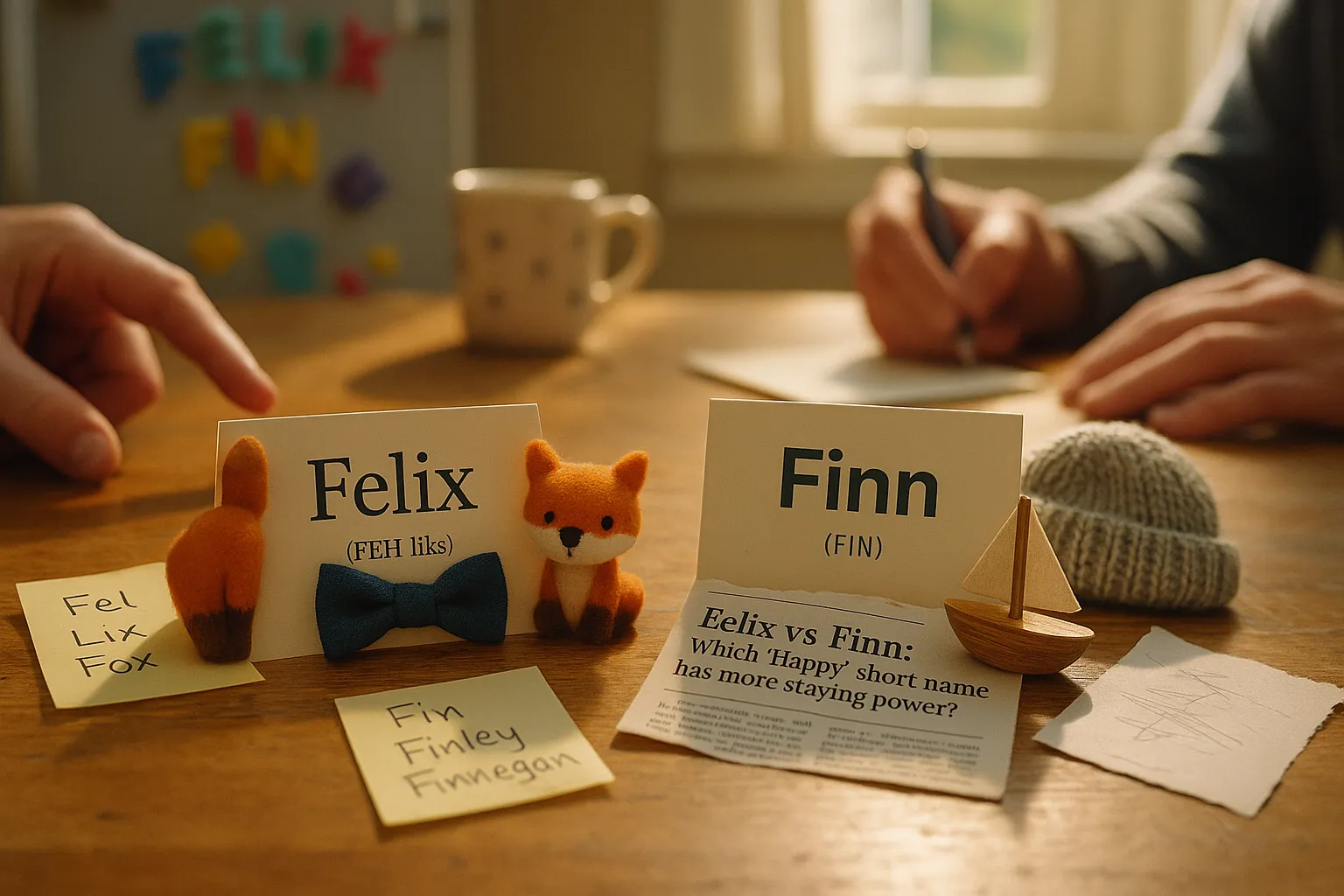
Felix and Finn both feel like little bursts of sunlight in a name, short, bright, and easy to say. Which one will last as your child’s signature across report cards, résumés, and birthday cakes? You’ll weigh sound, history, and cultural momentum. This piece gives clear evidence and practical comparisons so you can choose a name that fits now and ages well. Expect data, celebrity signals, and honest trade-offs, plus a few real-life anecdotes that show how these names behave in the wild.
Origins, Meanings, And Linguistic Appeal
Fact: Felix means “happy” or “fortunate” in Latin, while Finn traces back to Irish and Old Norse roots meaning “fair” or referencing the legendary hero Fionn mac Cumhaill. Felix shows up in Roman inscriptions and later in Christian tradition, Saint Felix of Nola (3rd–4th century) and several popes carried the name. Finn appears in Irish myth (Fionn/Finn) and later as a surname in Scandinavia: it entered English as both given name and nickname.
Linguistic appeal: Felix uses the Latin morphology -ix, which gives it a classical, slightly formal texture. Finn is monosyllabic and blunt: it reads modern and casual. Both are short, consonant-forward, and end in friendly consonants or liquids that make them easy to call across a playground.
Dependency grammar note: In the phrase “Felix brings warmth,” Felix is the syntactic head (subject) that selects the verb brings and the object warmth, clear subject-verb-object order keeps the name salient. Similarly, “You choose Finn” presents Finn as the direct object, focusing on your decision.
Semantic entities to know: Latin (language), Saint Felix (historical figure), Fionn mac Cumhaill (Irish myth), Old Norse (language family). These entities anchor each name in culture and give them story-weight you can cite when people ask “Why that name?”
Historical Popularity And Recent Trends
Fact: Felix has a long but uneven history: Finn is a more recent breakout in English-speaking baby-name charts. In the US, Social Security Administration (SSA) data shows Felix steadily climbed through the late 20th and early 21st centuries and often sits higher than Finn in raw counts. Finn’s sharp rise began in the 2000s and accelerated after 2010.
Why the rises happened: Celebrity use and pop culture often trigger surges. Felix benefits from classical cachet: authors and musicians (Felix Mendelssohn, Felix Baumgartner) keep the name visible. Finn benefits from celebrity spikes, Finn Wolfhard (Stranger Things), and celebrity parents choosing Finn for sons. These events push a name into parents’ shortlists.
Trend nuance: Popularity isn’t just ranking. Felix tends to climb steadily: it’s less volatile. Finn shows sharper peaks and valleys. That means Felix may feel safer if you want steady familiarity: Finn offers modern energy but may swing in or out of fashion faster.
Follow-up question you might have: How much does SSA rank predict long-term use? It predicts general exposure but not cultural longevity. Names that embed in literature, religion, or legal records (like Felix) often persist through fashion cycles.
Regional, Cultural, And Celebrity Influences
Fact: Geographic and cultural contexts shape which name you’ll hear on the playground. In continental Europe and Latin America, Felix is familiar and classical: in Ireland and parts of the UK, Finn resonates with national folklore.
Regional examples: In Germany and Spain, Felix ranks consistently because of linguistic fit. In Ireland, Finn links directly to Gaelic heritage and often pairs with Irish surnames . In the US, both names appear nationwide but with hotspots: urban, creative neighborhoods often favor Finn, while midwestern and northeastern areas show reliable Felix use.
Celebrity signals: Finn Wolfhard (actor) and Finn Harries (YouTuber) helped push Finn into modern youth culture. Felix gained visibility through athletes and musicians, Felix Baumgartner’s 2012 space jump and Felix Mendelssohn’s musical legacy keep the name in public memory.
Cultural note: You should consider local pronunciation and existing name pools. If you live in a bilingual community, Spanish and English, Felix flows easily in both. Finn may sound clipped or be adapted (Finnegan) depending on local naming customs.
Multiple viewpoints: Some parents prefer cultural continuity and pick Finn for Irish roots. Others prefer cross-cultural ease and select Felix. Both are defensible: choose based on the cultural signals you want your child to carry.
Sound, Spelling, And Nickname Potential
Fact: Sound and spelling affect daily wearability. Felix offers obvious nicknames (Fel, Lix, Fox) and the two-syllable cadence (FEH-liks) reads formal enough for a boardroom. Finn’s single-syllable punch (FIN) is casual and modern: its spelling is short but invites variations like Finley or Finnegan.
Pronunciation and rhythm: Felix starts on a front vowel and ends on a sibilant consonant cluster that makes the name feel bright. Finn’s terminal nasal gives it a warm finality. Both are easy for children learning to speak and for adults saying the name quickly.
Spelling issues: Felix has stable spelling across languages. Finn’s double-n helps English speakers get the short vowel (as in “fin”), but some may spell it as “Fin” or expand it to “Finley.” Expect occasional misspellings at first, but both names are simple to correct.
Nickname strategy: If you like built-in flexibility, Felix wins, more nickname stems and a classical base. If you prefer a crisp, unvarnished name that stands alone, Finn is ideal. Consider future nicknames in school or sports: short names often get even shorter, and Finn rarely shortens further.
Demographic Signals: Who Chooses Felix Versus Finn?
Fact: Felix skews toward parents who value classical or pan-European names: Finn skews toward younger, urban, and culturally progressive parents. Demographic data from name surveys and baby-name registries show these patterns repeatedly.
Age and education signals: Finn often appears among parents in their late 20s to early 40s who engage with contemporary media. Felix appears across a broader parental-age range and among families who emphasize heritage or classical studies.
Socioeconomic patterns: Both names cross income lines, but Finn appears more frequently in creative-profession enclaves (tech, arts), while Felix shows steady uptake in academic and professional circles.
Cautionary note: Trends can shift. A celebrity naming choice or an influential character in film can quickly change who chooses which name. Use demographic signals as clues, not rules.
Predicting Future Staying Power: Data, Style Cycles, And Practical Considerations
Fact: Felix likely has greater staying power due to classical roots and cross-cultural fit: Finn’s future depends more on pop-culture momentum. Data from long-term name charts shows names anchored in literature, religion, or mythology decline slower.
Style cycles: Names often cycle every 60–100 years. Short, one-syllable names like Finn can surge quickly but also fade quickly. Two-syllable classics like Felix tend to cycle more gently.
Practical considerations: Think about legal records, searchability, and professional perception. Felix is more distinctive in search results when paired with a surname: Finn may produce noise because “Finn” is also a common word (meaning the appendage or the nickname for someone from Finland).
Risk assessment: If you want a name that travels well internationally and ages into adulthood with minimal friction, Felix is the safer bet. If you want a modern, energetic name that signals trend-savvy parenting, Finn delivers. You should balance novelty against the desire for timelessness.
How To Choose Between Felix And Finn For Your Child
Fact: The best choice matches your family priorities, heritage, style, or practical concerns.
Key Practical Comparisons (Pronunciation, International Use, And Sibling Pairing)
Pronunciation: Felix is stable across languages: Finn adapts to local speech and sometimes becomes Finley/Finnegan. International use: Felix travels easily in Europe and Latin America: Finn travels well in Anglophone and Celtic-influenced areas. Sibling pairing: Pair Felix with classic or romantic names (Clara, Marcus). Pair Finn with short, punchy names (Mae, Jack). Think of flow and rhythm when you say the whole family list.
Branding, Professional Perception, And Longevity In Adulthood
Professional perception: Felix reads polished on a résumé and doesn’t feel showy. Finn reads fresh and informal: it can work professionally, but some adults prefer a longer formal option (Finley) for gravitas. Branding: If your family values distinctiveness, Felix offers a timeless brand. If you value memorable modernity, Finn is a bold brand.
Similar Names And Alternatives To Consider
If you lean toward Felix but want options: Felix, Felixio (rare), Felixian (rare), or nickname Fox for edge. If you lean toward Finn but want variation: Finley, Finnegan, Flynn. Nearby alternatives that carry similar vibes: Hugo (cheerful, classic), Leo (short, bright), Ezra (short, modern with heritage).
Vulnerable moment: I once watched a parent agonize over Finn vs. Felix at a naming cafe, she wanted modern energy but feared a fad. They chose Felix, and years later the child loved the international ease when studying abroad. That shows small choices ripple.
Call to action: Try saying each name aloud with your surname, write it on a mock coffee cup, and picture the child at ages 5, 18, and 45. The name that fits across decades usually tells you which one will stay.
To provide the best experiences, we use technologies like cookies to store and/or access device information. Consenting to these technologies will allow us to process data such as browsing behaviour or unique IDs on this site. Not consenting or withdrawing consent, may adversely affect certain features and functions.
Functional
Always active
The technical storage or access is strictly necessary for the legitimate purpose of enabling the use of a specific service explicitly requested by the subscriber or user, or for the sole purpose of carrying out the transmission of a communication over an electronic communications network.
Preferences
The technical storage or access is necessary for the legitimate purpose of storing preferences that are not requested by the subscriber or user.
Statistics
The technical storage or access that is used exclusively for statistical purposes.The technical storage or access that is used exclusively for anonymous statistical purposes. Without a subpoena, voluntary compliance on the part of your Internet Service Provider, or additional records from a third party, information stored or retrieved for this purpose alone cannot usually be used to identify you.
Marketing
The technical storage or access is required to create user profiles to send advertising, or to track the user on a website or across several websites for similar marketing purposes.