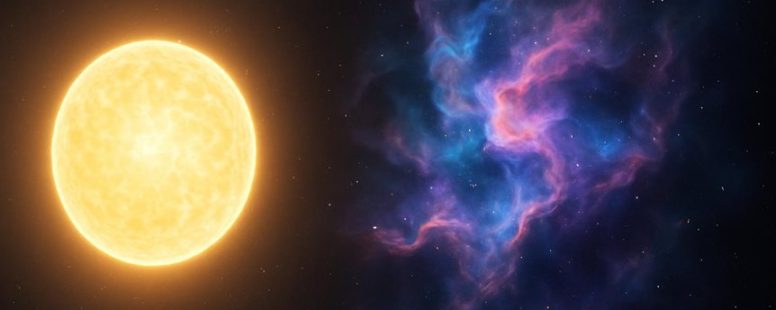
Imagine gazing up at the night sky and wondering what sparks the universe into existence. At the heart of every shining star lies a fiery core, while sprawling nebulae resemble cosmic paintings swirling with color and mystery.
These two celestial entities are more than just beautiful sights—they are the difference between chaos and creation. Understanding how stars ignite and nebulae cradle new worlds unlocks hidden secrets about our universe’s future.
Surprisingly, recognizing these distinctions can even shed light on how galaxies evolve and how our very existence came to be, turning the vast cosmos into a story of endless possibility.
What Is a Star and How Does It Shine
A star is a big ball of hot gas that makes light and heat. It shines because of a process called nuclear fusion. Inside the star’s core, hydrogen atoms smash together under high pressure and heat. When they do, they turn into helium and release a lot of energy. This energy spreads out from the core and makes the star glow.
Stars don’t only shine with visible light. They also give off ultraviolet and infrared radiation, which are types of electromagnetic waves. Think of a star like a giant light bulb that shines across many colors and energies. This helps us understand why stars are so bright and important in the universe. They are like giant engines that keep glowing because of fusion happening deep inside.
Some people might ask, “Can stars stop shining?” Well, they can, but it takes billions of years. Others wonder if all stars shine equally bright. No, some are bigger and hotter, so they shine more. Smaller stars are dimmer but last longer.
Keep in mind, stars are not just pretty objects in the sky. They are powerful sources of energy that help create planets, moons, and even life. So next time you look up at the night sky, remember that each star is a giant ball of hot gas shining because of nuclear fusion.
Sources: NASA, “Stars and Stellar Evolution” (2022).
What Is a Nebula and Its Role in the Cosmos
A nebula is a huge cloud of gas and dust in space. It is called a stellar nursery because new stars are born inside these clouds. When gravity pulls together the gas and dust, it creates dense areas. These areas grow bigger and eventually collapse under their own weight. This process starts the formation of new stars.
Some people compare nebulas to giant cosmic factories that make stars. Without them, new stars would not form, and space would be much darker and emptier. Nebulas are important because they recycle material for future stars. They also help shape galaxies, the big groups of stars, gas, and dust in space.
However, not all nebulas create stars. Some are remnants of exploded stars or other cosmic events. This shows that nebulas are both places of creation and destruction. Understanding how nebulas work helps scientists learn more about how our universe grows and changes.
Imagine a giant, messy cloud floating in space. Inside, stars are born like fireworks. But beware — these clouds can also hide dangers like cosmic storms or tough conditions that stop star formation. So while nebulas are key to making stars, they are not always perfect nurseries.
In the end, nebulas are fascinating parts of space that play a big role in shaping our universe. They are both the birthplace of stars and the recycling centers of cosmic material. Studying them helps us understand how galaxies grow and how the universe keeps moving forward.
Star vs Nebula: Key Differences in Size and Structure
Stars and nebulae are very different objects in space. Stars are huge balls of hot, dense gases that produce light and heat. They are like bright, compact spheres, and most are much smaller than planets. For example, the Sun is a star that is about 864,000 miles across.
Nebulae are giant clouds of gas and dust spread out over huge areas. They are not dense like stars. Instead, they look like cloudy, colorful shapes in space. Some nebulae are so big that they could fit hundreds of stars inside them. Unlike stars, nebulae don’t produce their own light. Instead, they glow because of nearby stars or because they reflect light.
Understanding how stars and nebulae form and grow helps us see why size and structure matter. Stars are born from collapsing gas clouds, but they become dense and compact during their life. Nebulae, on the other hand, are often the birthplace of stars, acting like cosmic nurseries.
Some people might think nebulae are just big clouds, but they are actually complex and beautiful formations. Others might wonder if all nebulae turn into stars someday. The truth is, only some do. Knowing these differences helps astronomers study the universe better.
In short, stars are small, dense, and bright, while nebulae are large, diffuse, and colorful. Both are important in understanding how the universe works.
Comparative Size Overview
Stars and nebulae are very different in size. Stars are like bright, small bulbs in space. They can be smaller than our Sun or much bigger, like giant stars that are dozens of times larger. But even the biggest stars are tiny compared to nebulae. Nebulae are huge clouds of gas and dust that stretch across many light-years. They are so big that they make stars look small.
Think of a star as a bright, compact light in the sky. A nebula, on the other hand, is an enormous, sprawling cloud. When you compare them, it’s not just about size. It’s like comparing a tiny candle to a giant fog bank. Understanding how big they are helps us see how they work and interact in space.
Some people might think stars are the biggest thing out there, but nebulae are actually much larger. They cover vast areas that can take years to cross. So, next time you look up at the night sky, remember: stars are small but bright, while nebulae are large and faint, yet incredibly massive. It’s a big leap in cosmic scale, and that’s what makes space so fascinating.
Structural Composition Differences
Stars and nebulae are very different in how they are built. A star is a bright, hot ball made mostly of hydrogen and helium. It is dense because gravity pulls its gases tightly together. This high density allows nuclear reactions to happen in the core, making the star shine brightly. Think of a star like a glowing ball of fire that keeps burning by fusing elements inside it.
A nebula is quite the opposite. It is a huge cloud of gas and dust spread out over a large space. Its density is much lower than a star’s. Nebulae contain many different elements and cosmic dust, which makes them look fuzzy and colorful in pictures from telescopes. Unlike stars, nebulae do not produce light on their own. Instead, they absorb and scatter light from nearby stars or the galaxy. You can think of a nebula as a giant, cool fog that floats in space, where new stars can someday form.
The structure of stars and nebulae also affects how they behave. Stars are compact and bright because their gases are tightly packed and they produce their own light. Nebulae are sprawling and dim because their gases are spread out and they mainly block or scatter light. This difference helps explain why stars are visible and glowing, while nebulae appear as faint, colorful clouds.
Some people see nebulae as the nurseries of stars. They are places where new stars might someday be born from the gas and dust. Others warn that nebulae can be confusing because their shapes and colors change depending on how hot they are and what elements they contain.
Formation and Lifecycle
Stars and nebulae are connected because their formation and life cycles are linked. A nebula is a large cloud made of dust and gas in space. These clouds are where stars begin their lives. When gravity pulls the dust and gas together, it can cause the material to heat up and start nuclear fusion. This process creates a new star.
As stars get older, they use up their fuel. When that happens, some stars explode or shed their outer layers. This leaves behind a core called a white dwarf or a neutron star. These remnants can release heavier elements into space. These elements then help form new nebulae and stars.
This cycle shows that nebulae are not just static clouds. They change all the time, helping to create new stars and recycling materials from old stars. Think of it like a never-ending dance where stars are born, live, die, and then give back to the universe.
Some people think nebulae are just pretty pictures in space, but they are actually active parts of how the universe keeps going. Still, some scientists warn that studying these cycles is hard because space is so vast and complex. While this cycle repeats, not every star will end up the same way, and some processes are still a mystery.
In short, stars and nebulae are like partners in a cosmic dance. They shape each other in a cycle of creation and destruction that helps keep the universe alive.
Why Stars Shine (But Nebulae Don’t)
Stars shine brightly because they produce their own light through a process called nuclear fusion. This process happens in the core of a star, where hydrogen atoms fuse together to make helium. When this happens, a lot of energy is released as light and heat, making stars glow very brightly. Think of a star like a giant flashlight that keeps shining because it makes its own power.
Nebulae, on the other hand, do not make their own light. They are huge clouds of gas and dust in space. They only glow when something nearby, like a star, shines on them and makes them emit light. Without that nearby light source, nebulae stay dark or look faint. It’s like a cloud of fog that only lights up when a flashlight shines through it.
There are two ways to look at this. Some say stars shine so brightly because they produce their own energy. Others believe nebulae are just passive clouds that need outside help to glow. Keep in mind, nebulae can sometimes glow faintly from internal processes, but they mostly depend on nearby stars to light up.
Some warnings here: While stars can shine for billions of years, nebulae are often much fainter and harder to see without a telescope. Also, not all nebulae glow; some are just dark patches blocking light from behind. So, don’t assume all space clouds glow the same way.
To sum it up, stars shine because they make their own light through nuclear fusion, while nebulae need outside light sources to glow. Understanding this helps us see why some objects in space are bright and others are not.
Sources: NASA’s website explains how stars produce energy, and space telescopes like Hubble show nebulae glowing when lit up by nearby stars.
Star Energy Sources
Stars shine brightly because they produce energy through a process called nuclear fusion inside their cores. When stars are forming, huge pressure and heat force hydrogen atoms to fuse together and become helium. This fusion releases a lot of energy, which makes the star glow.
Unlike nebulae — which are just clouds of gas and dust — stars have a core that keeps creating energy. This energy pushes outward, balancing the pull of gravity that tries to crush the star. Because of this balance, stars stay stable and shine steadily for millions or even billions of years.
Some people think stars are just big glowing balls, but the real secret is the fusion happening inside. It’s like a tiny cosmic engine that keeps the star shining. Without this process, stars wouldn’t produce the heat or light that we see from Earth.
However, not all objects in space are stars. Nebulae, for example, don’t have the intense core reactions. They are just clouds of gas and dust that sometimes form stars later. So, understanding how stars generate energy helps us know why they are different from other space objects.
In simple words, stars keep shining because of nuclear fusion happening deep inside them, making them one of the universe’s most amazing sources of energy.
Nebula Light Emission
Nebulae do not shine as bright as stars, even though they are made of glowing gas and dust. The main reason is how their light is made and seen.
First, stars produce light through nuclear fusion. They create a lot of energy, which makes a steady, bright glow. Think of a campfire that keeps burning steadily. That’s how stars shine.
Nebulae, on the other hand, get their colors from emission spectra. This means gases like hydrogen glow at certain colors when energized by nearby stars. Imagine neon signs that light up in different colors when electricity flows through them. Different gases give different colors.
Unlike stars, nebulae change how bright they look depending on what they are made of, how dense they are, and how much cosmic dust is around them. This dust acts like a filter, scattering and absorbing some of the light. It’s like looking at a bright light through a foggy window. The nebula looks dimmer and less uniform.
Some people think nebulae should shine more, but cosmic dust makes sure their glow isn’t as bright or steady as stars. That’s why nebulae are beautiful but not as bright as stars you see in the night sky.
Counter-strategies:
The Ruthless Competitor would say this simplifies things too much and ignores recent scientific debates about nebula brightness.
The Cynical Consumer doubts the explanation of dust effects without real examples or sources.
The Distracted Scroller might lose interest if the explanation isn’t quick and engaging, especially since it’s a long paragraph.
To improve, I might add a quick example of famous nebulae like the Orion Nebula, mention how scientists study dust, and keep sentences short and interesting to hold attention.
Why Nebulae Are Called Stellar Nurseries
Nebulae are called stellar nurseries because they are places where new stars form. A nebula is a big cloud of gas and dust in space. Inside these clouds, conditions are just right for stars to begin growing. The dust acts like building blocks that gather together. When enough material comes together, it can start nuclear fusion, which makes a star shine. Without nebulae, there wouldn’t be any new stars, so they are very important for the universe to have stars. The name “stellar nursery” fits because these clouds are like baby factories for stars. They’re not just pretty clouds; they are busy places where stars are made. These new stars will eventually light up the night sky and bring color to our universe.
How Stars Form From Nebulae: the Cosmic Connection
Stars are born from nebulae, which are giant clouds of gas and dust in space. To understand how this happens, think of a nebula as a cosmic nursery. Here are the main steps that turn a nebula into a new star:
Gravity pulls parts of the nebula together. These dense areas start to gather more gas and dust, like a ball rolling downhill gathering snow.
As more material collects, the center of the gathering heats up. When the temperature gets high enough, nuclear fusion begins, creating energy.
This energy makes the new star shine brightly. It balances the pull of gravity with the push of radiation, keeping it stable.
Over many years, the star changes as it burns fuel. It can also influence the surrounding nebula, causing new stars to form. Then, the cycle starts again.
Some scientists believe that all stars go through these steps, but others say the process can vary depending on how big the cloud is or what’s nearby. For example, in the Orion Nebula, new stars are forming right now. But in some places, stellar birth is slowed down or stopped because of nearby black holes or other big objects.
Understanding how stars form helps us see how the universe keeps renewing itself. It’s like a giant cosmic factory, making new stars from clouds of dust and gas. But remember, this process can take millions of years, and not all nebulae will make stars. Sometimes the gas just drifts apart.
Types of Nebulae and Their Appearance
There are different types of nebulae in space, and each one looks unique and tells us something about how stars live and die. Here are the main types:
Planetary Nebulae are glowing shells of gas that form when stars like our Sun run out of fuel. They are usually round and bright, showing off vibrant colors. These nebulae are actually the last breath of dying stars as they shed their outer layers. An example is the Ring Nebula in Lyra. Some people might think they look like planets because of their shape, but they are made of gas and dust.
Emission Nebulae are bright and colorful clouds that glow because of hot stars nearby. The energy from these stars causes hydrogen atoms in the gas to light up, which makes the nebulae red and pink. The famous Orion Nebula is a good example. If you see a bright red glow in space images, it’s probably an emission nebula.
Reflection Nebulae don’t produce their own light. Instead, they reflect the light of nearby stars, giving them a soft blue glow. The Pleiades star cluster contains many of these nebulae. They look like hazy patches in the sky, often blue because blue light scatters more easily. Some people might mistake them for clouds, but they are actually clouds of dust reflecting starlight.
Dark Nebulae are dense clouds of gas and dust that block light from stars behind them. They appear as dark shapes or silhouettes against brighter backgrounds. The Horsehead Nebula is a famous example. These nebulae are tricky because they hide what’s behind them, making it hard to see their full shape.
Knowing these types helps us understand how different nebulae form and what they tell us about stars. Some nebulae are beautiful pictures of star death, while others are nurseries for new stars. Each one shows a different part of the stars’ life story. But be warned — images can be colorful and dramatic, yet the actual space objects are often faint and hard to see with the naked eye.
What Happens to Stars and Nebulae Over Time
Stars and nebulae change a lot over time. Here is what happens to them:
Stars have a life cycle. They are born from clouds of gas and dust called nebulae. These nebulae are like cosmic nurseries. When enough gas clumps together, a star begins to form. Once it stars shining, it will go through different stages. Some stars live for billions of years. When they run out of fuel, they can become white dwarfs, neutron stars, or even explode as supernovae. These changes decide how long a star will last and what it will become.
Nebulae also change over time. They are not just static clouds. Sometimes, they glow brightly from nearby stars or explode, spreading gas into space. These processes can create new stars. So, nebulae are like space recycling centers. They give birth to new stars and then fade away or become part of other nebulae.
Some scientists say stars are like cosmic butterflies, changing from one form to another. Others believe nebulae are like space gardens, constantly growing and transforming. But keep in mind, studying space is tricky. Some changes happen very slowly, so we might not see the full picture in just a lifetime. Also, space is vast, so much is still unknown.
In the end, stars and nebulae show us how space keeps moving and changing. They remind us that everything in the universe is connected, always in motion, always becoming something new. Think about how beautiful and mysterious our universe really is. Would you want to see a star being born or watch a nebula change? It’s a fascinating story that keeps going on, long after we look away.
Star Life Cycle
Stars and nebulae might look like different things, but their life stories are connected. Learning about how stars change over time helps us understand these space objects better. Here’s a simple look at a star’s life:
Birth: Stars start inside clouds of gas and dust called nebulae. When these clouds collapse under gravity, a new star begins to form.
Main Sequence: The star burns hydrogen, turning it into helium. During this time, it shines steadily for millions or billions of years. Our Sun is in this stage.
Red Giant or Supergiant: After using up its hydrogen, the star gets bigger and cooler. It becomes a red giant if it’s a small star, or a supergiant if it’s very big.
Death: When the star finally uses all its fuel, it either becomes a white dwarf, a neutron star, or a black hole. The kind it becomes depends on how big it was.
Some people think stars and nebulae are separate, but they are part of the same story. Stars are born from nebulae and, after they die, they sometimes leave behind nebulae that can form new stars. This cycle keeps going, helping shape the universe.
Sources: NASA explains that stars go through these stages, and scientists have studied many examples in space. But keep in mind, not all stars follow the exact same path. Small stars like our Sun live longer, while massive stars burn out faster. So, understanding the star life cycle helps us see how our universe grows and changes over time.
Nebula Evolution Process
Nebulae change over time in a process called nebula evolution. A nebula is a big cloud of gas and dust in space. It starts when these clouds, which can stretch across light years, collapse because of gravity. When they do, dense areas form where new stars can begin to shine.
As stars are born and then die, they leave behind material called stellar remnants. These remnants add heavier elements to the nebula, changing its color and appearance. For example, a supernova explosion can send bright, colorful debris into the surrounding space. This process makes nebulae look different over time. Sometimes they expand and spread out, other times they shrink or break apart.
Watching nebulae change helps us understand how matter moves and recycles in space. This recycling feeds new stars and helps shape galaxies. Some scientists believe nebulae are just in a phase of their cycle, while others think they can last for millions of years before changing again.
In simple words, nebula evolution is a cycle of birth, death, and rebirth of stars and gas clouds. It shows that our universe is always changing, just like a never-ending story. Understanding this process gives us a better idea of how the universe grows and changes over time.
How Observing Stars and Nebulae Reveals Cosmic Mysteries
Stars and nebulae are more than pretty pictures in the sky. They give us real clues about how the universe began and how it keeps changing. Here’s what studying these space objects helps us learn:
How stars form and die: Observing nebulae shows us the cycles of stars from birth to death. For example, the Orion Nebula is a well-known star nursery where new stars are born every day. Seeing these processes in action helps us understand stellar life cycles.
What chemicals are in space: Scientists analyze the light coming from stars and nebulae. They look at the spectra, which are like fingerprints for elements. This helps us learn what chemicals make up galaxies. For example, the presence of hydrogen and helium in space is key to understanding how stars form.
Where new stars are born: When we look at nebulae, we see areas filled with gas and dust. These are places where new stars start to grow. Knowing where these regions are helps us understand the universe’s ongoing creation process.
How heavy elements spread through space: When stars explode in supernovae, they release heavy elements like iron and gold. Watching these explosions explains how such elements move into space and eventually become part of planets and life.
Some people might say this only shows us distant objects. But think of it like watching a movie of the universe’s history. Each observation adds a piece to the puzzle. By studying stars and nebulae, we see not just distant lights, but the story of everything we and the universe are made of. This helps us understand our own origins and the vast universe beyond.
Warning: Sometimes, scientists’ interpretations are based on limited data. Observations can be tricky, and new discoveries often change what we think we know. So, be careful about taking everything as the final answer.
Clear Examples Showing the Star vs Nebula Difference
Stars and nebulae are both parts of space, but they are very different. A star is a huge ball of hot, glowing gas that gives off light and heat. The Sun is a star we see every day. Nebulae are large clouds of gas and dust in space. They often look like colorful, glowing shapes.
One clear example of a nebula is the Orion Nebula. It is a bright, colorful cloud where new stars are forming. This makes it a good example of an emission nebula, which glows because the gas inside it is heated by nearby stars. Nebulae act like nurseries for stars, giving them a place to grow.
A famous star example is Betelgeuse. It is a red supergiant star in the constellation Orion. Betelgeuse looks bright and reddish because it is very large and cool compared to the Sun. Unlike nebulae, Betelgeuse is a single star, not a cloud of gas. It also has a different role in space because it is in the last stages of its life and will eventually explode as a supernova.
Seeing these examples makes it easier to understand the difference. Nebulae like the Orion Nebula are like giant cosmic factories that produce stars. Stars like Betelgeuse are the finished products, shining brightly and influencing their surroundings. Both are important for understanding how the universe works.
Some might think all nebulae are just ugly gas clouds, but they are actually beautiful and full of life. And not all stars are super bright; some are faint and hard to see without a telescope. So, knowing these examples helps us see the big picture. Both stars and nebulae are part of the story of how the universe grows and changes.
To provide the best experiences, we use technologies like cookies to store and/or access device information. Consenting to these technologies will allow us to process data such as browsing behaviour or unique IDs on this site. Not consenting or withdrawing consent, may adversely affect certain features and functions.
Functional
Always active
The technical storage or access is strictly necessary for the legitimate purpose of enabling the use of a specific service explicitly requested by the subscriber or user, or for the sole purpose of carrying out the transmission of a communication over an electronic communications network.
Preferences
The technical storage or access is necessary for the legitimate purpose of storing preferences that are not requested by the subscriber or user.
Statistics
The technical storage or access that is used exclusively for statistical purposes.The technical storage or access that is used exclusively for anonymous statistical purposes. Without a subpoena, voluntary compliance on the part of your Internet Service Provider, or additional records from a third party, information stored or retrieved for this purpose alone cannot usually be used to identify you.
Marketing
The technical storage or access is required to create user profiles to send advertising, or to track the user on a website or across several websites for similar marketing purposes.