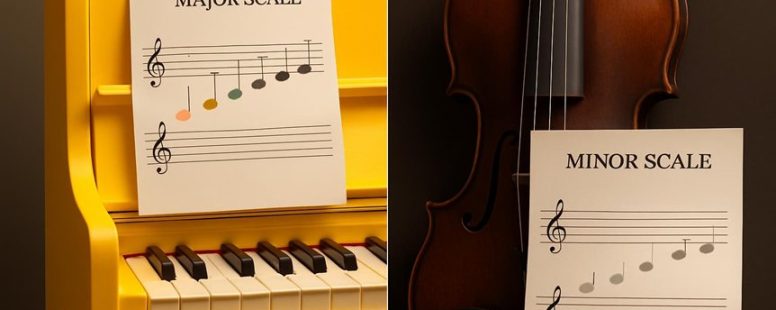
In a rush and craving a quick emotional hit from music? Major and minor scales are like two different moods packed into just a handful of notes, transforming a simple melody into a vivid story.
Think of them as musical mood rings—one radiates sunshine, the other whispers secrets in the shadows. Knowing this subtle difference can instantly deepen your connection to a song, turning fleeting moments into lasting impressions.
Plus, understanding these scales unlocks a secret shortcut to recognizing the mood of any tune, even when you’re pressed for time.
What Are Major and Minor Scales in Simple Terms?
Major and minor scales are two types of musical patterns that create different feelings in music. A major scale sounds bright and happy. It makes you think of cheerful songs or sunny days. A minor scale sounds sad or serious. It makes you feel more thoughtful or somber.
Think of a major scale as a rainbow full of colors. It lifts your mood with its cheerful notes. In contrast, a minor scale is like a cloudy sky. It has a darker, more serious sound. These scales are made by arranging notes in specific orders. When you hear a song, it’s usually based on one of these scales. That’s why some songs make you feel happy, and others make you feel sad.
Some people like the bright sound of major scales for upbeat songs. Others prefer the sad or reflective mood of minor scales for emotional music. Knowing the difference helps you understand why music can make you feel different things. It’s like how different colors or flavors can change your mood. So, next time you listen to a song, think about whether it uses a major or minor scale and what feeling it creates.
How Do Major and Minor Scales Sound and Feel?
Major and minor scales are types of musical patterns that sound and feel very different. A major scale sounds bright, happy, and uplifting. It makes you feel good, like a sunny day or a celebration. On the other hand, a minor scale sounds sad, serious, or a little lonely. It can remind you of feelings like longing or introspection.
These feelings happen because of how the scales are built. Major scales use a specific pattern of whole and half steps that create a cheerful sound. Minor scales have a different pattern, giving them a more somber or reflective mood. For example, a song in a major key might make you want to dance or smile, while a song in a minor key might make you pause and think.
Cultural background also influences how we feel about these scales. In Western music, major is often linked to happiness and celebration, while minor is linked to sadness or melancholy. But in other cultures, these feelings can change. For example, some Asian music uses scales that sound joyful even if they are technically minor.
The way scales make us feel is connected to our subconscious and how our brains interpret sound. Sometimes, just changing from a major to a minor scale on the same song can turn a happy tune into a sad one. It shows how powerful small changes in music can be.
However, not everyone reacts the same way. Some people might find minor scales uplifting, depending on their personal experiences or cultural background. So, while these scales are common tools for expressing emotions, they are not the only way music can make us feel.
How to Build a Major Scale Step-by-Step
A major scale is a group of notes that sound happy and bright. It is built using a simple pattern of steps called whole steps and half steps. The pattern is: whole, whole, half, whole, whole, whole, half. This pattern is the same no matter what note you start on.
For example, if you start on the note C, you move up a whole step to D, another whole step to E, then a half step to F. After that, you go up whole steps to G, A, B, and finally a half step back to C. This creates the C major scale.
You can use this pattern to build a major scale on any note. Just follow the same steps. It helps to practice playing the scale up and down. This makes your music sound more complete and helps you improvise better.
Some people find it easier to learn the pattern by writing it out or using a keyboard or guitar. For example, on a piano, each key is a step. You can see the pattern clearly when you look at the white keys.
There are two main points to remember: first, always follow the W-W-H-W-W-W-H pattern. Second, practice moving through different keys to become more familiar with the sound of major scales.
Keep in mind, if you are just starting, it might feel strange at first. But with practice, playing major scales will become much easier and even fun. Do you think you will try building a scale on a different note next?
How to Create a Minor Scale Pattern
A minor scale pattern is a set of notes that creates a sad or serious sound in music. To create a minor scale pattern, you start by picking a root note, which is the main note that defines the key. Then, you follow a specific sequence of whole steps (two frets on a guitar or two keys on a piano) and half steps (one fret or one key). The pattern for a natural minor scale is: whole, half, whole, whole, half, whole, whole.
For example, if you pick A as your root note, the scale will be A, B, C, D, E, F, G, and back to A. This pattern works the same on any root note. To make sure your minor scale sounds right, always follow this pattern exactly. Some musicians also choose to change the pattern slightly to create different types of minor scales, like the harmonic minor or melodic minor, but the basic natural minor pattern is the most common.
Would you like to see how this pattern applies on a guitar or piano? Remember, practicing this pattern slowly and then speeding up will help you remember it better. Keep in mind that creating scales takes time, so don’t get discouraged if it feels tricky at first.
Choose Your Root Note
Choosing your root note is the first step in making a minor scale pattern. The root note is the starting point of your music. It helps decide the mood and key of your song. For example, starting on A gives you A minor, which is popular because it works well in many songs. Your root note also helps you create melodies and chords later on.
Here are some tips:
Pick a note that feels right emotionally or fits your song’s story.
Think about how the root note will match with other chords you plan to use.
Remember, different root notes will give you different minor scales, shaping your sound.
Some musicians like to choose a root note based on the mood they want. A lower note like E can sound sad or serious, while a higher note like C might feel brighter. It’s good to try different root notes and see which one fits best for your music.
Keep in mind that choosing the right root note takes practice. Sometimes, what feels right emotionally might not match the chords you want to use. Experiment and see what sounds best for your song.
Apply Whole and Half Steps
A whole step is two frets on a guitar or two keys on a piano, while a half step is just one fret or one key. These steps are the building blocks of scales, including minor scales.
In a minor scale, the pattern of steps is specific. Starting from the root note, you move up a whole step, then a half step, another whole step, another whole step, a half step, a whole step, and finally a half step to reach the octave.
This pattern gives minor scales their sad or serious sound. For example, if you start on A, moving according to the pattern will give you the A minor scale.
Knowing where to place these whole and half steps helps you create authentic minor sounds. It also helps you build chords and explore different musical ideas. Some musicians prefer natural minor scales, while others use different types like harmonic or melodic minors, which change the step pattern slightly.
Just remember, if you don’t get the pattern right, the scale will sound different. That’s why understanding where to put whole and half steps is key for making your music sound correct and expressive.
Maintain Correct Pattern
A minor scale is a musical pattern that helps musicians create emotional and interesting music. The most important thing is to follow the exact pattern of whole and half steps. If you miss a step or get it wrong, the mood of the music can change a lot. Some people say you don’t need to memorize the pattern, but practicing it over and over helps you remember the right intervals better.
Here are some steps to keep your minor scale correct: First, focus on the specific order of whole steps and half steps. For example, the natural minor scale follows this pattern: whole, half, whole, whole, half, whole, whole. Second, use a metronome, which is a device that keeps a steady beat, to help you play at a consistent speed. Third, regularly check your pattern against trusted music books or online resources to make sure you’re playing it right.
Some musicians believe that once you’ve learned the pattern, you can play it from memory without checking. Others say it’s better to keep reviewing until it feels natural. Both ways have their good and bad points. Practicing the pattern daily helps you get it right faster, but relying only on memory can lead to mistakes if you’re not careful.
If you want to make sure your minor scale sounds correct, take your time and listen carefully. Playing along with a recording can help you hear if your pattern matches. Remember, a small mistake can affect the feeling of the whole song, so accuracy matters. Just like a recipe, following the steps exactly makes the result better.
What Makes Major and Minor Scales Different in Notes and Intervals?
A major scale is different from a minor scale mainly because of the notes and intervals they use. An interval is the space between two notes. In a major scale, the pattern of intervals is whole step, whole step, half step, whole step, whole step, whole step, half step. This pattern makes the scale sound bright and happy.
A minor scale has a different pattern. Its most common form, the natural minor, follows the pattern: whole step, half step, whole step, whole step, half step, whole step, whole step. This pattern gives it a sadder or more somber sound. One key difference is that the third note in a minor scale is lower or flattened compared to a major scale. This lowered note changes the overall mood of the scale.
Think of it like a story told with notes. The major scale sounds like a happy story, while the minor scale sounds more serious or sad. These differences in notes and intervals shape the melodies and chords you can create from each scale.
Some people prefer the bright sound of a major scale for happy songs, while others like the emotional depth of a minor scale for more serious music. Both scales are useful, but knowing how their notes and intervals differ helps you choose the right one for your music.
How to Recognize Major and Minor Scales in Songs
How to Tell if a Song Is in a Major or Minor Key
The easiest way to tell if a song is in a major or minor key is to listen for the overall mood and the sounds of the notes. Major keys usually sound happy, bright, and cheerful. Minor keys tend to sound sad, darker, or more emotional. Here are some simple steps to help you figure it out:
Listen to the feeling of the melody. Does it make you feel good and upbeat? Or does it feel more serious and somber? The mood of the song is a good clue.
Pay attention to the notes used. In minor keys, the third note of the scale is often flattened, which gives the music a more somber sound. For example, in A minor, the third note is C, but in A major, it’s C sharp.
Notice the chords and how they revolve around certain notes. Major songs often use chords based on the first, fourth, and fifth notes of the scale. Minor songs will have chords that include the flattened third.
Try singing along or humming the melody. If it sounds like a bright, happy tune, it’s likely in a major key. If it sounds more emotional or sad, it might be in a minor key.
Keep in mind, some songs switch between major and minor, which can make it tricky. Also, some musical genres use certain scales to create specific feelings, so listening carefully is key. With practice, you’ll get better at recognizing these differences just by listening to your favorite songs.
Why Knowing the Difference Matters for Musicians and Listeners
Knowing whether a song is in a major or minor key is important because it changes how you feel when you listen. A major key usually sounds happy, bright, and uplifting. A minor key often feels sad, somber, or reflective. Recognizing the difference helps both musicians and listeners enjoy music more.
For musicians, understanding major and minor keys is useful because it helps them create melodies and chords that match the mood they want to express. For example, if a composer wants to make a song sound hopeful, they might choose a major key. If they want it to sound sad, they might pick a minor key. This knowledge also helps musicians improvise and write music that feels authentic and emotional. It is like choosing the right paint colors to match the mood of a picture.
For listeners, knowing the difference between major and minor keys can make listening more meaningful. It helps you understand why a certain song makes you feel happy or sad. For example, the song “Over the Rainbow” is in a major key and feels joyful, while “The Sound of Silence” is in a minor key and feels more introspective. Recognizing these differences can deepen your appreciation for music and help you notice what makes a song special.
Some people might find it tricky to tell if a song is in a major or minor key at first. It takes practice. You can start by listening to the main scale or chord of a song and asking yourself if it sounds bright or dark. Tools like music apps or a piano can also help you identify the key more easily.
However, there are limits. Some songs use both major and minor sounds, or change keys throughout, which can confuse even experienced listeners. Also, cultural differences might influence how we perceive these sounds. So, while knowing the difference is helpful, it is not the only way to enjoy music.
Quick Tips to Identify Major and Minor Scales by Ear
To tell major and minor scales apart by ear, you need to focus on how they sound. Major scales usually sound happy or bright, while minor scales often sound sad or somber. A good way to tell them apart is by listening to the mood they create.
Another way is to listen for the pattern of intervals, which are the steps between notes. Major scales have a specific pattern of whole and half steps, like whole-whole-half-whole-whole-whole-half. Minor scales have a different pattern, often sounding more emotional or darker. If you practice listening for these patterns, it will become easier to tell them apart.
Some musicians also listen for the characteristic sound of the third note in the scale. In a major scale, the third note sounds strong and stable. In a minor scale, the third sounds a bit lower, giving a sadder feel.
Keep practicing by playing melodies and trying to guess if they are based on a major or minor scale. With time, your ear will naturally pick up on these clues. Remember, even experienced musicians sometimes mix up the two, so don’t worry if it takes a while to master.
Recognize Happy or Sad Sound
Music can make us feel happy or sad. The main difference is in the scales used. Major scales sound bright and cheerful. Minor scales sound more sad or thoughtful. To tell if a melody sounds happy or sad by ear, follow these simple steps:
First, listen to the overall feeling of the music. Does it make you feel uplifted or joyful? That’s probably a major scale. Does it make you feel quiet or reflective? That’s likely a minor scale.
Second, pay attention to the tone of the music. Bright, lively melodies usually belong to major keys. Darker, softer tunes tend to be minor.
Third, compare the sound to familiar songs. For example, the theme from “Happy” by Pharrell Williams uses a major scale and sounds upbeat. On the other hand, “Someone Like You” by Adele uses a minor scale and feels more sad.
Be aware that some songs mix both major and minor sounds, so it may not be straightforward. Also, cultural differences can change how we interpret happy and sad music.
In short, recognizing happy or sad sounds involves listening to the overall mood and the type of scale used. With practice, you’ll get better at knowing if a melody is cheerful or somber just by ear.
Listen for Interval Patterns
Listening for interval patterns is the best way to tell if a scale is major or minor. An interval is the distance between two notes. By hearing these distances, you can figure out the mood of the scale. For example, a major scale sounds bright and happy because it has a big third interval, called a major third. A minor scale sounds sad or somber because it has a smaller third, called a minor third.
To identify scales by ear, follow these steps. First, listen for the main intervals. Focus on the distance between notes. Whole steps and half steps help you decide what kind of scale it is. A whole step is two keys apart, while a half step is one key apart. The pattern of these steps makes each scale unique.
For example, if you hear a scale with a big third interval after the root note, it is likely a major scale. If the third is smaller, it is probably a minor scale. Some music teachers suggest practicing with familiar songs or scales to train your ear. Over time, recognizing these patterns becomes easier.
However, there are limits. Some scales can sound similar, especially when played quickly or with lots of notes. It can also be tricky if the music has lots of embellishments or improvisation. Be patient and keep practicing to improve your skills.
Listening for interval patterns is a helpful skill. It saves time and makes you a better musician. Whether you want to write songs, play an instrument, or just understand music better, recognizing these intervals is a key step.
Common Mistakes When Learning to Recognize Scales and How to Avoid Them
Recognizing scales correctly is key for anyone learning music, but many beginners make common mistakes. The main problem is that they often depend only on how the notes sound. Without paying attention to the pattern or the size of the steps between notes, they can get confused. To do better, practice regularly and break down the scales into small parts. Here are some mistakes to watch out for and how to fix them:
Ignoring interval patterns: Scales have specific step sizes, like whole steps and half steps. Learning these patterns helps you recognize the scale faster. For example, the major scale has a pattern of whole, whole, half, whole, whole, whole, half. Practice identifying these intervals on your instrument or with a keyboard app.
Relying only on ear training: While listening is important, it’s also helpful to look at the notes visually or study the theory behind scales. Using a music theory book or scale charts can make it easier to see the pattern. Combining listening with visual learning gives a clearer picture.
Skipping slow, deliberate practice: Many beginners rush through learning scales. Instead, take your time. Play each scale slowly and focus on understanding every step. This helps your brain remember the pattern better. For example, practice C major scale note by note, really listening to each one.
Some musicians find that focusing only on sound can lead to mistakes, especially with more complex scales. Others find that slow, careful practice is boring but effective. The best approach is to use both methods — listen closely and study the patterns visually.
To provide the best experiences, we use technologies like cookies to store and/or access device information. Consenting to these technologies will allow us to process data such as browsing behaviour or unique IDs on this site. Not consenting or withdrawing consent, may adversely affect certain features and functions.
Functional
Always active
The technical storage or access is strictly necessary for the legitimate purpose of enabling the use of a specific service explicitly requested by the subscriber or user, or for the sole purpose of carrying out the transmission of a communication over an electronic communications network.
Preferences
The technical storage or access is necessary for the legitimate purpose of storing preferences that are not requested by the subscriber or user.
Statistics
The technical storage or access that is used exclusively for statistical purposes.The technical storage or access that is used exclusively for anonymous statistical purposes. Without a subpoena, voluntary compliance on the part of your Internet Service Provider, or additional records from a third party, information stored or retrieved for this purpose alone cannot usually be used to identify you.
Marketing
The technical storage or access is required to create user profiles to send advertising, or to track the user on a website or across several websites for similar marketing purposes.