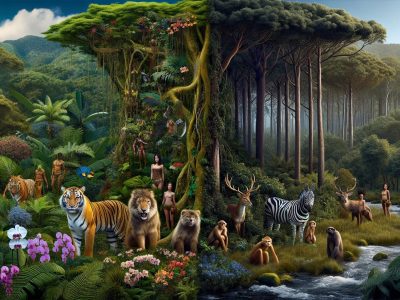
Picture walking through a lush forest, the air alive with rustling leaves and chirping birds. Now picture a rocky desert, silent and still under the blazing sun. One teems with vibrant life; the other holds only lifeless elements shaped by time. But what truly sets living things apart from non-living ones? Is it movement, growth, or something deeper?
Understanding this difference goes beyond curiosity—it’s key to grasping how our world operates. From the tiniest microbes to towering mountains, everything around you falls into one of these two categories. By exploring their unique traits, you’ll uncover an intricate balance that sustains life as we know it.
Characteristics Of Living And Non-Living Things
Living and non-living things differ fundamentally in their attributes. Understanding these differences helps you categorize the environment around you.
Defining Living Things
Living things are organisms that exhibit biological processes such as growth, reproduction, and metabolism. They include plants, animals, fungi, bacteria, and protists. For example, a bird flying in the sky or a tree absorbing sunlight showcases life functions like movement and photosynthesis.
Defining Non-Living Things
Non-living things lack biological activities and do not grow or reproduce. These can be natural objects like rocks or artificial items like buildings. For instance, a river flows due to gravity but doesn’t undergo metabolic changes.
Key Characteristics Of Living Things
Growth: All living organisms increase in size over time due to cell division.
Reproduction: Species continuity is ensured by producing offspring; for example, mammals giving birth.
Response To Stimuli: Changes in surroundings trigger reactions; plants bend towards light (phototropism).
Metabolism: Chemical reactions sustain life processes; digestion transforms food into energy.
Adaptation And Evolution: Over generations, living beings evolve traits for survival.
Key Characteristics Of Non-Living Things
Absence Of Cellular Structure: Unlike living entities with cells as basic units of life, non-living objects don’t have cells.
No Growth Or Reproduction: A car remains unchanged unless externally modified.
Lack Of Metabolic Activity: Rocks neither consume nor convert energy.
Inability To Respond Actively To Stimuli: While metal may expand under heat (thermal expansion), this is purely physical without awareness.
Permanence Without Decay From Within: Materials like plastic degrade externally but don’t biologically decompose internally.
These distinctions clarify how life operates uniquely compared to inert matter surrounding it.
Difference Between Living And Non-Living Things
Living and non-living things differ in their ability to perform biological functions, respond to stimuli, grow, reproduce, and use energy. Understanding these distinctions helps you categorize the world around you effectively.
Biological Processes
Living organisms undergo complex biological processes, such as metabolism and respiration. For example, plants convert sunlight into glucose through photosynthesis while animals break down food for energy. Non-living things like rocks or water lack these activities as they do not have cells or enzymes required for biochemical reactions.
Response To Stimuli
Living organisms react to changes in their environment. A deer flees when it hears a predator approaching; similarly, plants bend toward light sources (phototropism). In contrast, non-living objects remain unaffected by external influences—neither a stone moves when touched nor does it change its state due to sound or light.
Growth And Development
Growth in living beings involves cell division and enlargement. A sapling gradually becomes a tree through cell multiplication and elongation processes. On the other hand, non-living things only change externally if acted upon by an outside force—for instance, erosion reshapes mountains over time but doesn’t signify growth.
Reproduction And Adaptation
Reproduction ensures species survival among living beings. Animals give birth or lay eggs while bacteria multiply rapidly through binary fission. Also, adaptation helps species evolve traits suited to their environments; polar bears developed thick fur for Arctic climates. Non-living entities do not reproduce or adapt since they’re devoid of genetic material or evolutionary mechanisms.
Energy Utilization
Energy transformation is essential for life forms; humans consume carbohydrates that breakdown into ATP molecules powering bodily functions. Plants absorb solar energy during photosynthesis converting it into chemical energy stored as starches/sugars. Non-livings lack this capability—they neither generate nor store energy actively.
Examples Of Living And Non-Living Things
Living and non-living things exist in every environment around you, from bustling cities to remote wilderness. Understanding specific examples helps clarify the differences between these two categories.
Common Examples Of Living Things
Living things include organisms that perform essential life processes. Animals, such as cats, dogs, and birds, are mobile creatures demonstrating movement and growth. Plants like oak trees and sunflowers photosynthesize to produce energy while growing over time. Microorganisms like bacteria and fungi contribute significantly to ecosystems by breaking down organic matter or supporting nutrient cycles.
Humans also represent living things because of their ability to think, reproduce biologically, adapt behaviorally to changing environments, and grow physically through cell division. Aquatic creatures like fish or amphibians illustrate diverse biological adaptations suited for water habitats. All these examples share characteristics—metabolism, reproduction, response to stimuli—that define them as living entities.
Common Examples Of Non-Living Things
Non-living things lack biological activities but serve distinct roles in your surroundings. Objects like rocks provide structural stability for landscapes without undergoing growth or energy transformation. Man-made items such as buildings or cars showcase technological development but don’t exhibit life functions.
Natural elements including rivers and mountains may seem dynamic due to movement (water flow) or slow changes (erosion); but, they do not metabolize energy nor reproduce themselves biologically. Tools like chairs or computers further exemplify non-living entities designed solely for utility rather than self-sustenance or adaptation over generations.
Understanding these examples emphasizes how both categories interact within ecosystems where each plays a critical role even though fundamental differences in nature.
Importance Of Understanding The Difference
Recognizing the distinction between living and non-living things is crucial for deeper awareness of natural systems. It helps you interpret interactions within ecosystems and appreciate the balance sustaining life.
Role In Nature
Understanding these differences clarifies how ecosystems function. Living organisms, such as plants converting sunlight into energy, play active roles in maintaining equilibrium. Non-living components like water, air, and soil provide essential resources but do not engage in biological processes. For example, while trees absorb CO2 during photosynthesis to release oxygen, rocks remain inert even though environmental changes.
This knowledge enables you to evaluate ecological relationships better. A predator-prey dynamic or a symbiotic relationship between fungi and trees showcases how living entities depend on each other for survival. Non-living factors like temperature or mineral composition often influence these relationships indirectly yet significantly.
Scientific And Educational Relevance
Identifying what constitutes life aids scientific exploration across biology, chemistry, and physics. You rely on this distinction when studying cell functions (biology), chemical interactions (chemistry), or energy transfer processes (physics). For instance, microbial studies focus solely on living organisms with metabolic activity rather than inert substances like salts.
From an educational perspective, teaching children about these contrasts builds foundational knowledge of science early on. Demonstrating how seeds sprout into plants versus explaining why a stone remains unchanged offers practical examples that resonate with learners.
Conclusion
Understanding the difference between living and non-living things helps you appreciate the complexity of life and the elements that sustain it. This knowledge deepens your awareness of how ecosystems function and highlights the delicate balance between biological activity and inert matter in our environment.
By recognizing these distinctions, you gain valuable insights into natural systems, enabling a greater appreciation for both the dynamic processes of living organisms and the essential roles played by non-living components. It’s a perspective that fosters curiosity about the world around you while emphasizing life’s incredible diversity.
To provide the best experiences, we use technologies like cookies to store and/or access device information. Consenting to these technologies will allow us to process data such as browsing behaviour or unique IDs on this site. Not consenting or withdrawing consent, may adversely affect certain features and functions.
Functional
Always active
The technical storage or access is strictly necessary for the legitimate purpose of enabling the use of a specific service explicitly requested by the subscriber or user, or for the sole purpose of carrying out the transmission of a communication over an electronic communications network.
Preferences
The technical storage or access is necessary for the legitimate purpose of storing preferences that are not requested by the subscriber or user.
Statistics
The technical storage or access that is used exclusively for statistical purposes.The technical storage or access that is used exclusively for anonymous statistical purposes. Without a subpoena, voluntary compliance on the part of your Internet Service Provider, or additional records from a third party, information stored or retrieved for this purpose alone cannot usually be used to identify you.
Marketing
The technical storage or access is required to create user profiles to send advertising, or to track the user on a website or across several websites for similar marketing purposes.