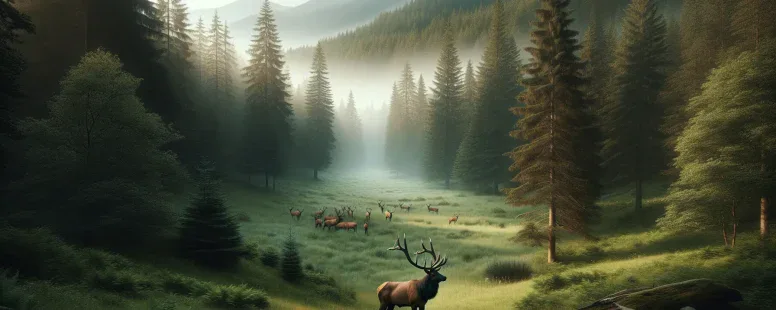
Picture a misty forest at dawn—the air crisp and the ground alive with the soft crunch of fallen leaves. Suddenly you catch a glimpse of movement between the trees. Is that a deer or something much larger? The silhouettes seem similar yet something about their presence feels worlds apart.
You might think elk and deer are just cousins in the wild but their differences run deeper than size or antlers. Understanding what sets them apart can transform your next hike or camping trip into a real-life wildlife adventure. Discovering these subtle distinctions opens a window into the secret rhythms of the forest and lets you spot details most wanderers miss. Are you ready to see the woods with new eyes?
Overview of Elk and Deer
Observe elk and deer in a clearing, and you might see two shadows, similar yet unique, brush past mossy stones. Elk (Cervus canadensis) stand as North America’s second-largest wild deer after moose, towering at 4 to 5 feet at the shoulder, with males (bulls) sometimes weighing more than 700 pounds. In contrast, white-tailed deer (Odocoileus virginianus) usually reach about 3 feet in shoulder height and rarely crack 300 pounds. Elk carry long, sweeping antlers with multiple tines, while deer antlers typically form a more compact, forked structure.
Walk through Rocky Mountain National Park in October, and you’d hear the haunting bugle of bull elk—an eerie sound made to attract cows and ward off rivals, a sound you’d never hear from whitetails, who rely on snorts and grunts. Elk herds roam widely in open meadows and aspen groves but deer slip quietly through dense forests, wary of every snapping twig. Both species browse on varied plants yet elk graze large grassy areas and may strip bark from aspens, while deer favor young shoots, fruit, and tender leaves.
People sometimes mistake young elk for big deer at dusk—yet, if you look, the elk’s white rump patch and dark neck set them apart from the deer’s slender tail and color banded fur. A wildlife biologist might tell you: elk can migrate more than 100 miles between their summer and winter habitats, while most deer hold tight to small home ranges. Did you ever wonder why deer freeze in headlights, but elk barrel on through? Behavioral studies (Smith et al., 2019, Journal of Wildlife Management) proved deer rely more heavily on camouflage and stillness, making their survival strategy a high-stakes gamble against passing cars.
Next time you find yourself staring at hoofprints by a creek, ask yourself—do the tracks point towards the secretive world of deer, or the grandeur of elk moving as living shadows across the landscape?
Physical Differences Between Elk and Deer
Understanding physical differences between elk and deer helps you spot them in any wild landscape. Key features set these majestic animals apart at first glance.
Size and Weight
Size and weight of elk and deer show a clear distinction. Elk tower over most deer, reaching 4 to 5 feet at their shoulder, while mature white-tailed deer typically stand about 3 feet tall (National Park Service). Adult male elk (bulls) can weigh up to 1,100 pounds, though most average 700–800 pounds. Female elk (cows) usually tip the scale around 500 pounds. For comparison, mature male white-tailed deer (bucks) rarely weigh over 300 pounds, with most does under 200 pounds. In areas like Yellowstone or the Rockies, hikers regularly encounter tracks of 800-pound bull elk, dwarfing nearby deer prints.
Species
Adult Male Height (ft)
Adult Male Weight (lbs)
Adult Female Weight (lbs)
Elk
4-5
700-1100
~500
Deer
~3
<300
<200
Antlers and Body Structure
Antlers and body structure distinguish elk from deer with pronounced clarity. Bull elk grow antlers that often sweep upward and back, sometimes spreading over 4 feet wide. Their antlers branch in a single curve with several tines jutting upward. In contrast, deer antlers look more compact and sharply forked. White-tailed bucks show antlers with multiple points (tines) growing vertically rather than outstretched. Watching an elk bugle, its head and massive antlers silhouetted against the sky, you’d never confuse it with the leaner, sleeker body form of a deer. Elk bodies appear sturdier and barrel-chested, while deer look lighter, with narrower frames and more delicate limbs.
Coat Color and Markings
Coat color and markings create unique visual cues. Elk wear tan or light brown coats, featuring a distinctive yellowish rump patch and dark brown neck mane, which stand out even from afar. Their coats get shaggier in winter, adding to the dramatic look. Deer, such as white-tailed, usually have reddish-brown coats in summer that turn grayish in cold months. The signature white tail, raised like a flag when alarmed, gives white-tailed deer their name. Spotting a herd at dawn, you may noticed elk blending into golden meadows while deer melt into the woodland shadows—nature’s camouflage shaped by habitat.
Behavioral Differences
Behavioral patterns between elk and deer shapes how you encounter them in wild landscapes. Social rituals, calls, and seasonal habits draw sharp contrasts between these iconic species.
Social Structure and Habits
Elk live in large herds, sometimes with up to 400 individuals in open valleys or meadows—like the bustling communities seen in Yellowstone. You might find them grazing shoulder-to-shoulder, communicating constantly with barks and mews. These elk herds show hierarchal layers, where dominant cows lead the group outside the fall rut season. Deer, like the white-tailed, prefer solitude or small family groups. Their movements seem secretive: you’ll catch a white flash as a deer bounds away through undergrowth, rarely lingering in crowds. They freeze at sudden noise, relying on stealth more than strength. Some ecologists, such as Geist (1991), notes elk remain bolder, standing firm or forming defensive circles, especially when calves are present. You’ll probably wonder, would an elk defend its calf against a wolf, while deer flee at the first scent of danger? This contrast tells much about their roles within North American ecosystems, that’s rooted in centuries of predation and adaptation.
Mating and Reproduction
Mating rituals between elk and deer highlight dramatic behavioral differences shaped by evolutionary pressures. Bull elk participate in loud, brash competitions, bugling to announce their presence across entire valleys. During the rut in September to October, bull elk herd and fiercely defend harems that can include up to 20 cows. You might picture two males clashing antlers at dawn, mist swirling as their breath clouds the air. Deer rutting, by contrast, looks less theatrical. Bucks mark territory with scrapes and rubs, patrol wooded edges, and chase does for brief, quiet encounters—often at dusk. Fawn births peak in late Spring, often with twins; mothers hide newborns in tall grass, returning for brief feeds. Elk calves, also born in Spring, take refuge in thicker underbrush while cow elk fiercely guard the nursery group—sometimes rushing intruders with snorts or feints. Researchers at the National Park Service observe these behaviors year after year, reinforcing that elk display more communal and combative rut behaviors, while deer excel in secrecy and stealth.
Which would you rather witness on your next forest hike—a thunderous elk melee echoing across hills, or the still hush of a hidden deer nursery? These differences makes every wildlife encounter a unique story chasing through the forests of North America.
Habitat and Range Comparison
Tracking the habitats of elk and deer introduces you to two stories unfolding across North America. Picture following hoofprints through drifting snow, revealing a narrative driven by ancient instincts and seasonal rhythms. Each track, almost like a living map, hints at the landscapes these animals call home—vast open spaces for elk and shadowy thickets for deer. The journey from grasslands to dense forests tells you more about survival than any field guide.
Geographic Distribution
Looking at geographic range, elk (Cervus canadensis) claim the broad stage—stretching across the Rocky Mountains, Pacific Northwest, and pockets of the Midwest. Yellowstone’s meadows echo with elk bugles each autumn, drawing wildlife watchers from miles around. While herds thrive in Wyoming’s open valleys, remnant populations wander forested hills in Kentucky and Pennsylvania after reintroduction projects (Rocky Mountain Elk Foundation, 2022). In winter, you might find elk migrating up to 150 miles, their movements orchestrated along ancient corridors shaped by snowpack and forage.
White-tailed deer (Odocoileus virginianus), on the other hand, have adapted to an astonishing diversity of settings, spreading from Central America to southern Canada. In suburban Connecticut, deer graze behind backyard fences, while in Mississippi river bottoms, their silhouettes cut through morning fog. Range maps show white-tailed deer flourishing in nearly every contiguous US state—except for some arid Southwest deserts. Mule deer (Odocoileus hemionus) favor the arid basins and mountain ranges of the western United States, carving out territory where trees give way to sagebrush and canyons.
Ask yourself: which would you rather track at dawn—a herd of elk blazing a trail through snow-draped meadows, or a solitary deer slipping between shadows in your local woods?
Preferred Environments
Observing elk habitat choices tells you they’re creatures of change and openness. Elk select open grasslands, alpine meadows, and aspen groves, always seeking wide sightlines to spot threats. In Colorado’s Estes Park, elk bed down under cottonwoods and graze riverbanks, unbothered by hikers snapping photos. During migratory periods, they move from high mountain basins to sagebrush flats, always following the greenest plants (National Park Service, 2023).
Deer, in contrast, prefers secrecy and shelter. White-tailed deer pick thickets, forest edges, and overgrown fields where they can melt into the undergrowth within seconds. In spring, does stash fawns in dense cover, trusting camouflage rather than the distance elk favor. Urban deer conceal themselves in patches of woods between highways and quiet cul-de-sacs, showing how flexibility ensures survival.
If you find hoofprints in muddy creekbeds, pause for a moment. Is the path broad and clear, leading toward distant hills—a likely sign of elk? Or does the trail disappear under low branches and windy brush, a silent signature left by a cautious deer?
Species
Range/Distribution
Preferred Habitat
Elk
Rockies, PNW, Midwest, reintroduced Appalachians
Open meadows, grasslands, aspen groves
White-tailed
North America (except Southwest deserts)
Forest edges, thickets, fields, suburban woods
Mule Deer
Western US: mountains, basins, canyons
Sagebrush, mountain slopes, open forests
Diet and Foraging Patterns
Watch elk graze in the golden light and you’ll notice their appetites seem nearly endless. These massive animals—much larger than any white-tailed deer—must constantly consume, sometimes eating up to 20 pounds of grasses, forbs, and woody plants daily (Rocky Mountain Elk Foundation). Elk rely heavily on open meadows for grazing, especially in summer, and you’d rarely see them picking through the underbrush. When winter sets in, their huge herds move, seeking whatever shrubs and bark they can find after snows bury the grasses.
Picture a white-tailed deer slipping silently through the forest edge. Deer aren’t picky at all, but they do browse more selectively than elk. Using narrow snouts, deer nibble tender shoots, buds, acorns, berries, and even fungi if it’s available (National Deer Association). Unlike elk, deer often return to the same feeding spots, eating smaller quantities but more frequently. They tend to avoid middle of large open areas, prefering cover where quick escapes prove possible.
Have you ever spotted a line of foraged twigs, cleanly snipped at an angle? That’s likely elk—deer leave jagged, torn edges behind because their teeth lack upper incisors. When you walk through a meadow, check what plants are missing: if the grass stands tall but shrubs look battered, elk have been through. If everything seems nibbled randomly, deer probably passed by.
Sometimes debate circles around whether elk or deer are better at adapting during food shortages. Some researchers say elk’s size and social networks allow them to spread out and exploit new foraging grounds more efficiently (Wisconsin DNR). Others claim a deer’s agility and cunning browsing lets them survive even where resources dwindle. Both species prove remarkably adaptive, yet their strategies—roaming herds versus stealthy browsers—rarely overlap neatly.
Next time you find a thicket transformed or a meadow trampled, consider what story unfolds in those hoofprints. Who shaped the landscape—giant elk or agile deer? Maybe the only way to really know is to slow down and notice the clues left behind—a shorn branch here, a nibbled acorn there. Every journey through the woods reveals a new chapter in the ongoing feast and struggle of North America’s iconic foragers.
Importance to Ecosystems and Human Culture
Elk and deer shape ecosystems like silent architects across North America, thier feeding habits ripple through forests, meadows, and grasslands. When you spot an elk herd churning up aspen groves, it’s not just a natural spectacle–it’s a lesson in ecological engineering. Elk graze heavily, opening up thick understory layers and letting sunlight paint new mosaics across the forest floor. Over decades, their browsing paths create habitats for birds, small mammals, and wildflowers, like how a gardener clears space for new blooms. Compare that with deer, whose selective nibbling on tender shoots and seedlings can tip the scales for competing plant species. Given high white-tailed deer populations in some states, you’ll see young trees vanish, saplings stripped bare like they never even stood a chance. According to the U.S. Forest Service, some forests with dense deer populations show almost no forest regeneration at ground level (USDA Forest Service, 2019).
Culturally, both animals stand as icons but tell different stories. Listen to Indigenous elders describing elk: they’ll speak of strength, endurance, and community, woven into spiritual traditions and beadwork patterns. Deer, meanwhile, slip quietly into legends and family tales as symbols of gentleness and renewal. Hunters in the Rocky Mountains share anecdotes of chasing bull elk bugles echoing for miles, the stuff of myths and adrenaline. In contrast, suburban gardeners might recall a family of deer tiptoeing through backyards at dawn, provoking delight or frustration in equal measure. Would you feel awe at the sight of massive elk antlers mounted above a fire place, or would you prefer a deer’s fleet-footed grace surprising you along a morning trail? Both animals star in folklore, hunting traditions, and wildlife tourism economies–the North American Model of Wildlife Conservation rests in part because elk and deer can rebound from near-extinction when managed wisely (Boone and Crockett Club, 2022).
Questions linger, though: Do elk and deer benefit ecosystems equally, or can local population booms leave landscapes tattered? What do you notice on your own hikes—lush wildflowers or bare stems where deer have feasted? In choosing which animal’s story to follow, which lesson for resilience or balance stands out as yours to carry forward?
Conclusion
Next time you step into the woods or stroll through a meadow, take a moment to look for the subtle clues left behind by elk and deer. Noticing the differences in tracks, antlers, and behaviors can turn an ordinary hike into a rich learning experience.
Let your curiosity guide you as you listen for distant bugles or spot a flash of white in the underbrush. The more you learn about these remarkable animals, the more rewarding your time outdoors will become.
To provide the best experiences, we use technologies like cookies to store and/or access device information. Consenting to these technologies will allow us to process data such as browsing behaviour or unique IDs on this site. Not consenting or withdrawing consent, may adversely affect certain features and functions.
Functional
Always active
The technical storage or access is strictly necessary for the legitimate purpose of enabling the use of a specific service explicitly requested by the subscriber or user, or for the sole purpose of carrying out the transmission of a communication over an electronic communications network.
Preferences
The technical storage or access is necessary for the legitimate purpose of storing preferences that are not requested by the subscriber or user.
Statistics
The technical storage or access that is used exclusively for statistical purposes.The technical storage or access that is used exclusively for anonymous statistical purposes. Without a subpoena, voluntary compliance on the part of your Internet Service Provider, or additional records from a third party, information stored or retrieved for this purpose alone cannot usually be used to identify you.
Marketing
The technical storage or access is required to create user profiles to send advertising, or to track the user on a website or across several websites for similar marketing purposes.