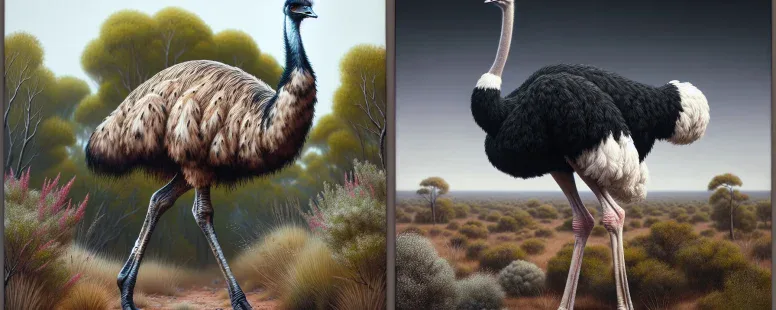
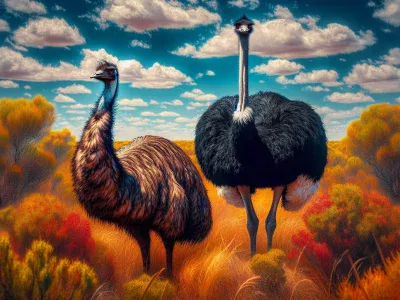
Picture standing on a sunbaked plain as two colossal birds dash across the horizon—one with feathers rippling like windblown grass, the other looming taller than a fence post. You might squint and wonder: are those both ostriches, or is one an emu? The world of flightless birds is full of surprises, and these giants are more than just lookalikes.
Unraveling the mysteries between emus and ostriches opens a window into distant continents, unexpected adaptations, and quirky behaviors. Knowing the difference isn’t just trivia—it can spark curiosity about evolution, geography, and the wild wonders of nature. Get ready to see these birds in a whole new light.
Overview Of Emus And Ostriches
You see emus striding through the dusty stretches of Australia, shadows cast long under the fierce sun. These flightless wonders, Dromaius novaehollandiae, stand nearly 6 feet tall. They’re second only to ostriches in height among living birds. You might spot them in bushland or grassland, their shaggy double-feathered coats ruffling as they dart in zigzag patterns, escaping threats with swiftness.
Ostriches, Struthio camelus, roam Africa’s open savannas and arid plains. When startled by lions or cheetahs, they sprint up to 43 mph (Smithsonian National Zoo), leaving a cloud of swirling dust. They can reach up to 9 feet in height—picture gazing up at an adult male, towering over basketball players. Their plumage, smooth and bold, sets them apart from the muted rustle of emu feathers.
Biologists marvel at their anatomy: stiff-legged gait, powerful thighs, massive eye-orbitals. Emus wield three toes; ostriches two, the larger forming a hoof-like pad, perfect for running across dryland terrain. Did you know ostrich eggs hold the title of world’s largest bird egg, weighing nearly 3 pounds? If you ever wondered which bird lays the eggs fit for a giant’s breakfast, that’s your answer—another quirky divide between these avian titans.
Both birds exhibit fascinating parental patterns. Male emus incubate the eggs and care for the chicks solo—an example of rare paternal dedication among birds. Ostrich males and females share incubation shifts, swapping roles under the harsh African sun. Isn’t it intriguing how evolution shaped cooperation and solitary parenting so differently between species? Researchers explore these family dynamics for clues to survival strategies (Journal of Avian Biology, 2021).
Where does your curiosity take you—imagining the ancient Gondwanan split that sent one ancestor south, another north, each adapting to distant continents? Track their footprints, observe their diets—fruits, insects, stones, and roots—and you’ll start to see distinct ecological stories. How do social groups, predation pressures, and climate forge the path of adaptation? The sheer contrast might make you wonder which bird would win a footrace across the savanna, or what songs these silent giants hear in the wind.
Physical Differences Between Emu And Ostrich
Physical features set emus and ostriches apart across continents and habitats. Emus display rugged adaptations for Australian landscapes while ostriches show striking savanna features.
Size And Appearance
Size differences between emu and ostrich attract immediate attention. Ostriches stand tallest, reaching up to 9 feet and weighing over 320 pounds, with wings spanning more than 6 feet (National Geographic). Emus appear more moderate, topping out near 6 feet and usually weighing under 130 pounds. Next to an ostrich towering above travelers’ heads, an emu seems more approachable, its body compact and streamlined for darting through dense bushland in southern Australia.
You could ask, if both are built for running, why does the ostrich look so formidable? Longer legs and greater mass give ostriches leverage for sprinting at speeds up to 43 mph. Emus run slower, maxing around 30 mph, but they twist and pivot with agility, ducking through scrub and grass with ease in their native range.
Feather And Color Patterns
Feather differences instantly hint at climate adaptation. Ostriches wear loose, soft black and white plumage (in males), with females bearing brownish-gray tones. These shady feathers provide both camouflage and heat regulation under Africa’s blazing sun. Emus, on the other hand, have shaggy double-shafted feathers, colored brown or gray with a coarse texture that block sunlight yet insulate from cool nights. This adaptation matches the unpredictable Australian weather—one day scalding and the next unseasonably cold.
Ostriches lack the feathered lushness at their legs and neck; you’ll see the bare, pinkish skin in contrast to their bulky bodies. Emus cover more of their bodies in feathers, giving them a shaggy, almost prehistoric look, their necks colored in striking blue hues during breeding season—a trait rarely seen in ostriches.
Legs, Beaks, And Feet
Legs and feet tell a story of survival. Ostriches sport only two toes per foot, providing a powerful push with each stride and acting like natural shock absorbers, useful in escaping predators on the African plains. Emus have three toes, spreading their weight to navigate soft terrain, with feet adapted for gripping and pivoting.
Ostrich legs show visible muscle lines and an explosive spring—think of them as sprinting machines. By contrast, emu legs are thinner but very strong, able to leap obstacles and change direction rapidly. Ostriches display a large, flat beak useful for grabbing leaves, seeds, and tiny creatures. Emus have narrower, more pointed beaks suited for pecking foliage, small insects, and seeds from tough ground.
Every anatomical detail hints at a larger story—regions shaped birds’ very bones, beaks, and feet to thrive where the wild throws both danger and nourishment at them.
Habitat And Geographic Distribution
Get ready to step into landscapes as wild as any adventure novel—these birds don’t just live, they dominate their respective worlds. The ground beneath your feet bends to their presence, from the endless Australian outback to the sprawling savannas of Africa. Where might you find these giants if you set off on a journey across continents?
Native Regions
Emus, with their signature blue patches and solemn gaze, only live in Australia. No place else in the world can lay claim to their legacy. You could be hiking across the Northern Territory’s red dust, winding through eucalyptus, or watching grain fields sway in Victoria—always, the emu is near. Australia made the emu a national symbol, a bird so entrenched in local legend that even coins feature its form (Australian Government, Royal Australian Mint, 2023).
Ostriches reign supreme in Africa. You could be on safari in Tanzania’s Serengeti, tracing tracks along the cracked ground, or scanning the horizon of South Africa’s Karoo desert—there goes the ostrich, as unmissable as a marching drumline. North to south, east to west, their range stretches across most of sub-Saharan Africa, yet you won’t find them in the planet’s rainforests or mountains (Africa Geographic, 2022).
Preferred Environments
Emus thrive in places with surprise and variety. Think about scrubland where each bush can hide a watchful eye, or grasslands where swift sprints dodge dingoes and hungry eagles. Floodplains, open forests, and even farmlands get claimed by these nomads. When droughts shrive Australia’s rivers and grass—emus move in broken zigzags across hundreds of kilometers, following the rain. Few birds use the land as resourcefully.
Ostriches claim the hottest, driest places and somehow turn them into a stage. They’re at home in savannas speckled with acacias, semi-arid deserts shimmering in heat, and plains where gazelles dart by. Did you know they sometimes share ground with zebras or even lions? Yet, they stick to open terrain, relying on their vision and speed to outwit predictors. When the sun blazes at 100°F (38°C), ostriches simply flop in the shade or fan their feathers—no panic in those dinosaur eyes.
What do these differences suggest? Try asking, what might have happened if emus wandered into Africa, or ostriches crossed the Wallace Line into Australia? Their worlds shaped their bodies and habits, showing you the power of place and possibility. If you were to draw a map based on their footprints, you’d see continents themselves pulling the strings.
Behavior And Diet
Behavior patterns in emus and ostriches reflect their evolutionary journey across contrasting landscapes. These flightless giants shape their days in rhythms that reveal just how survival and adaptation dance together in wild terrain.
Social Structure
Emus form loose flocks, sometimes numbering over 20 birds. Picture watching a wave of emus as they weave through eucalyptus groves—each individual moves almost like a piece in a kinetic sculpture, rarely tightly knit but always within sight of kin. Their social bonds intensify during breeding season, when males singlehandedly defend nests and nurture young, a rare spectacle even among birds.
Ostriches, in comparison, rely on their herd for protection against fierce African predators, running in groups from a handful to 50 individuals or more. Ostrich flocks organize like living radar systems, with some always watching while others graze or preen. When danger looms, ostriches scatter with astounding synchrony, their legs pounding the savanna in a display of sheer power. Some zoologists question whether this group vigilance evolved more from necessity than preference, but the fact remains: ostriches lean on coordinated alertness in unpredictable environments.
Feeding Habits
Dietary habits set emus and ostriches even further apart. Emus forage as generalists, their long bills pecking at seeds, fruits, insects, and even small reptiles. You might spot emus swallowing stones—gastroliths—a behavior that helps them grind tough seeds inside their muscular gizzards. When rains bring sudden flushes of bush tomatoes and native grasses, emus quickly target these resources, ensuring energy for their nomadic movements.
Ostriches act as open-country grazers. Their powerful beaks pluck grasses, succulents, and occasionally insects directly from the dry soil. During droughts, ostriches survive on roots and leaves that other creatures pass by, showcasing a dietary resilience admired by conservationists (Smithsonian National Zoo, 2022). Unlike emus, who drink whenever water is available, ostriches have adapted to extract moisture from their food—sometimes going days or even weeks without direct drinking.
Both birds display curious eating quirks: emus often chase shimmering heat mirages, pecking at them out of curiosity, while ostriches ingest shiny objects, mistaking them for edible items. Some local African farmers joke that anything lost in the veldt, from buttons to coins, winds up in an ostrich crop.
Would emus learn to eat thorny acacias if they ever wandered the Serengeti? Could ostriches compete against kangaroos for spinifex seeds in Australia’s outback? Only geography and imagination draw the boundaries, but the differences etched into these birds’ habits speak volumes about the wild worlds that shape them.
Reproduction And Lifespan
Emu and ostrich reproduction highlights distinct strategies shaped by continent and climate. You’ll notice how their parental roles and longevity echo their unique survival stories.
Nesting And Mating
Emus craft their nests low in grassy clearings, hiding clusters of emerald-green eggs that shimmer at dusk. You could wander out into the Australian outback during breeding season, and spot a solitary male standing sentinel by a small nest—he’s guarding up to 15 eggs, his feathers bristling as dusk falls. Emu courtship means female emus chase and drum, then leave after laying, entrusting incubating and chick-rearing to fiercely devoted fathers. Males stay on the nest, rarely eating, sometimes dropping to half their body weight (National Geographic, 2020).
Ostriches, by contrast, stage communal dramas. Multiple hens lay pale eggs in one sandy scrape, competing to earn the prized center spot. Ever see a lineup of eggs almost too many to count? Sometimes more than 20 collect in a dancing spiral. Both ostrich parents take turns on the nest; males incubate by night for camouflage, females by day. Who guards which hour? Evolution’s hidden clock ticks, blending security and deception. Ostrich mating displays rival a parade—males puffing black-and-white plumage, drumming, and swinging necks to draw the choosiest mates.
Lifespan Differences
Ostriches outlive emus, often reaching up to 40 years in captivity with records over 45 (Smithsonian’s National Zoo, 2023), while emus rarely see past 20 years—think of two generations of emus for every one of ostrich. Wild emus typically average around 10–15 years. What would it feel like to watch birds who might remember your grandparents? Ostrich longevity grants herds multi-generational memory, mothers and daughters nesting together as droughts have come and gone.
For both species, predators shape the odds. Young emus, vulnerable to dingoes and foxes, test their luck in open grass, while ostrich chicks dodge hyenas, jackals, and lions, sprinting under parental wings. You see lifespans not just counted in years, but in narrow escapes and near-misses—each feather a ledger of adaptation.
Bird
Egg Color
Incubation Role
Wild Lifespan
Captive Lifespan
Emu
Green
Male only
10–15 years
Up to 20 years
Ostrich
Pale (white/cream)
Male/female shared
30–40 years
40 years+
What if emus parented like ostriches—would those little green eggs ever survive open plains? Consider how each strategy isn’t just instinct but a response to predators, habitat, and risk. Whenever you peer into a nest or count footprints fading in red sand, you’re witnessing stories of patience, protection, and peril that shaped the endurance of world’s largest birds.
Economic And Cultural Importance
Emus and ostriches shape economies and identities across continents, pressing their footprints into both industry and imagination. You look not just at two birds, but at intersecting stories of livelihood, legacy, and symbolism.
Role In Farming And Agriculture
Emus and ostriches fuel entire agri-businesses, although in startlingly different ways. In Australia, you’ll find farms fencing in hundreds of emus mainly for their oil, meat, and leather (Australian Government, AgriFutures Australia). That oil, rich in omega-3s and anti-inflammatory compounds, sits on pharmacy shelves beside muscle rubs, and is even whispered about at beauty counters as a natural skin elixir. Ostriches stride across dusty pens in South Africa, delivering the world’s largest eggs—each weighing almost 3 lbs—while their feathers glint in fashion ateliers from Paris to Milan.
Can one bird outdo the other? Yes, economic scale, ostriches supply bigger commercial farms. Their lean, red meat finds its way onto gourmet menus worldwide, and leather from the bird’s bumpy hide upholsters luxury bags or shoes—Prada and Hermès have showcased ostrich leather in exclusive lines. Meanwhile, emu oil exports have quietly grown, especially as skincare has surged in North America.
Did you ever wonder, what makes these birds worth a farmer’s investment? Simply, they’re resilient, low-maintenance, and they thrive in marginal lands unsuitable for cattle or crops. But compare their feed efficiency and growth rates in financial tables and you’ll see ostrich farming returns outpace emus in sheer profit per acre.
Bird
Primary Products
Farm Location
Market Value Range (USD)
Notable Use
Emu
Oil, Meat, Leather
Australia, US
$30–$40/kg (oil)
Skincare, anti-inflammatories
Ostrich
Meat, Leather, Egg
South Africa, Namibia
$20–$35/lb (meat)
Fashion, gourmet food
The dependence on these birds goes deeper than economics; farmers in Western Australia or Oudtshoorn have stories of risky starts and windfall profits, nest egg dreams, and seasons where a stubborn emu or a broody ostrich hen made all the difference. Sometimes, a clutch of eggs means hope—sometimes, dust and feathers.
Cultural Significance
Emus and ostriches are more than commodities; they’re metaphors, mascots, even myths. The emu, standing tall on Australia’s coat of arms opposite the kangaroo, represents progress, because, as legend says, neither creature can move backward easily. Indigenous Australian stories tell of the emu rising in the night sky—the ‘Emu in the Sky’ constellation, painting cosmology in star and shadow.
Contrast this with the ostrich, woven into African folklore as clever and elusive, often starring in fables with lions and jackals. In ancient Egypt, royalty wore ostrich feathers to symbolize truth and divine order, while Maasai warriors still use ostrich plumes in ceremonial dress. If you travel to Oudtshoorn during the annual Klein Karoo Arts Festival, you’d hear songs, see ostrich races, and taste recipes old as colonial railroads.
Which bird tugs stronger at the cultural heartstrings? Arguably, the emu commands a symbolic loyalty: schoolchildren in Brisbane and Perth spot emus in crests, currency, and folklore. Ostriches, but, have strutted into spiritual pageants, court rituals, and designer runways, adapting with each generation.
Ask yourself: which symbol endures the longest—one carved in stone, or one revived nightly in story and laughter? Maybe the importance of these birds can’t be weighed in feathers or fortune alone, but in how they inhabit memory and belonging.
Emus and ostriches don’t just show up at farm gates or on dinner plates; they spark the imagination, link city dwellers to wild horizons, and inspire new ways to adapt. Their stories ripple through economies and culture alike, because your world needs both the epic and the everyday.
Conclusion
Exploring the worlds of emus and ostriches opens your eyes to the remarkable ways nature adapts life to different continents. When you look beyond their size and speed you’ll find stories of survival evolution and cultural meaning woven into every feather and stride.
Next time you spot an image of either bird or hear their names in conversation you’ll have a deeper appreciation for what sets them apart. Their differences aren’t just biological—they’re a testament to the diversity and wonder of the natural world.
To provide the best experiences, we use technologies like cookies to store and/or access device information. Consenting to these technologies will allow us to process data such as browsing behaviour or unique IDs on this site. Not consenting or withdrawing consent, may adversely affect certain features and functions.
Functional
Always active
The technical storage or access is strictly necessary for the legitimate purpose of enabling the use of a specific service explicitly requested by the subscriber or user, or for the sole purpose of carrying out the transmission of a communication over an electronic communications network.
Preferences
The technical storage or access is necessary for the legitimate purpose of storing preferences that are not requested by the subscriber or user.
Statistics
The technical storage or access that is used exclusively for statistical purposes.The technical storage or access that is used exclusively for anonymous statistical purposes. Without a subpoena, voluntary compliance on the part of your Internet Service Provider, or additional records from a third party, information stored or retrieved for this purpose alone cannot usually be used to identify you.
Marketing
The technical storage or access is required to create user profiles to send advertising, or to track the user on a website or across several websites for similar marketing purposes.