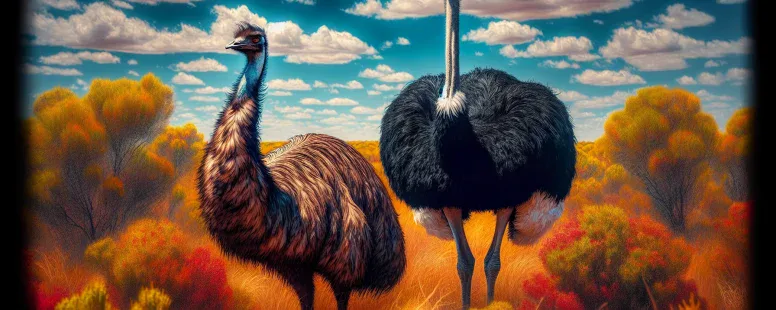
Picture standing in a sunbaked field as two giants of the bird world stride past—one with a deep, booming call echoing across the plains, the other towering above the grasslands with eyes sharp as desert glass. You might wonder if these feathered titans are twins separated by continents or rivals in a race across the wild.
Unlocking the differences between emus and ostriches isn’t just about spotting size or speed; it’s a journey into the heart of their habitats, their quirky behaviors, and the secrets that help them thrive where few creatures dare. As you peel back the layers, you’ll discover surprising facts that go far beyond feathers and footprints, revealing why these birds are so much more than just flightless wonders.
Overview of Emus and Ostriches
Both emus and ostriches dominate as the largest flightless birds, yet their worlds remain separated by continents. Emus roam Australia’s bushland, grasslands, and forests, blending into wild eucalyptus groves. Ostriches stride across the savannas and desert plains of Africa, like shadows rippling in the afternoon heat.
Folk in the outback might recall seeing emus darting through low-lying shrubs, their dark feathers catching the sun; they’re famously curious, sometimes following travelers just out of reach. Birdwatchers in Kenya often spot ostriches mingling with herds of zebras and gazelles, which is no coincidence—these birds often act as sentinels, their eyes scanning for danger, a gift that earned them praise from Maasai elders.
How tall do you think an emu stands? Some tower at 6.2 feet (Forbes, 2022), but ostriches aren’t easily overshadowed—some males stretch beyond 9 feet, eye-level with a giraffe’s shoulder (National Geographic, 2023). Eggs tell their own story. If you ever held an emu’s teal-green egg or an ostrich’s creamy, football-sized sphere, you’d feel the difference instantly; an ostrich egg weighs up to 3.1 pounds, while an emu egg feels lighter at about 1.4 pounds (Australian Museum, 2021).
Emus, with their three-toed feet, move in zigzag bursts, weaving through trees and outpacing pursuers at 30 mph. Ostriches rely on their two protruding toes and long stride to sprint up to 43 mph, dust pluming in their wake. Which would win a race across the Serengeti? Some speculate ostriches possess a mechanical grace, while emus rely on sheer agility.
If you compare their diets, emus peck for native fruits, seeds, and insects—sometimes swallowing curious objects that catch their fancy. Ostriches, on the other hand, consume roots, grass, lizards, and occasionally swallow pebbles to grind food in their muscular gizzard.
There’s more than one way to survive in wild lands. Adaptations run in every feather and gene: emus withstand long droughts by conserving water, ostriches use their strong legs both for running and for defense, delivering kicks powerful enough to deter lions (BBC Earth, 2020).
Every encounter with these birds raises new questions. Could an emu adapt to life in Africa’s open plains? Does the ostrich’s communal nesting strategy outpace the lone vigilance of the emu mother? Each species challenges what you might expect from the world’s biggest birds.
Attribute
Emu
Ostrich
Native Range
Australia
Africa
Height
Up to 6.2 feet (1.9 m)
Up to 9 feet (2.7 m)
Top Speed
30 mph (48 km/h)
43 mph (70 km/h)
Egg Weight
1.4 lbs (650 g)
3.1 lbs (1.4 kg)
Foot Structure
Three toes
Two toes
Habitat Example
Eucalyptus woodlands, grassland
Savannah, semi-deserts
Main Defense
Running, camouflage
Running, powerful kick
Could you distinguish an emu’s silhouette at dusk from that of a distant ostrich? The details reveal more than size: coloration, gait, groupings, even attitude on approach—each trait tells part of their evolutionary journey.
Physical Differences Between Emus and Ostriches
You’re looking at birds that can’t fly, but their bodies tell very different stories. Details like size, feathers, and legs shape how emus and ostriches live, thrive, and even run from predators.
Size and Weight Comparison
Emus stand up to 6.2 feet tall but usually max out at 120 pounds. Ostriches, in contrast, grow over 9 feet and can weigh more than 320 pounds. You’ll notice this massive disparity at a glance when you see a pair together at a wildlife reserve. Among large birds, ostriches tower above—hence, their long, powerful stride. Emus, while striking, blend better with bushland trees thanks to their shorter frame and muted silhouette. Smithsonian’s National Zoo documents ostriches’ top weight as high as 346 pounds, compared to emus’ average of 100 pounds.
Species
Maximum Height (ft)
Average Weight (lbs)
Emu
6.2
100–120
Ostrich
9
220–346
Plumage and Coloration
Emus have shaggy, brown-black feathers that look more like coarse hair than traditional bird plumes. That dullness helps blend into Australian grasslands and forests—making them nearly invisible until you’re ten feet away. Ostriches, on the other hand, show stark contrast: males display dramatic black-and-white feathers, while females wear muted grays. The feather structure holds surprise—ostrich plumes are loose and soft, lacking the tight vanes regular birds have. If you’ve ever seen ostrich boas at a fashion show, you’ve glimpsed the bird’s unique gift. Camouflage works differently for ostriches, their coloring breaking up their outline on open African plains.
Beaks and Legs
You’ll see beaks on both that look flat and broad, but ostriches have slightly more hooked ends for uprooting tough desert plants. Emus pick berries, seeds, and insects with straight, blunt beaks. Their legs are built differently, too—emus walk on three toes per foot, while ostriches only have two, maximizing speed. An ostrich can kick with enough force to kill a lion, evidenced by wildlife rangers’ reports in South Africa; emus, meanwhile, deliver quick forward kicks to deter dingoes and foxes. The difference in legs shapes their running styles—emus zigzag around trees, ostriches sprint with straight-line speed across open grassland, leaving faint clouds of dust behind.
Habitat and Distribution
You uncover stark contrasts when you zoom in on the places emus and ostriches call home—differences woven through landscape, climate, and tradition. The vast red-dust heart of Australia echoes with the soft drumming of emu feet while African sunrises spotlight ostrich silhouettes stretching across the savanna. Each bird dominates its domain, the landscape shaping its story at every turn.
Native Regions
You find emus all over mainland Australia, from the rainshadow grasslands of Queensland to eucalyptus forests in Victoria. Emus rarely stay still, wandering more than 12 miles a day when searching for water during droughts (CSIRO, 2011). In contrast, ostriches roam the arid savannas and thorny bush of Sub-Saharan Africa—think South Africa’s Karoo, Kenya’s savanna, and the Namibian desert. They cluster in loose groups, their tall forms visible for miles. Ostriches don’t migrate far but may shift ranges after rains, following new grass (BirdLife International, 2023). Isn’t it fascinating how these birds’ boundaries reflect continental extremes—oceans apart, yet similarly maximizing open spaces?
Adaptation to Environment
You see the climate’s fingerprint in every feather and footstep. Emus blend into Australia’s sun-bleached scrub with their shaggy dark-brown feathers, their three-toed feet splay wide to disperse weight—dancing over loose sand like a paddle on water. During drought, emus survive on dew and hidden seeds, going weeks without drinking (Australian Museum). Ostriches, though, are heat warriors. Large wings flap to cool them, and pale legs reflect sunlight on blazing days. Most ostriches huddle together at midday, using communal shade tactics. Two-toed feet dig for roots or defend against hyenas. If you have ever seen an ostrich sprint—neck forward, feathers rippling like banners—you’d wonder how adaptation gives rise to such effortless power. Each species tells a story of its home: one where agility and camouflage win against drought, the other where size and battle-readiness rule expansive plains.
Behavior and Lifestyle
Walking through the outback or the savanna, you’d notice emus and ostriches behaving in ways that tell a story of ancient survival. Both birds echo their continents’ rhythm, yet within their movements and choices, their uniqueness emerges.
Social Structure
Social groupings shape emu and ostrich daily lives with remarkable contrasts. Emus usually travel in loose pairs or as solitary wanderers, especially during non-breeding times—just picture an emu blending into a sunlit clearing, scanning for predators before stepping quietly away. Groups sometimes gather around limited food or water, feuding quietly for their share. According to the Australian Museum, emus join short-lived flocks of 20 or more when resources concentrate but typically split once needs are met.
Ostriches thrive in far more social settings. On Africa’s savannas, you’ll find ostrich herds of 5–50 birds, usually guarded by one dominant male (Struthio camelus) and a key female, like the protagonist of their own wild drama. Territorial males fiercely defend these units, occasionally picking noisy squabbles with rival bachelors, and juveniles grow learning complex pecking orders. A sight of an ostrich courtship display—a dramatic feather-fan dance—often attracts a circle of admiring birds and curious gazelles.
Feeding Habits
Diet and feeding strategies for emus and ostriches explain much about their character. Emus use their wedge-shaped beaks to forage widely—think of a bushland buffet starring seeds, native fruits, beetles, and caterpillars. During droughts, emus show impressive adaptive abilities; the Australian Department of Environment notes emus travel over 10 miles daily, consuming whatever is available and sometimes ingesting pebbles for digestion. Which bird do you think would outlast a dry spell, given such endurance?
Ostriches, on the other hand, demonstrate a methodical grazing style—pulling up plant shoots, munching on tough succulents, and occasionally snapping up grasshoppers or lizards. Unlike emus, ostriches rarely bother seeking water sources daily, they get much of their hydration from food (Cornell Lab of Ornithology). Their double-lobed stomachs—which act like natural mills—grind fibers efficiently while the birds stand under the baking sun. Even in the harshest droughts, ostriches can survive for days without direct water, a trick emus have not quite mastered.
Reproduction and Lifespan
Mating, nesting, and growing old—here is where the real stories of emu and ostrich life play out. Emu breeding reverses parental roles: the larger female (Dromaius novaehollandiae) lays deep-green eggs in a ground nest, then leaves incubation to her mate. For about 56 days, the male hardly eats, defending the nest while the world goes by around him—picture him, steadfast and weather-beaten, as predators slink by. Hatchlings shadow their father for up to 18 months, learning survival step-by-step.
Ostrich reproduction takes a different path, with each male building a shallow nest for several females, who all lay eggs together—sometimes as many as 60 in a single scrape. The dominant female gets prime nesting placement, while “minor” females rally at the edges. Incubation rotates between the black-feathered male (at night) and drab female (by day), optimizing camouflage from lions or hyenas. According to Wildlife Conservation Society, ostrich chicks sprint within hours of hatching, chasing adults’ shadows across the grassland.
Emus can reach 20 years in the wild, ostriches sometimes live over 40, if predators or hunters doesn’t intervene. When you compare these two, ask yourself which parental strategy resonates: the lonely emu father or the communal ostrich brood?
Semantic Entity
Emu
Ostrich
Habitat Sociality
Solitary or loose groups
Stable herds with dominant structures
Feeding Behavior
Opportunistic forager (omnivore)
Selective grazer (omnivore)
Reproduction Roles
Male incubates & rears chicks
Male/female share, communal egg-laying
Lifespan (Wild)
Up to 20 years
Up to 40+ years
Economic and Cultural Significance
You see both emus and ostriches carry more than just feathers and speed—they move economies and cultures across continents. Picture a bird’s footstep echoing on a red-dusted plain or a golden savanna, stirring markets, myths, and memories at once. Let’s tread through the fields and stories that these birds shape.
Farming and Uses
You might not know, but emu farming boomed in Australia in the late 20th-century, with over 700 licensed farms by 1997 (Australian Bureau of Statistics). Farmers prize emus for their lean meat, rich in iron and protein, as well as their oil, used in skincare and traditional Aboriginal medicine. Their deep green eggs, striking against dry grass, sometimes sell in artisan markets as decorative objects or gourmet ingredients.
Ostriches march across South African and Namibian farms, where ranchers rear millions of birds for their enormous eggs, durable leather, and low-fat red meat (Food and Agriculture Organization, 2022). Ostrich leather, with its iconic quill-pattern, has become a symbol of luxury, gracing handbags and car seats worldwide. Ostrich feathers, famous during the Roaring Twenties, still flutter on haute couture runways and festive headdresses.
For both species, their farming links to environmental sustainability debates. Have you ever thought whether eating a steak from a running giant could reduce the carbon footprint compared to cattle? Studies suggest ratite farming may use less water and pasture (Journal of Cleaner Production, 2021). Yet, niche ethics questions about welfare and wild gene pools nudge the conversation in unexpected directions.
Bird
Primary Products
Countries Farmed
Unique Uses
Emu
Meat, oil, eggs
Australia, US, China
Skincare oils, Aboriginal medicine, crafts
Ostrich
Meat, leather, eggs, feathers
South Africa, Namibia, US
Luxury goods, gourmet food, fashion
Cultural Importance
When you look at an emu on a stamp or run your hand across an ostrich leather wallet, you’re holding threads of ancient stories. Emus stride through Australia’s Dreamtime narratives. According to the Arrernte people, the sun emerged when a giant emu egg shattered overhead, scattering light (National Museum of Australia). Their footprints mark creation sites, and their feathers adorn sacred objects.
Ostriches, revered in Pharaonic Egypt, found themselves painted on tomb walls, their eggs left as offerings in Mediterranean sanctuaries. Today, ostriches symbolize endurance and pride in southern Africa, featured on coins and tribal emblems. South Africans gaze at ostriches parading through Oudtshoorn’s “feather palaces,” relics from the feather trade boom.
Do emu dances and ostrich races—still crowd-pullers at rodeos and festivals—connect you with a wildness now rare? Artists, poets, and designers keep engaging with these birds as motifs for freedom, endurance, and untamed grace. Can you see yourself in the mirror of a bird’s legacy, or does their story flutter somewhere just out of reach?
With every feather collected and legend retold, emus and ostriches continue to stitch new economic seams and cultural layers into the fabric of human experience.
Key Differences at a Glance
Look close and you’ll see that emu and ostrich, while both ratites, tell very different stories through their features, behaviors, and cultural footprints. What if they swapped places, trading the ochre dust of Australia for the golden grasses of Africa? Would they survive as well, or would those toes, feathers, and instincts falter on foreign soil?
Size and Weight
Emus max out at about 120 pounds and rarely top 6.2 feet, while ostriches dwarf them at over 320 pounds and a towering 9 feet [Australian Museum, Smithsonian]. Standing beside an ostrich, emus seem nearly dainty—a fascinating difference considering both evolved for speed and stamina.
Feet and Toes
Emus walk with three toes, adapted for agile sprints on shifting scrub, their stride weaving patterns that disappear in the leaves. Ostriches, with their two thick toes—one looking like a hoof—pound out a living on hard-packed savanna, built for bursts of 43 mph, fast enough to blur the horizon. Which toe count would you bet on for a marathon across sand or stone?
Feather Structure and Plumage
Emus wear shaggy, brown-black coats that blend seamlessly with shade and bark. Ostriches flaunt black-and-white plumes (for males), sharp against acacia shadows. Each feather tells a camouflage story, survival dictated by the palette of each continent.
Group Dynamics and Parenting
An emu father, alone, tends a hidden clutch for 56 cold days, while ostrich families share communal nests, with one dominant female’s eggs front and center. Ostrich society’s a coalition, leadership chosen through ritual, while emus wander solo or in pairs, forging lives along winding bush tracks. Picture trading your life’s trust from solitary devotion for the safety—and chaos—of a herd.
Diet and Eating Habits
Emus chase diverse bites—fruit, seeds, insects—while ostriches stick more to plants, nibbling roots and lizards when opportunity strikes. Picture each bird in the wild: an emu tasting berries amid the gum trees, an ostrich grazing under the Saharan sun, nothing alike except that steady search for sustenance.
Economic and Cultural Roles
Emu oil fills vials on Australian shelves and their stories linger in Aboriginal Dreaming. Ostrich leather graces high-fashion runways, while their eggs once adorned Egyptian tombs. Which would you rather collect: a swirling green emu egg, or the bone-white, glossy shell of an ostrich?
Feature
Emu
Ostrich
Average Height
up to 6.2 ft
over 9 ft
Average Weight
up to 120 lbs
up to 320 lbs
Foot Structure
3 toes
2 toes
Maximum Speed
up to 30 mph
up to 43 mph
Parental Roles
Male incubates
Shared, dominant pair
Natural Habitat
Australia, bush/forest
Africa, savanna/desert
Cultural Significance
Aboriginal Australia
Africa, Egypt, luxury
Conclusion
Exploring the world of emus and ostriches opens your eyes to the wonders of adaptation and survival. Each bird tells a story shaped by its environment culture and evolutionary path.
Whether you’re fascinated by their speed unique behaviors or cultural impact there’s always more to discover about these remarkable birds. Let their differences spark your curiosity and inspire a deeper appreciation for the diversity of life on our planet.
To provide the best experiences, we use technologies like cookies to store and/or access device information. Consenting to these technologies will allow us to process data such as browsing behaviour or unique IDs on this site. Not consenting or withdrawing consent, may adversely affect certain features and functions.
Functional
Always active
The technical storage or access is strictly necessary for the legitimate purpose of enabling the use of a specific service explicitly requested by the subscriber or user, or for the sole purpose of carrying out the transmission of a communication over an electronic communications network.
Preferences
The technical storage or access is necessary for the legitimate purpose of storing preferences that are not requested by the subscriber or user.
Statistics
The technical storage or access that is used exclusively for statistical purposes.The technical storage or access that is used exclusively for anonymous statistical purposes. Without a subpoena, voluntary compliance on the part of your Internet Service Provider, or additional records from a third party, information stored or retrieved for this purpose alone cannot usually be used to identify you.
Marketing
The technical storage or access is required to create user profiles to send advertising, or to track the user on a website or across several websites for similar marketing purposes.