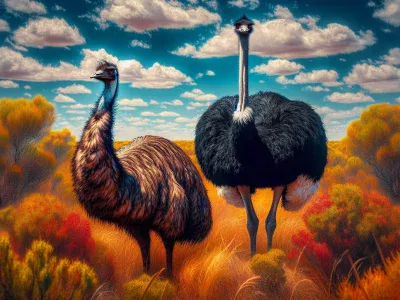
Imagine standing in the vast expanse of the Australian Outback or the African savanna, where two towering, flightless birds dominate the world. At first glance, ostriches and emus might seem like close cousins, sharing their impressive height and feathered frames. But look closer, and you’ll find a world of fascinating differences that set these giants apart.
From their habitats to their behavior and even their physical traits, ostriches and emus each bring something unique to the table. Whether it’s the ostrich’s record-breaking speed or the emu’s curious nature, these birds offer a glimpse into the wonders of evolution. So, what truly makes them distinct? Let’s jump into the details and uncover the traits that make each of these birds remarkable in their own right.
Overview Of Ostriches And Emus
Ostriches and emus stand out as two of the largest flightless birds, showcasing unique adaptations that suit their respective environments. These birds are often noted for their size, distinctive behavior, and striking physical features.
Key Characteristics Of Ostriches
Ostriches, native to the African savanna, are the largest birds on Earth. They can reach up to 9 feet in height and weigh between 220 and 350 pounds, making them imposing figures in their habitat. Known for their incredible speed, ostriches can run up to 45 miles per hour, using their powerful legs to evade predators.
Their diet mainly consists of plants, seeds, and occasional insects. With two toes on each foot, they use a sharp claw on the larger toe for defense. Ostriches also hold the record for the largest eggs of any living bird species, with each weighing around 3 pounds.
Social structures in ostriches vary, with groups ranging from small families to larger flocks of 50 or more individuals during migration. Male ostriches exhibit striking courtship displays, spreading their wings and bowing to attract females.
Key Characteristics Of Emus
Emus, native to Australia, are not as large as ostriches but still rank as the second-largest birds. Standing up to 6.2 feet tall and weighing 66 to 100 pounds, emus are well-adapted to the Australian Outback. They can dash up to 30 miles per hour, using their strong legs for both speed and defense.
Their feathers are soft and brown, providing excellent camouflage in the dry, scrubby vegetation. Emu diets include seeds, fruits, small insects, and even flowers, making them important seed dispersers in their ecosystem.
Unique parental behavior defines emus. After the female lays eggs, it’s the male who exclusively incubates them for about 56 days and protects the young after hatching. Emus also make deep, resonant calls to communicate, a distinctive trait among birds.
Their three-toed feet and relatively smaller stature compared to ostriches highlight their distinction, emphasizing adaptations to different geographic and ecological pressures.
Physical Differences
Ostriches and emus exhibit distinct physical characteristics that help them thrive in their respective environments. These differences are striking when you compare their size, feather structure, and overall appearance.
Size And Weight
Ostriches stand taller, reaching up to 9 feet and weighing between 220 and 350 pounds. In contrast, Emus max out at a height of 6.2 feet and weigh approximately 66 to 100 pounds. The ostrich’s towering stature and larger weight are adaptations for their fast running speeds, while emus’ relatively smaller size helps them navigate Australia’s dense vegetation.
Feather Structure
Ostrich feathers are smooth and lack the waterproof properties common in many birds. Their feathers appear more uniform and are designed to insulate and protect them in hot, arid environments. Emus, on the other hand, boast soft, brown feathers that feel shaggy. This unique texture provides them with camouflage in grasslands and excellent protection against the sun.
Neck And Leg Appearance
Ostriches have long, bare necks and muscular legs to support their large frames. Their legs contain two toes, allowing them to run quickly while maintaining balance. Emus, but, possess shorter necks and three-toed feet. This anatomical difference influences their movement and stability when exploring varied Australian terrain.
Behavioral Differences
Behavioral traits in ostriches and emus reflect their adaptations to distinct environments and evolutionary paths. These behaviors influence their interactions with habitats, food sources, and reproductive strategies.
Habitat Preferences
Ostriches occupy open savannas and arid deserts in Africa. Their preference for wide, open terrains optimizes their exceptional running speed, aiding in predator evasion. They use sparse vegetation for nesting and rest but rely heavily on their keen eyesight to spot threats from afar.
Emus, native to Australia, inhabit diverse environments, including forests, grasslands, and arid plains. Their adaptive nature allows them to thrive in areas with dense vegetation, providing camouflage and food. Seasonal migrations in search of better resources is common among emu populations, reflecting their survival resilience.
Diet And Foraging Habits
Ostriches primarily consume plants, seeds, and occasionally insects. Their foraging method relies on excellent eyesight to locate food across vast distances. The absence of teeth compels them to ingest small stones, known as gastroliths, which aid in grinding food within their gizzards.
Emus showcase omnivorous eating habits, consuming fruits, seeds, insects like grasshoppers, and small vertebrates. They play a significant ecological role by dispersing seeds over large areas. Their foraging often involves continuous movement, supporting their nomadic lifestyle.
Mating And Reproduction
Ostrich mating behavior involves elaborate courtship displays, where males perform dance-like movements to attract females. The dominant male mates with several females, who lay eggs in a communal nest. Both males and dominant females share incubation duties.
Emus display unique parental behavior. Males incubate eggs and care for chicks after females leave. Egg incubation lasts 8 weeks, during which the male eats minimally. Such behavior ensures high offspring survival rates, showcasing a rare example of male-dominant caregiving in the avian world.
Geographic Distribution
Ostriches and emus occupy distinct geographic regions, showcasing their evolution in separate ecosystems. Their native habitats reveal adaptations shaped by local demands.
Native Habitats Of Ostriches
Ostriches are native to Africa, thriving in open savannas, arid deserts, and semi-arid regions. Their habitats typically span across 25 African countries, including South Africa, Namibia, and Kenya. You notice that ostriches favor expansive, open landscapes for optimal predator detection and rapid escape. These vast areas align with their need for long-distance sprinting, as they rely on running speeds of up to 45 mph for survival.
Seasonal shifts in vegetation influence their location. They migrate within regions in search of food and water. Human intervention through ostrich farming has expanded their presence beyond Africa to areas like the United States, Europe, and Australia, though such populations are not naturally established.
Native Habitats Of Emus
Emus, Australia’s iconic bird species, are native exclusively to the continent of Australia. Spanning a diverse range of habitats, emus populate eucalyptus woodlands, grasslands, and open plains. Unlike ostriches, they adapt to various environments, including arid interiors and coastal regions, reflecting their ecological versatility.
Drought periods prompt emus to migrate large distances in search of sustenance, demonstrating opportunistic patterns. You see them during such times moving towards more resource-abundant areas. Historically, emu populations declined in certain regions like Tasmania due to human activity and environmental changes. Conservation efforts aim to safeguard their habitats, addressing ongoing threats like deforestation and climate fluctuations.
Economic And Cultural Significance
Role Of Ostriches In Human Economy
Ostriches have played an important part in agriculture and the textile indrustry. Their feathers, soft and durable, are prized for fashion items and decorative accessories. Ostrich leather, valued for its durability and unique quill pattern, is used in luxury goods like handbags, belts, and shoes. The meat, lean and red, serves as a healthy alternative to beef, rich in iron and low in fat.
Farms across Africa, the US, and Europe rear ostriches, with South Africa leading production. Beyond products, ostrich farming boosts local economies, providing jobs and exporting goods globally. In tourist areas, attractions like ostrich riding and racing draw visitors, blending economic benefits with cultural experiences.
Role Of Emus In Human Economy
Emus contribute significantly to industries through their oil, meat, and feathers. Emu oil, derived from fat, is a sought-after product in skincare and pain relief due to its anti-inflammatory properties. The meat, low in fat and cholesterol, fits well with health-conscious diets, and the feathers, though less commercially significant, are used in craft and indigenous art.
Australia facilitates emu farming in rural areas, creating income opportunities. Besides commercial use, emus hold cultural value for Indigenous Australians, symbolizing creation stories and appearing in traditional ceremonies. This blend of utility and cultural importance showcases their diverse significance.
Conclusion
Understanding the differences between ostriches and emus offers a deeper appreciation for these remarkable birds and their unique roles in their ecosystems. From their physical adaptations to their diverse behaviors and cultural significance, both species showcase the wonders of evolution and survival in distinct environments.
Whether it’s the towering ostrich dominating the African savanna or the adaptable emu thriving in Australia’s varied landscapes, each bird has evolved to excel in its habitat. Their fascinating traits and contributions to nature and human industries make them truly extraordinary creatures worth learning about and protecting.
To provide the best experiences, we use technologies like cookies to store and/or access device information. Consenting to these technologies will allow us to process data such as browsing behaviour or unique IDs on this site. Not consenting or withdrawing consent, may adversely affect certain features and functions.
Functional
Always active
The technical storage or access is strictly necessary for the legitimate purpose of enabling the use of a specific service explicitly requested by the subscriber or user, or for the sole purpose of carrying out the transmission of a communication over an electronic communications network.
Preferences
The technical storage or access is necessary for the legitimate purpose of storing preferences that are not requested by the subscriber or user.
Statistics
The technical storage or access that is used exclusively for statistical purposes.The technical storage or access that is used exclusively for anonymous statistical purposes. Without a subpoena, voluntary compliance on the part of your Internet Service Provider, or additional records from a third party, information stored or retrieved for this purpose alone cannot usually be used to identify you.
Marketing
The technical storage or access is required to create user profiles to send advertising, or to track the user on a website or across several websites for similar marketing purposes.