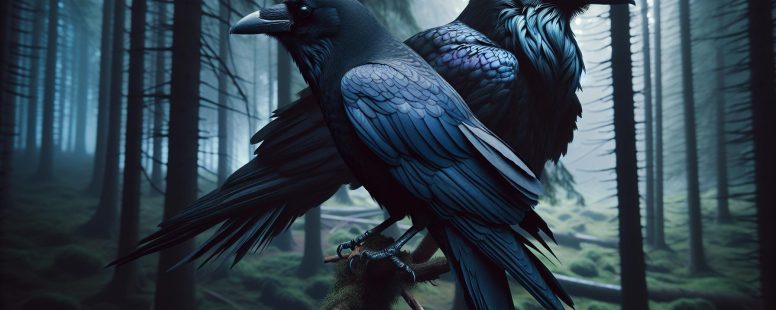
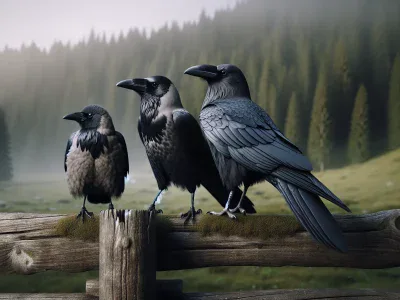
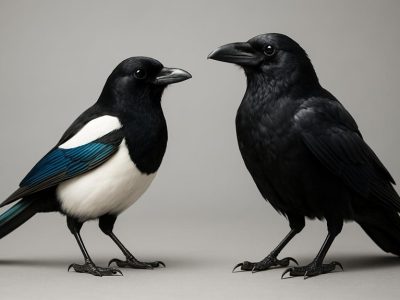
Imagine walking through a misty forest, the air filled with the haunting calls of black-feathered birds. You pause, wondering whether you’re hearing a crow or a raven. These mysterious creatures, often shrouded in folklore and myth, can be challenging to distinguish. Yet, understanding their differences reveals a intriguing area of avian diversity.
Crows and ravens, both members of the Corvidae family, share striking similarities but also possess unique traits that set them apart. While their glossy black feathers and intelligent eyes might appear identical at first glance, subtle nuances in their size, calls, and behavior offer clues to their identities. Delving into these distinctions not only enhances your birdwatching experiences but also deepens your appreciation for nature’s intricacies.
As you explore the enigmatic lives of crows and ravens, you’ll uncover surprising insights into their roles in ecosystems and cultures worldwide. So, are you ready to unravel the mystery?
Overview of Crows and Ravens
Crows and ravens belong to the Corvidae family and share many characteristics but exhibit distinct differences. Both birds possess black plumage, yet closer inspection reveals variations in size and shape. Ravens are generally larger than crows, with a wingspan that can reach up to 4.9 feet, while a crow’s wingspan typically measures about 3.3 feet.
Examining their calls helps identify each species. Crows make a cawing sound, whereas ravens produce a deeper croaking noise. Ravens have throat feathers that appear shaggy when they call, adding a distinctive feature.
Behavioral traits also set them apart. Crows are more social and often found in large groups, known as murders, while ravens usually travel in pairs. Also, ravens exhibit advanced problem-solving skills, often crafting tools to access food.
Habitat preference further distinguishes these birds. Crows adapt well to urban environments and can thrive alongside human populations, adapting to diverse food sources. Ravens prefer wilderness areas and favor wide open spaces or forests.
To summarize key differences:
Attribute
Crow
Raven
Size
Smaller, 3.3 feet wingspan
Larger, 4.9 feet wingspan
Call
Cawing sound
Croaking sound
Sociality
Groups (murders)
Pairs
Habitat
Urban areas
Wilderness areas
Understanding these differences not only helps in accurately identifying each bird but also enhances overall birdwatching experiences. Recognizing their unique roles in ecosystems deepens your appreciation for these intelligent creatures.
Physical Differences
Exploring the physical differences between crows and ravens provides valuable insights into identifying these intelligent birds.
Size and Weight
Crows are generally smaller than ravens. Their body length averages between 16 to 21 inches, with a wingspan reaching about 3.3 feet. Crows weigh around 0.7 to 1.4 pounds. Ravens, on the other hand, measure approximately 21 to 26 inches long, boasting a wingspan of up to 4.9 feet. They weigh between 1.5 and 4.4 pounds. Noticing these size disparities helps in distinguishing the two species, especially when seen together.
Beak Shape and Structure
Examining beak shape reveals significant differences. Crows have straighter and more slender beaks designed for pecking and handling a diverse diet. Ravens possess thicker, more curved beaks suitable for tearing and manipulating larger prey. This structural difference impacts their feeding habits and can assist in identifying the birds from a distance.
Feather Texture and Color
Feather details offer clues to identification. Crows display a uniform, glossy black feather texture. In contrast, ravens’ feathers exhibit a shaggier appearance, often with a blue or purple iridescent sheen. The differences in texture and coloration become apparent under sunlight or close observation, providing another method to differentiate these birds.
Behavioral Differences
Behavioral traits provide distinct characteristics for identifying crows and ravens. These differences reflect their adaptability and ecological roles.
Communication and Vocalizations
Crows and ravens have different vocalizations that set them apart. Crows employ a distinct “caw” sound, used in various contexts for communication, including territory defense and alert calls. Ravens, in contrast, use a deeper “croak” along with a wider repertoire of sounds such as clicks, knocks, and other complex calls. Ravens’ vocal variety indicates their advanced communication skills, often used for long-distance interaction. National Geographic notes that ravens can mimic other animals’ sounds and even human speech under certain conditions, showcasing their intelligence.
Feeding Habits
Crows and ravens exhibit distinct feeding habits that align with their environments. Crows are often opportunistic feeders, thriving in urban settings where they scavenge for food in dumpsters and parks. Their diet is quite varied, ranging from seeds to small animals. Ravens generally forage in less populated wilderness areas, consuming larger prey, carrion, and sometimes small mammals or birds. According to the Cornell Lab of Ornithology, ravens also exhibit impressive problem-solving skills, using tools to access food. This adaptability in ravens’ feeding strategies highlights their resourcefulness in harsher environments.
Social Interactions
Social structures differ significantly between crows and ravens. Crows are highly social birds, typically found in large groups known as murders. This social behavior aids in foraging and offers protection against predators. Ravens usually travel in pairs, emphasizing their preference for solitude and partnership. Their pair bonds are strong, lasting throughout their lives, and are often seen in mating displays and cooperative hunting. The University of Washington’s research suggests that ravens form complex social hierarchies, engaged in cooperative breeding and even problem-solving tasks as a unit.
These behavioral aspects illustrate the fascinating ecological niches crows and ravens occupy, enhancing your understanding of their cohabitation strategies and interactions with their habitats.
Habitats and Distribution
Crows and ravens, though part of the same Corvidae family, occupy different habitats and distribution patterns that reflect their distinct ecological preferences. Crows adapt well to urban environments, thriving in cities with access to human garbage, parks, and farmlands. They’re often found across North America, Europe, Asia, and Australia. With their ability to thrive in cities, crows demonstrate remarkable adaptability and resilience.
Ravens, but prefer more secluded wilderness areas, such as forests, mountains, and desert regions. In North America, they’re predominantly seen in the western and northern parts. Ravens inhabit regions ranging from the Arctic to the deserts down south, showcasing their preference for less disturbed environments. Their distribution spans across Europe, Asia, and North Africa.
If you encounter large groups of corvids in city parks, you’re likely observing crows, whereas solitary or paired birds in rural areas are probably ravens. These distribution patterns help in identifying these birds based on their preferred environments.
Intelligence and Problem-Solving
Crows and ravens showcase remarkable intelligence, frequently exhibiting problem-solving capabilities that captivate researchers’ attention. Ravens, for instance, demonstrate advanced tool-making skills, crafting hooks from twigs to extract insects from crevices. Crows, on the other hand, are known for their ability to use urban materials innovatively. In one study, crows dropped nuts onto roads, using passing cars to crack them open—a testament to their ingenuity and adaptability.
Both birds engage in complex social behaviors. Ravens are noted for playing, an activity that involves rolling in the snow or playful flight maneuvers. This behavior may contribute to their problem-solving prowess, as play often involves experimentation and learning. Crows, meanwhile, share information about food sources or potential threats through sophisticated vocalizations, a sign of their communicative abilities.
Research highlights the cognitive abilities of these corvids. In a series of experiments, ravens solved puzzles requiring sequential steps—displaying a level of reasoning comparable to that of great apes. Crows, too, have mastered tasks involving multiple tools, showcasing an understanding of causality and planning.
Given these facts, you might wonder whether intelligence and problem-solving are profoundly interconnected in these birds, aiding their survival in diverse environments. Unraveling these connections offers not only an appreciation of crow and raven intelligence, but also insights into the broader spectrum of animal cognition.
Mythology and Cultural Significance
Crows and ravens have captured human imagination in various mythology and cultures. Ravens often appear in Norse mythology as Odin’s companions, Huginn and Muninn, representing thought and memory. Crows feature prominantly in Native American tales, symbolizing change and transformation. These birds often carry messages between the realms of the living and the dead.
In literature, Edgar Allan Poe’s “The Raven” portrays the bird as a symbol of ominous visitations. In contrast, in Celtic traditions, crows are seen as messengers of the goddess Morrigan, warning of impending battles. These narratives highlight how both birds play roles in conveying wisdom, mystery, and foreboding.
Cultural interpretations often influence perceptions of these birds. You might associate crows with urban landscapes and adaptability, mirrored in their mythological roles as problem-solvers. Ravens, seen in wild countrysides, embody solitude and introspection, reflecting their cultural depiction as symbols of deeper understanding and transformation.
While both birds hold symbolic weight, their roles in myths and cultures illustrate diverse facets of human fascination. Understanding these narratives enhances appreciation of the intricate connections between these birds and human storytelling traditions.
Conclusion
Understanding the differences between crows and ravens enhances your birdwatching adventures and deepens your connection with nature. These remarkable birds, with their distinct physical and behavioral traits, not only captivate with their intelligence but also enrich cultural narratives across the globe. By recognizing their unique characteristics and habitats, you can appreciate the intricate roles they play in ecosystems and human storytelling alike. Embrace the opportunity to observe these fascinating creatures, and you’ll gain a newfound respect for their adaptability and cognitive prowess.
To provide the best experiences, we use technologies like cookies to store and/or access device information. Consenting to these technologies will allow us to process data such as browsing behaviour or unique IDs on this site. Not consenting or withdrawing consent, may adversely affect certain features and functions.
Functional
Always active
The technical storage or access is strictly necessary for the legitimate purpose of enabling the use of a specific service explicitly requested by the subscriber or user, or for the sole purpose of carrying out the transmission of a communication over an electronic communications network.
Preferences
The technical storage or access is necessary for the legitimate purpose of storing preferences that are not requested by the subscriber or user.
Statistics
The technical storage or access that is used exclusively for statistical purposes.The technical storage or access that is used exclusively for anonymous statistical purposes. Without a subpoena, voluntary compliance on the part of your Internet Service Provider, or additional records from a third party, information stored or retrieved for this purpose alone cannot usually be used to identify you.
Marketing
The technical storage or access is required to create user profiles to send advertising, or to track the user on a website or across several websites for similar marketing purposes.