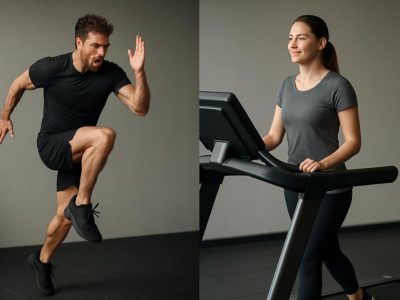
Picture the steady hum of machines as you step into the gym—the rhythmic pound of feet on a treadmill, the smooth glide of an elliptical. You can almost feel the pulse of energy in the air, each stride promising a stronger, leaner you. But as you lace up your sneakers and scan the rows of gleaming equipment, a question lingers: which machine truly delivers the edge?
Maybe you crave the rush of a heart-pounding run or the low-impact flow that feels almost like floating. What if the choice between elliptical and treadmill could unlock hidden benefits you never expected—boosting your mood, sparking new motivation, or transforming your workout routine? The answer isn’t as simple as it seems, and your decision might just surprise you.
Comparing the Elliptical and Treadmill: Key Differences
Choice between elliptical and treadmill can feel like standing at a crossroads in your fitness journey. Sometimes, the elliptical’s smooth stride sweeps you forward, carrying your feet along a path that barely leaves the ground—with every push and pull, your upper and lower body merges in a synchronized rhythm. If you’ve ever watched someone on an elliptical, they often look like they’re gliding across a surface of invisible ice, arms and legs moving in harmony, barely creating a sound in the gym’s steady clatter.
Treadmills, on the other hand, throws you into the heart of kinetic energy with each step. The belt hums underneath as your feet strike down, thumping with a pulse that matches your heartbeat or, for some, the pounding beat of a motivational playlist. Runners chase distance goals, while walkers dial up an incline, simulating uphill treks. Ever notice how some users seem lost in thought, gazing straight ahead, while others stare down at their stats, each minute ticked off like a small victory?
From a biomechanical angle, ellipticals reduces impact on joints by supporting fluid movement patterns. People with knee or hip sensitivities often prefer ellipticals, since clinical reviews—such as those cited in the Journal of Orthopaedic & Sports Physical Therapy—show less joint stress compared to treadmill use. Meanwhile, treadmills adapts to multiple speeds and inclines, inviting interval sprints or fat-burning walks, and mirrors the real mechanics of running on pavement. This makes treadmills popular for those training for races or aiming to boost bone density, as confirmed in studies published by the American Council on Exercise.
Calories burned shifts depending on machine intensity and personal stats. For example, someone weighing 155 pounds burns around 335 calories after 30 minutes of vigorous elliptical training, while the same person running at 6 mph on a treadmill expends about 372 calories (Harvard Medical School). Your breathing, your pace, and your motivation—all play a part. If you’re drawn to variety, treadmills offer more workout customization through presets, virtual trails, and incline choices; ellipticals delivers a lower-impact, total-body session every time, yet limits gait patterns.
Durability and maintenance sometimes breaks the tie. Ellipticals tend to have fewer moving parts exposed to stress, so maintenance’s simpler, but treadmills offers users a familiar, straightforward experience.
When you choose between these machines, do you crave the meditative focus of repetitive strides, or does your mind wander toward the full-body flow of an elliptical’s silent arc? Each choice shapes not only the muscles you work, but possibly the way you view your own progress. If you’ve ever found your routine getting stale, trying the “other” machine might spark new motivation—your fitness crossroads is paved with possibilities.
Benefits of Using an Elliptical
Stepping on an elliptical in the gym feels different from the start. Maybe you’re searching for gentle motion without the pounding of a treadmill, or maybe you’ve seen people gliding as if floating above the ground. Using an elliptical brings several notable advantages, especially if you value joint protection and efficient, holistic movement.
Low-Impact Cardio for Joint Health
Ellipticals use a gliding, circular motion that reduces impact forces on your knees, hips, and ankles. Doctors at the Mayo Clinic identify ellipticals as a smart choice for people with arthritis or recovering from sports injuries because the machine’s pedals never leaves your feet airborne, unlike treadmills or running outdoors. Think about your knees after a long run on concrete—ellipticals shift that equation, offering a cardio workout where jolting pain often steps aside. If joint pain stops you from lacing up your sneakers, you could feel more willing to exercise regularly. Physical therapists often recommend ellipticals after ACL surgery because its design mimics walking but avoids the hard shockwaves.
Full-Body Workout Features
Ellipticals engage both your upper and lower body with dual-action handlebars and leg drives, so you’re working your arms, core, and legs in unison. Compare this to treadmills that mostly targets your lower half and core only if you maintain posture. In research published by Harvard Health, using the handles increased caloric burn and activated more muscles simultaneously than treadmill walking at similar speeds. Consider the elliptical’s handles as your steering wheel, propelling your workout forward, while your legs push with rhythm. Every session becomes a cross-country trek, climbing invisible mountains, maneuvering through imaginary terrain while targeting quads, glutes, biceps, triceps and even your abdominal stabilizers—sometimes without even noticing. If time is scarce, this efficiency stands out: you get more muscle groups firing in one move, possibly unlocking greater cardiovascular gains with less wear and tear.
Benefits of Using a Treadmill
Treadmills anchor your cardio routine with familiar reliability and wide-ranging options. Your running or walking journey finds a steady companion here, pushing boundaries while letting you control the terrain.
Versatility for Running and Walking
Treadmills let you adapt every step. Adjustable speeds transform a calm walk into a sprint, and incline settings mimic outdoor hills right inside your gym. Someone with marathon goals can build up endurance in intervals, while another person may use the same treadmill for low-impact walking during recovery periods. You’ll notice that pros, like track athletes such as Allyson Felix, use treadmills for off-season training, fine-tuning pace and stamina without weather constraints.
Custom workout programs guide you through hills, sprints, and gentle strolls. Do you ever wonder what it’s like running through San Francisco’s rolling streets, or walking a riverside path? Treadmill consoles often include preset routes and virtual landscapes, helping you stay motivated on even the grayest days.
Calorie Burn and Intensity Options
Treadmills heat up your calorie burn. Harvard Health Publishing reports a 155-pound individual burns about 372 calories jogging at 6 mph for 30 minutes (source: Harvard Medical School). By playing with incline and speed, you amplify heart rate, challenge muscle groups, and maximize energy expenditure. HIIT sessions on treadmills—a popular approach you’ll see in boot camp classes—alternate short bursts of speed with active recovery, boosting overall calorie use.
If you’re returning from an injury, treadmills let you safely control impact by adjusting speed and incline or using shock-absorbing decks on higher-end machines. Some people try interval training or gentle walks on these models to reintroduce movement gradually without risking further injury.
Ever challenged yourself to race your best time on a rainy evening? Treadmills set benchmarks and track progress, letting you chase new personal records in a controlled, supportive setting. Obsess over numbers, or use the auto-adjust features and just zone out—either way, treadmills quietly nudge you a little further every run.
Factors to Consider When Choosing
When you stand before a row of machines, the elliptical and the treadmill sometimes seem like archenemies in your fitness story. Their screens flicker, promising different journeys, but which path fits your ambitions, your body, your home? Let’s break down the factors that really shape this decision.
Fitness Goals and Preferences
Fitness targets guide you—whether you’re aiming to torch calories, build endurance, or just boost your mood after a long day. If running outdoors feels like meditation for you, a treadmill might echo that freedom, each mile tracked a mini victory. On the other hand, maybe you love efficiency: here, ellipticals shine, working your arms and legs simultaneously. Did you ever wonder if you could save time while still getting your heart racing? That’s a major elliptical advantage for multi-taskers or those squeezing workouts into packed days.
Research from Harvard Health Publishing shows that treadmills, with incline and speed adjustments, accommodate interval training and steady-state cardio alike. If you enjoy chasing personal records or prepping for a real-world race, treadmill metrics mirror road running’s demands. For anyone preferring smooth, rhythmic movement or mindless, podcast-fueled cardio, the elliptical whispers—skip the pounding, protect your stride.
Injury Concerns and Rehabilitation
Injuries can sideline your ambitions, and joint health often dictates your next step. Picture recovering from a sprained knee—you wince thinking about high-impact pounding on a treadmill. This is where ellipticals gently cradle your joints. The American Academy of Orthopaedic Surgeons advises low-impact aerobic activity for people with osteoarthritis, and ellipticals check this box, mimicking natural walking motion while reducing shock.
But, if you crave walking mechanics for rehab after an ankle injury, treadmills provide that linear, steady pattern under controlled speeds, often favored by physical therapists. Which matters more for you: minimizing impact or restoring gait? If bone density improvement or high-intensity training tops your checklist, the treadmill’s load-bearing impact, when gradually built up, provides those skeletal benefits—as long as your physician agrees.
Space, Cost, and Maintenance
Home fitness setups echo practical realities—room size, budget, noise tolerance. Visualize your living room: do you picture a robust, belt-driven treadmill or a compact, whisper-quiet elliptical? Treadmills often require more floor area, with the moving belt and incline mechanisms; ellipticals, while sometimes taller, usually occupy less space lengthwise.
Price tags can catch you off-guard. Mid-range ellipticals typically cost $600 to $1,400, while treadmills with similar features land between $700 to $2,000 (Consumer Reports, 2023). Some ellipticals attract buyers with fewer repair issues, given their simpler mechanics; ask yourself, do you mind lubricating a treadmill belt every few months or dealing with motor wear? Both machines need care, but maintenance costs and assembly complexity often tip the scales for busy households.
Your choice intertwines with these factors as intimately as lacing your sneakers before a workout. Picture your goals, honor your body’s needs, and measure your space—each step brings you closer to that energizing, sustainable routine.
Expert Recommendations: Which Is Better Elliptical or Treadmill?
Picture yourself as a seasoned coach, stopwatch ticking, gym floor humming beneath your feet. You gaze across the room—elliptical to the left, treadmill roaring to the right, each drawing exercisers with different needs. Which one would you send someone to if they walked up today?
Cardiologists from the American Heart Association suggest that both elliptical trainers and treadmills, if used at moderate intensity, can reduce cardiovascular risk factors (AHA, 2023). But, rehabilitation, physical therapists often advocate for the elliptical, especially for users with post-injury concerns or joint conditions like osteoarthritis. Take Janet, a marathon runner whose knees “talked back” after years pounding the pavement—her therapist shifted her to the elliptical. Within weeks, her pain shrank and her endurance, surprisingly, didn’t slip.
But what if you’ve got big goals, say, prepping for your first 10K or dreaming of a Boston Marathon finish line? Running coaches typically nudge you toward the treadmill. The reason: treadmill running closely mimics outdoor running mechanics. Olympic-level athletes—think Eliud Kipchoge—use treadmills for speedwork on icy days. Your stride, cadence, and impact align better with your race-day reality. That’s why the treadmill, even though it can be tough on joints, stands tall in sports training labs.
Ever wonder why pro football players or soccer stars sweat it out on treadmills in training videos? Speed and power intervals. Studies in the Journal of Strength and Conditioning Research (2022) found treadmill intervals drive up VO2 max, a key marker for aerobic power, more efficiently than steady-state elliptical use. Yet elliptical intervals showed lower perceived exertion scores. In short, you can push harder, with less joint stress, on the elliptical—but the treadmill takes your running metrics further.
Some sports medicine specialists, like Dr. Michael Fredericson at Stanford, spin a different tale for older adults. He tells patients, “Ellipticals keep you moving when knees rebel.” Research from the CDC confirms that adults over 60 enjoy higher exercise adherence rates with ellipticals because they remove impact barriers.
But here’s a twist: If burnout threatens, variety rescues motivation. There’s wisdom in mixing modalities. Elite triathletes crisscross between treadmills, ellipticals, and even stationary bikes to challenge new muscle groups and keep boredom at bay. Why not break the rut yourself—alternate machines week by week. Can you guess which combo ignites the biggest smile at the end of the workout?
If you’re after the throne of maximum calorie burn, the treadmill often wins; but if longevity in your daily grind matters, many experts point to the elliptical’s joint-friendly whisper. Still, the debate simmers. Ask yourself: Are your knees kings, or is your ego chasing records? Both machines have champions and critics, every expert shaping their answer to fit your story.
Lean into the experiments. Try both machines for a month, as several trainers at Equinox and Planet Fitness have challenged clients to. Discover the narrative your body tells—sometimes, the best recommendation enters through curious, personal trial, echoing expert advice while writing a story that’s uniquely yours.
Conclusion
Choosing between an elliptical and a treadmill comes down to what motivates you and fits your lifestyle. Both machines offer powerful ways to boost your fitness and support your health goals. You might find that your preferences shift with time or as your needs change.
Don’t be afraid to mix things up. Trying both can reveal new strengths and keep your workouts fresh. Listen to your body and let your fitness journey evolve—you’ll discover what truly works for you.
To provide the best experiences, we use technologies like cookies to store and/or access device information. Consenting to these technologies will allow us to process data such as browsing behaviour or unique IDs on this site. Not consenting or withdrawing consent, may adversely affect certain features and functions.
Functional
Always active
The technical storage or access is strictly necessary for the legitimate purpose of enabling the use of a specific service explicitly requested by the subscriber or user, or for the sole purpose of carrying out the transmission of a communication over an electronic communications network.
Preferences
The technical storage or access is necessary for the legitimate purpose of storing preferences that are not requested by the subscriber or user.
Statistics
The technical storage or access that is used exclusively for statistical purposes.The technical storage or access that is used exclusively for anonymous statistical purposes. Without a subpoena, voluntary compliance on the part of your Internet Service Provider, or additional records from a third party, information stored or retrieved for this purpose alone cannot usually be used to identify you.
Marketing
The technical storage or access is required to create user profiles to send advertising, or to track the user on a website or across several websites for similar marketing purposes.