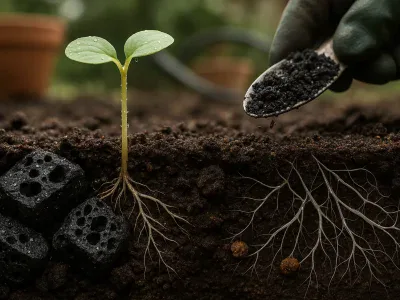
Plant root systems are essential for nutrient absorption and structural support. They anchor plants firmly in the soil while facilitating water and mineral uptake.
Importance Of Roots In Plants
Roots provide stability by anchoring plants to the ground, preventing erosion. They absorb water and dissolved minerals necessary for growth. Roots also store food reserves like starch, crucial during periods of dormancy or stress.
Some roots form symbiotic relationships with fungi (mycorrhizae) to enhance nutrient uptake, especially phosphorus. For example, legumes have nitrogen-fixing nodules that improve soil fertility. These roles make roots indispensable in ecosystems.
Classification Of Root Systems
Plant root systems are categorized into taproot and fibrous types based on structure and function.
Taproot System
Found in dicots like carrots and radishes, the taproot system consists of a primary root growing downward with smaller lateral roots branching off. It penetrates deep into the soil, accessing groundwater in arid conditions.
Fibrous Root System
Common in monocots like grasses and wheat, fibrous roots consist of numerous thin roots spreading horizontally near the surface. This shallow spread prevents soil erosion while efficiently absorbing surface nutrients after rainfall.
Both systems exhibit adaptations depending on environmental conditions or plant needs, showcasing their diversity across species.
What Is A Taproot System?
A taproot system features a prominent primary root that grows vertically downward, with smaller lateral roots branching from it. This structure enhances stability and allows plants to access deep water reserves in the soil.
Structure And Characteristics Of Taproots
The primary root in a taproot system develops directly from the radicle of the seed. It exhibits significant growth compared to lateral roots, which are thinner and shorter. The main root penetrates deeply into the ground, making it well-suited for arid environments where surface water is scarce. Taproots often store nutrients like starch, providing energy during unfavorable conditions.
Taproots exhibit positive geotropism (growth toward gravity), ensuring deeper penetration into the soil layers. Root hairs near the tip assist in absorbing water and minerals efficiently. These systems promote strong anchorage, making plants resistant to uprooting by wind or erosion.
Examples Of Plants With Taproots
Plants like carrots (Daucus carota), radishes (Raphanus sativus), and turnips (Brassica rapa) are classic examples of edible taproots used as food sources globally. Non-edible plants such as dandelions (Taraxacum officinale) also possess taproots that help them thrive in compacted soils.
Agricultural crops like sugar beets (Beta vulgaris) depend on their thickened taproots for storing sucrose, while trees like oaks (Quercus spp.) and pines (Pinus spp.) rely on deep taproot systems for stability and accessing groundwater during droughts.
What Is A Fibrous Root System?
A fibrous root system consists of numerous thin roots that grow outward from the base of a plant’s stem. These roots form a dense network close to the soil surface, offering several adaptive advantages in specific environments.
Structure And Characteristics Of Fibrous Roots
Fibrous roots lack a dominant primary root and instead develop multiple thin, thread-like roots of similar size. These roots spread laterally, creating a mat-like structure that stabilizes soil effectively and prevents erosion. Unlike deep taproots, fibrous roots focus on absorbing water and nutrients near the surface, making them well-suited for areas with frequent rainfall.
These roots emerge from the stem or nodes rather than originating as a single radicle. Their shallow growth pattern allows efficient utilization of surface nutrients after precipitation. Due to their extensive coverage area, they also enhance aeration in topsoil layers.
Examples Of Plants With Fibrous Roots
Plants with fibrous root systems include monocots like rice, wheat, barley, and grasses such as Bermuda grass or ryegrass. Corn plants exhibit these root types too. Ornamental plants like lilies and palms also feature fibrous roots.
In agriculture, crops like onions rely on this system for nutrient absorption over widespread areas. You can notice how grasses maintain stability even on steep slopes—this showcases their role in preventing erosion through dense rooting networks near surfaces.
Key Differences Between Taproot And Fibrous Root
Understanding the differences between taproot and fibrous root systems helps you grasp how plants adapt to their environments and fulfill their roles in ecosystems.
Structural Differences
Taproots consist of a single, dominant primary root that grows deep into the soil. This primary root develops from the radicle of a seed and produces smaller lateral roots, creating a vertically oriented system. Examples include carrots, radishes, and turnips. These roots are often thickened for nutrient storage.
Fibrous roots lack a central primary root. Instead, they form numerous thin, thread-like roots of similar size that spread horizontally near the soil’s surface. This dense network stabilizes soil effectively, as seen in grasses like wheat and rice.
Functional Differences
Taproots specialize in accessing water and nutrients from deeper soil layers. They provide anchorage for taller plants like oak trees while storing energy reserves such as starch during adverse conditions.
Fibrous roots excel at preventing erosion by forming a mat-like structure over large areas. They absorb surface-level water quickly after rainfall, benefiting crops like barley or onions in regions with frequent light rains.
Adaptations To Environmental Conditions
Taproots dominate in arid or semi-arid areas where deep water access is crucial for survival. Plants such as sugar beets thrive due to their ability to store sucrose within their thickened taproots under dry conditions.
Fibrous roots perform well in moist environments with loose soils. Their shallow growth pattern supports rapid nutrient uptake following rain events while maintaining soil integrity on steep slopes, exemplified by grasses growing along hillsides or rice fields in floodplains.
Importance Of Choosing The Right Root System In Agriculture
Selecting the appropriate root system in agriculture directly affects crop success and soil health. Each root type offers unique advantages tailored to specific environmental conditions, plant species, and farming goals.
Maximizing Water Use Efficiency
Taproots access deep water reserves during droughts; this is crucial for crops like carrots or sugar beets in arid regions. Fibrous roots excel at absorbing surface moisture after rainfall, aiding crops like rice or wheat where frequent watering occurs.
Preventing Soil Erosion
Fibrous roots create dense networks that hold topsoil firmly, reducing erosion risks on slopes or loose soils. For instance, grasses stabilize terrain effectively in hilly areas.
Enhancing Nutrient Absorption
Deep-growing taproots reach subsoil nutrients unavailable to shallow systems. Conversely, fibrous roots absorb abundant nutrients near the surface, ensuring consistent uptake for monocots such as barley and lilies.
Improving Soil Structure And Fertility
Legume plants with fibrous roots contribute nitrogen through nodules while maintaining soil stability. Taproot-producing trees like oaks aerate deeper layers, improving long-term soil quality.
Optimizing Agricultural Productivity
Matching root systems with climate conditions maximizes crop yields—taproot crops thrive under low rainfall, while fibrous-rooted ones flourish with sufficient precipitation or irrigation practices.
Conclusion
Understanding the differences between taproot and fibrous root systems helps you appreciate how plants adapt to their environments. Each root type plays a unique role in supporting plant growth, stability, and survival under varying conditions.
Whether it’s the deep-reaching taproots or the erosion-preventing fibrous roots, these systems demonstrate nature’s incredible design for resilience and efficiency. By recognizing their significance, you’re better equipped to make informed decisions in gardening, agriculture, or environmental conservation efforts.
To provide the best experiences, we use technologies like cookies to store and/or access device information. Consenting to these technologies will allow us to process data such as browsing behaviour or unique IDs on this site. Not consenting or withdrawing consent, may adversely affect certain features and functions.
Functional
Always active
The technical storage or access is strictly necessary for the legitimate purpose of enabling the use of a specific service explicitly requested by the subscriber or user, or for the sole purpose of carrying out the transmission of a communication over an electronic communications network.
Preferences
The technical storage or access is necessary for the legitimate purpose of storing preferences that are not requested by the subscriber or user.
Statistics
The technical storage or access that is used exclusively for statistical purposes.The technical storage or access that is used exclusively for anonymous statistical purposes. Without a subpoena, voluntary compliance on the part of your Internet Service Provider, or additional records from a third party, information stored or retrieved for this purpose alone cannot usually be used to identify you.
Marketing
The technical storage or access is required to create user profiles to send advertising, or to track the user on a website or across several websites for similar marketing purposes.