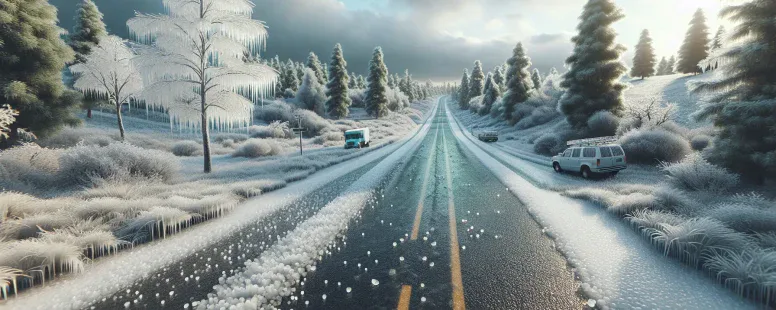
Picture yourself standing by the window as winter’s chill paints the world in silver and gray. You hear the sharp tap of ice pellets bouncing off the sidewalk then notice a glassy sheen forming on the trees. Is it sleet or freezing rain transforming your neighborhood into a shimmering wonderland? The answer isn’t as simple as it seems.
Understanding the difference between these two icy marvels isn’t just a matter of curiosity—it can help you stay safe and even appreciate the hidden artistry of winter storms. Knowing what to expect lets you navigate slippery roads with confidence and spot the subtle beauty in each type of precipitation. Get ready to discover how something as simple as a few degrees can turn a cold day into a dazzling spectacle or a treacherous challenge.
What Is Sleet?
Sleet means small, translucent ice pellets that tap-dance on your sidewalk, each one a fleeting sculpture shaped by the sky. You might wonder, “How come rain sometimes turn into tiny beads of ice before even touching the ground?”
How Sleet Forms
Sleet forms when snowflakes fall through a shallow layer of warm air, melt partially to raindrops, then pass through a colder layer that refreezes them before ground contact. You picture it: snow drifting down, but hitting a hidden warm pocket, it loses form—then, in a split-second, it hardens again, like a story interrupted mid-sentence and finished with an icy punctuation. The National Weather Service identifies sleet by the staccato rattle it makes on rooftops and by its tendency to bounce, unlike freezing rain which clings and coats (NOAA, 2023).
Typical Weather Conditions for Sleet
Sleet usually falls during winter storms when the surface temperature hover close to 32°F and a thin warm layer sits above a deeper freezing stratum. You remember last January, streets shimmering with sleet after an evening storm, cars slowing to avoid slippery patches, parents urging caution. Sleet common in places like the Midwest or Northeast U.S.: think of Chicago, Philadelphia, or Boston after a nor’easter brushes in. Meteorologists track vertical temperature profiles with sounding balloons—catching those sneaky warm air intrusions that make sleet possible. Have you ever noticed that sleet often mixes with snow or rain, especially when the weather can’t make up it’s mind? Sleet doesn’t coat power lines or trees like freezing rain, but it can still make roads hazardous, layering up quickly into crunchy, hazardous mosaics.
What Is Freezing Rain?
Freezing rain brings a different kind of winter magic. Instead of bouncing pellets, you see sheets of glistening ice on every tree branch, car, and sidewalk. You might wonder why ice doesn’t form before the rain lands—here’s the science.
How Freezing Rain Forms
Freezing rain forms when snowflakes fall through warm air aloft, melting into rain, then passing back through a thin layer of cold air just above ground before landing. Unlike sleet, raindrops don’t have time to solidify mid-air. Instead, they freeze on contact with cold surfaces, coating everything in a layer of glaze ice. This process creates vivid winter scenes—tree limbs sparkling under streetlights, roads turned to glass, and powerlines drooping beneath heavy ice. Is it any wonder people mistake this for sleet? Picture waking up to frozen door handles or sidewalks so slick, even salt barely helps. Meteorologists like those at NOAA (National Oceanic and Atmospheric Administration) and The Weather Channel monitor vertical temperature profiles to predict freezing rain events, using weather balloons and Doppler radar for real-time data.
Typical Weather Conditions for Freezing Rain
Freezing rain usually happens when surface temperatures are below 32°F (0°C) while a shallow layer of warm air sits above the ground. During winter storms, this temperature inversion occurs more often in places like the Ohio Valley, the Southern Plains, and the mid-Atlantic. For example, in January 1994, a major ice storm in Kentucky left over 500,000 homes without power, illustrating just how severe freezing rain can get. You often see freezing rain at the boundary where cold and warm air masses meet, especially near stationary fronts. Utility companies brace for these events, knowing even a quarter inch of accumulation may bring down trees and powerlines (National Weather Service). When you walk outside after freezing rain, how many times have you slipped or marveled at the ice sculptures Mother Nature creates overnight?
If you hear the forecast mention “glaze” or “icing,” that signals freezing rain is possible—not sleet.
Key Differences Between Sleet and Freezing Rain
You encounter sleet and freezing rain most during dramatic winter storms, but the two types of winter precipitation bring vastly different risks and wonders to your day. Each shapes your winter landscape in unique ways, affecting everything from travel plans to that quiet walk under glistening trees.
Appearance and Impact
Sleet appears as tiny, bouncing ice pellets, peppering the ground and windshield with quick tapping sounds. You glance outside, noticing the pavement dotted by translucent beads, resembling clear rock salt scattered by some unseen hand. Sleet tends to pile up, forming slushy layers along roads and walkways. Your car tires dig grooves in the crunchy accumulation, making it resemble a thin layer of pebbles—hard but not impenetrable.
Freezing rain, by contrast, looks like invisible rain until it lands. Once it touches branches, roads, or powerlines, it transforms into a seamless glassy glaze. You walk outside and see every twig, mailbox, and railing encased in a uniform, slick coat, reflecting streetlights like crystal sculptures. Impact differs greatly: sleet stays loose and can be shoveled or swept, while freezing rain adheres, forming solid ice sheets nearly impossible to break without salt or tools.
One time, in St. Louis, an overnight freezing rain storm left entire neighborhoods shimmering under the dawn, but the weight of that smooth ice snapped tree limbs and brought down electrical wires, cutting power for days. Sleet, even when noisy, rarely accumulates enough to bring infrastructure to its icy knees.
Safety Concerns and Hazards
Sleet creates road hazards, but it doesn’t cling—vehicles often maintain some traction on the pebbly surface. But, you start to slide if you brake hard or turn suddenly, especially at intersections where sleet mixes with tire heat and re-freezes. Walkers, runners, and drivers all need to slow down for better control on sleet.
Freezing rain, on the other hand, can produce black ice—surfaces that seem wet but are dangerously slick. Each winter, ER doctors report a spike in falls after freezing rain coats city sidewalks. Emergency vehicles respond slower as entire neighborhoods lose access to roads, and power outages become common because the ice’s weight pulls down powerlines. According to the National Weather Service, freezing rain storms caused $2 billion in damages across the US between 2010 and 2020.
Questions linger: Did you ever try scraping half an inch of ice off your windshield before sunrise, only to watch your scraper bounce harmlessly away? Can you recall sneaking down your own front steps, clutching the railing, wondering if you’d make it to the mailbox or risk a spectacular fall?
Sleet rarely causes tree limbs to snap, while freezing rain leaves entire canopies shattered, streets blocked, and power knocked out for thousands—a difference in winter precipitation that shapes the very rhythm of post-storm recovery.
How to Identify Sleet vs. Freezing Rain
Spotting sleet or freezing rain can feel like unraveling a secret written across the winter night. When you step outside and hear that unmistakable patter, you’re probably listening to sleet. These ice pellets—often no bigger than a peppercorn—bounce off driveways, clatter across window sills, and gather in tiny hills along curbs. If you kneel down and gather a handful, they won’t stick together, they slosh around in your palm like the last ice cubes in a chilled glass. Local news stations in cities like Chicago or Hartford report sleet events with warnings about dangerous highways, but rarely about extensive power outages (NWS, 2023).
Freezing rain announces itself more stealthily. Walk outside after a winter storm in Atlanta or St. Louis, and every twig glistens beneath a thin, unbroken shell of ice. Freezing rain never bounces: it lands as invisible rain, instantly glossing over surfaces into slick, treacherous glass. Try to open your car door after a night of freezing rain—the handle may be sealed tight, imprisoned under a crystal casing. Roads look wet, but hide “black ice,” responsible for countless traffic accidents each winter (US DOT, 2022). Meteorologists and road crews often dread its arrival because freezing rain topples tree limbs and rips power lines like they’re little more than threads.
Which one’s beneath you right now? Ask yourself a few questions:
Do you hear a tap-tap-tap against your window, or only silence and then sudden stillness?
Sleet creates sound, freezing rain moves quietly.
Is it easy to scoop up the precipitation in your hand?
If so, it’s likely sleet; with freezing rain, surfaces fuse into a single icy slab.
Are branches bending gently under the accumulated weight, or are they sealed together and shimmering, immobilized?
Sleet accumulates but doesn’t glue; freezing rain weaves a cocoon of ice around every surface.
Once, a driver in Oklahoma described sliding through a red light—not because he saw ice, but because the road looked merely wet after freezing rain. The National Weather Service now issues “Ice Storm Warnings” whenever ice accretion exceeds 0.25 inches, a level known to snap tree limbs and disable power for days.
When you try to decide if you face sleet or freezing rain, look and listen for those behavioral cues in precipitation, observe what’s happening on the ground, and remember: in the language of winter, even the quietest storm tells its story in a code you can learn to read.
Conclusion
Knowing the difference between sleet and freezing rain can help you stay safer and more prepared when winter weather hits. By paying attention to the sights and sounds around you, you’ll be able to spot these types of precipitation and adjust your plans or driving habits if needed.
Stay alert during winter storms and use what you’ve learned to protect yourself and those around you. With a little awareness, you can enjoy the beauty of winter while minimizing the risks that come with icy conditions.
To provide the best experiences, we use technologies like cookies to store and/or access device information. Consenting to these technologies will allow us to process data such as browsing behaviour or unique IDs on this site. Not consenting or withdrawing consent, may adversely affect certain features and functions.
Functional
Always active
The technical storage or access is strictly necessary for the legitimate purpose of enabling the use of a specific service explicitly requested by the subscriber or user, or for the sole purpose of carrying out the transmission of a communication over an electronic communications network.
Preferences
The technical storage or access is necessary for the legitimate purpose of storing preferences that are not requested by the subscriber or user.
Statistics
The technical storage or access that is used exclusively for statistical purposes.The technical storage or access that is used exclusively for anonymous statistical purposes. Without a subpoena, voluntary compliance on the part of your Internet Service Provider, or additional records from a third party, information stored or retrieved for this purpose alone cannot usually be used to identify you.
Marketing
The technical storage or access is required to create user profiles to send advertising, or to track the user on a website or across several websites for similar marketing purposes.