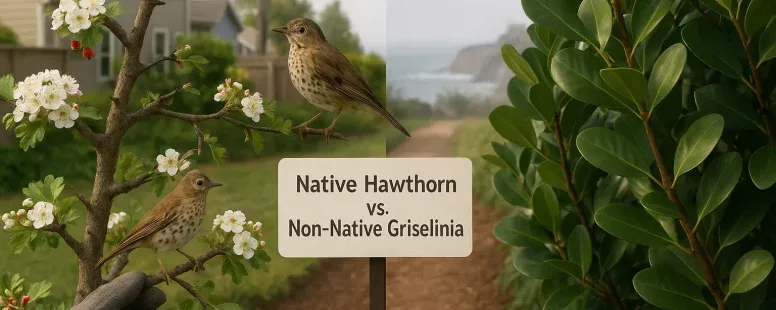
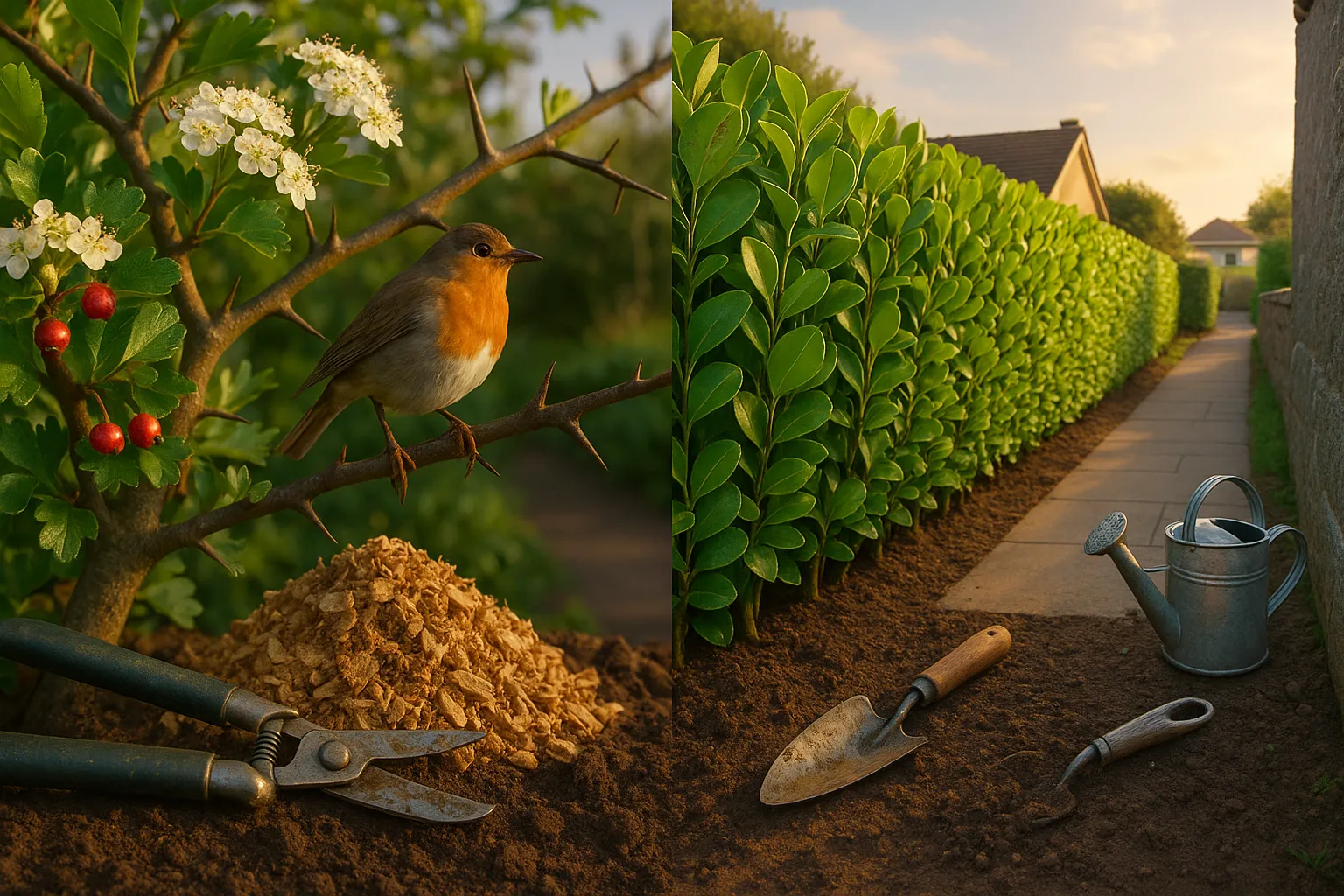
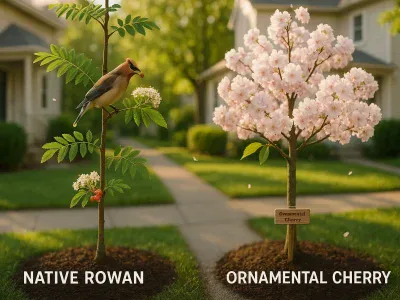
Hawthorn (Crataegus spp.) and Griselinia littoralis sit on opposite ends of a common garden question: choose the local, thorny native that feeds insects and birds, or the glossy, fast-growing non-native that screens views and tolerates salty air? You can weigh more than looks, think food webs, seasonal signals, maintenance time, and local rules. This comparison walks you through clear, practical differences so you can pick the plant that fits your site and values. Expect concrete traits, real tradeoffs, and honest mistakes I’ve seen gardeners make when they pick the wrong shrub for the job.
At-A-Glance Comparison: Origins, Form, And Key Traits
Fact: Hawthorn is native to many temperate regions and Griselinia littoralis is native to New Zealand and considered non-native in most other places. Hawthorn (Crataegus monogyna, C. laevigata and relatives) evolved with local insects and birds. Griselinia littoralis arrived in gardens because it makes dense, evergreen screens.
Origins, Hawthorn: native to Europe, parts of North America, and Asia depending on species. Griselinia: native to coastal New Zealand.
Form, Hawthorn: typically a small tree or large shrub with thorny branches and deciduous leaves. Griselinia: an evergreen, glossy-leaved shrub or small tree with smooth bark.
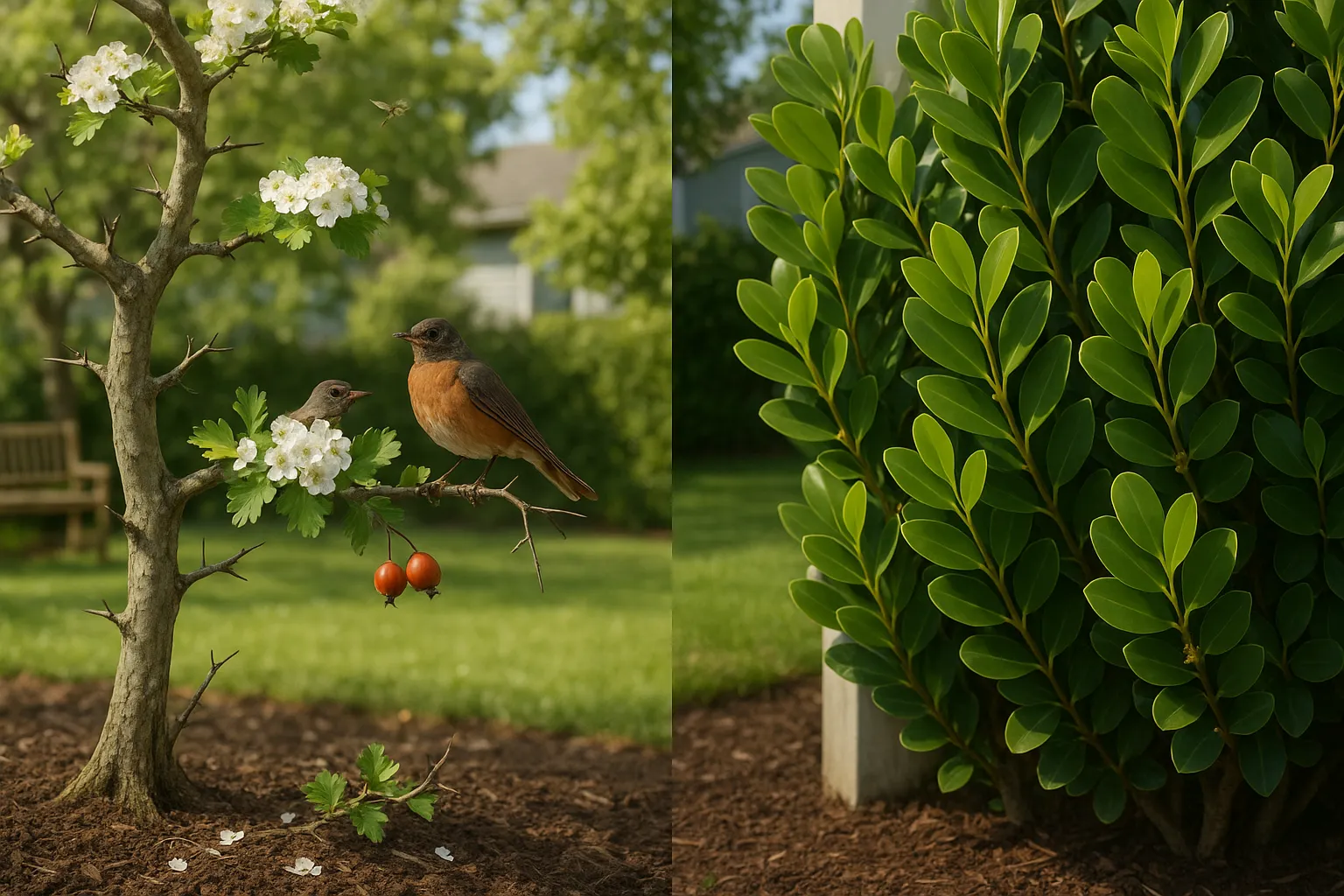
Key traits, Hawthorn offers spring blossoms (white to pink), summer foliage, and red/orange haws in autumn. Griselinia keeps green, leathery leaves year-round and produces inconspicuous flowers and black fruit seldom eaten by local wildlife.
Practical takeaway: If you need seasonal wildlife food and signaling, hawthorn delivers. If you need year-round screening and wind tolerance, Griselinia often performs better.
Identifying Features: How To Tell Hawthorn From Griselinia
Fact: Leaves, flowers, and fruit give the fastest ID clues. Below are clear, observable differences you can use on a site visit.
Leaf, Flower, And Fruit Characteristics
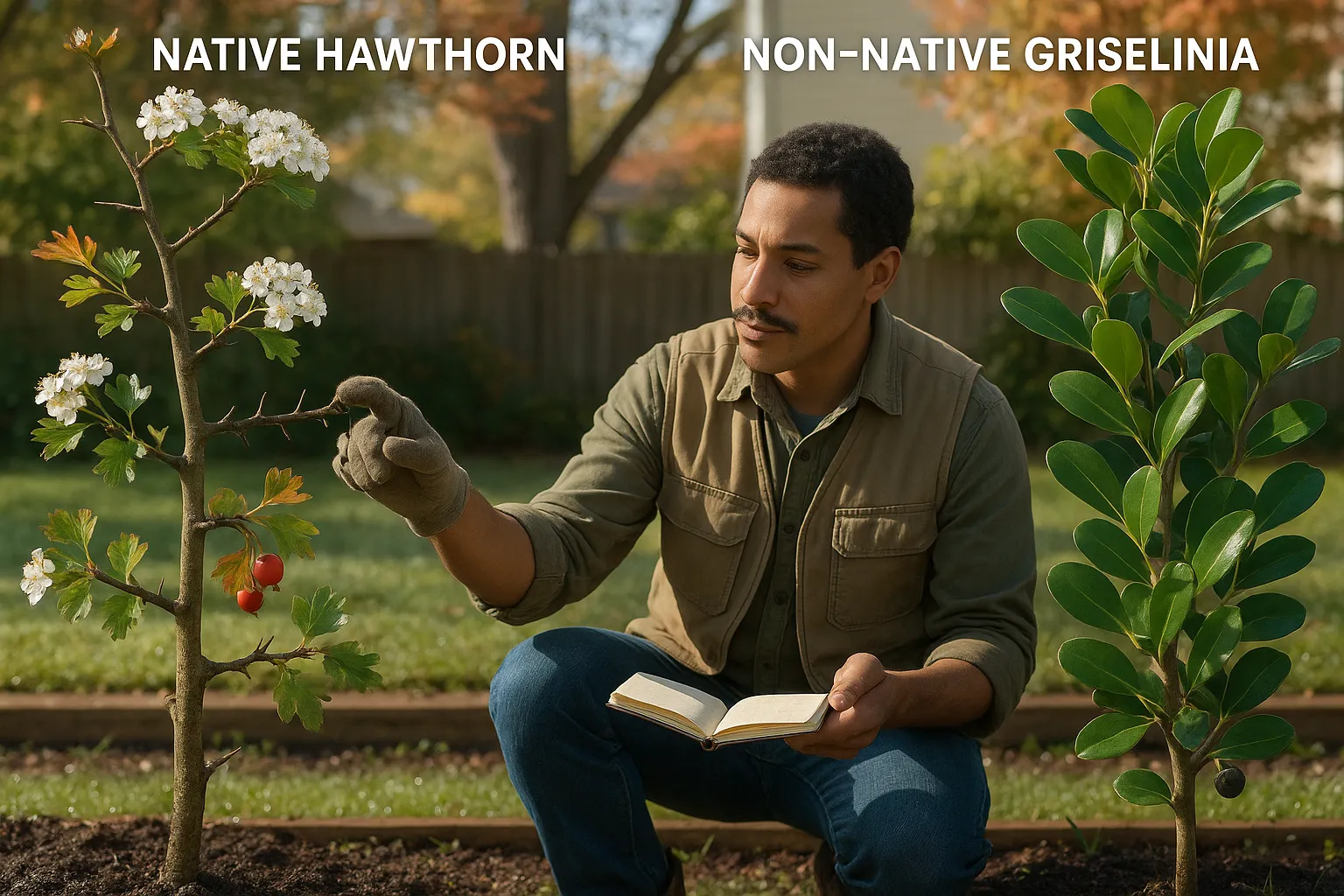
Hawthorn leaves are usually lobed or toothed, thin, and turn color in autumn. Flowers appear in clusters of five-petaled blossoms in spring and smell faintly almond-like: fruit (haws) are berry-like pomes, often bright red. Griselinia leaves are simple, entire (no lobes), glossy, and leathery: they stay green through the year. Their flowers are tiny and greenish: fruit are small, dark, and rarely abundant.
Growth Habit, Size, And Bark
Hawthorn grows as a multi-stem shrub or small tree up to 6–10 m depending on species and pruning. It usually has thorned branches and gnarly bark on older stems. Griselinia grows 3–8 m, often with a single trunk if trained: bark is smooth and pale. You’ll feel thorns on hawthorn, use that as a quick tactile test.
Seasonal Appearance And Wildlife Signaling
Hawthorn signals season changes loudly: white spring flowers, green summer canopy, colorful fruit in fall, and naked thorned branches in winter. That sequence feeds pollinators and birds. Griselinia sends a different message: consistent green foliage, modest seasonal cues, and less food for native wildlife. If you want a living calendar in your yard, hawthorn is the signal you need: if you want constant privacy, Griselinia signals stability.
Ecological Roles And Biodiversity Impact
Fact: Native hawthorn supports more native insects and birds than non-native Griselinia in most temperate regions. The following sections explain why, and where exceptions appear.
Native Hawthorn: Benefits For Local Ecosystems
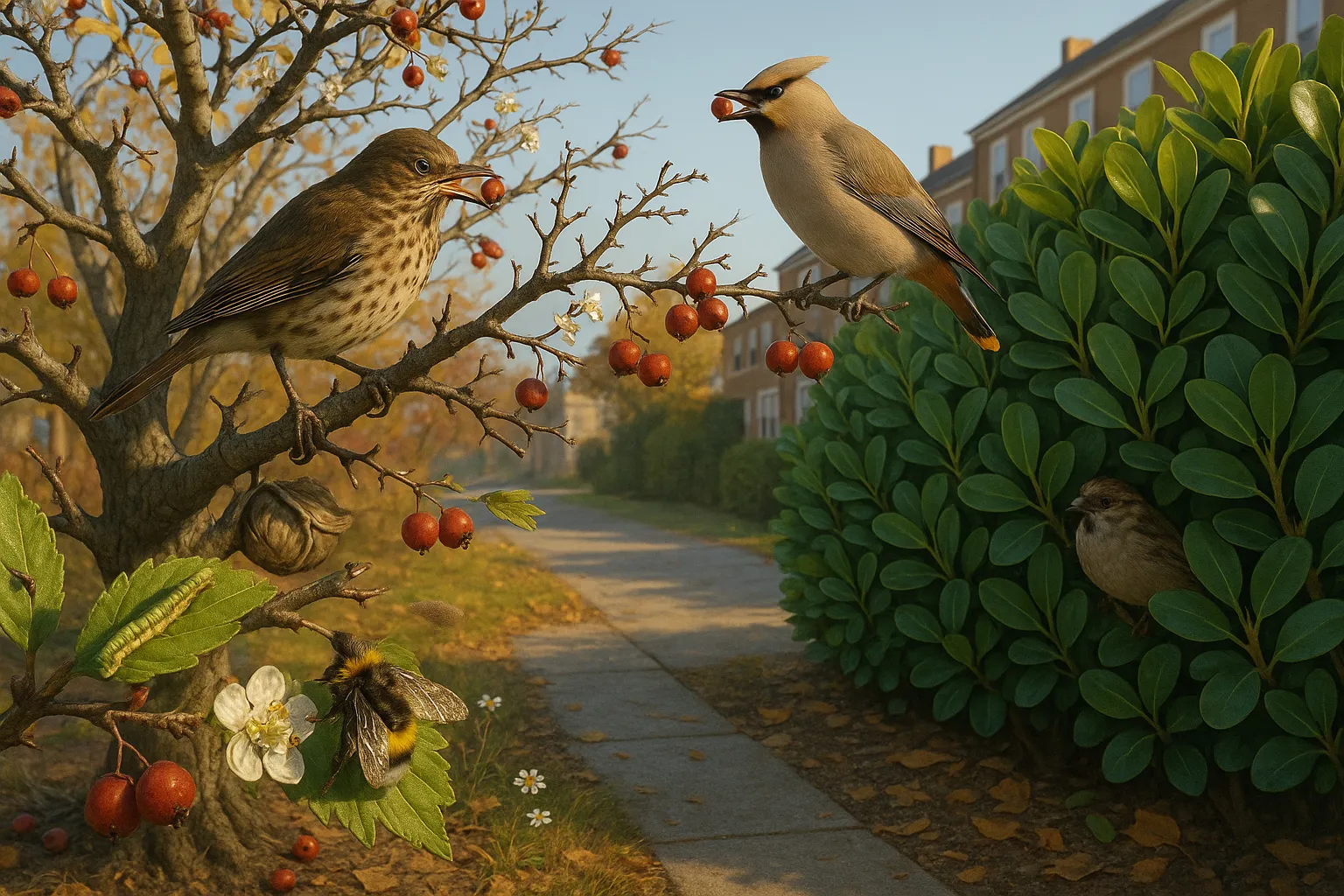
Hawthorn serves as host plant for caterpillars (like hawthorn-specialist moths), provides nectar to bees and other pollinators, and supplies high-energy fruit for thrushes, waxwings, and small mammals in autumn. It also offers thorny nesting sites that deter some predators, which helps nesting songbirds. If your goal includes boosting native biodiversity or restoring a hedgerow, hawthorn provides measurable gains: native trees support far more native insect species than exotic species do.
Griselinia: Effects Of A Non-Native Shrub On Habitat
Griselinia gives structure but fewer native interactions. It can shelter birds and add evergreen cover, but it rarely hosts specialist insects. In some coastal urban plantings Griselinia reduces seasonal food abundance because its fruit and flowers don’t match local pollinators’ schedules. In regions where Griselinia naturalizes, it can displace native shrubs, so local context matters.
Pollinators, Birds, And Food Web Considerations
Your choice changes the food web. Hawthorn increases pollinator visits in spring and bird diversity in fall. Griselinia increases year-round cover but often lowers seasonal food peaks. If you manage a small urban patch, mixing both species can provide year-round structure and seasonal food: but if you must pick one for biodiversity, pick native hawthorn.
Landscape Uses, Design Considerations, And Maintenance
Fact: Use hawthorn when you want seasonal interest and wildlife value: use Griselinia when you want evergreen screening and low visual maintenance.
When To Choose Hawthorn: Garden And Urban Uses
Choose hawthorn for hedgerows, wildlife gardens, and sites where spring blossom and autumn fruit matter. It tolerates pruning into dense hedges and can form living fences. It’s ideal for community gardens focused on native habitat. Beware: thorns make hawthorn less suited to high-traffic areas near paths where children play.
When To Choose Griselinia: Advantages And Limitations
Choose Griselinia for coastal windbreaks, formal hedges, and visual screens that require an evergreen backdrop. It tolerates pruning into neat shapes and resists salt spray. Limitation: it adds little to native food webs and may require removal if local regulations discourage non-native plantings.
Pruning, Soil, Watering, And Pest Management For Both
Hawthorn prefers well-drained soils, moderate watering once established, and benefits from annual formative pruning to manage thorns and shape. Watch for fireblight (Erwinia amylovora) in some regions: remove and destroy infected wood promptly. Griselinia prefers fertile, well-drained soil, regular watering until established, and annual pruning to maintain density. It can suffer scale insects and leaf spot: control with targeted treatments and good airflow. Both plants benefit from mulching, and both can handle pruning: but hawthorn tolerates harder cuts and responds well to rejuvenation pruning while Griselinia may reshoot more slowly.
Invasiveness, Legal Considerations, And Management Strategies
Fact: Griselinia can naturalize outside its native range, and some jurisdictions track it: hawthorn species can also act invasive in places where non-local taxa are planted. Check local regulations before large plantings.
Assessing Invasiveness Risk And Local Regulations
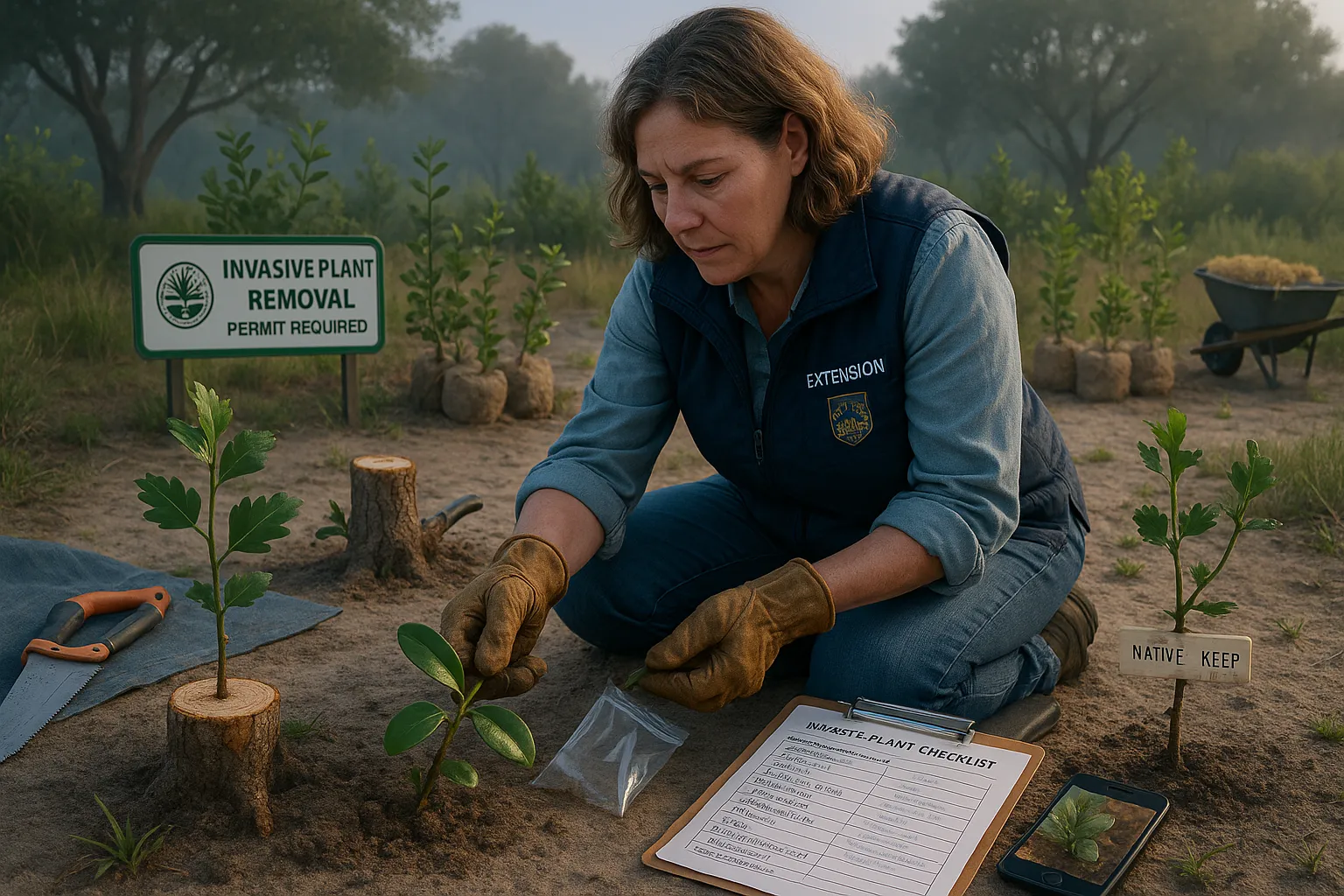
Assess risk by consulting your state’s invasive plant lists or local extension service. For example, some coastal councils in Australia and parts of the Pacific track Griselinia naturalization. Hawthorn species native to your region are usually low risk: but, planting non-local Crataegus subspecies can introduce unwanted hybrids. Your local extension office or botanical garden will tell you which species are permitted and recommended.
Early Detection, Control Methods, And Restoration Practices
Detect non-native spread early by surveying nearby natural areas for seedlings. Control Griselinia and unwanted hawthorn volunteers by pulling small seedlings or cutting and applying herbicide to stumps when necessary (follow label directions). Restoration favors native replanting: after removal, stabilize soil, plant a mix of native shrubs (including local Crataegus if appropriate), and monitor for regrowth. Record what you remove and when, this helps local managers and reduces repeat work. I once left a root collar when cutting a large Griselinia hedge and it resprouted vigorously: don’t make that same lazy cut.
Selecting The Right Plant: Practical Decision Guide
Fact: Decide with site conditions, wildlife goals, and maintenance capacity in mind. Below are tools to make a clear choice.
Site Assessment Checklist (Exposure, Soil, Wildlife Goals)
Exposure: Is the site coastal or inland? Griselinia tolerates salt: hawthorn tolerates inland winds but not constant salt spray.
Soil: Is drainage good? Both prefer well-drained soils: hawthorn tolerates poorer soils better.
Wildlife goals: Do you want more pollinators and birds? Choose hawthorn. Want year-round screen? Choose Griselinia.
Human use: Are children or pets near? Avoid thorny hawthorn on play edges.
Regulations: Check local invasive plant lists and planting guidelines.
Cost: Plant cost is similar: long-term replacement cost may be higher for species that naturalize or fail in your site.
Practical next step: map your site against the checklist, rank priorities, then choose the species that aligns with the top three priorities. If you value both screening and biodiversity, plant a mixed hedge: hawthorn interspersed with Griselinia or other evergreens gives both cover and seasonal food. Remember, no plant is perfect, pick the plant that best fits your goals and be ready to learn as it grows.
To provide the best experiences, we use technologies like cookies to store and/or access device information. Consenting to these technologies will allow us to process data such as browsing behaviour or unique IDs on this site. Not consenting or withdrawing consent, may adversely affect certain features and functions.
Functional
Always active
The technical storage or access is strictly necessary for the legitimate purpose of enabling the use of a specific service explicitly requested by the subscriber or user, or for the sole purpose of carrying out the transmission of a communication over an electronic communications network.
Preferences
The technical storage or access is necessary for the legitimate purpose of storing preferences that are not requested by the subscriber or user.
Statistics
The technical storage or access that is used exclusively for statistical purposes.The technical storage or access that is used exclusively for anonymous statistical purposes. Without a subpoena, voluntary compliance on the part of your Internet Service Provider, or additional records from a third party, information stored or retrieved for this purpose alone cannot usually be used to identify you.
Marketing
The technical storage or access is required to create user profiles to send advertising, or to track the user on a website or across several websites for similar marketing purposes.