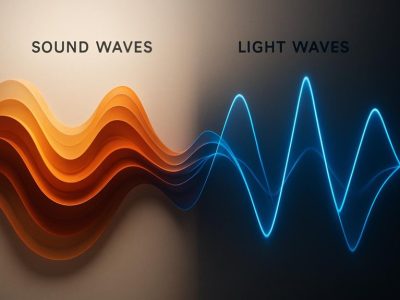
Picture standing on a quiet beach, watching waves roll in under a painted sky. Each crest rises and falls in a mesmerizing rhythm, but what secrets those waves hold beyond their beauty? The hidden language of waves isn’t just for poets—it’s the foundation of everything from music to Wi-Fi.
When you tune into your favorite song or catch a signal on your phone, you’re tapping into a world shaped by wavelength and frequency. These two concepts might sound like scientific jargon, but they hold the key to understanding how energy moves, connects, and even entertains you. Unraveling the difference between wavelength and frequency can open your eyes to a universe of invisible patterns pulsing all around you.
Understanding Wavelength and Frequency
Wavelength and frequency, two core semantic entities in wave physics, shape your daily experiences, often unnoticed. Wavelength measures the length of one complete wave cycle, either in water, light, or sound. If you picture standing on a windy beach, you see each crest and trough—those visible distances are wavelengths. Frequency, in contrast, counts how many full cycles pass a point per second—it’s measured in hertz (Hz). Whenever you tap your finger to a favorite song, you’re matching your movement to frequency, not wavelength.
Wavelengths get shorter as frequency gets higher—a simple relationship seen in electromagnetic waves. For example, red light has a wavelength near 700 nanometers and a frequency about 430 THz, while purple light gets packed into 400 nanometers but zooms up to 750 THz frequency. (National Institute of Standards and Technology, 2022) Each color, each sound, each signal you rely on, from FM radio to Wi-Fi, rests on unique combinations of these properties. Long wavelengths like radio waves might stretch across a football field, while gamma rays squeeze into atomic scales.
Everyday decisions—choosing Wi-Fi bands, selecting music, using microwaves—connect directly to these concepts. Think about why your remote control barely works through walls; infrared wavelengths simply don’t pass through solid objects as radio waves do. why a dog hears a whistle that you can’t? Their hearing taps into higher sound frequencies, beyond human range.
Nature harnesses these principles too, if you consider birds navigating by Earth’s electromagnetic fields. Artists, engineers, and scientists all study these wave properties closely, driven by curiosity and creativity. Each discovery sharpens your understanding of the world’s invisible architecture. Without questioning definitions, you might miss how frequency shapes the clarity of a phone call or how wavelength determines the color of a sunset.
Here’s a table showing several real-world examples:
Wave Type
Typical Wavelength
Typical Frequency
Everyday Example
Radio Wave
1 m – 100 km
3 kHz – 300 MHz
FM radio, TV signals
Microwave
1 mm – 1 m
300 MHz – 300 GHz
Wi-Fi, microwave ovens
Visible Light
400 – 700 nm
430 – 750 THz
Colors you see
UV Light
10 – 400 nm
750 THz – 30 PHz
Sunburns, sterilization
Sound (air)
17 mm – 17 m
20 Hz – 20,000 Hz
Human voice, dog whistles
Understanding wavelength and frequency doesn’t just sharpen your science knowledge; it uncovers a layer of universal order stretching from crashing waves to wireless data.
What Is Wavelength?
Wavelength captures the distance between two identical points in consecutive wave cycles—picture the gap from crest to crest in an ocean swell, stretching endlessly toward some unseen shore. You’re surrounded by wavelengths every moment, whether you’re streaming music over Wi-Fi or watching sunlight shimmer across a window.
Definition and Units
Wavelength, by definition, measures the spatial period of a wave—the length from one repeating point, such as a peak, to the next. In physics, you’ll often see wavelength represented with the Greek letter lambda (λ). The standard unit for wavelength is the meter (m), a unit commonly seen in electromagnetic spectrum tables or acoustic studies. For shorter waves like visible light, nanometers (nm) or micrometers (μm) appear frequently, emphasizing just how tiny some wavelengths can be. When you reflect on numbers—red light stretches to around 700 nm, while violet light compresses to about 400 nm (NIOSH, 2016).
Examples in Everyday Life
You experience wavelength constantly, likely without noticing it. The rainbow splitting through clouds? Each color corresponds to photons with their unique wavelength. Wi-Fi? The router beams invisible waves at wavelengths of about 12 centimeters on a 2.4 GHz band. When music vibrates through air, the pitch you hear relates directly to the sound wave’s wavelength. Someone whistling a high note? It means short, tightly packed sound waves fly at your ears. Dogs hear frequencies and hence wavelengths that your ears can’t touch—picture a world full of signals slipping right past your awareness.
Schools of fish navigate by sensing subtle vibrations around them, using lateral lines that detect pressure wave wavelengths (Popper & Coombs, 1980). Meanwhile, city planners design buildings to minimize the impact of seismic waves, knowing certain wavelengths can rattle structures apart. How often have you wondered why your phone’s radio antenna typically measures around a quarter wavelength of the signal it receive? Designers tune that length for efficient energy transfer, not appearance.
If every song you love, picture you share online, or natural wonder you marvel at owes its pattern to wavelength, what could you discover by simply recognizing these hidden metrics at work?
What Is Frequency?
Frequency counts the rhythm of the universe—ticking off each wave that passes through a fixed point every second. Every moment, your phone, your favorite song, even your heartbeat dances in time to the precise march of frequency.
Definition and Units
Frequency measures how often a repeating event occurs per unit of time, commonly used with waves like sound, light, or radio. Scientists denote frequency using the hertz (Hz), which equals one cycle per second. You hear a note played on a piano; if its string vibrates at 440 Hz, you’re counting 440 back-and-forth motions every second—creating the note “A” above middle C.
Frequency (f) = cycles per second (measured in Hz)
Sound frequency controls pitch: high frequency equals high notes, low frequency equals deep notes.
Light frequency determines color: higher frequencies make violets and blues; lower frequencies bring out reds.
Every digital device you use—Wi-Fi routers, televisions, even the clock ticking on your microwave—relies on a unique frequency that sets it apart in the crowded world of invisible signals.
Real-World Applications
Frequency guides your experience, choices, and environment. Radio stations don’t all play at once because each occupies a different frequency band. When you tune to 101.5 FM, you ask your radio’s electronics to filter only the waves oscillating 101.5 million times per second. Mobile networks carve up the frequency spectrum so millions talk at once without chaos.
Sound frequency changes everything about music. Dolphins communicate with clicks above 100,000 Hz; humans hear from 20 Hz to 20,000 Hz. Some sounds—such as a dog whistle’s sharp tweet—slip by unnoticed because their frequencies exceed your hearing range.
Light frequencies touch daily life in ways you might not notice. LED lights emit specific frequencies to create all colors. The rainbow stretching over the ocean after rain, each band corresponds to a particular light frequency, splitting from the sun’s white light.
If you ever scanned through a Wi-Fi menu and picked the 5 GHz option over 2.4 GHz, you chose a network running at twice the frequency: faster data with shorter range. Medical technicians use frequency, too—ultrasound machines send millions of pulses per second to construct images of a beating heart before a baby is born.
In sum, frequency isn’t just a concept in science textbooks, it shapes conversations, art, navigation, and connections that define your day.
Key Differences Between Wavelength and Frequency
Wavelength and frequency may seem like just numbers, but they’re two sides of every wave’s story. Think of them as the wave’s heartbeat and footprints—tied together, each telling you something different about the energy moving all around.
Mathematical Relationship
Wavelength and frequency form a mathematical partnership that stays unbroken in every wave. You find it easy to see if you picture a surfer riding ocean waves: each wave crest is spaced out (wavelength), and the number of crests that pass the surfer every second (frequency) depends directly on each other. The faster the crests, the closer they must be packed to fit more in.
Property
Symbol
Unit
Link Equation
Wavelength
λ
meter (m)
λ = v / f
Frequency
f
hertz (Hz)
f = v / λ
Wave Speed
v
meters/second
v = λ × f
For instance, radio stations—like 95.9 FM—choose their frequency to match wavelengths that can travel through buildings and air. If you double a frequency while the speed of light or sound remains fixed, the wavelength shrinks by half. Scientists in labs or on oil rigs use this relationship, tuning sensors for seismic waves or tweaking lasers in optical communication networks (source: Physics LibreTexts, 2024).
How They Affect Wave Behavior
Wavelength influences the way waves interact with the world around them. Long wavelengths slip easily around corners or barriers, like how low bass thumps reach you even if walls block higher-pitched music. This also explains why AM radio (with long waves) can reach rural areas, while FM (shorter waves) sometimes fades fast outside cities.
Frequency, on the other hand, decides what your senses can detect. High-frequency waves in light reveal vivid blues and violets, while lower ones bring reds and oranges. Human hearing? It’s limited—dogs catch high-pitched frequencies you miss, which explains why a dog whistle is silent to you but not to your pet. Scientists use frequency as a diagnostic tool: in MRI scanners, different tissue types reflect unique frequencies, creating pictures of your insides without a scalpel.
So, ask yourself—when you next choose a Wi-Fi channel or listen for thunder after a lightning bolt (light waves travel faster, sound slower), which side of the wave are you tuning into? The footprints (wavelength) or the heartbeat (frequency)? Every technology, from fiber optics to your smart speaker, depends on this hidden dance between distance and rhythm.
Importance in Science and Technology
Frequency and wavelength act as invisible architects in your world shaping everything from how you voice resonate through air to how images appears crisp on a screen. You ever wonder why your microwave heats leftovers while your Bluetooth headphones stream music—no wires, no drama? That’s wavelength and frequency at play, choreographing the dance of energy and information.
MRI scanners rely on radio frequencies to map your insides, picking up tiny signals and translating them into detailed images—like an artist painting bone and tissue. Wireless communication owes its speed to high-frequency signals, while low-frequency radio save lives when broadcasting emergency alerts across continents (Federal Communications Commission, 2023). Why do you think you remember the catchy jingle from your favorite show, but not the static in between? It’s frequency modulation, carrying voices over the air while cutting through noise.
Astronomers probe distant galaxies by decoding frequencies of starlight, revealing cosmic fingerprints. In quantum technology, controlling frequency allows researchers to manipulate particles, edging closer to the computing revolution (Nature, 2022). Is it possible for these waves to unlock new pathways in medicine, climate study, or digital art? Already, researchers harness terahertz frequencies to spot cancer cells—seeing what the naked eye can’t.
Sometimes, longer wavelengths bend round barriers, letting Wi-Fi sneak past thick walls (National Institute of Standards and Technology, 2021). Other times, short wavelengths grant us the sharpest images, like the pixels in your smartphone display. If you follow energy across these waves, you’ll find the blueprint for everything electronic, acoustic, or luminous in your day. How many hidden patterns orchestrate the buzz of your daily life, waiting for you to tune in and see them?
Conclusion
When you start to notice the patterns of wavelength and frequency in your world you’ll see energy and information in a whole new light. Whether you’re streaming music connecting to Wi-Fi or marveling at the colors of a sunset these invisible properties shape your experiences every day.
By understanding how wavelength and frequency work together you gain insight into the hidden rhythms that connect everything around you. Let this knowledge inspire your curiosity and help you make more informed choices in our increasingly connected world.
To provide the best experiences, we use technologies like cookies to store and/or access device information. Consenting to these technologies will allow us to process data such as browsing behaviour or unique IDs on this site. Not consenting or withdrawing consent, may adversely affect certain features and functions.
Functional
Always active
The technical storage or access is strictly necessary for the legitimate purpose of enabling the use of a specific service explicitly requested by the subscriber or user, or for the sole purpose of carrying out the transmission of a communication over an electronic communications network.
Preferences
The technical storage or access is necessary for the legitimate purpose of storing preferences that are not requested by the subscriber or user.
Statistics
The technical storage or access that is used exclusively for statistical purposes.The technical storage or access that is used exclusively for anonymous statistical purposes. Without a subpoena, voluntary compliance on the part of your Internet Service Provider, or additional records from a third party, information stored or retrieved for this purpose alone cannot usually be used to identify you.
Marketing
The technical storage or access is required to create user profiles to send advertising, or to track the user on a website or across several websites for similar marketing purposes.