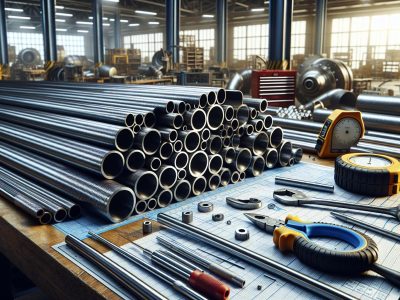
Tubes are hollow cylindrical structures that are measured by their outside diameter (OD) and wall thickness for accurate dimensions. They are valued for their precision and consistency, especially in applications requiring tight tolerances.
Characteristics Of Tubes
Measurement Standards: Tubes are measured by their outside diameter and wall thickness, ensuring precise dimensions. Unlike pipes, measurements don’t depend on internal diameter.
Shape Variability: While round is the most common, tubes also come in square, rectangular, and oval shapes.
Material Options: Materials include steel, aluminum, copper, and plastic, chosen based on strength, weight, and corrosion resistance.
Dimensional Tolerances: Tubes maintain stricter tolerances, which makes them suitable for precision-focused projects.
Common Uses Of Tubes
Structural Applications: In construction or fabrication, tubes reinforce frameworks, handrails, and bridges.
Automotive Industry: Tubes are used for engine components, exhaust systems, and suspension parts due to their strength.
Medical Devices: In healthcare, tubes serve as components in tools, implants, and diagnostic equipment.
Heat Transfer Systems: Tubes are essential in boilers, condensers, and radiators to help fluid or air flow.
Hydraulic Systems: In machinery, tubes transport fluids under high pressure for operational efficiency.
Use tubes when precision dimensions, varied shapes, or specific material properties are critical to your project’s success.
What Are Pipes?
Pipes are hollow cylindrical materials primarily used to transport fluids and gases. They are measured by their nominal diameter (ND) and schedule, which defines wall thickness.
Characteristics Of Pipes
Measurement Standards: Pipes use nominal diameter and schedule, which relate to internal diameter and wall thickness. These measurements differ slightly from actual dimensions.
Shape: Pipes are typically round to ensure uniform pressure distribution.
Material Options: Pipes are commonly made from steel, cast iron, copper, PVC, or stainless steel.
Tolerances: Pipe tolerances are less strict compared to tubes, allowing greater variation in dimensions.
Common Uses Of Pipes
Fluid Transport: Pipes are essential in plumbing systems, water supply lines, oil pipelines, and gas distribution networks.
Construction: Pipes often serve as structural components or conduits for electrical wiring.
Industrial Applications: Industries use pipes in chemical processing, steam systems, and manufacturing facilities.
Agriculture: Pipes help irrigation systems and drainage solutions.
Pipes provide functionality in applications where precise dimensions aren’t the primary requirement.
Key Differences Between Tubes And Pipes
Tubes and pipes differ significantly in design, material, and usage. Understanding these differences helps you select the right option for specific needs.
Design And Dimensions
Tubes are measured by their outside diameter (OD) and wall thickness. These precise measurements make tubes suitable for applications requiring uniformity and tight tolerances. Tubes can have various shapes, including round, square, rectangular, or oval.
Pipes rely on nominal diameter (ND) and schedule (wall thickness) for measurement. These values prioritize flow capacity over exact dimensions. Pipes are almost always round to maintain consistent fluid or gas flow under pressure.
Material And Strength
Tubes are made from materials like steel, aluminum, copper, and plastics. These materials ensure strength, corrosion resistance, or lightweight properties depending on the requirement. Tubes often undergo stricter inspections, ensuring higher tolerances and greater structural integrity.
Pipes, typically produced from steel, cast iron, copper, PVC, or stainless steel, focus on functionality over precision. Their properties support fluid and gas transport and tolerate variations in pressure and temperature without requiring stringent dimensional accuracy.
Usage And Applications
Tubes are common in applications with precise requirements. Examples include medical devices, hydraulic systems, heat exchangers, and automotive components. Their shape and material diversity make them suitable for structural applications as well.
Pipes are ideal for fluid and gas transport in plumbing, water distribution, oil pipelines, and gas supply lines. They’re also used in construction for structural support and in chemical or agricultural systems for transporting liquids or gases effectively.
Pros And Cons Of Tubes And Pipes
Tubes and pipes each offer unique advantages and disadvantages, depending on the application. Choosing the right one improves efficiency, cost-effectiveness, and performance.
Advantages Of Tubes
Precision: Tubes provide tight tolerances, ensuring consistent dimensions in applications like medical devices or heat exchangers.
Versatility: Tubes come in various shapes, such as square and rectangular, suitable for structural or aesthetic uses.
Material Options: Tubes are made from steel, aluminum, copper, and plastics, making them compatible with diverse industries.
Strength: Tubes undergo rigorous testing, ensuring high strength for critical applications, including aerospace and hydraulics.
Advantages Of Pipes
Flow Capacity: Pipes efficiently transport fluids and gases, making them essential in plumbing and gas distribution systems.
Cost-Effective: Compared to tubes, pipes are often less expensive due to lower precision requirements.
Compatibility: Pipes work well with standard fittings, simplifying assembly in projects such as water supply lines.
Durability: Pipes are designed to resist pressure and wear, important in oil pipelines or chemical processing.
Disadvantages Of Tubes
Higher Costs: Precision manufacturing and strict tolerances increase the cost of tubes.
Limited Flow Applications: Tubes are less effective for high-volume fluid or gas transport.
More Labor-Intensive: Custom shapes or materials may require specialized handling and equipment.
Disadvantages Of Pipes
Lower Precision: Pipes lack the uniformity needed for applications requiring exact dimensions.
Shape Restriction: Pipes are primarily round, limiting their use in projects that need non-cylindrical shapes.
Heavier Wall Variations: Fluctuations in wall thickness may cause inconsistent performance in some scenarios.
Choosing Between Tube And Pipe
Choosing between a tube and a pipe depends on your project’s requirements for precision, function, shape, and material. Understanding the distinct factors can help you make the right selection.
Factors To Consider
Measurement Standards
Tubes are measured by their outside diameter (OD) and wall thickness, ensuring precision and uniformity. Pipes, but, are measured by nominal diameter (ND) and schedule, focusing on flow capacity instead of precise dimensions.
Material Options
Tubes come in various materials like steel, aluminum, copper, and plastic, meeting requirements for strength, corrosion resistance, or flexibility. Pipes typically use materials like steel, PVC, cast iron, and stainless steel, offering durability and effective flow performance.
Shape Variations
Tubes are available in round, square, rectangular, and oval shapes, offering versatility for structural or custom applications. Pipes are only round, as this shape ensures consistent pressure distribution for fluid or gas transport.
Application Needs
Tubes work best for precision applications like medical devices, automotive components, or structural designs. Pipes suit systems prioritizing flow, such as plumbing, gas lines, and industrial fluid transport.
Cost and Tolerance
Tubes often cost more due to their strict manufacturing tolerances and inspection processes. Pipes usually have looser tolerances, making them a cost-effective choice for high-volume transport.
Industry-Specific Recommendations
Construction Industry
Use tubes for structural stability, such as in handrails or load-bearing components. Opt for pipes when designing water, sewage, or HVAC systems.
Automotive and Aerospace
Use tubes for precise components like hydraulic systems, fuel lines, or structural frameworks. Pipes are less appropriate due to their lack of precision.
Plumbing and Utilities
Pipes fit the needs of transporting fluids and gases in water supply, sewage, or gas distribution. Tubes aren’t necessary unless testing or precise flow measurement is required.
Medical Devices
Tubes suit medical applications like catheters or surgical instruments, where tight tolerances and material quality are critical. Pipes are not suitable in this context.
Industrial Applications
Choose pipes for systems handling chemicals, oil, or large-scale fluid transfer. Use tubes for heat exchangers or custom assemblies requiring accuracy.
Conclusion
Choosing between tubes and pipes depends on your project’s specific requirements for precision, functionality, and material properties. By understanding their differences in measurements, applications, and design, you can select the option that best suits your needs.
Whether you prioritize precision and versatility or functionality and cost-effectiveness, knowing when to use tubes or pipes ensures your project is both efficient and successful. Use this knowledge to make confident, informed decisions tailored to your industry and application.
To provide the best experiences, we use technologies like cookies to store and/or access device information. Consenting to these technologies will allow us to process data such as browsing behaviour or unique IDs on this site. Not consenting or withdrawing consent, may adversely affect certain features and functions.
Functional
Always active
The technical storage or access is strictly necessary for the legitimate purpose of enabling the use of a specific service explicitly requested by the subscriber or user, or for the sole purpose of carrying out the transmission of a communication over an electronic communications network.
Preferences
The technical storage or access is necessary for the legitimate purpose of storing preferences that are not requested by the subscriber or user.
Statistics
The technical storage or access that is used exclusively for statistical purposes.The technical storage or access that is used exclusively for anonymous statistical purposes. Without a subpoena, voluntary compliance on the part of your Internet Service Provider, or additional records from a third party, information stored or retrieved for this purpose alone cannot usually be used to identify you.
Marketing
The technical storage or access is required to create user profiles to send advertising, or to track the user on a website or across several websites for similar marketing purposes.