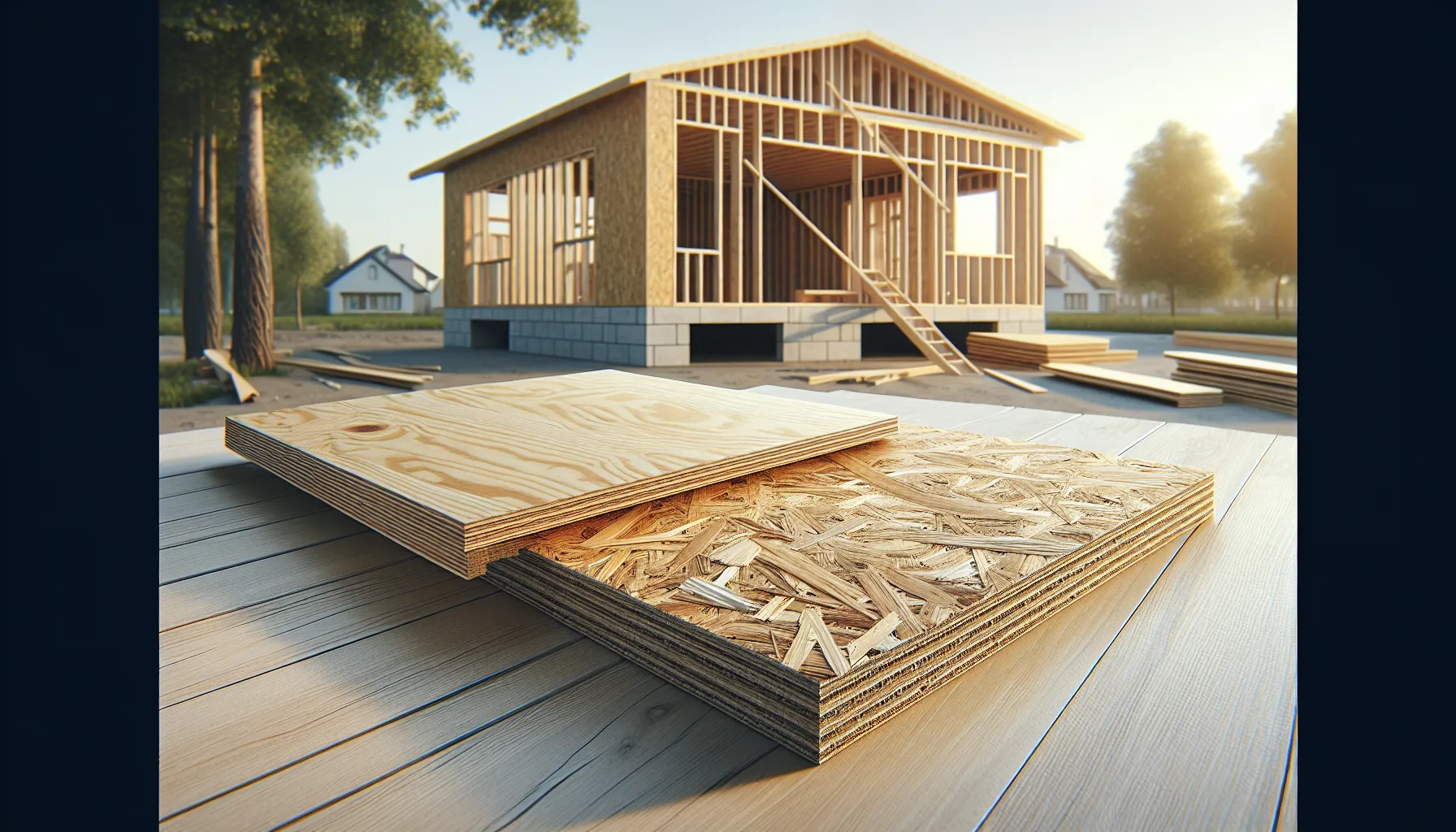
Choosing the right material for your construction or renovation project is crucial, and the debate often boils down to plywood versus OSB. Both are popular engineered wood options with unique properties, uses, and advantages. But what precisely sets them apart? By delving into their material composition, performance characteristics, and practical applications, you’ll gain confidence in making an well-informed choice for your next project.
Overview of Plywood and OSB
What Is Plywood?
Plywood is an engineered wood product crafted from thin layers of veneer bonded together at contrasting angles using adhesive. This cross-grain construction enhances its strength and prevents warping, making plywood a versatile choice.
What Is OSB?
Oriented Strand Board (OSB) is manufactured from wood strands and adhesives compressed into layers. These wood strands are oriented strategically to maximize durability and stiffness, resulting in a product suitable for load-bearing applications.
Materials Used in Plywood and OSB
Composition and Manufacturing Process of Plywood
Plywood involves thin sheets of wood veneer obtained from logs, layered and adhered under immense pressure to form panels. The grain directions are alternated to bolster stability.
Composition and Manufacturing Process of OSB
OSB production begins with shredding wood into strands of specified dimensions. These strands, mixed with adhesives and wax, are then heat compressed to create rigid panels with uniform characteristics.
Performance Characteristics
Strength and Durability
Plywood’s cross-layered structure provides exceptional shear strength, making it less susceptible to splitting or cracking. Conversely, OSB offers great uniformity and consistent performance under stress, but may delaminate over prolonged exposure to moisture.
Moisture Resistance
Moisture resistance varies between the two: plywood’s laminated layers can resist water penetration better, while OSB demands additional sealing to achieve comparable resistance.
Cost and Availability
Plywood Pricing and Availability Factors
Plywood tends to be more expensive due to the manufacturing process and standard wood species used. But, it is widely available in diverse thicknesses and grades.
OSB Pricing and Availability Factors
OSB is generally cost-effective and available in large formats, making it an economical option for projects necessitating substantial coverage.
Applications and Use Cases
Common Uses for Plywood
Plywood sees extensive use in structural framing, cabinetry, and decorative furniture due to its aesthetic grain patterns and reliable strength.
Common Uses for OSB
OSB is favored for sheathing in walls, roofing, and subflooring, where its uniformity and affordability streamline large-scale construction.
Advantages and Disadvantages
Pros and Cons of Plywood
Advantages include higher aesthetic appeal and better water resistance, whereas the drawbacks are higher cost and potential variability in quality.
Pros and Cons of OSB
OSB offers affordability and consistent performance, but drawbacks include susceptibility to water damage if not properly sealed.
To provide the best experiences, we use technologies like cookies to store and/or access device information. Consenting to these technologies will allow us to process data such as browsing behaviour or unique IDs on this site. Not consenting or withdrawing consent, may adversely affect certain features and functions.
Functional
Always active
The technical storage or access is strictly necessary for the legitimate purpose of enabling the use of a specific service explicitly requested by the subscriber or user, or for the sole purpose of carrying out the transmission of a communication over an electronic communications network.
Preferences
The technical storage or access is necessary for the legitimate purpose of storing preferences that are not requested by the subscriber or user.
Statistics
The technical storage or access that is used exclusively for statistical purposes.The technical storage or access that is used exclusively for anonymous statistical purposes. Without a subpoena, voluntary compliance on the part of your Internet Service Provider, or additional records from a third party, information stored or retrieved for this purpose alone cannot usually be used to identify you.
Marketing
The technical storage or access is required to create user profiles to send advertising, or to track the user on a website or across several websites for similar marketing purposes.