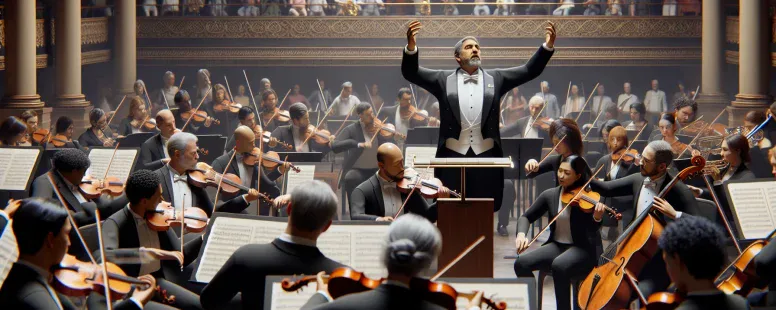
Picture the lights dimming in a grand concert hall as a wave of sound washes over you—strings shimmer, brass blares, and woodwinds dance through the air. You’re swept into a world where every note tells a story, but what truly separates an orchestra from a symphony? It’s a question that stirs curiosity even among seasoned music lovers.
Peel back the layers and you’ll discover more than just technical definitions. Understanding the difference opens doors to richer concert experiences and deeper appreciation for the music that moves you. Get ready to uncover a secret world where words and music intertwine, revealing nuances that can transform the way you listen forever.
Understanding the Terms: Orchestra and Symphony
You’ll hear the word orchestra, you might picture a grand stage filled with rows of musicians, strings glimmering under bright spotlights. Orchestras bring together sections like strings, woodwinds, brass, and percussion—each group with roles in creating rich sonorities. For instance, violins and cellos carry melodies in many Hollywood film scores; trumpets and timpani announce excitement at the start of Beethoven’s Fifth. Every orchestra, whether the Berlin Philharmonic or the local youth ensemble, serves as a living organism, where individual musicans breathe life into sheet music.
Yet, “symphony” cuts another direction. You see, a symphony means both a form and a musical event. When Mozart composed his “Symphony No. 40,” he crafted a work with four movements, each exploring emotional territory. If you attend a “symphony,” you’re witnessing the orchestra perform such complex work—often featuring broad narratives and shifting moods. The term never refers to the group of players, it refers only to the musical composition itself. Semantics here matter, because this nuance can deepen your understanding of programs and conversations. Isn’t it odd how “symphony orchestra” then pops up as a phrase? This just means an orchestra that performs symphonies, not something else entirely.
Ask yourself: if a jazz big band has thirty musicians but never plays a symphony, is it ever an orchestra in this sense? Or if the string quartet plays a Mozart “symphony,” are they still a symphony? The answer hinges on classification, tradition, and sometimes local custom—entity roles and terms carry weight in music history as well as linguistics (Oxford Music Online, Grove Music).
Historical Origins and Evolution
Orchestra and symphony have roots stretching deep into European musical tradition, yet their paths cross with unexpected twists. You probably wander how these terms grew apart over centuries, each following a distinct but intertwined journey.
Development of the Orchestra
Orchestra began as a gathering of musicians for courtly entertainments in the 1600s—think lavish banquets at Louis XIV’s Versailles. Small ensembles, barely more than a chamber group, would swell as composers like Haydn and Beethoven craved new sounds. By the late 18th century, orchestras featured structured sections: violin, cello, clarinet, trumpet—all coordinated by a conductor waving a baton.
Major European cities—like Vienna, London, and Paris—competed to showcase grander orchestras for their elite audiences. This fueled innovation, with Wagner expanding orchestras for his operas to over 100 musicians, breaking norms. Today, you can see orchestras adapting everywhere, from film scores to Olympic ceremonies—demonstrating ongoing evolution. (Kennedy Center, 2023).
Emergence of the Symphony
Symphony started as a musical form rather than a group, but the word’s journey is fascinating. In the 1700s, symphony described lively pieces that opened Italian operas. Soon, composers like Mozart and Haydn were crafting multi-movement works exploring drama and contrast—listen to Haydn’s “Surprise Symphony” for a shocking chord that sparked 18th-century applause.
As the orchestra grew larger, composers aimed bolder. Beethoven’s 9th Symphony called for singers, a thunderclap in music history. Now, symphony also means the event—a “symphony concert”—and the musical structure, a paradox that sometimes confuse you. Even today’s TV series soundtrack borrows this structure, weaving tension and release across episodes.
Historical convergence of orchestra and symphony persists, yet each encapsulates a unique story shaped by social ambition, creative risks, and technological change. If an orchestra is the palette, then symphony often is the painting—a living tradition that keep inviting you to listen beneath the surface.
Key Differences Between Orchestra and Symphony
Distinguishing between orchestra and symphony sharpens your concert experience, letting you notice nuances that can slip under most listeners’ radars. Every time you pick up a program or hear someone refer to a “symphony orchestra,” you’re encountering centuries of musical evolution in two tightly entwined words.
Terminology and Definitions
Understanding the terminology shapes your appreciation for music, especially if you’re curious about what takes place on a concert stage.
Orchestra names an entity—a group of musicians united by strings, brass, woodwinds, and percussion. Examples include the New York Philharmonic or the Berlin Philharmonic, each an assembly of up to 100 players.
Symphony refers to a structure—a large-scale composition, often in four movements, by composers like Beethoven or Brahms. It’s not a synonym for the orchestra itself. If a conductor announces “Tonight we perform Beethoven’s Fifth Symphony,” they’re highlighting the work, not the group.
Some performers mix up terms: people say “the symphony is rehearsing,” when technically, the orchestra practices the symphony. This subtle confusion traces how overlapping usage hides these distinctions.
Structure and Composition
Structure and composition define how orchestras and symphonies interact, and how their collaboration shapes concert experiences.
Orchestra structures typically involve strings (violins, violas, cellos, basses), woodwinds (oboes, clarinets, bassoons), brass (trumpets, trombones, horns) and percussion (timpani, cymbals). Most have hierarchies—concertmaster, principals, section players—coordinated under the baton of a conductor.
Symphony pieces are often grand canvases—multi-movement works with evolving themes and contrasting sections. Beethoven’s “Symphony No. 9” adds a choir to the orchestra, breaking tradition and reimagining possibilities. Mozart or Tchaikovsky shaped ideas of what a symphony can contain, integrating solos, call-and-response, and emotional shifts.
You’re more likely to spot vast orchestras during symphonies than during smaller forms like concertos or suites. Some modern film scores, like John Williams’s for “Star Wars,” borrow symphonic form and orchestral scale, blending both terms for storytelling power.
Roles in Classical Music
Roles in classical music outline how orchestra and symphony influence each other, and how listening habits adapt over time.
Orchestras act as vessels—they transport symphonies from silent sheet music to vibrant, expressive performances. Think Chicago Symphony Orchestra premiering Shostakovich or Vienna Philharmonic unveiling Mahler; every orchestra leaves an interpretive stamp on the symphony they bring to life.
Symphonies serve as monuments—cornerstones of orchestral repertoire, anchoring concert seasons and drawing diverse audiences. Some gravitate to “iconic” symphonies, like Dvořák’s “New World,” for accessibility, while others pursue lesser-known works for innovation.
Debates pop up around which is more “important”—ensemble or composition—but most musicians and critics (Taruskin, Grove Music Online) agree: their intertwining is what keeps classical music vital, dynamic, and ever-evolving. If you look closer, questions arise: does the orchestra shape the symphony, or does the symphony shape the orchestra?
Orchestra and symphony’s duality challenges you—whenever you hear either term, you’re invited to listen for history and harmony, for both the story told and the storytellers.
Notable Examples in Music History
Musical milestones from both orchestra and symphony contexts continue to echo through concert halls worldwide. You’ll find the border between soundcraft and composition reveals itself in the stories of legendary ensembles and unforgettable masterpieces.
Famous Orchestras
Several orchestras stand as benchmarks in orchestral performance, casting long shadows over the music world. Berlin Philharmonic, for example, transformed the orchestral landscape with their crisp articulation under Herbert von Karajan. Their 1960s Beethoven cycle not just enchanted listeners but changed recording standards (Berlin Philharmonic, Digital Concert Hall).
Vienna Philharmonic, steeped in centuries-old tradition, brings you New Year’s concerts that seem to bottle the spirit of classical Vienna. Their relationship with composers like Brahms and Mahler raises the question: do orchestras help define a regional sound, or does the city sculpt its orchestra?
New York Philharmonic, the oldest symphony orchestra in the United States, shaped American concert life since 1842. They’ve gave premieres of pieces like Dvořák’s “New World Symphony,” helping listeners navigate the birth of American classical identity.
Some think: a world-class orchestra only rests on its musicians, but conductor-leaders like Leonard Bernstein and Gustavo Dudamel prove vision drives cohesion. What if the ensemble makes the city’s heart beat, rather than merely reflecting it?
Iconic Symphonies
Select symphonies transcend notes on a score, migrating into popular consciousness and shifting the narrative of Western music. Beethoven’s Symphony No. 9 (“Choral”) is not just an orchestral tour de force, it’s become a symbol of unity, the “Ode to Joy” sung in moments of celebration and protest alike (BBC, “The Story of Beethoven’s Ninth”).
Mahler’s Symphony No. 2 (“Resurrection”) explodes boundaries, using huge forces and choral power to grapple with afterlife and hope. His textural layering still challenges and inspire conductors and players worldwide.
Shostakovich’s Symphony No. 5, premiered in 1937, uses coded irony to navigate the dangerous waters of Soviet censorship, structuring a message of both compliance and defiance. If you heard its last movement, you might wonder: is triumph staged, or does shade lurk behind the brass shine?
Each symphony invites you to recognize not just the hand of its composer but to listen for the soul of an era, the aspirations and anxieties scored into the fabric of orchestral color. Who decides which symphony survives the centuries? Sometimes, it’s the audience, sometimes the state, often the orchestra that renews its life in every performance.
Why the Distinction Matters for Music Lovers
Noticing the difference between orchestra and symphony rewires your listening experience, you find yourself navigating musical landscapes with more clarity. Picture you step into the Boston Symphony Hall with its golden balconies, and someone’s debating if tonight’s performance features the orchestra or the symphony. It sounds minor, right? But suddenly you realize—you’re not discussing the same thing at all.
Understanding that “orchestra” means the group of musicians—strings, woodwinds, brass, and percussion, for example—the entity itself; while “symphony” signals the grand composition they’re about to play—like Tchaikovsky’s Sixth Symphony, which has multiple emotional movements. These distinctions act kind of like maps for navigating concert programs. You see a schedule listing Gustav Mahler’s Symphony No. 5 by the New York Philharmonic: you know that’s the orchestra, performing a specific symphonic work. Mixing the terms blurs the picture, like swapping chef for recipe.
Catch the difference and your concert experience, listening, and even conversation shift. Say you’re collecting recordings—maybe you’re comparing the Vienna Philharmonic’s take on Beethoven’s Ninth Symphony with Leonard Bernstein’s legendary recording. Instead of just hearing beautiful noise, now you’re listening for how a particular orchestra interprets complex symphonic structures. You become attuned to subtleties in phrasing, tempo, balance—elements only orchestras animate.
Music historians, like Alex Ross (The Rest Is Noise, 2007), trace how both symphonies and orchestras have mirrored society. The symphony as a form often reflected the political energy of its time—Beethoven’s Eroica symphony humming with revolutionary France’s spirit—while orchestras as institutions sometimes shaped cities’ cultural identities, from Berlin to Chicago.
Consider attending family concerts, where children fidget in seats, or streaming a performance online—does knowing whether you’re witnessing the ensemble or the composition shape your expectations? It might. For instance, symphony orchestras often explore more than symphonies: overtures, concertos, modern movie scores. Suddenly, each program listing becomes a puzzle you could decode.
Actionable tip: Next time you look at a concert program, ask yourself what’s really being presented—does the title refer to the musical work or the performers? Engaging actively with these terms makes you a more invested listener, transforming passive consumption into energetic exploration.
Listening is not just about sound—it’s about context, history, and identity embedded in words, performances, and creations. Understanding this distinction lights up a new layer of meaning that no algorithm—at least not yet—can ever replicate for you.
Conclusion
When you understand the difference between an orchestra and a symphony you’re not just learning definitions—you’re unlocking a richer way to experience music. The next time you scan a concert program or listen to a recording you’ll have a sharper sense of what’s unfolding before you.
Let your curiosity guide you as you discover the realm of orchestral music. Each concert becomes an opportunity to appreciate the artistry behind every note and the stories woven into both the ensemble and the music they perform.
To provide the best experiences, we use technologies like cookies to store and/or access device information. Consenting to these technologies will allow us to process data such as browsing behaviour or unique IDs on this site. Not consenting or withdrawing consent, may adversely affect certain features and functions.
Functional
Always active
The technical storage or access is strictly necessary for the legitimate purpose of enabling the use of a specific service explicitly requested by the subscriber or user, or for the sole purpose of carrying out the transmission of a communication over an electronic communications network.
Preferences
The technical storage or access is necessary for the legitimate purpose of storing preferences that are not requested by the subscriber or user.
Statistics
The technical storage or access that is used exclusively for statistical purposes.The technical storage or access that is used exclusively for anonymous statistical purposes. Without a subpoena, voluntary compliance on the part of your Internet Service Provider, or additional records from a third party, information stored or retrieved for this purpose alone cannot usually be used to identify you.
Marketing
The technical storage or access is required to create user profiles to send advertising, or to track the user on a website or across several websites for similar marketing purposes.