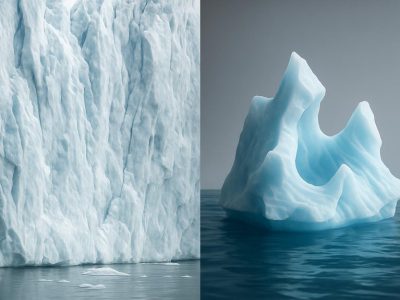
While both ice and snow share the same chemical composition—frozen water—they’re distinctly different forms of precipitation that impact our environment in unique ways. You’ve likely encountered both throughout your life, but understanding what sets them apart goes beyond casual observation.
The key differences between ice and snow lie in their formation processes, physical properties, and how they interact with the world around them. Ice typically forms as a solid sheet when liquid water freezes, creating a dense, transparent material. Snow, but, develops in clouds when water vapor crystallizes directly into delicate, intricate flakes that fall to earth. These fundamental distinctions affect everything from winter road safety to recreational activities.
What Are Ice and Snow?
Ice and snow are both frozen forms of water that exist in distinct physical states. They share the same chemical composition (H₂O) but differ significantly in their structure, formation process, and characteristics. Understanding these differences helps explain their unique behaviors in various environmental conditions.
The Formation of Ice
Ice forms when liquid water cools to its freezing point (32°F or 0°C) and transitions directly from a liquid to a solid state. This transformation occurs molecule by molecule as water loses heat energy and the hydrogen bonds between molecules strengthen, creating a rigid crystalline structure. Ice typically appears as a solid, transparent mass with a density of 0.9167 g/cm³, making it less dense than liquid water.
The formation process can happen in several environments:
In lakes and ponds when surface water freezes during cold weather
In freezers when water is deliberately cooled below freezing
In clouds when supercooled water droplets freeze onto particles
In soil when ground moisture freezes, creating permafrost
Ice crystals arrange themselves in a hexagonal lattice structure, which explains why bulk ice can appear clear when free of air bubbles and impurities. This crystalline arrangement creates the slippery surface that makes ice potentially dangerous on roads and sidewalks.
How Snow Develops
Snow develops through a process called deposition, where water vapor transforms directly into ice crystals without passing through the liquid phase. This atmospheric phenomenon begins high in clouds where temperatures are below freezing. Tiny water vapor molecules cluster around microscopic particles like dust or pollen, forming ice crystals with the characteristic six-sided symmetry.
As these crystals fall through the atmosphere, they grow larger by collecting more water vapor molecules. The specific shape and complexity of snowflakes depends on the temperature and humidity conditions they encounter during their descent. For example, perfect stellar dendrites (the classic star-shaped snowflakes) form in clouds at temperatures around 5°F (-15°C) with high humidity.
Unlike ice, snow consists of individual crystals with significant air spaces between them, giving it a much lower density—typically around 0.1 g/cm³ for fresh snow. This structure creates snow’s distinctive properties:
Light weight and fluffy texture when freshly fallen
Excellent insulation capabilities due to trapped air
High albedo (reflectivity) that bounces sunlight back into space
Ability to compress and compact under pressure or over time
Snow crystals can take on countless variations, with scientists categorizing them into ten basic types including plates, stellar crystals, columns, and needles. The old saying that “no two snowflakes are alike” holds scientific truth due to the countless environmental factors influencing each crystal’s growth pattern during it’s journey to the ground.
Physical Properties of Ice vs. Snow
Ice and snow display distinctive physical properties even though sharing the same chemical composition of frozen water. These differences stem from their unique formation processes and structural arrangements at the molecular level.
Density and Structure
The density and structure of ice and snow differ significantly. Ice has a crystalline structure with molecules arranged in a rigid, hexagonal lattice, giving it a density of approximately 0.92 g/cm³. This arrangement is why ice floats on water, which has a density of 1 g/cm³. The molecules in ice are tightly packed with minimal air spaces, creating a solid, hard material that can support significant weight.
Snow, in contrast, has a much lower density, typically ranging from 0.05 to 0.3 g/cm³ depending on its condition. Fresh powder snow is less dense (0.05-0.07 g/cm³), while packed snow approaches 0.3 g/cm³. This lower density results from the large amount of air trapped between individual snowflakes. The intricate lattice structure of each snowflake creates numerous air pockets, making snow an excellent thermal insulator. This insulating property explains why snow serves as effective protection for plants and small animals during winter months, maintaining temperatures near 32°F (0°C) beneath a snow layer even though much colder air temperatures above.
Color and Transparency
Ice and snow exhibit different optical properties about color and transparency. Pure ice appears transparent or slightly blue due to its molecular structure absorbing longer wavelengths (red) while allowing shorter wavelengths (blue) to pass through. Thicker ice often displays a deeper blue color as this selective absorption increases with depth. Ice’s crystalline structure allows light to pass through with minimal scattering, contributing to its transparency.
Snow, but, appears white because of how light interacts with its structure. When sunlight hits snow, the countless tiny ice crystals and air pockets scatter all wavelengths of visible light equally in multiple directions, reflecting the full spectrum back to our eyes. This diffuse reflection of all visible wavelengths creates snow’s characteristic white appearance. Older snow may develop grayish or yellowish tints due to pollution, algae growth, or other contaminants.
The transparency difference between ice and snow explains their contrasting visual effects in nature. You’ll notice ice forming clear sheats on lakes while snow creates a bright, reflective blanket on landscapes. This reflectivity gives snow an albedo (reflection coefficient) of up to 90%, significantly higher than ice’s albedo of 30-40%. This high reflectivity plays a crucial role in Earth’s climate by reflecting solar radiation back into space, affecting global temperature patterns.
Temperature Characteristics
Temperature affects ice and snow differently due to their structural compositions. The thermal properties of these frozen forms of water determine how they respond to environmental conditions and interact with their surroundings.
Melting Points
Ice and snow share the same melting point but respond differently to temperature changes. Both begin melting at 32°F (0°C) under normal atmospheric pressure, converting from solid to liquid states. But, snow typically melts faster than solid ice because:
Snow’s larger surface area exposes more material to warmer temperatures
The air spaces between snowflakes allow heat to penetrate more efficiently
Sunlight absorption occurs throughout snow’s structure rather than just on the surface
During partial melting conditions, snow undergoes metamorphism, transforming from fluffy powder to denser, granular forms. This process changes snow’s physical properties while maintaining its solid state, creating variations like corn snow or firn before complete melting occurs.
Insulation Properties
Snow functions as an excellent natural insulator due to it’s unique structure. The air pockets trapped between snow crystals significantly reduce heat transfer, creating a protective layer that shield underlying surfaces from extreme cold. Snow’s insulating effectiveness depends on several factors:
Fresh, fluffy snow provides better insulation than compacted snow
A snow layer of 8-12 inches can keep ground temperatures near 32°F even when air temperatures drop below 0°F
Snow’s thermal conductivity (0.05-0.3 W/m·K) is much lower than ice (2.2 W/m·K)
This insulation property creates the “igloo effect,” where snow shelters maintain interior temperatures significantly warmer than outside air. Animals like voles and lemmings take advantage of this by creating subnivean zones—networks of tunnels beneath the snowpack where temperatures remain relatively stable.
Ice, conversely, conducts heat more efficiently than snow. Its dense crystalline structure transfers thermal energy more readily, making it a poor insulator. This conductivity explains why ice feels colder to touch than snow at the same temperature—it removes heat from your skin more rapidly, creating a more intense sensation of cold.
Visual and Tactile Differences
Ice and snow display distinct visual and tactile characteristics even though their shared chemical composition. These differences affect how you perceive and interact with these forms of frozen water in everyday situations.
Crystal Formation
Ice crystals form as a solid, transparent sheet with a uniform molecular structure. When water freezes into ice, molecules arrange themselves into a rigid hexagonal lattice, creating a dense, clear material. This crystalline structure causes light to pass through with minimal scattering, giving ice its characteristic transparency.
Snow crystals, in contrast, form individually in the atmosphere as tiny ice particles grow. Each snowflake develops unique branches and patterns based on temperature, humidity, and atmospheric conditions. Snow crystals typically exhibit hexagonal symmetry with intricate, delicate structures. These complex formations create millions of reflective surfaces that scatter light in all directions, producing snow’s brilliant white appearance.
The crystalline differences between ice and snow are visible even without magnification. Ice appears as a solid, glossy surface while snow presents as a collection of individual, intricate crystals when viewed up close.
Texture and Consistency
Ice presents a hard, smooth surface with minimal porosity. When you touch ice, it feels solid, slippery, and cold against your skin due to its efficient heat conductivity. Ice maintains structural integrity under pressure, cracking rather than compressing when sufficient force is applied.
Snow offers a softer, more yielding texture created by its loose arrangement of ice crystals with abundant air spaces. Fresh powder snow feels light and fluffy, while older or partially melted snow becomes more granular and dense. Snow compresses easily under pressure, allowing you to:
Form it into snowballs and sculptures
Leave footprints when walking across it
Compact it through activities like skiing or snowshoeing
The tactile difference between ice and snow results from their fundamental structures—ice as a solid mass versus snow as a collection of crystals with air gaps. This structural variation creates not just different sensations but also affects how we interact with these materials in winter environments.
Temperature also influences texture; ice feels colder to touch than snow at the same temperature because ice conducts heat away from your skin more rapidly than snow’s air-filled structure, which provides insulation against heat transfer.
Practical Implications of Ice vs. Snow
Understanding the differences between ice and snow has significant real-world applications that affect safety, recreation, and daily life during winter months. These frozen water forms create distinct challenges and opportunities based on their unique physical properties.
Safety Considerations
Ice and snow present dramatically different safety hazards in winter environments. Ice creates slippery surfaces with minimal traction, increasing fall risks on sidewalks, roads, and driveways. Black ice—thin, transparent ice layers on dark surfaces—poses particular danger because it’s virtually invisible to drivers and pedestrians. In contrast, fresh snow provides some natural grip due to its crystalline structure, though it becomes more hazardous when compacted by foot or vehicle traffic.
Temperature fluctuations that cause partial melting and refreezing transform snow into ice, creating treacherous conditions. This freeze-thaw cycle explains why accident rates spike by 34% during winter weather events according to the Federal Highway Administration. For winter driving, snow typically allows limited traction whereas ice offers almost none, requiring different defensive driving techniques for each condition.
Structural loading represents another critical safety difference. Snow accumulation on roofs creates substantial weight—a one-foot snow layer weighs approximately 10-20 pounds per square foot depending on moisture content. Ice dams forming along roof edges can trap melting snow, leading to water damage and potentially catastrophic roof collapse. Building codes in snow-prone regions specify minimum snow load requirements of 30-50 pounds per square foot to mitigate these dangers.
Recreational Uses
Ice and snow offer distinct recreational opportunities based on their unique physical properties. Ice’s solid surface supports activities that require stability and glide such as:
Skating – Ice’s low friction coefficient (0.03) enables efficient gliding on frozen lakes, ponds, and rinks
Ice fishing – Solid ice platforms support people and equipment for winter angling
Hockey – Game dynamics depend on ice’s predictable rebound properties and consistent playing surface
Curling – Strategic sliding of stones relies on precise ice conditions with a friction coefficient between 0.01-0.04
Snow’s versatile structure facilitates different recreational pursuits:
Skiing and snowboarding – Snow’s compressibility creates variable surfaces from powder (density 0.05-0.1 g/cm³) to packed runs (0.2-0.3 g/cm³)
Snowshoeing – Snow’s depth allows for wilderness exploration with specialized footwear distributing weight
Building snow sculptures – Snow’s cohesive properties at temperatures near freezing enable construction of snowmen, forts, and artistic creations
Sledding – Snow’s variable compaction creates natural sliding surfaces with friction coefficients between 0.12-0.25
The recreational economy surrounding these winter conditions generates approximately $20 billion annually in the U.S., with snow-based activities accounting for about 75% of this revenue compared to ice-related pursuits at 25%.
The ability to accurately assess and distinguish between these two forms of frozen water isn’t just academic—it’s essential for winter safety, recreation planning, and making informed decisions in cold-weather environments.
Environmental Impact and Role
Ice and snow play crucial roles in Earth’s ecological systems, regulating climate patterns and maintaining environmental balance. Their presence impacts everything from local weather conditions to global climate stability through various mechanisms.
Water Cycle Contributions
Ice and snow function as natural water reservoirs, storing approximately 68.7% of Earth’s freshwater in glaciers and ice caps. During winter months, precipitation falls as snow and accumulates in mountainous regions, creating seasonal snowpacks that serve as crucial water storage systems. These snowpacks gradually release water through spring and summer melting, providing steady flows to rivers and streams when rainfall is typically lower.
In alpine environments, snowmelt contributes up to 75% of the annual water supply to downstream communities. The timing of this melt determines agricultural planning, hydroelectric power generation, and municipal water availability for millions of people. For example, the Sierra Nevada snowpack supplies 30% of California’s water needs, highlighting the critical connection between winter snow accumulation and year-round water security.
Snow’s porous structure allows it to act as a natural filter, trapping atmospheric pollutants as it falls and later releasing them into soil and waterways during melting. This process, called “ionic pulse,” delivers the entire winter’s accumulation of pollutants in concentrated bursts during spring thaw, creating temporary but significant water quality challenges.
Climate Regulation
Ice and snow regulate Earth’s temperature through albedo effect—the reflection of solar radiation back into space. Fresh snow reflects up to 90% of incoming sunlight compared to open ocean, which reflects just 6%. This high reflectivity creates a cooling feedback loop essential for maintaining global temperature balance.
The Arctic sea ice cover functions as Earth’s air conditioner, cooling the planet’s surface and influencing atmospheric circulation patterns. Recent studies show that Arctic sea ice has declined by 13.1% per decade since 1979, disrupting these cooling mechanisms and contributing to accelerated warming in polar regions—a phenomenon called Arctic amplification.
Permafrost—permanently frozen ground in polar regions—stores approximately 1,700 billion tons of carbon, nearly twice the amount currently in the atmosphere. As warming temperatures causes permafrost to thaw, microbes break down previously frozen organic matter, releasing carbon dioxide and methane. This creates a positive feedback loop where warming causes more greenhouse gas release, which triggers additional warming.
Mountain glaciers regulate regional climate stability by moderating temperature extremes and influencing precipitation patterns. Their white surfaces reflect solar radiation that would otherwise be absorbed by darker land surfaces, cooling surrounding areas during summer months. The Hindu Kush Himalayan region, home to over 54,000 glaciers, provides this cooling service for densely populated areas of South Asia, benefiting over 1.9 billion people who dependent on these water towers for irrigation, drinking water, and hydropower.
By understanding the environmental impacts of ice and snow, we can better appreciate how these frozen forms of water maintain Earth’s delicate ecological balance and why there changing conditions under climate change poses significant challenges for our planet’s future.
Conclusion
Now you understand that ice and snow are both frozen water yet they exist as distinctly different materials in our winter landscapes. Their unique formation processes give them dramatically different physical properties that impact everything from how they feel to their role in nature.
These differences matter in practical ways too. They affect your safety when exploring winter conditions and determine which recreational activities you’ll enjoy. Beyond personal experiences ice and snow play vital roles in Earth’s climate regulation water storage and ecological balance.
The next time you crunch through fresh snow or slide across an icy surface you’ll appreciate that these aren’t just two versions of frozen water but completely different phenomena with unique characteristics and important roles in our world.
To provide the best experiences, we use technologies like cookies to store and/or access device information. Consenting to these technologies will allow us to process data such as browsing behaviour or unique IDs on this site. Not consenting or withdrawing consent, may adversely affect certain features and functions.
Functional
Always active
The technical storage or access is strictly necessary for the legitimate purpose of enabling the use of a specific service explicitly requested by the subscriber or user, or for the sole purpose of carrying out the transmission of a communication over an electronic communications network.
Preferences
The technical storage or access is necessary for the legitimate purpose of storing preferences that are not requested by the subscriber or user.
Statistics
The technical storage or access that is used exclusively for statistical purposes.The technical storage or access that is used exclusively for anonymous statistical purposes. Without a subpoena, voluntary compliance on the part of your Internet Service Provider, or additional records from a third party, information stored or retrieved for this purpose alone cannot usually be used to identify you.
Marketing
The technical storage or access is required to create user profiles to send advertising, or to track the user on a website or across several websites for similar marketing purposes.