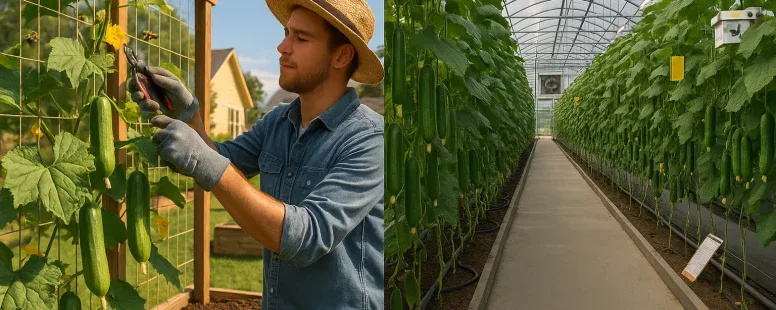
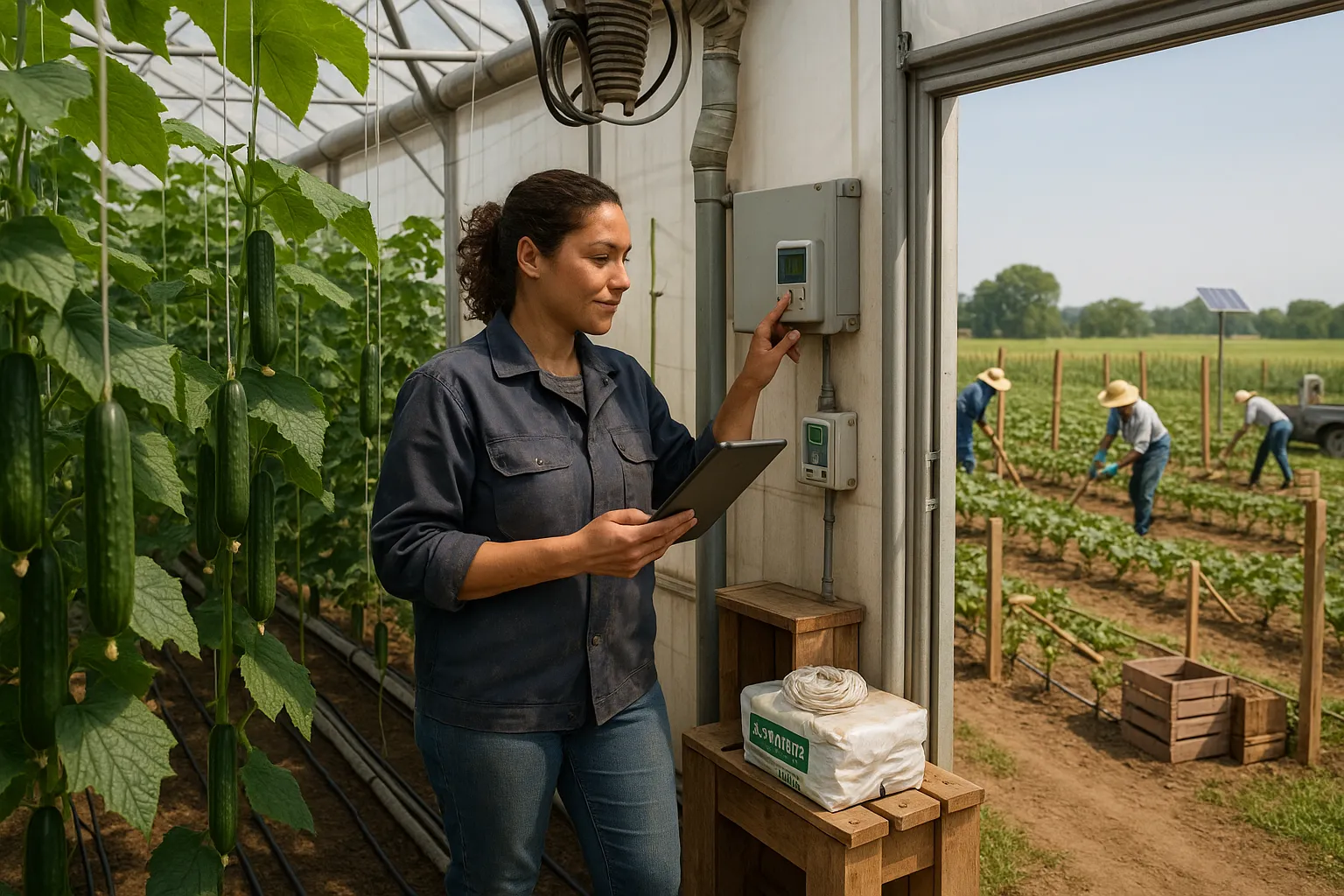
You can grow cucumbers in a backyard trellis or inside a heated greenhouse, but the experience, risks, and rewards differ sharply. Picture the sun warming leaves and bees humming through a summer morning, versus the steady hum of fans and the controlled scent of moist soil in a greenhouse. Each option gives you a different set of advantages: outdoor culture is low-cost and pollinator-friendly: greenhouse culture boosts yield, extends season, and reduces some pest pressures. This article compares those two approaches side-by-side so you can choose the one that matches your climate, market goals, and appetite for hands-on management.
Quick Comparison Snapshot
Fact: Greenhouse production typically yields more and extends season: outdoor is cheaper and simpler.
If you need a one-line decision: choose outdoor for low startup cost and simple labor: choose greenhouse for higher, more predictable yields and season control. Outdoor cucumbers depend on local weather, pollinators, and shorter seasons. Greenhouse cucumbers depend on infrastructure: climate systems, pollination workarounds, and continuous labor.
Outdoor: low investment, natural pollination, variable yields, greater pest exposure.
Greenhouse: higher capital and operational cost, year-round or off-season supply, better fruit quality, and reduced rain-related disease.
This snapshot primes the choice. Read the sections below to match these facts to your goals and local conditions.
Growing Conditions And Climate Requirements
Fact: Cucumbers need warm soil, bright light, and consistent moisture: greenhouse lets you control these precisely.
Soil, Light, Temperature And Humidity Needs
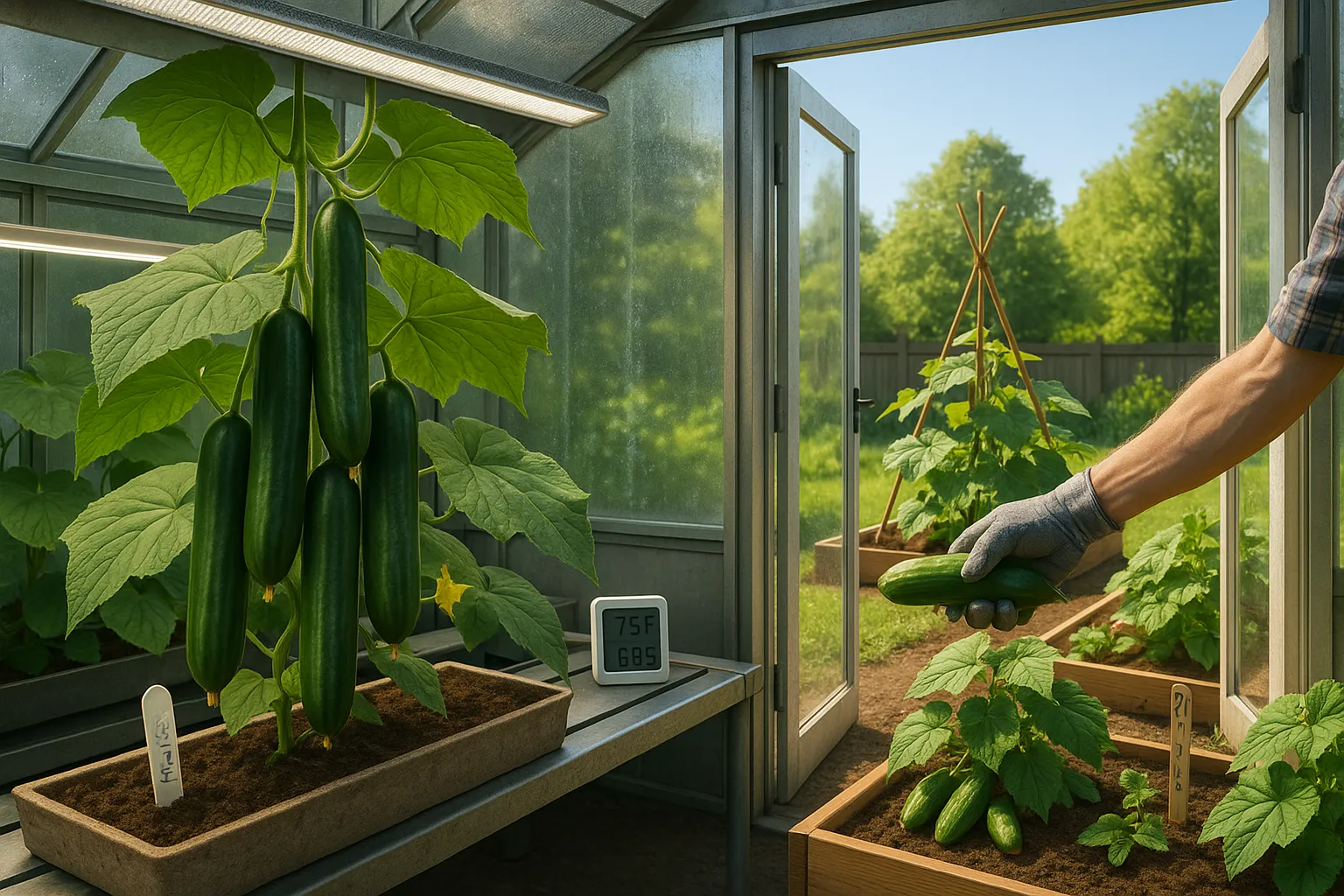
Cucumbers prefer well-drained loam with organic matter. Outdoors you adjust soil with compost and raised beds. In greenhouses you grow in beds, pots, or soilless mixes like coconut coir. Light matters: full sun outdoors gives high photosynthesis: inside, you may need supplemental LED lighting in low-light months. Temperature range is clear: daytime 70–85°F and nights above 60°F optimize growth. Humidity should sit around 60–75% for good fruit set: greenhouses let you keep humidity stable, outdoor environments change hourly.
Season Length And Temperature Thresholds For Outdoor Versus Greenhouse
Fact: Outdoor season limits you to frost-free months: greenhouses multiply your growing window.
In temperate zones you get roughly 3–4 months of reliable cucumber production outdoors. Frost kills vines. In a heated greenhouse you can grow cucumbers nearly year-round where heating is economical. Use thermal screens and night insulation to lower fuel use.
Variety Selection For Each Environment
Fact: Choose varieties by setting: open-pollinated or slicer types work outside: parthenocarpic and gynoecious hybrids often work best inside.
Outdoor you lean to disease-resistant slicers like ‘Marketmore’ or pickling varieties such as ‘Boston Pickling.’ In greenhouses you prefer parthenocarpic hybrids (e.g., ‘Tasty Green’ or ‘Safari’) that set fruit without bees and produce uniform, long fruits favored in markets. Select based on heat tolerance, disease resistance, and growth habit (vining vs. bush).
Yield, Harvest Timing, And Crop Scheduling
Fact: Greenhouse systems usually double or triple outdoor yields per square foot due to denser planting and longer season.
Typical Yields Per Plant And Per Area
A healthy outdoor vine yields about 10–20 lb per plant in a season, depending on variety and care. In a greenhouse, intensively trained vines can yield 30–60 lb per plant yearly when grown continuously. Per area, expect outdoor yields of 200–600 lb per 1,000 sq ft over a season: greenhouses commonly exceed 1,000 lb per 1,000 sq ft annually under good management.
Harvest Frequency, Fruit Size, And Quality Differences
Fact: Greenhouse cucumbers offer consistent fruit size and more frequent harvests: outdoor harvests cluster with weather.
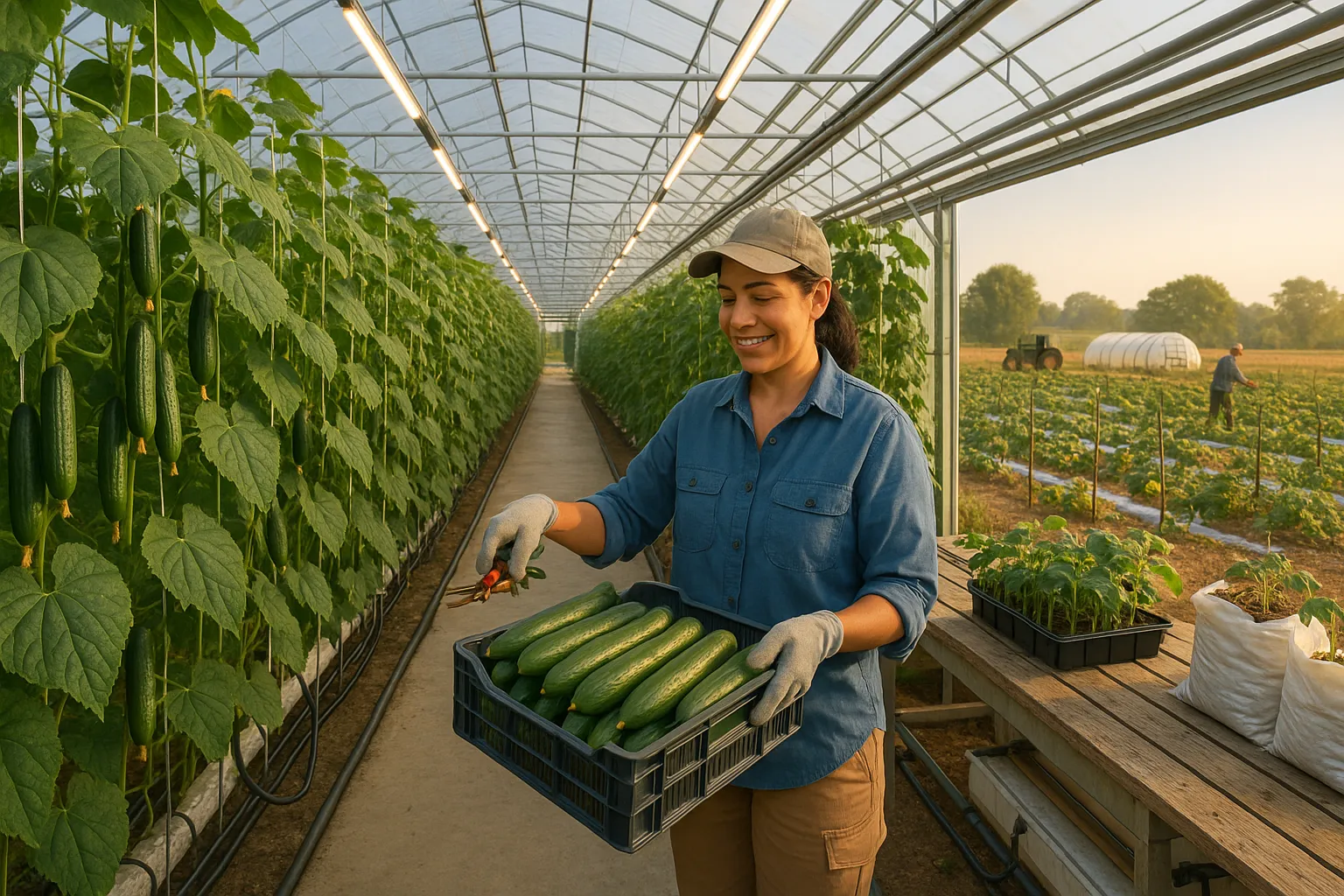
Outdoor harvests come in waves after warm spells. Fruit size can vary with heat and moisture stress. Greenhouse harvesting is steadier: you pick smaller, market-ready fruit every 1–2 days, maintaining high quality and appearance. This regularity supports restaurant and grocery customers.
Extending The Season With Greenhouse Techniques
Fact: You extend production with heat, light, and cultural tricks.
Use row covers, low tunnels, or high tunnels to add weeks outdoors. In greenhouse use supplemental lighting, night insulation, and fertigation scheduling to maintain growth through winter. Crop rotation inside containers and replacement of substrate keep soil-borne disease low so you can run back-to-back crops.
Pest, Disease, And Pollination Management
Fact: Pest and disease profiles differ by environment: pollination strategy must change when you move inside.
Common Pests And Diseases: Risk Profiles By Setting
Outdoors you face cucumber beetles, aphids, spider mites, and fungal diseases like powdery mildew and downy mildew. Greenhouses reduce beetle pressure but increase whiteflies, thrips, and spider mite outbreaks if humidity and ventilation slip. Soil-borne pathogens like Pythium and Fusarium can occur in both but flourish in poorly drained conditions.
Biological, Cultural, And Chemical Controls For Outdoor And Greenhouse Crops
Fact: Use an integrated approach tailored to each setting.
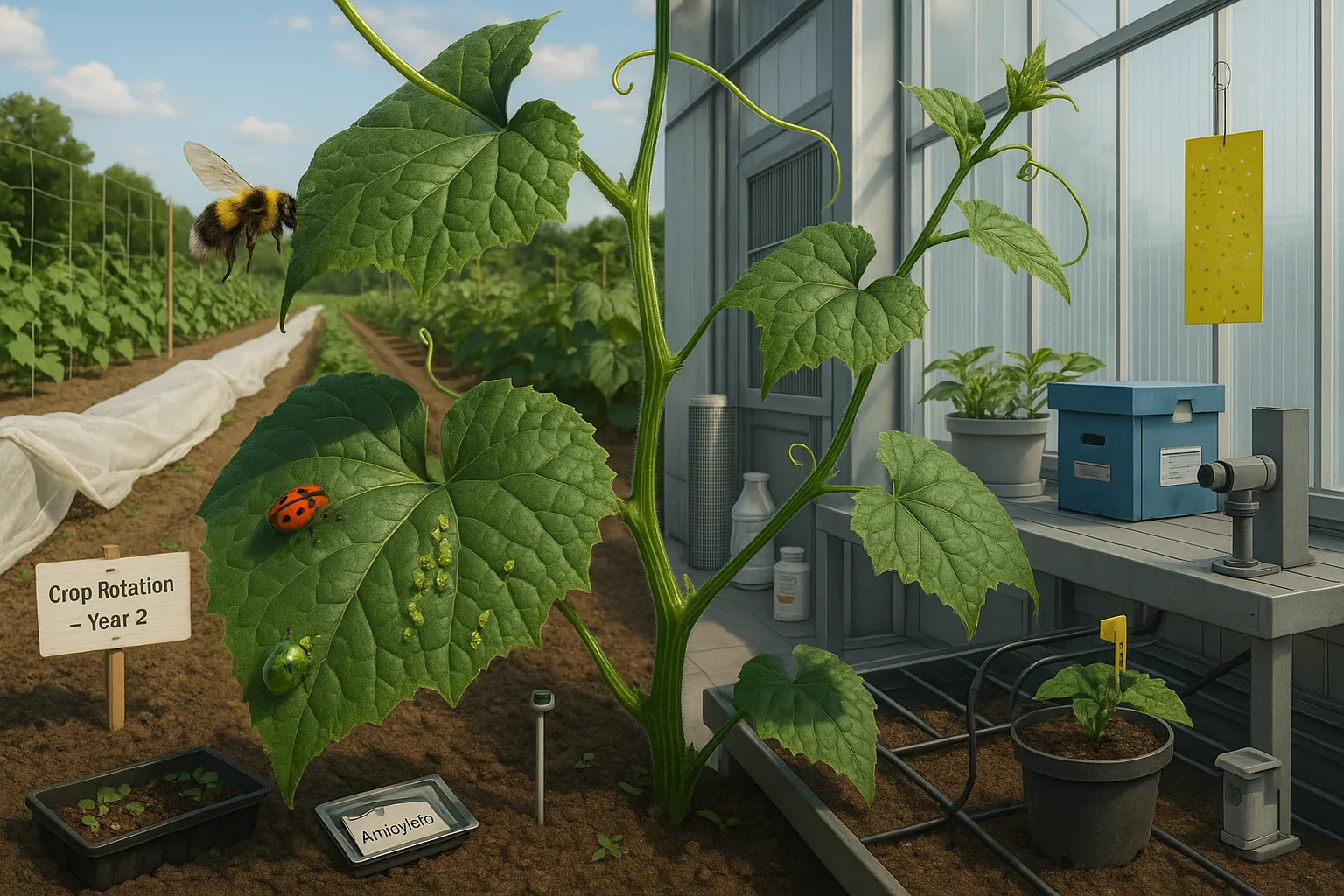
Biological control: release predatory mites (Amblyseius) in greenhouses: introduce lady beetles outdoors. Cultural control: crop rotation, sanitation, and proper spacing reduce disease. Chemical control: apply pesticides as last resort and follow label rules. In greenhouses, use sticky traps and screen vents to limit insect entry. Outdoors, row covers early in the season exclude pests and improve soil warmth.
Pollination: Open-Air Pollinators Versus Assisted Pollination
Fact: Outdoor cucumbers rely on bees: greenhouses often need assisted pollination or parthenocarpic varieties.
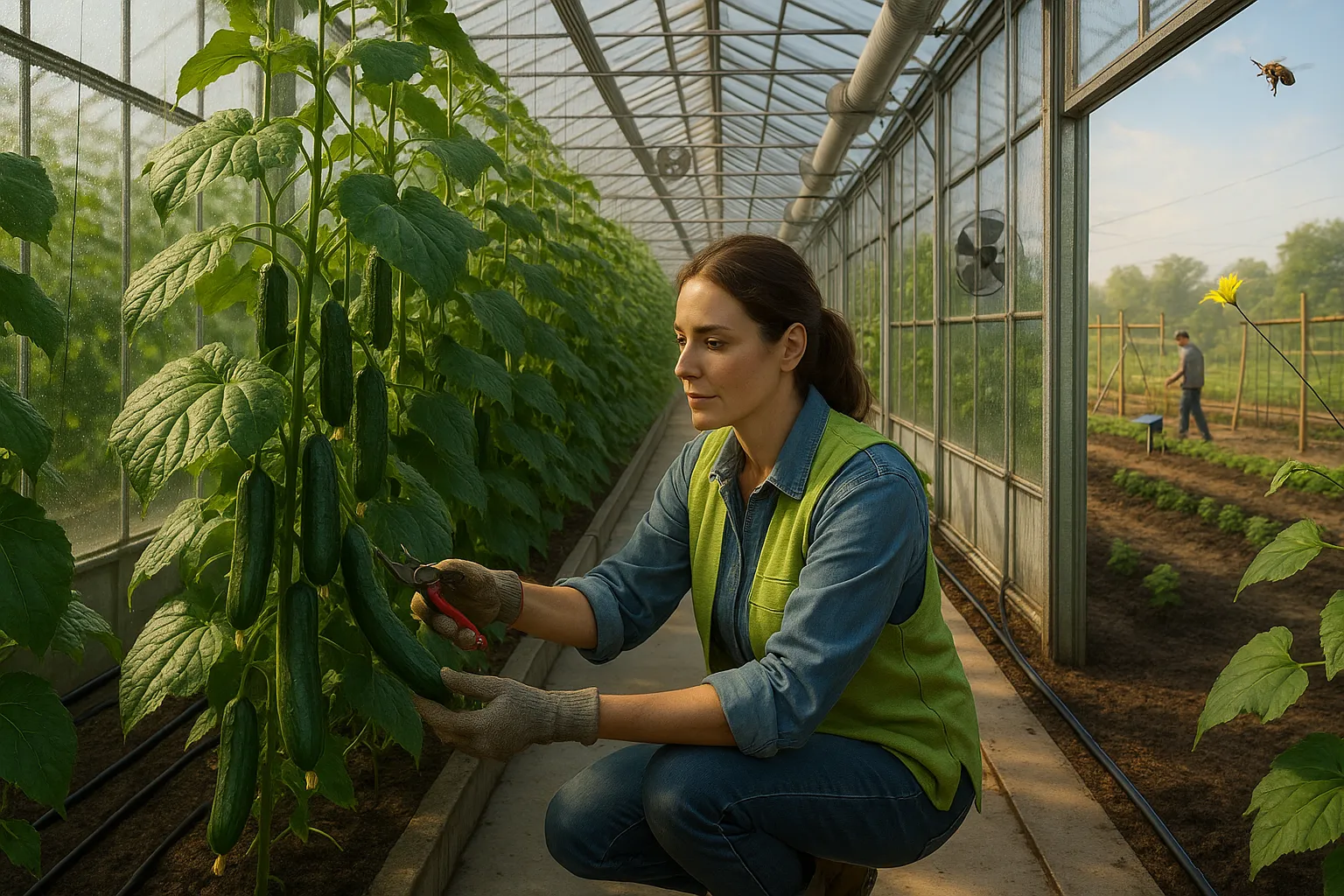
If you grow outdoors, protect pollinator habitat and avoid broad-spectrum insecticides during bloom. In greenhouses you can introduce bumblebee hives, vibrate flowers mechanically, or grow parthenocarpic (self-fruit-setting) varieties to bypass pollinators.
Costs, Infrastructure, And Labor Considerations
Fact: Greenhouses require higher upfront and operating costs: outdoor systems shift cost to labor and weather risk.
Initial Investment And Ongoing Operational Costs
Initial outdoor costs include seed, trellis material, and soil amendments, relatively low. Greenhouse startup includes structure, glazing, climate control, irrigation automation, and possibly supplemental lighting, costs run from a few thousand for hobby high tunnels to hundreds of thousands for commercial glasshouses. Ongoing costs: heating, cooling, electricity, and substrate replacement are higher in greenhouses.
Labor Requirements And Management Intensity
Fact: Greenhouses demand steady, skilled labor: outdoor work peaks seasonally.
Outdoor labor spikes during planting and harvest. Tasks are straightforward: weeding, trellising, picking. Greenhouse labor is continuous: pruning, trellising, monitoring climate, and hand pollination or hive management. You need more technical skill for greenhouse systems.
Water, Fertility, And Energy Use Comparison
Fact: Greenhouses use water and fertilizer more efficiently but consume more energy.
Drip fertigation inside a greenhouse delivers nutrients efficiently, reducing water waste. Outdoor irrigation often loses more to evaporation. But, heating and cooling make greenhouse energy bills significant. Evaluate local energy costs and water availability when choosing a system.
Best Practices For Successful Cucumber Production In Each Setting
Outdoor Best Practices: Site Selection, Supports, And Protection Strategies
Choose a south-facing site with full sun and good drainage. Improve soil with compost and test pH (ideal 6.0–6.8). Install T-post and twine trellis or A-frames to keep fruit off soil. Use floating row covers early to warm soil and exclude pests. Plant in succession every 10–14 days for continuous harvest.
Greenhouse Best Practices: Climate Control, Spacing, And Sanitation
Control temperature with ventilation, evaporative cooling, and heating. Maintain 60–75% relative humidity to limit powdery mildew but avoid high humidity that invites botrytis. Space plants according to training system, vertical trellising saves floor space. Sanitation: remove old leaves, sterilize tools, and use clean substrate to reduce disease carryover.
Planting, Maintenance, And Harvest Checklist (Actionable Steps)
Test and prepare soil or substrate.
Choose appropriate variety for setting.
Install trellis and irrigation.
Sow or transplant when soil temp > 60°F.
Prune and train vines weekly in greenhouses: pinch lateral shoots outdoors as needed.
Monitor pests and deploy biological controls early.
Harvest every 1–3 days for fresh market quality.
These steps keep tasks clear and measurable so your crop performs predictably.
How To Decide: Choosing Between Outdoor And Greenhouse For Your Goals
Fact: Your market, scale, risk tolerance, and climate should drive the decision.
Decision Factors: Market, Scale, Risk Tolerance, And Climate
Market: If you sell to restaurants year-round, greenhouse supply may pay back quickly. Scale: small hobby plots favor outdoor: commercial high-density production favors greenhouse. Risk tolerance: outdoors accepts weather variability: greenhouse reduces weather risk but adds financial risk from high costs. Climate: short, cool seasons push you toward protected culture or high tunnels.
Quick Decision Guide: When To Choose Outdoor, When To Choose Greenhouse
Choose outdoor when: you want low startup cost, you have a long warm season, you rely on natural pollinators, or you sell seasonally.
Choose greenhouse when: you need year-round supply, you seek higher and consistent yields, you can afford infrastructure, or you face heavy outdoor disease or pest pressure.
If you are unsure, start outdoors with season-extension tools like high tunnels. You can scale into greenhouse production later once you prove market demand and learn crop management. Good planning reduces surprises, but expect a learning curve, some mistakes will happen, and you’ll learn faster from them.
To provide the best experiences, we use technologies like cookies to store and/or access device information. Consenting to these technologies will allow us to process data such as browsing behaviour or unique IDs on this site. Not consenting or withdrawing consent, may adversely affect certain features and functions.
Functional
Always active
The technical storage or access is strictly necessary for the legitimate purpose of enabling the use of a specific service explicitly requested by the subscriber or user, or for the sole purpose of carrying out the transmission of a communication over an electronic communications network.
Preferences
The technical storage or access is necessary for the legitimate purpose of storing preferences that are not requested by the subscriber or user.
Statistics
The technical storage or access that is used exclusively for statistical purposes.The technical storage or access that is used exclusively for anonymous statistical purposes. Without a subpoena, voluntary compliance on the part of your Internet Service Provider, or additional records from a third party, information stored or retrieved for this purpose alone cannot usually be used to identify you.
Marketing
The technical storage or access is required to create user profiles to send advertising, or to track the user on a website or across several websites for similar marketing purposes.