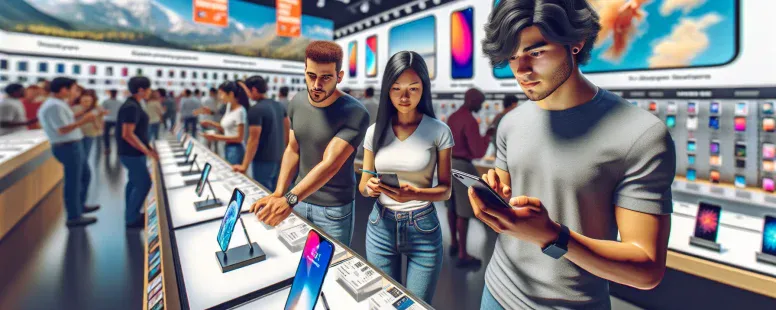
Picture yourself standing in a bustling electronics store—the hum of conversation swirling around you, the glow of sleek displays reflecting in your eyes. Rows of smartphones beckon with their polished glass and whispered promises of innovation. On one side, Apple’s iconic logo gleams like a beacon of simplicity and elegance. On the other, Samsung’s vibrant screens pulse with the thrill of cutting-edge technology.
Choosing between Apple and Samsung isn’t just about specs or price tags—it’s about the experience you crave and the story you want your device to tell. Are you drawn to seamless integration and a world where everything just works, or do you crave customization, bold features, and the freedom to shape your own tech journey? There’s more to this rivalry than meets the eye, and the surprising advantages might just change the way you see your next smartphone.
Brand Overview
When you think about Apple and Samsung, you probably recall famous logos before product specs. Storytellers at Apple cast their products as lifestyle essentials, framing the iPhone and iPad as parts of your creative journey—from sketching an idea at a cafe, to editing a video by the river. Samsung, on the other hand, paints the Galaxy lineup as the ultimate toolkit for tech explorers, always throwing in a new trick—like S Pen handwriting or foldable screens.
You see thousands of people in airports clutching MacBooks, which signals status and reliability. Others snap group selfies on Galaxy S phones at concerts, stretching wide-angle lenses to capture every edge. Users notice how Apple’s operating system feels locked-down, every setting and software update choreographed for predictability—an approach some admire for security, a few find stifling. Samsung’s Android flavor offers more tinkering freedom if you like custom widgets, diverse app stores, and even split-screen multitasking. For every rule Apple makes, Samsung seems to offer an alternative route.
Ask yourself why so many tech reviewers on YouTube unbox both brands side by side, marveling at differences in material finish, camera style, and even notification sounds. Apple’s design philosophy prizes minimalism, evident in the uniform glass, subdued metal, and single-button ethos. Samsung pursues edge-to-edge innovation, reflecting in vibrant AMOLED displays and unique features such as wireless Powershare.
The brands compete fiercely. According to Counterpoint Research (2023), Samsung held 22% of global smartphone market share, Apple trailed with 19%. Yet, in the US, Apple led with 52% consumer share, while Samsung claimed about 26%. Each strategy meets different needs: Apple nurtures loyalists in its ecosystem, with AirPods pairing instantly, or iMessage group chats flowing exclusively between iPhones. Samsung’s Galaxy Buds, watches, and tablets interconnect but also interact—sometimes awkwardly, sometimes smoothly—with a broader Android universe.
People texting from a ski lift or editing photos in a cab choose ecosystems that echo their identity, not just brand allegiance. What story are you hoping to tell with your next device?
Design and Build Quality
Picture you’re holding two smartphones—one Apple, one Samsung. Instantly, your palm feels Apple’s unibody aluminum frame, cool and seamless, while Samsung’s glass-and-metal fusion offers a slick, futuristic vibe. Would you say Apple’s iconic design language, refined since the iPhone 4, signals luxury or minimalism? Statista (2023) found that 61% of surveyed users associated Apple with “premium craftsmanship.” Meanwhile, Samsung’s Galaxy S23 Ultra radiates confidence with its squared corners and Dynamic AMOLED display. The Gorilla Glass Victus 2, used in recent Samsung flagships, often survives drops that’d make most Apple users cringe—but is durability enough if the device don’t spark aesthetic excitement?
Anecdotes abound. One traveler, after dropping her iPhone 14 Pro on concrete at LAX, still snapped sunset pics minutes later. Another creative swears by his Galaxy Z Fold 5, joking, “It’s a tablet in disguise—try reading comics on the subway, people stare.” Both brands experiment, some say Apple’s design rarely risks, others admire Samsung’s audacity, especially with foldables. Does familiarity breed comfort—or does it stifle innovation? If your phone’s a reflection of you, would you choose the timeless elegance of Apple, or the dynamic energy of Samsung?
Then there’s texture—you ever noticed the subtle haptics in an iPhone when unlocking with FaceID, or the soft matte finish of the S23 Ultra? These micro-experiences, easily missed, shape your daily interactions. Apple prioritizes precision milling and ceramic shield glass; Samsung, ultrasonic fingerprint sensors and curved edge displays. Both brands tout IP68 water resistance, but teardowns by iFixit show differences in repairability—Samsung edges ahead for modular parts, while Apple offers better, but glued-in, internals.
You might ask: do design trends reflect cultural values? Apple embodies restraint—symmetry, understated colors, and a reverence for object permanence. Samsung chases trends—sunburst hues, eco-friendly materials, foldable ambitions—channeling optimism about the future. Which speaks to you?
User Experience and Interface
You tap the glass and your story begins—Apple’s iOS cradles you in a consistent cocoon, icons gliding like marbles along a velvet path. Every gesture echoes purpose: swipe up, and multitasking unfurls in a cascade as seamless as a silk ribbon. Users describe the interface as “intuitive,” citing how settings and notifications nest exactly where you’d expect—no fishing required. The dependency links here are tightly woven: app, system, and accessory speak a unified dialect, which echoes in Apple’s infamous “It just works” mantra. According to Statista (2023), over 83% of US iPhone users report immediate comfort with the interface after switching from Android.
Walking into Samsung’s Android world, you step out on a playground with infinite climbing frames. One UI, Samsung’s skin on Android, lets you move widgets, icons, and colors like brushstrokes on a canvas. Numerous features—Split Screen, Edge Panel, S Pen gestures—invite you to build workflows as unique as fingerprints. Dependency paths sprawl: Samsung’s Galaxy ecosystem loops in wearables, foldable devices, and even Windows PCs using SmartSwitch and Link to Windows. If customization is your story’s cue, you’ll writ large on Samsung. Would you rather follow a clear footpath, or dance at the edge of the map?
Consider the learning curve: Apple’s gentle slope fits casual users—those who just want to take photos, send messages, and browse TikTok, for example—while Samsung’s broader peaks and valleys reward those who tinker, tweak, and personalize. Grandma’s transition to her first iPhone might be smooth as butter, but her Galaxy-toting grandson likely spends weeks perfecting home screen layouts. Still, fragmentation—where different Samsung devices run different Android versions—sometimes leaves users feeling lost in a funhouse of variants, say critics on Reddit’s r/Galaxy.
An anecdote breaks through the stats: During a family reunion, cousins set their phones side-by-side. The iPhone’s AirDrop shares photos in two taps, while the Galaxy sibling downloads the Quick Share app, toggles permissions, and still dazzles with support for more file types. Both tell a story about what matters more—easy predictability, or power-user flexibility.
Research from the Pew Research Center highlights that 74% of surveyed iPhone users praise consistent system updates, whereas only 48% of Samsung owners do the same. Notification systems? Apple presents banners predictably; Samsung lets you silence, snooze, or stack them with granular controls, but the options can overwhelm.
So ask yourself: Are you seeking an interface you’ll master in minutes or a playground where you script your own rules? Each approach bends to a different dependency structure, and your preference shapes which digital world you’ll call home.
Performance and Features
Performance and features shape your daily smartphone journey more than any label or logo. Both Apple and Samsung build their flagship devices for speed, power, and innovation, through each approaches their craft a bit differently.
Hardware Capabilities
Apple hardware blends the self-designed A-series chipsets with highly optimized components. Every iPhone pairs an A15 or A16 Bionic chip with tightly controlled memory and storage, producing benchmarks that routinely outpace competitors. In 2023, the iPhone 14 Pro averaged 1,870 single-core and 5,350 multi-core scores in Geekbench 5 tests (source: AnandTech). Battery efficiency follows suit, as iPhones can squeeze more screen time from smaller battery capacities; for example, the iPhone 13’s 3,240mAh cell runs neck-and-neck with Samsung models sporting 4,000mAh batteries.
Samsung carries firepower in quantity and flexibility. Top-tier Galaxy phones, like the S23 Ultra, use the Snapdragon 8 Gen 2 or Samsung’s own Exynos, paired with up to 12GB RAM—doubling most iPhones for raw multitasking. Samsung also builds hardware playgrounds: want a stylus for note-taking or doodling? The S Pen comes embedded. Need a phone that folds in half or opens like a book? Galaxy Z Fold5 and Flip5 lead the way. These features transform the device from a mere phone into a hybrid tool that’s part tablet, part workhorse, part entertainment center.
Surprisingly, device longevity sometimes plays out differently than you might expect. Many iPhone users, including creatives and business professionals, boast about five-year-old devices that “feel new,” their performance holding up thanks to hardware-software synergy. Meanwhile, Samsung fans cite panels that refresh at 120Hz for butter-smooth scrolling or praise for microSD card slots on select models—features Apple omits. If your daily workflow involves juggling apps, editing power-hungry videos, or gaming, you’ll notice the difference in sustained performance and flexibility.
Software and Updates
Apple controls both the operating system and the update cycles, so your device typically receives software support for 5-6 years. Users like Juliet, a music producer from LA, still uses her iPhone XR with iOS 17, getting new features and the latest security patches every autumn. Over 85% of iPhones globally upgrade to the newest major iOS within six months of release (source: Apple Q1 2024 Earnings Report). This consistency creates peace of mind, especially for those who depend on the latest privacy features and seamless ecosystem integrations, like AirDrop and Handoff.
Samsung’s ecosystem runs on Android with its own One UI interface layered on top. The Galaxy team pledges four years of Android OS updates and five years of security patches for many flagships (source: Samsung 2023 Press Release). But Android’s open nature means feature rollouts sometimes stagger or depend on region, carrier, and hardware. Some users, like Raj in Mumbai, received Android 13 months ahead of others in New York. But, Samsung’s regular security patches and quick bug fixes have earned praise among security-conscious users, and One UI’s customization options allow power users to mold software to their lifestyles in ways iOS simply doesn’t allow.
Questions linger: Do you value the predictability of Apple’s closed-garden approach, or do you prefer the creative chaos and customization of Samsung’s open field? Each platform tells a different story through updates, reflecting a brand philosophy that reaches beyond the home screen.
Ecosystem and Compatibility
Ecosystem integration shapes your daily tech rhythm, each brand orchestrating its own digital symphony. For Apple, seamless cohesion defines the experience—your iPhone, MacBook, iPad, and Apple Watch move as one, with Handoff, AirDrop, and Universal Clipboard creating invisible threads that tether every device together. You take a call on your Mac, your iPad pings a note to your iPhone, and a photo shared via AirDrop appears across all screens, as if by magic—Apple designed this symbiotic relationship to reward users who stay loyal to the orchard. Statistically, 88% of US iPhone owners also own at least one other Apple device, demonstrating how sticky Apple’s web can be (CIRP, 2023).
Samsung, meanwhile, spins a more open web. The Galaxy ecosystem spans phones, tablets, wearables, TVs, and even refrigerators—building connections through SmartThings and One UI’s Device Control. Picture you’re prepping dinner, glancing at notifications on your Galaxy Watch, then pulling up your shopping list on your Samsung refrigerator’s touchscreen. Not as tightly knit as Apple’s garden, perhaps, but this matrix of compatibility stretches far beyond brand lines. You pair a Galaxy S23 with Sony headphones, a Google smart speaker, or even a Windows laptop with little resistance. Android’s versatility is Samsung’s wild card.
In terms of ecosystem lock-in, Apple walks you down a single, well-paved path. Its Harmony is seductive but demanding; you gain effortless sync, but exit can mean digital culture shock. AirPods work extraordinarily well with iPhone, less so with Android. Lose an iPhone—lose the iMessage world, FaceTime group chats, even Find My device-finding magic. Apple’s closed doors guard both privacy and convenience. Samsung, conversely, lets you hop the fence more easily. Quick Share works with other Androids too, and Samsung allows you to sideload software, change app defaults, and swap default services at whim.
Lists of System Compatibility
Brand
Ecosystem Scope
Cross-Brand Integration
Device Diversity
Lock-In Difficulty
Apple
End-to-end, macOS, iOS, iPadOS, tvOS, watchOS
Limited, favors Apple devices
Moderate (14+ product lines)
High
Samsung
Android + proprietary (One UI, SmartThings)
Broad, many third-party devices
Extensive (phones, TVs, IoT, etc)
Moderate to low
Consider anecdotes—switchers often express relief at Apple’s predictability. One user describes losing a Galaxy phone, bracing for chaos, then marveling at how all photos, texts, and settings reappear on an iPhone signed in to iCloud. On the other hand, a Samsung loyalist once taught friends at a party how to stream a playlist to both Samsung TVs and portable speakers using a single swipe—something impossible inside Apple’s walls.
Think about which matters more: peace of mind from a walled garden, or the galloping freedom of an open prairie. Would you prefer a universal remote or a perfectly matching set? This decision echoes through every device you own, never just one phone at a time.
Pricing and Value for Money
Apple and Samsung shape their pricing strategies like chess masters planning calculated moves on a board. You’re standing in front of pristine white shelves dotted with iPhone 15 Pro and Galaxy S23 Ultra. Each carries a price tag that whispers stories—$999 for Apple’s flagship, $1,199 for Samsung’s most feature-packed smartphone. For mid-tier seekers, Apple’s iPhone SE (2022) lands at $429, while Samsung responds with the Galaxy A54 at around $450. What does this say about user priorities? Flexibility or a one-size-fits-all philosophy?
Comparative Pricing Table
Model
Brand
Launch Price (USD)
Notable Feature
iPhone 15 Pro
Apple
$999
A17 Pro Chip, ProMotion Display
Galaxy S23 Ultra
Samsung
$1,199
200MP Camera, S Pen Support
iPhone SE (2022)
Apple
$429
Compact Design, A15 Bionic
Galaxy A54
Samsung
$450
120Hz Display, Expandable Storage
Consumers sometimes ask, “Am I paying for lasting value or brand prestige?” A neighbor once shared that his iPhone SE outlived two of his Androids, saving him about $300 over five years. But, your cousin, who craves the bleeding-edge tech, swapped her Galaxy phone twice in three years but always enjoyed deep launch discounts—Samsung’s frequent promos often slashing up to 20% off within months after release.
“Why does Apple resist price drops or wild discounts?” one might suspect—many cite brand positioning, resale stability, and consistent hardware-software integration (IDC, 2023). Meanwhile, Samsung leans into aggressive carrier bundles and trade-ins, making its ecosystem a revolving door for deal hunters.
Value also emerges through hidden factors—warranty, software support, resale value. An iPhone from 2019 still fetches roughly 60% of its purchase price (SellCell, 2024), whereas a Galaxy S20 Ultra holds closer to 40%. If upcycling older tech means something to you, that percentage translates into future freedom—or limitation.
Can you measure value merely by upfront numbers? If you consider bundled subscriptions, Apple’s One plan wraps iCloud, Apple Music, and TV+ into one $16.95 monthly bow. Samsung counters with Samsung Care+ and 100GB of free OneDrive storage for a year.
So what tip the scale for you—stability and long-term value or up-to-the-minute features with more frequent upgrade cycles? Each pricing structure is not just a sticker on glass and metal; it’s a doorway into how you define worth. If you reached for the phone that’s easiest on your wallet, would you miss out on the story you hope it will help you tell?
Customer Support and Reliability
Ever tried calling Apple Support on a Sunday afternoon, just when your iPhone suddenly decided to ignore its own fingerprint sensor? Apple’s customer support, according to J.D. Power rankings (2023), typically answers within 3 minutes and their Genius Bar staff can feels almost like a team of tech paramedics, always ready with empathy and polish. In contrast, contacting Samsung support might seem like wandering into a digital bazaar—you’ll get regional call centers, online chatbots and a variety of service partners that offer experience as varied as Samsung’s device lineup. Which would you pick: the tailored, in-person efficiency of Apple’s in-store appointments, or the flexible but less consistent patchwork of Samsung repair shops?
Global repair turnaround times show: Apple averages 2-3 business days for standard repairs (source: Apple official site), while Samsung’s US centers report case-by-case timelines, with 44% of users reporting a 4+ day wait (Statista, 2023). This gap grows wider when you considers third-party repairs; Apple’s ecosystem may lock you in, but keeps parts and processes uniform across all official outlets. Meanwhile, Samsung’s openness encourages local experimentation, but can introduce unpredictability. A friend once described picking up his repaired Galaxy S22 as a “lucky draw”—sometimes it was flawless, sometimes his device returned with a new problem, leaving him with more questions than answers.
Data tells another story. In the US, 82% of iPhone owners report “satisfaction” with official customer support (Pew Research, 2023), while Samsung users report 68% satisfaction. Both brands offer robust warranties—Apple’s standard 1-year hardware coverage can expand with AppleCare+, while Samsung includes a similar warranty and lets you add Samsung Care+ to cover accidental damage.
One perplexing detail: Apple quietly collects diagnostics during every support visit, building model-specific reliability matrices, which sometimes prompt proactive recalls or free repairs. Samsung, though, decentralizes data gathering; this means some defects persist longer in the wild before Samsung address them. Would you rather trade privacy for proactivity, or embrace the adventure of a diverse but slower feedback loop?
Both giants have their flaws. Apple’s support stories sometimes include “genius” misdiagnoses or long Genius Bar queues, especially after new iPhone launches. Samsung’s more “democratic” repair ecosystem can leave you playing phone tag with third-party shops over a single accessory. Reliability itself is subjective: statistically, iPhones retain higher resale values and break less often over two years (Consumer Reports, 2023), but Samsung’s dust and water resistance scores top lab charts and their foldables shrug off accidents that’d leave an iPhone blinking for help.
So—if your phone tells your story, what kind of safety net do you wants for your digital double? Explore, question, compare. Customer support and reliability might not glow on a spec sheet, but these invisible threads keeps your tech life woven together, balancing peace-of-mind and possibility—like a safety harness for the climb, or a parachute stitched by your trusted brand.
Conclusion
Choosing between Apple and Samsung isn’t just about specs or price tags—it’s about what fits your lifestyle and values. Both brands offer compelling reasons to join their communities and each delivers a unique experience that goes beyond the device in your hand.
Think about what matters most to you, whether it’s seamless integration, customization, design, or long-term value. Your next smartphone isn’t just a tool—it’s a reflection of your identity and the story you want to tell every day.
To provide the best experiences, we use technologies like cookies to store and/or access device information. Consenting to these technologies will allow us to process data such as browsing behaviour or unique IDs on this site. Not consenting or withdrawing consent, may adversely affect certain features and functions.
Functional
Always active
The technical storage or access is strictly necessary for the legitimate purpose of enabling the use of a specific service explicitly requested by the subscriber or user, or for the sole purpose of carrying out the transmission of a communication over an electronic communications network.
Preferences
The technical storage or access is necessary for the legitimate purpose of storing preferences that are not requested by the subscriber or user.
Statistics
The technical storage or access that is used exclusively for statistical purposes.The technical storage or access that is used exclusively for anonymous statistical purposes. Without a subpoena, voluntary compliance on the part of your Internet Service Provider, or additional records from a third party, information stored or retrieved for this purpose alone cannot usually be used to identify you.
Marketing
The technical storage or access is required to create user profiles to send advertising, or to track the user on a website or across several websites for similar marketing purposes.