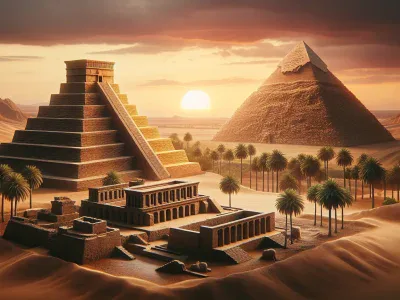
What Is Older: Pyramids or Stonehenge?
When we gaze upon ancient marvels, questions about their age often stir curiosity. Both the Great Pyramids of Giza and Stonehenge stand as testaments to human ingenuity, each wrapped in history that fascinates millions. But as we stand in awe of their grandeur, we might wonder: which came first? Are we witnessing the ancient world’s treasurers of the sun-scorched Egyptian desert, or are the weathered stones of Stonehenge the older sentinel of time? By embarking on this journey of discovery, we’ll unravel the history, purpose, and impact of these iconic structures, delving deep into what their ages reveal about our ancestors and ourselves.
The Great Pyramids of Giza

Historical Context and Construction Timeline
The Great Pyramids of Giza, particularly the Pyramid of Khufu, are emblematic of ancient Egyptian civilization. Constructed during the Fourth Dynasty of the Old Kingdom, this majestic structure was erected around 2580-2560 BC. The timeline showcases a staggering achievement, reflecting advanced engineering, organizational skills, and a societal structure that could marshal significant resources for construction.
Architectural Significance and Purpose
These pyramids served as elaborate tombs for pharaohs, designed to ensure their journey into the afterlife. Beyond mere burial sites, they stand as powerful symbols of the divine status of the Egyptian kings, demonstrating not only architectural brilliance but also deep spiritual beliefs of the time. Their alignment with celestial bodies reveals a sophisticated understanding of astronomy, underlining the pyramids’ function both as tombs and as a means to connect with the cosmos.
Cultural Impact and Legacy of the Pyramids

The cultural impact of the Great Pyramids extends beyond their physical presence. They have inspired countless generations, becoming synonymous with ancient wisdom and technological prowess. Today, they evoke notions of mysteries unsolved and achievements unconceived, serving as a critical point of pride for Egyptians and a marvel for global visitors.
Beyond tourism, they inspire literature, art, and even contemporary architecture. The pyramid form has permeated various aspects of popular culture, symbolizing not just the ancient world but humanity’s relentless ambition.
Stonehenge: An Overview

Historical Context and Construction Timeline
Dating back to around 3000-2000 BC, Stonehenge represents a pivotal moment in prehistoric Britain. While its exact purpose remains elusive, evidence suggests that it was built in several stages, culminating in the iconic stone circle we recognize today. Its construction period overlaps with the late Neolithic and early Bronze Age, highlighting a transition in human social organization and spirituality.
Architectural Significance and Purpose
Unlike the pyramids, which served a singular royal purpose, Stonehenge’s function is more enigmatic. Some propose it as a ceremonial site, while others speculate about its astronomical alignment with solstices. This ambiguity invites numerous interpretations, allowing us to view it through various lenses of ancient human life.
Cultural Impact and Legacy of Stonehenge

Stonehenge’s cultural significance cannot be understated. It has become an emblem of ancient Britain, captivating the imagination of artists, historians, and visitors alike. It draws people from around the globe, especially during summer and winter solstices, where modern-day pagans and curious tourists gather to celebrate connections to the earth and cosmos.
Also, its mysterious nature prompts profound questions, making it a focal point for theories about prehistoric rituals and community organization, so enshrining its legacy not just as a monument, but as a profound symbol of humanity’s quest for understanding.
Comparison of Dating Methods

Archaeological Findings and Implications
As we seek to determine which structure is older, we rely on various dating methods. Radiocarbon dating techniques applied to organic materials found at both sites inform us about their respective timelines. In the case of the pyramids, our oldest evidence strongly supports a date in the mid-third millennium BC. Conversely, Stonehenge’s timber structures suggest human activity dating back to earlier in the Neolithic period, around 3000 BC.
Evaluating the Evidence: Pyramids vs. Stonehenge
While both monuments exhibit impressive age, the pyramids still hold claim to being younger, positioned within the larger context of ancient civilization’s rise. The timelines suggest the pyramids emerged approximately 500-600 years after the initial construction of Stonehenge.
Conclusion
In resolving the age-old question of what came first, the Great Pyramids of Giza or Stonehenge, we find that while the latter stands slightly older, both structures invite us to ponder the extraordinary, varied tapestry of human accomplishment. As we continue to explore our history, let us appreciate the ingenuity and determination that brought these magnificent sites to life, allowing their legacies to endure well into our modern age. The civilisations behind these monuments are worth comparing too — read about what is older: Egypt or China. The ground these structures stand on has its own ancient story in what is older: Oceanic or Continental Crust. For another ancient geological comparison, see what is older: Gneiss or Dike.

- WxWidgets Alternatives for Cross-Platform GUI Development - October 22, 2026
- Best Tpu - October 21, 2026
- Mikrotik Product Comparison - October 20, 2026
by Ellie B, Site Owner / Publisher