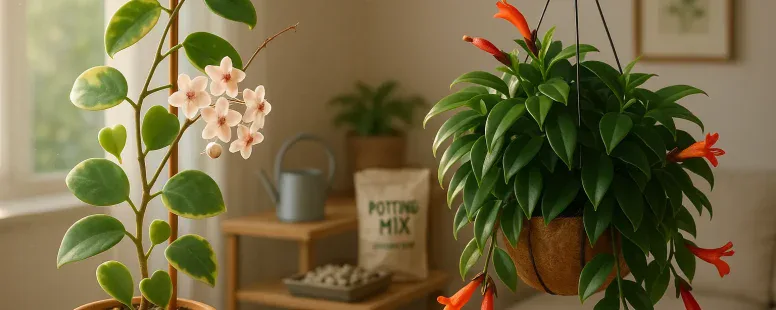
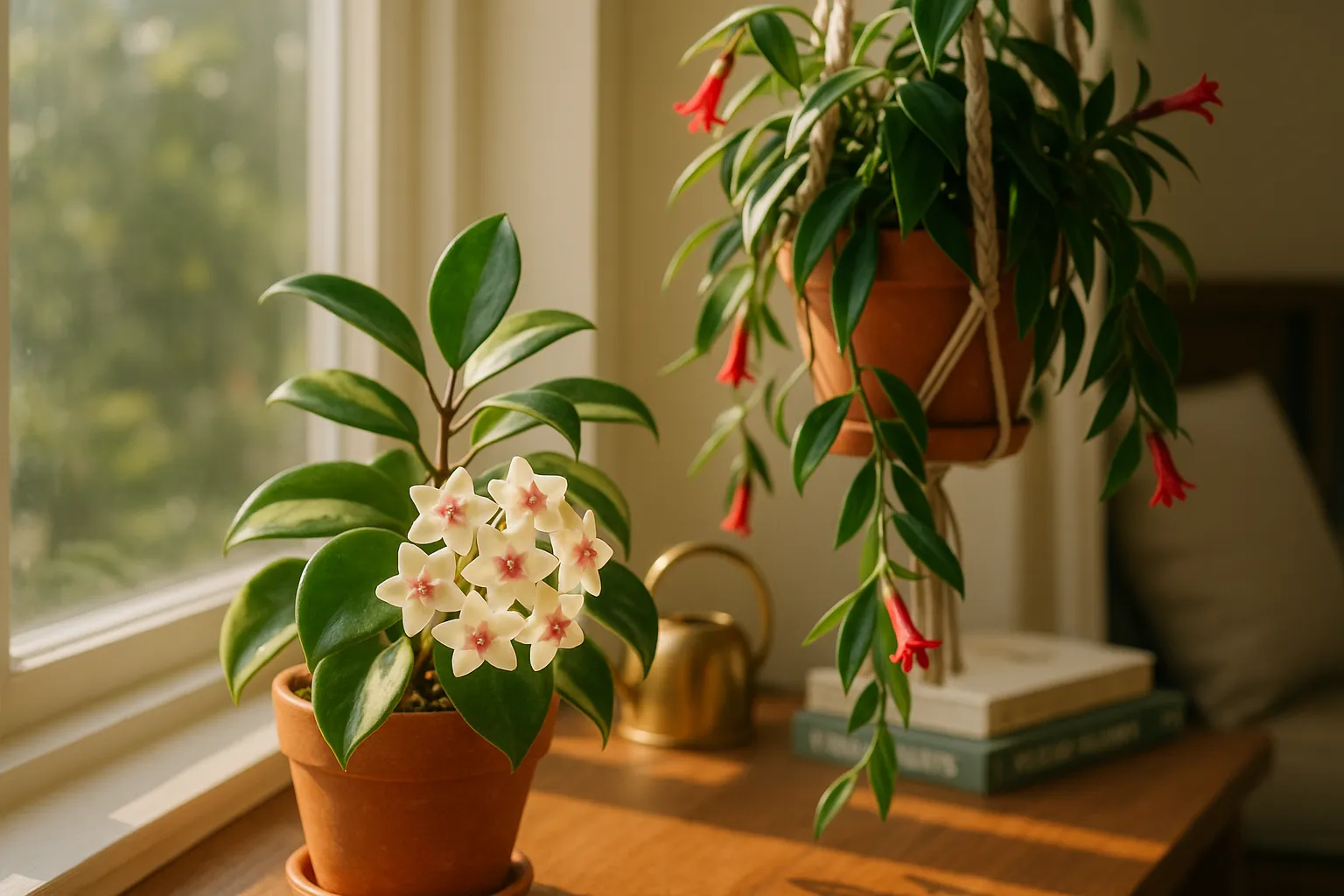
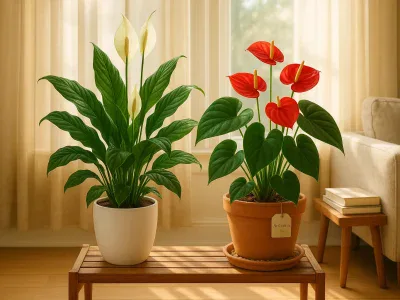
You want a houseplant that rewards attention with long-lasting flowers and a relaxed, sculptural presence. Hoyas and lipstick plants both do that, but they give you very different experiences: one offers clusters of waxy, star-shaped blossoms that feel like living jewelry: the other produces tubular, lipstick-like flowers that peek from glossy buds. Choosing between them is less about right and wrong and more about matching style, time, and space. In this guide you’ll get clear comparisons, practical care tips, and buying advice so you can pick the plant that fits your life, not the one that looks good in someone else’s photo.
Hoya and lipstick plant appear similar at first glance. Yet they differ in leaf form, flowering habits, and how forgiving they are to mistakes. Read on to learn which will thrive in your light, your schedule, and your design goals.
What Are Hoyas And Lipstick Plants? Quick Overview And Key Differences
Fact: Hoya is a genus of more than 200 species in the Apocynaceae family: lipstick plant (Aeschynanthus) is a smaller genus closely related but distinct in flower shape and growth habit.
Hoyas are epiphytic or semi-epiphytic vines native to Asia and Australia. They have thick, often succulent leaves and produce clusters called umbels of star-shaped flowers. Many Hoya species, like Hoya carnosa and Hoya kerrii, are prized for their long-lived, waxy blooms and attractive foliage.
Lipstick plants (Aeschynanthus radicans and relatives) are tropical trailing plants from Southeast Asia. They have thinner leaves and tubular flowers that emerge from colored buds, the petals look like a smear of lipstick sliding from a tube. Their blooms are typically more elongated and showy in a hanging basket.
Key differences at a glance:
Flowers: Hoyas have star-shaped umbels: lipstick plants have tubular, protruding flowers.
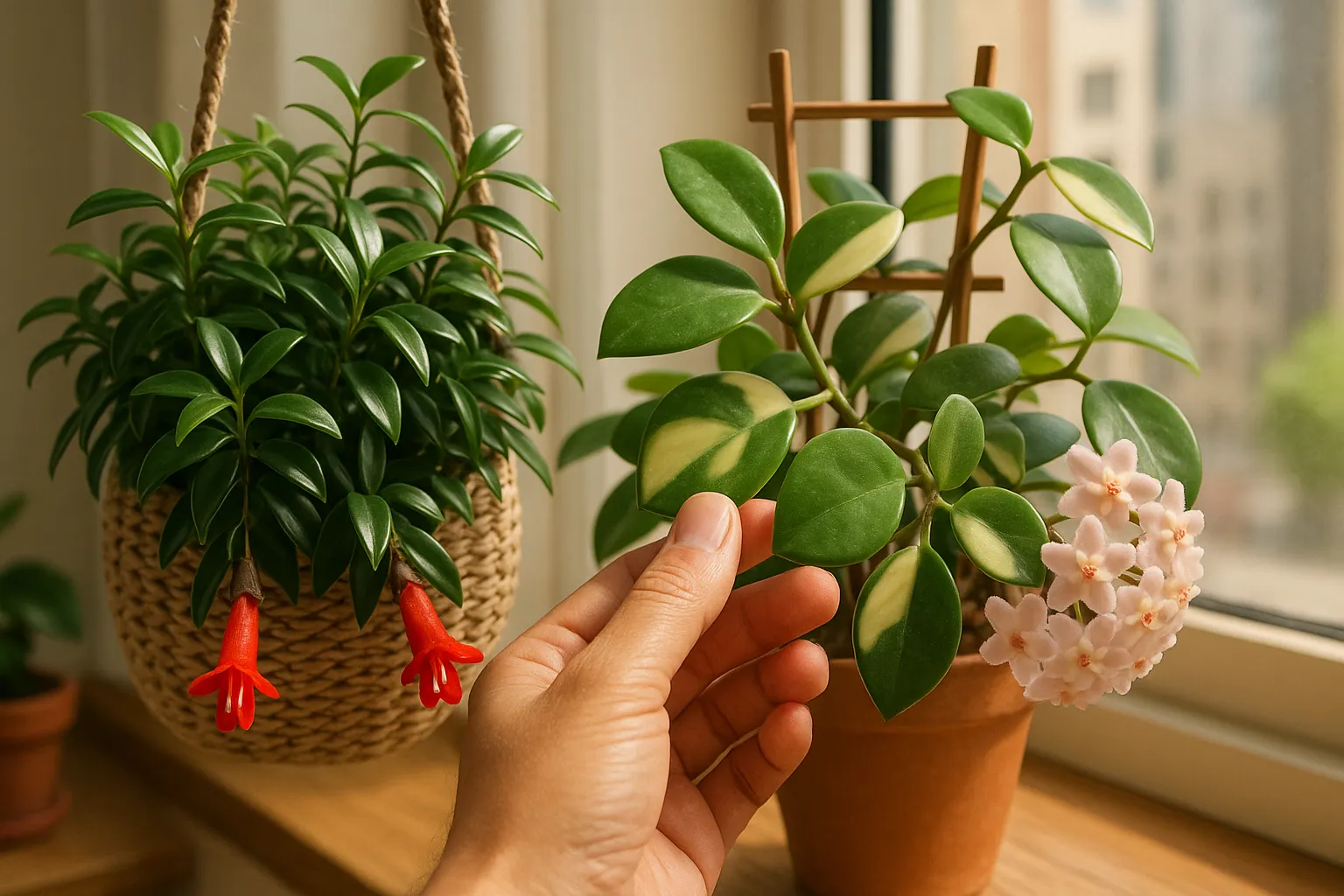
Leaves: Hoya leaves tend to be thicker and sometimes variegated: lipstick leaves are thinner and glossier.
Habit: Hoyas often form vines or clumping mats: lipstick plants trail and cascade.
Named entities: Hoya carnosa, Hoya kerrii, Aeschynanthus radicans, Royal Horticultural Society (RHS). For cultivation specifics, consult the RHS plant pages or the Missouri Botanical Garden for species profiles.
Appearance And Growth Habit: How To Tell Them Apart
Fact: You can identify these plants quickly by checking leaf thickness and flower shape.
Leaf Shape, Texture, And Color
Hoya leaves are usually thicker and may be succulent-like. Hoya carnosa shows oval leaves with occasional cream variegation: Hoya kerrii has heart-shaped leaves that collectors love. Lipstick plant leaves are thinner, elliptical, and glossy: they often have a more uniform deep green tone. If you squeeze a leaf gently, a Hoya leaf will feel firmer and springier.
Flower Structure, Fragrance, And Blooming Patterns
Hoyas produce umbels, small clusters of 5–30 star flowers. Many hoyas give a sweet, sometimes heavy fragrance in the evening (Hoya multiflora is noted for scent). Lipstick flowers are tubular with a protruding corolla, often red, orange, or deep pink. Lipstick blooms are less likely to be fragrant but very visible on a hanging basket. Hoyas will often keep individual flowers for weeks: lipstick flowers generally last several days to a week.
Size, Growth Rate, And Vining Versus Bushy Habits
Hoyas can climb or trail: some species form long vines that you train up a trellis. Growth is moderate: many species take a season to settle. Lipstick plants trail aggressively and quickly fill hanging baskets. If you want a fast-filling, trailing display choose lipstick: if you want sculptural, trainable vines, pick Hoya.
Care Requirements: Shared Needs And Important Differences
Fact: Both plants like bright, indirect light and good drainage, but they differ in water needs and tolerance for low humidity.
Light And Placement Recommendations
Place both in bright, indirect light. Hoyas will tolerate a bit more direct morning sun, which can encourage blooming. Lipstick plants prefer bright light but not harsh sun on their leaves. A south-facing window with a sheer curtain or an east-facing window usually works well for both. If light is too low, you will see leggy growth and few flowers.
Watering, Drainage, And Soil Mixes
Hoyas like to dry slightly between waterings. Use a fast-draining mix with orchid bark or perlite to mimic epiphytic conditions. Lipstick plants prefer evenly moist soil but not waterlogged conditions. A peat-based potting mix with added perlite gives them structure while draining well. Overwatering causes root rot for both: under-watering shows as shriveled leaves on Hoya and dropped flowers on lipstick.
Humidity, Temperature, And Feeding Schedules
Fact: Lipstick plants prefer higher humidity than many common Hoya species.
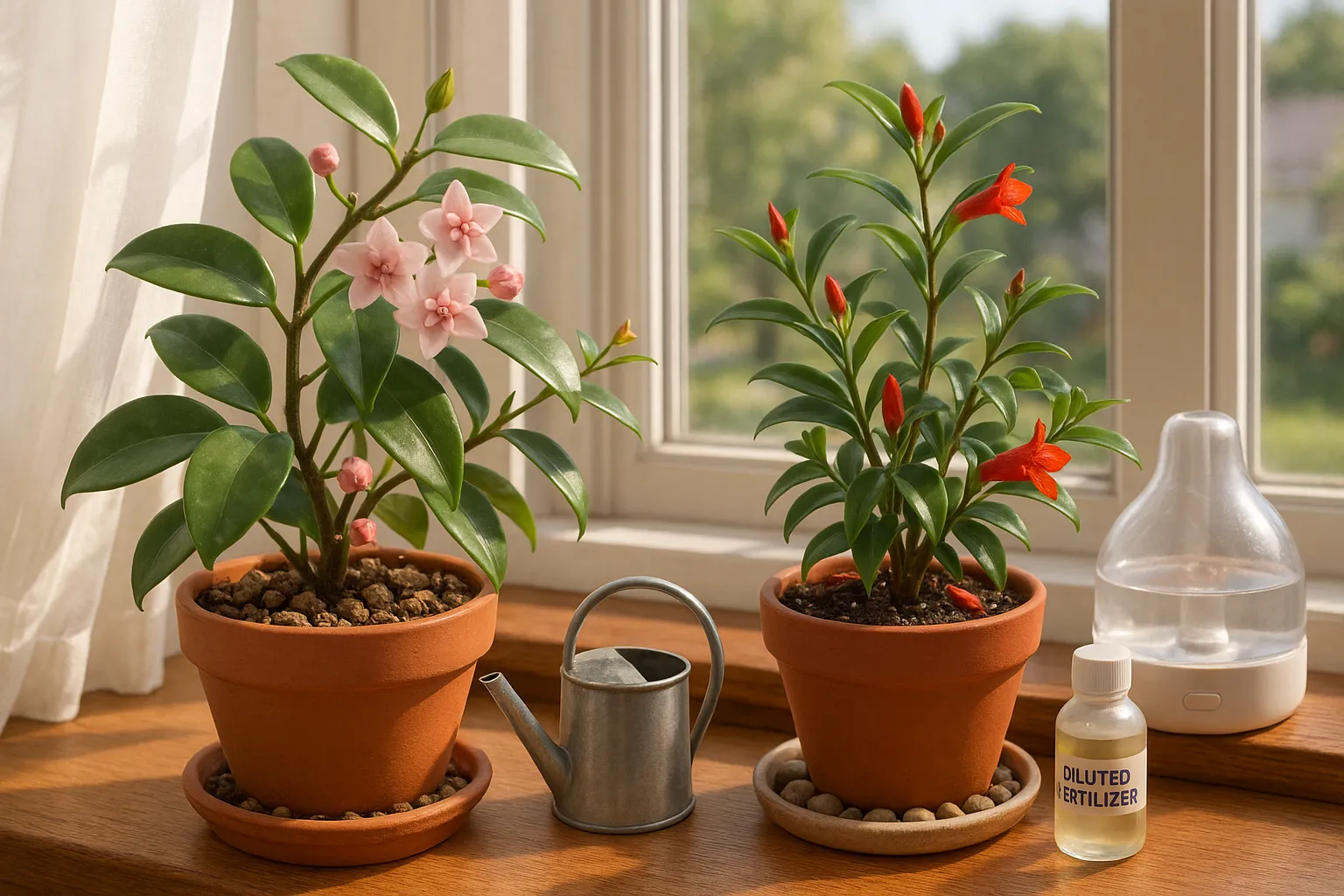
Keep temperatures between 65–80°F (18–27°C). Lipstick plants appreciate humidity above 50%: hoyas often tolerate lower humidity, especially the more succulent species. Feed both lightly during the growing season: a balanced liquid fertilizer every 4–6 weeks for lipstick and a diluted fertilizer for hoyas every 6–8 weeks. Too much nitrogen can boost leaf growth at the expense of flowers.
Propagation, Repotting, And Pruning Techniques
Fact: Both plants propagate easily from stem cuttings: methods differ slightly because of their growth form.
Propagation Methods: Cuttings, Air Layering, And Seeds
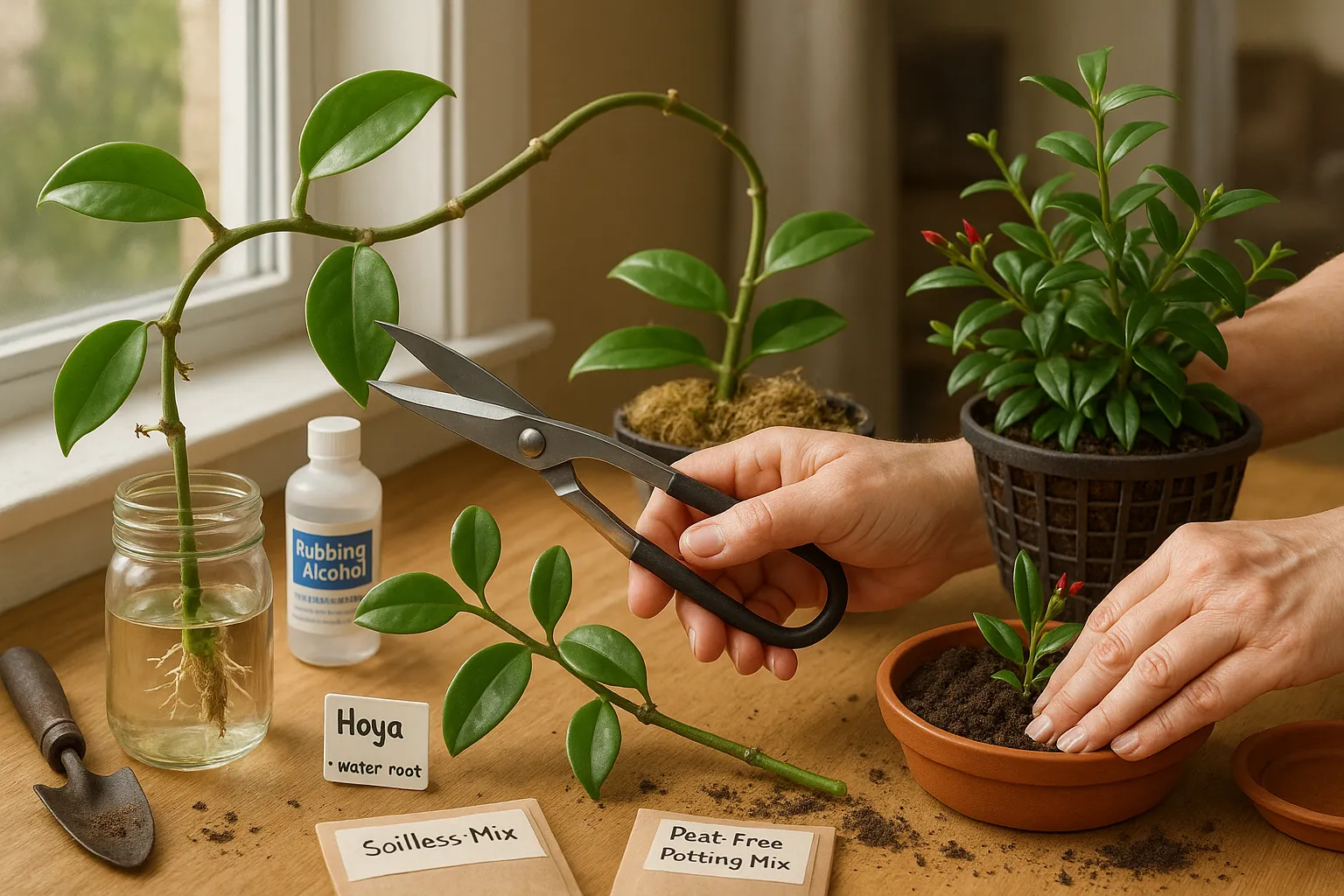
You can propagate hoyas by stem cuttings with nodes: many hobbyists root them in water or a soilless mix. Some hoyas respond well to air layering when you want to preserve a long vine. Lipstick plants root quickly from tip cuttings placed in moist potting mix. Seeds are rarely used for houseplant propagation because they take longer and lose parent traits.
When And How To Repot: Best Pot Types
Repot only when roots are tightly bound or when mix breaks down. Hoyas like slightly snug pots: growers often repot every 2–3 years. Use terracotta or plastic with drainage holes. Lipstick plants appreciate repotting yearly or every other year if they’re in small hanging baskets. Use a pot with good drainage: baskets with liner also work well.
Pruning For Shape, Blooming, And Health
Prune to shape and remove leggy growth. For hoyas, avoid cutting spurs (flowering nodes) if you want blooms: those spurs often rebloom. With lipstick plants, regular light pruning encourages bushier growth and more flowers. Sterilize tools to reduce disease spread.
Common Problems, Pests, And How To Fix Them
Fact: Most problems stem from improper water, light, or potting mix rather than mysterious disease.
Typical Leaf And Root Issues (Yellowing, Dropping, Rot)
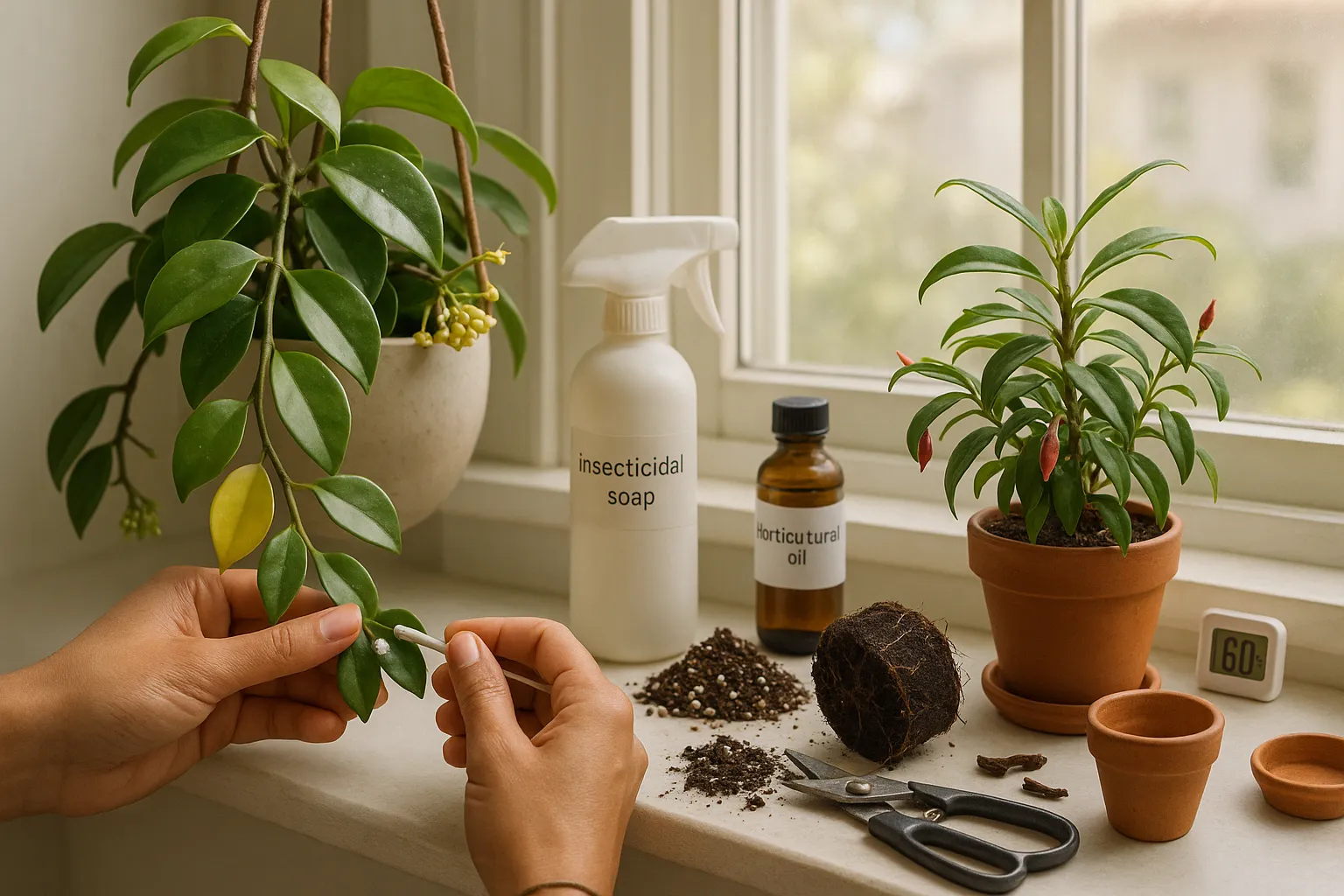
Yellowing leaves on hoyas often mean overwatering or low light. Dropping leaves on lipstick plants usually signals water stress or root damage. Soft, dark roots indicate root rot: remove affected roots and repot into fresh, well-draining mix. If only lower leaves yellow, that may be natural leaf senescence.
Insect Pests And Disease Prevention/Treatment
Both plants attract common pests: mealybugs, spider mites, and scale. Inspect new plants closely. Treat early with insecticidal soap or a horticultural oil: for mealybugs use isopropyl alcohol on a cotton swab for visible clusters. Keep humidity balanced, very dry air favors spider mites. Sanitation prevents many issues: wipe leaves, remove dead material, and isolate infected plants.
Troubleshooting Low Blooming Or Poor Growth
Fact: Insufficient light or too much fertilizer often reduces blooms.
If your Hoya won’t bloom, increase bright indirect light and cut back on nitrogen-heavy feed. For lipstick plants, ensure even moisture and higher humidity: low humidity can reduce bud set. Check for root-bound pots: cramped roots can prevent flowering. Be patient: both plants may need several months of stable conditions before they reward you with abundant blooms.
Choosing Between Hoya And Lipstick Plant: Practical Considerations
Fact: Match the plant to your light, display plans, and how much time you’ll invest in care.
Space, Display Style, And Aesthetic Goals
If you want a sculptural climber or potted piece to train on a hoop or trellis, choose a Hoya. If you prefer a dramatic hanging basket with pendulous flowers, pick a lipstick plant. For small shelves choose compact hoyas like Hoya kerrii. For long, trailing streams of color use Aeschynanthus radicans.
Time Commitment, Experience Level, And Reliability
Hoyas reward patience: they can be forgiving and live for decades with proper light. Some species slow-grow and suits intermediate growers. Lipstick plants grow quickly and bloom readily under the right conditions, making them good for beginners who can keep humidity and moisture steady. If you travel frequently and often forget watering, a Hoya’s drought tolerance will be kinder to you.
Buying Tips: Selecting Healthy Specimens And Varieties To Consider
Look for firm leaves, no sticky residue (a sign of pests), and active new growth. Avoid plants with brown mushy roots or heavy leaf drop. Consider named varieties: Hoya carnosa ‘Krimson Queen’ for variegation, Hoya wayetii for narrow leaves, and Aeschynanthus marmoratus for patterned foliage. Ask the seller about recent watering and light, and request pot condition photos if buying online.
Named entities and resources: check plant care pages at RHS and the Missouri Botanical Garden for species details and verified cultivation notes.
Call-to-action: Decide which factors matter most to you, flowers, form, or ease, then pick the species that fits. Start small, observe your plant’s responses, and adjust care: you’ll learn faster than any guide can teach. Good luck, and enjoy the flowers.
To provide the best experiences, we use technologies like cookies to store and/or access device information. Consenting to these technologies will allow us to process data such as browsing behaviour or unique IDs on this site. Not consenting or withdrawing consent, may adversely affect certain features and functions.
Functional
Always active
The technical storage or access is strictly necessary for the legitimate purpose of enabling the use of a specific service explicitly requested by the subscriber or user, or for the sole purpose of carrying out the transmission of a communication over an electronic communications network.
Preferences
The technical storage or access is necessary for the legitimate purpose of storing preferences that are not requested by the subscriber or user.
Statistics
The technical storage or access that is used exclusively for statistical purposes.The technical storage or access that is used exclusively for anonymous statistical purposes. Without a subpoena, voluntary compliance on the part of your Internet Service Provider, or additional records from a third party, information stored or retrieved for this purpose alone cannot usually be used to identify you.
Marketing
The technical storage or access is required to create user profiles to send advertising, or to track the user on a website or across several websites for similar marketing purposes.