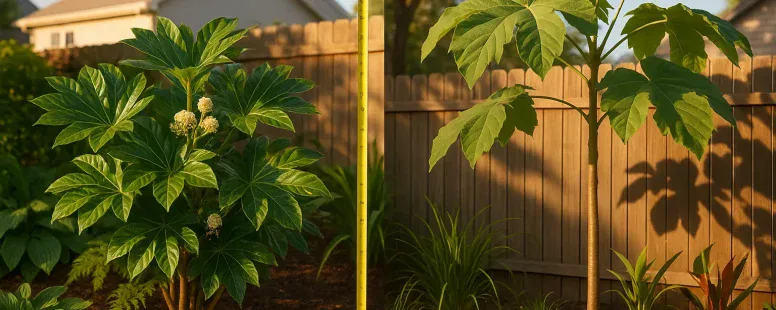
You can tell these two plants apart from across a garden bed: Fatsia japonica wears glossy, deeply lobed leaves that catch light like green fans, while Tetrapanax spreads huge, papery leaves that hint at palm-like drama. Both promise bold, tropical flair in temperate gardens, but they deliver different textures, sizes, and maintenance demands. In this comparison you’ll discover surprising uses, honest pitfalls, and practical criteria to pick the right one for your site, whether you crave a low-maintenance understory or a headline-making specimen.
Quick Comparison: Key Differences At A Glance
Fact: Fatsia japonica is a compact evergreen shrub: Tetrapanax is a larger, semi-evergreen to deciduous arborescent plant.
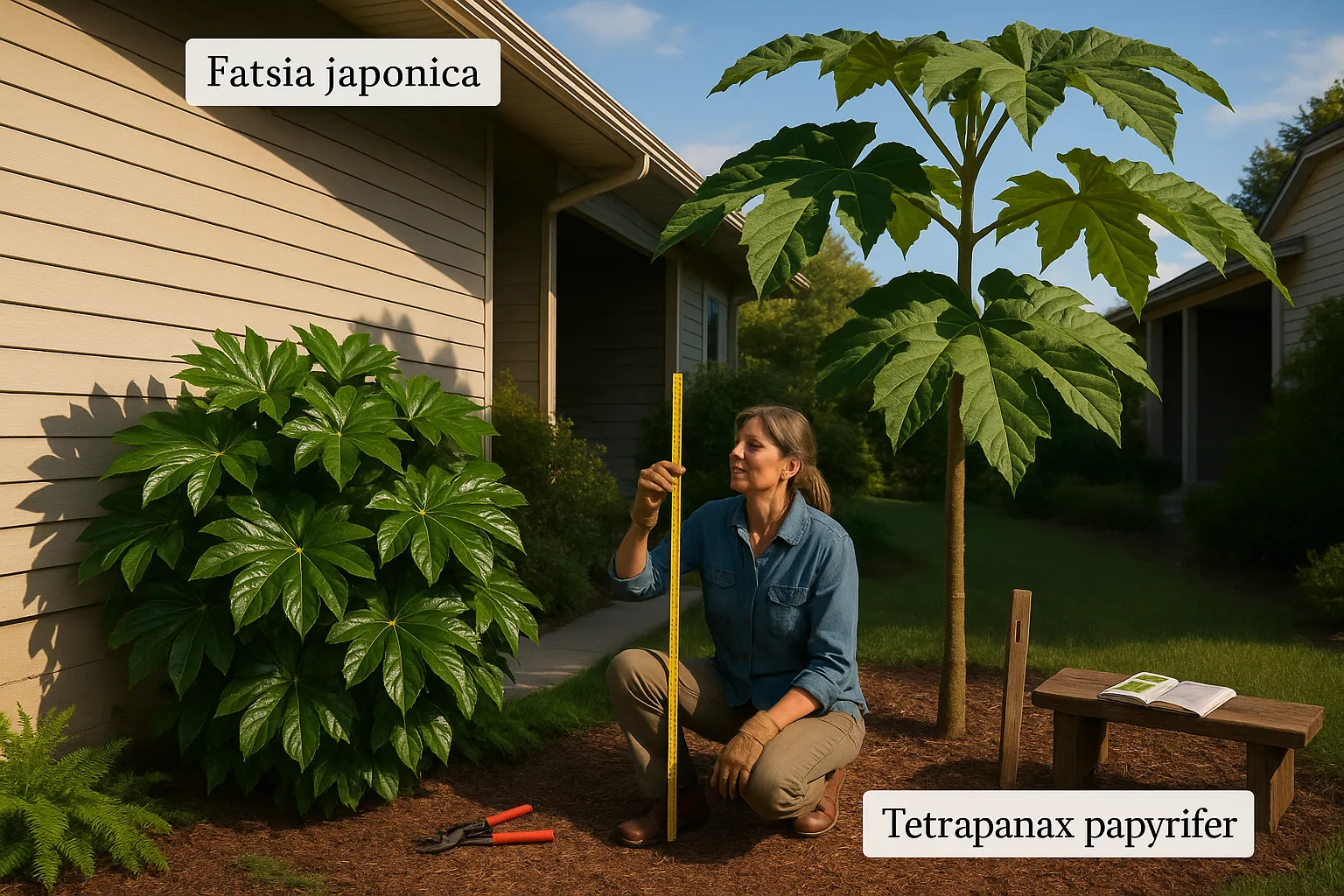
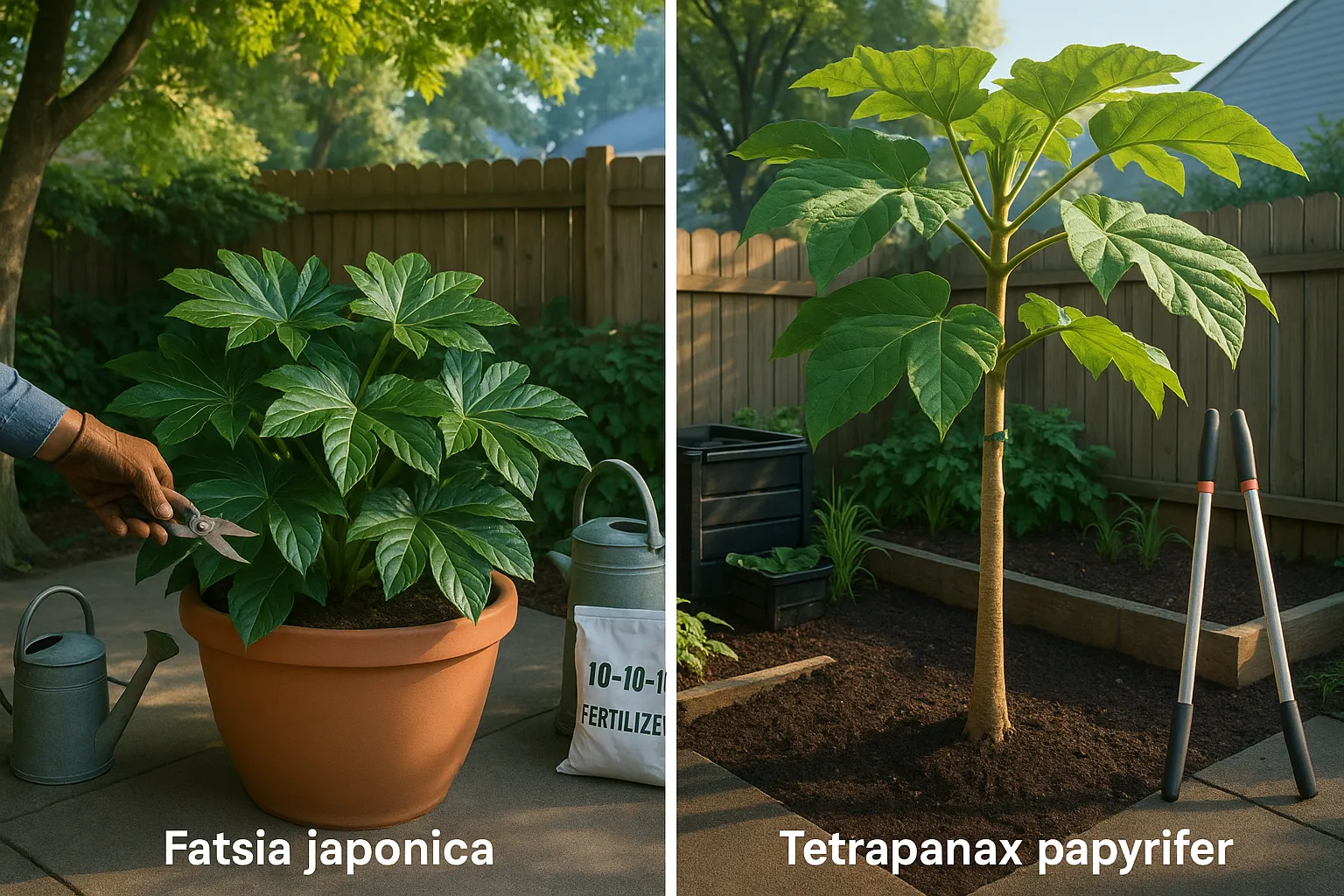
Quick facts you need first: Fatsia japonica (commonly called Japanese aralia) typically reaches 3–8 feet (0.9–2.4 m) and holds glossy, palmate leaves year-round in mild climates. Tetrapanax papyrifer (commonly called rice-paper plant) can reach 8–20 feet (2.4–6 m) with massive 2–3 foot (60–90 cm) leaves and a more palm-like silhouette.
Use these criteria to compare at a glance: size, leaf texture, hardiness, and maintenance. Fatsia fits tight spaces and shaded spots. Tetrapanax fills large borders and creates dramatic focal points. Fatsia tolerates urban pollution and limited light: Tetrapanax demands space, sun to part shade, and sometimes winter protection.
Semantic entities: Fatsia japonica, Tetrapanax papyrifer, USDA hardiness zones, Royal Horticultural Society (RHS).
Why this matters: the choice changes your microclimate, sight lines, and the amount of pruning you’ll do every season. Keep reading for botanical background and care specifics so you pick the one that thrives in your garden.
Botanical Background And Native Ranges
Fact: Fatsia and Tetrapanax come from different botanical families and regions of East Asia.
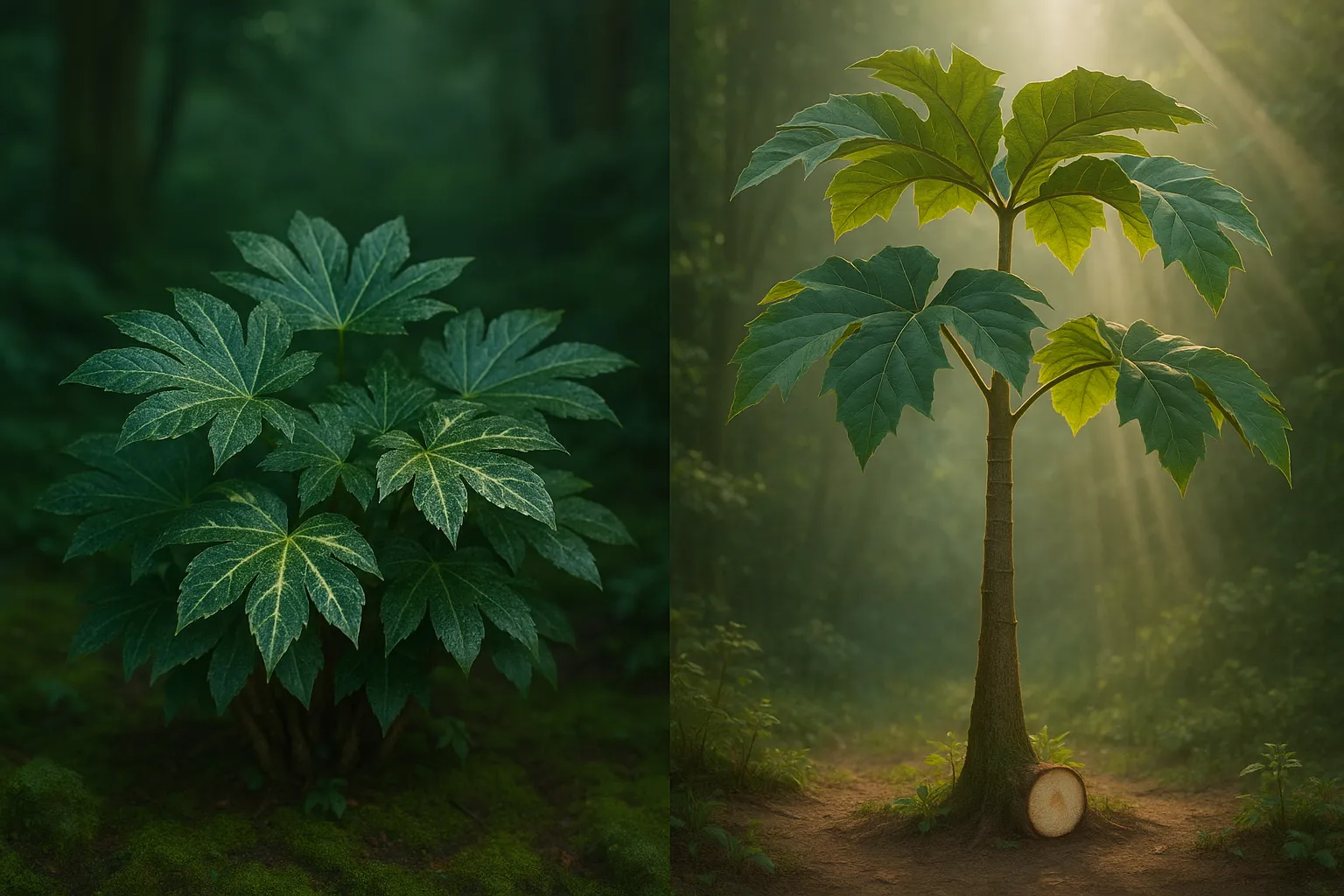
Fatsia japonica belongs to the Araliaceae family. Native to southern Japan, Taiwan, and nearby islands, it evolved as an understory shrub in cool, humid forests. Its genetic relatives include Hedera (ivy) and Aralia. The plant’s evergreen habit helped it persist under a canopy where light is filtered.
Tetrapanax papyrifer sits in the Araliaceae family too, but in a different genus: it originates from Taiwan. Historically cultivators valued Tetrapanax for its tall trunk and the pith that yields a fibrous material (used traditionally for rice-paper production), hence the common name rice-paper plant. Tetrapanax evolved to occupy disturbed slopes and forest edges where more light reached it, which explains its larger leaves and quicker vertical growth.
Named entities and sources: Royal Horticultural Society plant profiles, USDA hardiness data, historical uses in Taiwan.
Follow-up note: if you want an exact hardiness match, check USDA zone maps for your county. Both genera can show regional variability, some Tetrapanax accessions are more cold-tolerant than others, and some Fatsia cultivars (like ‘Mitsuko’ or ‘Spider’s Web’) differ in variegation and size.
Appearance, Size, And Growth Habit
Fact: Fatsia is compact with glossy palmate leaves: Tetrapanax is taller with larger, thinner leaves.
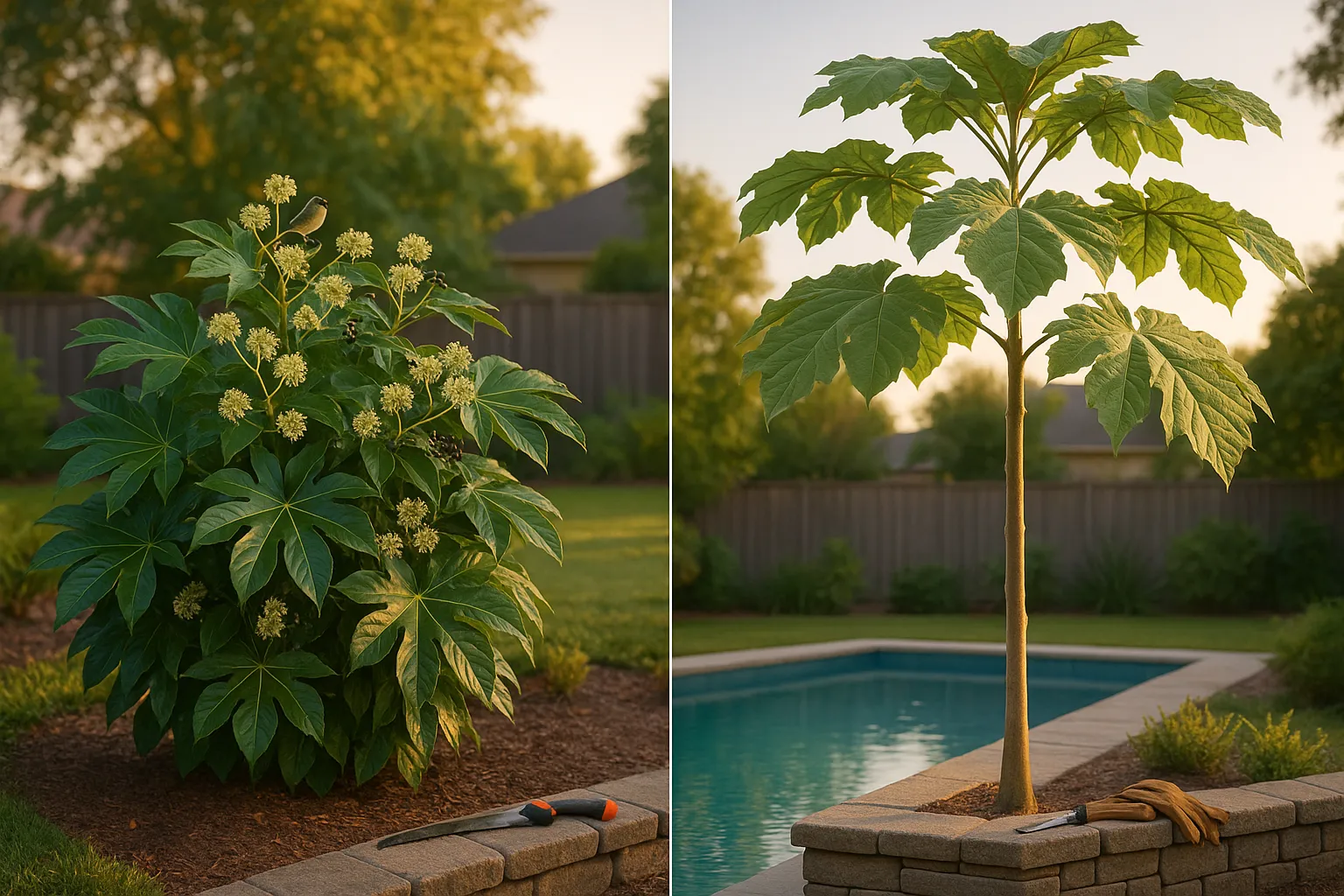
Fatsia japonica leaves measure 6–12 inches (15–30 cm) across. They have 7–9 lobes and a leathery texture. The plant forms a clump from multiple stems: older specimens can look tree-like but rarely develop a single trunk. Flowering is modest: small white umbels in autumn followed by black berries that attract birds.
Tetrapanax leaves routinely exceed 2 feet (60 cm) width and appear on a single clear trunk or a few stout stems. Leaves feel papery and slightly ruffled. In spring it may push a fast flush of growth and, in mild climates, retain much of its foliage: in colder zones it often defoliates. Its silhouette reads more like a small palm or tree, and it adds vertical emphasis where Fatsia gives mass and texture.
Anecdote: I once planted a Tetrapanax behind a pool and it created the exact tropical backdrop I wanted, guests assumed a palm group had been installed. But the spot required pruning each winter after a few cold snaps: that was a lesson in choosing location carefully.
Visual markers to choose by: leaf size (small vs large), sheen (glossy vs papery), and habit (multi-stem clump vs single trunk).
Cultivation And Care: How They Differ
Fact: Fatsia tolerates deep shade and low maintenance: Tetrapanax prefers more light, space, and richer soil.
Light, Temperature, And Hardiness Requirements
Fatsia japonica: thrives in shade to part shade and is hardy to roughly USDA zone 7 (some say zone 6b for sheltered sites). It tolerates cool, damp conditions and mild urban winters.
Tetrapanax papyrifer: prefers full sun to part shade and is generally hardy to USDA zone 8 in typical forms: some cultivars survive zone 7 with mulch and protection. Tetrapanax dislikes prolonged freezing more than Fatsia.
Practical rule: give Tetrapanax a sun sweep early in the day for best leaf development: keep Fatsia tucked under taller canopy or on a shaded patio.
Soil, Watering, And Fertilization Needs
Fatsia: tolerates a wide pH range but prefers rich, well-draining loam with steady moisture. It withstands occasional drought but performs best with regular water. Fertilize once in spring with a balanced slow-release fertilizer (for example, an all-purpose 10-10-10).
Tetrapanax: needs fertile, moisture-retentive soil with good drainage. It responds to higher fertility: apply compost in spring and a balanced feed during the growing season. Tetrapanax will show stress with extended drought, water deeply rather than frequently.
Pruning, Growth Rate, And Container Considerations
Fatsia: slow to moderate growth. Prune lightly to remove old leaves and shape: it tolerates shearing if you want a hedge. Fatsia adapts well to large containers (20+ inches) and makes an excellent patio focal point.
Tetrapanax: faster growth and larger final size. Prune to maintain a single trunk or to reduce spread: you may need mechanical pruning tools on mature plants. Tetrapanax can grow in very large containers but will need frequent repotting and winter protection.
Warning: Tetrapanax can become top-heavy and may flop in wind if not staked or properly sited.
Propagation, Pests, And Common Problems
Fact: Both species propagate by cuttings and root division: Tetrapanax also establishes from suckers and seed readily.
Propagation Methods And Timing
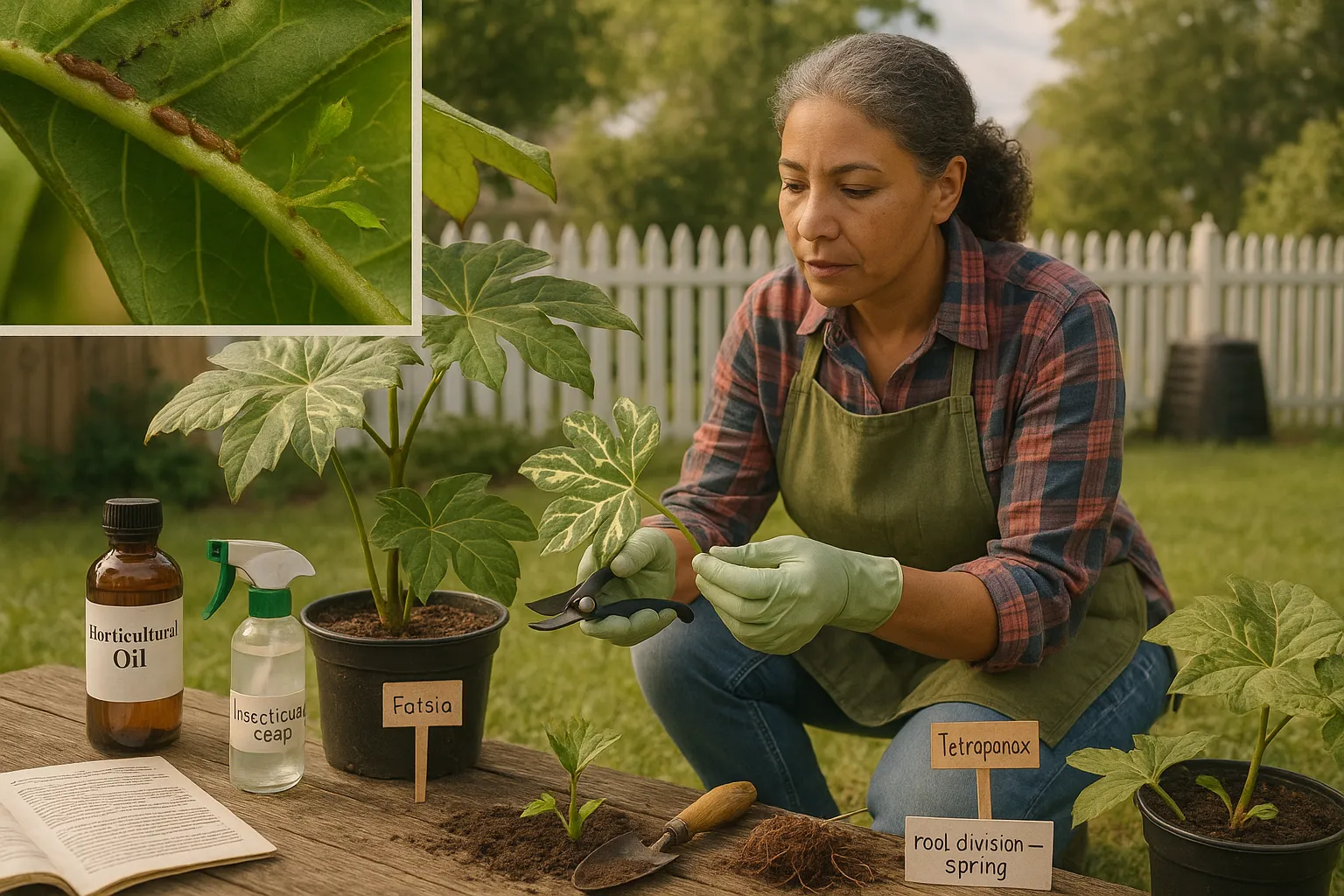
Fatsia propagation: take semi-ripe cuttings in summer or divide clumps in spring. Root cuttings in a moist, well-draining medium with bottom heat for best results. Variegated cultivars propagate by cuttings to retain leaf patterns.
Tetrapanax propagation: propagate by softwood cuttings in late spring or by seed sown fresh: larger specimens produce basal suckers that root easily. If you want a single-trunk specimen, remove suckers promptly.
Pests, Diseases, And Troubleshooting Tips
Common pests: scale insects and aphids show up on both. Use horticultural oil in spring for scale and a mild insecticidal soap for aphids.
Diseases: Fatsia can suffer from leaf spot in poorly-drained soils: Tetrapanax may develop root rot if overwatered in heavy soils. Both can show winter scorch in exposed cold sites.
Troubleshooting: yellowing leaves on Fatsia often indicate too much sun or poor drainage. Browning edges on Tetrapanax usually indicate cold damage or salt spray. If you spot dieback, cut to healthy tissue and check for scale under the leaf axils.
Named resources: use local extension services (for example, your county extension office) for region-specific disease identification and treatment recommendations.
Landscape Uses, Design Ideas, And Pairings
Fact: Fatsia works as a shade filler and container plant: Tetrapanax makes a bold vertical accent or backdrop.
Design idea for Fatsia: plant a trio of Fatsia japonica ‘Variegata’ beneath an oak or next to a shaded patio. Pair with hostas (Hosta spp.), ferns (Polystichum or Dryopteris), and groundcovers like Lamium for layered texture. Its evergreen foliage keeps the bed interesting in winter.
Design idea for Tetrapanax: place Tetrapanax behind lower shrubs like Ceanothus or Lavandula to create a dramatic tropical backdrop. Combine with Canna, Phormium, and ornamental grasses for a poolside or Mediterranean-influenced scheme.
Public-space use: Tetrapanax suits large parks and hotel landscapes where scale is needed. Fatsia fits courtyards, shady streetscapes, and as underplanting for magnolia and camellia.
Pairing tip: consider seasonal contrast, Fatsia’s evergreen glossy leaves set off spring bulbs: Tetrapanax’s large leaves frame summer-flowering specimens and hide structural elements you don’t want seen (compost bins, fences).
Choosing Between Fatsia Japonica And Tetrapanax
Fact: choose Fatsia for shade, compact sites, and low maintenance: choose Tetrapanax for scale, drama, and sun-exposed sites with room.
Site-specific recommendations and final selection criteria:
Space: if your site is under 10 feet across, pick Fatsia. If you have a 10×10 ft or larger bed with headroom, Tetrapanax is a candidate.
Light: choose Fatsia for deep shade: choose Tetrapanax for part shade to full sun.
Climate: in USDA zones 7 and colder, favor Fatsia unless you can protect Tetrapanax in winter. In zones 8–10, both will flourish, Tetrapanax will simply be larger.
Maintenance: pick Fatsia if you want low pruning and container ease. Pick Tetrapanax if you accept pruning, potential winter care, and more vigorous feeding.
Design intent: choose Fatsia for a polished, evergreen texture: choose Tetrapanax when you want striking tropical scale and a focal point.
Honest warning: Tetrapanax can overwhelm small yards quickly and may require removal if sited poorly: Fatsia can become leggy in too much shade and may look sparse without companion plants.
Call to action: measure your space, note your USDA zone and light exposure, then trial a single specimen (or container-grown plant) for one season before committing to a mass planting. If you’re leaning to a low-fuss planting, start with Fatsia: if you’re chasing drama and have the room, try Tetrapanax, but be ready to prune and protect after harsh winters. Good luck, and enjoy watching whichever you choose shape your garden.
To provide the best experiences, we use technologies like cookies to store and/or access device information. Consenting to these technologies will allow us to process data such as browsing behaviour or unique IDs on this site. Not consenting or withdrawing consent, may adversely affect certain features and functions.
Functional
Always active
The technical storage or access is strictly necessary for the legitimate purpose of enabling the use of a specific service explicitly requested by the subscriber or user, or for the sole purpose of carrying out the transmission of a communication over an electronic communications network.
Preferences
The technical storage or access is necessary for the legitimate purpose of storing preferences that are not requested by the subscriber or user.
Statistics
The technical storage or access that is used exclusively for statistical purposes.The technical storage or access that is used exclusively for anonymous statistical purposes. Without a subpoena, voluntary compliance on the part of your Internet Service Provider, or additional records from a third party, information stored or retrieved for this purpose alone cannot usually be used to identify you.
Marketing
The technical storage or access is required to create user profiles to send advertising, or to track the user on a website or across several websites for similar marketing purposes.