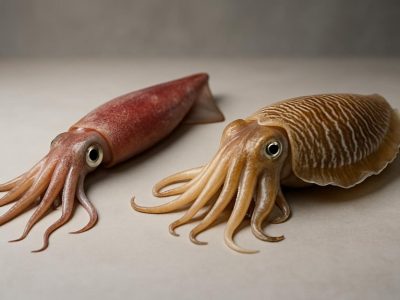
Picture yourself gliding through crystal-clear waters, sunlight dancing on rippling waves as two mysterious creatures dart past—one with a sleek, torpedo-shaped body, the other unfurling its arms like silk ribbons in the current. You might wonder if these underwater wonders are just distant cousins or if there’s a world of difference beneath those tentacles.
As you explore the secrets of the ocean, knowing what sets a squid apart from an octopus can unlock a whole new layer of fascination. Beyond their mesmerizing movements and otherworldly appearance, these animals reveal surprising advantages in survival, intelligence, and even cuisine. Ready to dive deeper and discover what truly separates these captivating cephalopods?
Overview of Squid and Octopus
Squid and octopus, both cephalopods within the class Mollusca, differ in evolutionary lineage, behavior, and physiology. You’ll find squid, like the Humboldt squid and giant squid, often glide in open waters using triangular fins. Octopuses, such as the common octopus and mimic octopus, typically crawl along rocky sea beds with rounded heads and flexible bodies. Scientists at National Geographic observe that squids can reach lengths up to 43 feet (Architeuthis dux), while octopuses rarely exceed 16 feet (Enteroctopus dofleini).
Adaptation stories emerge when you look at each animal’s arms—octopuses display eight muscular arms lined with suckers, excel at squeezing through tiny gaps, and hide with advanced camouflage. Squid have eight shorter arms and two specialized tentacles tipped with hooks or pads, which enable rapid, dart-like predatory strikes. Which defense sounds more effective—octopus ink clouds perfectly blending into a coral outcrop or squid jetting away at startling speeds with ink-smeared trails?
Marine biologists document that squid live mostly in schools and communicate with dynamic chromatophore color displays, while octopuses lead solitary lives, showing curiosity and puzzle-solving prowess. why some cultures revere octopus intelligence but regard squid as a seafood delicacy? That highlights how cephalopods’ adaptations, from bioluminescent flashes to escape artistry, intertwine with human fascination.
The taxonomy matrix below compares core entities:
Feature
Squid (Teuthida)
Octopus (Octopoda)
Habitat
Pelagic, open ocean
Benthic, rocky or sandy areas
Arm structure
8 arms + 2 tentacles
8 arms only
Social behavior
Schooling, group hunting
Mostly solitary
Longevity
1–2 years [NOAA]
1–5 years [NOAA]
Notable examples
Humboldt squid, giant squid
Common octopus, mimic octopus
You get to journey through evolutionary marvels here; squid and octopus show contrasting approaches to intelligence, mobility, and self-defense, whether drifting in twilight zones or outwitting a predator in a tidepool.
Key Physical Differences
Key physical differences between squid and octopus shape your entire perception of these cephalopods. Both share underwater mastery but display distinct body forms, appendages, and visual profiles.
Body Structure
You’ll spot the biggest contrast in body structure when you picture a squid’s sleek torpedo body with triangular fins trailing behind—think of the Humboldt squid (Dosidicus gigas) darting in the open Pacific. In contrast, you’d see the common octopus (Octopus vulgaris) with its soft, rounded mantle and no fins. Squids have a rigid pen (internal shell) that supports swimming in currents, but octopus lack this, letting them squeeze through dime-sized cracks during escape stunts. Photographers often chase giant squid with their elongated frames, yet divers marvel when an octopus folds its body flat, hiding in coral crevices. Which adaptation would you bet is more effective for survival?
Arms and Tentacles
Eight arms define both species, but that’s just the beginning. Squids add two longer tentacles—with club-shaped tips—for precise prey capture, a trait visible in fast hunters like the giant squid. Suckers on their arms line up in two neat rows, making it easier to grip slippery fish. Octopuses, including the mimic octopus, boast suckers covering every inch of their eight flexible arms, each possessing independent nerve bundles (see Huffard, 2010, Biol. Lett.). No tentacles, just arms—so an octopus can contort around rocks, pop open jars, and even mimic other animals. Have you watched an octopus unscrew a bottle or a squid snatch a shrimp mid-swim? The difference is unmistakable.
Size and Appearance
You get everything from thumb-sized pygmy squid to the monumental 14-meter-long giant squid (Architeuthis dux)—making squid size more variable by orders of magnitude. Most octopuses stay small, like Octopus joubini, but specimens like the North Pacific giant octopus can reach 30 kg, though their sprawling arms make them look even larger. Color and pattern surprises abound: squid shift like strobe lights for social signaling, while octopuses display a painter’s palette of hues and textures for camouflage. Can you picture what a diver sees when an octopus vanishes against ochre sands, while a nearby squid flashes colors in open water? Their appearances tell their evolutionary story all in one glance.
Habitat and Behavior
Squid and octopus, both masters of adaptation, occupy distinct spaces in the marine world. Where you find them tells a story about their evolution, survival, and mysterious ways.
Habitat Preferences
Squid usually inhabit open ocean environments—pelagic zones filled with shifting light, vast schools, and relentless predators. You’ll often spot species like the Humboldt squid off the coasts of Chile and Peru, forming dense groups that shimmer below fishing boats (NOAA Fisheries). Some giant squids lurk in the cold, dark depths beyond 300 meters, haunting waters near New Zealand and Japan.
Octopus prefer complexity over openness. You’re more likely to find a common octopus hiding among Mediterranean rocks, squeezed into a tiny crevice, or camouflaged against Australia’s coral reefs (Smithsonian Ocean). Their benthic lifestyle lets them vanish in a blink by blending with algae, shells, or sandy bottoms. Some like the coconut octopus use shells for armor, literally carrying home on their backs.
Hunting and Diet
Hunting behavior in squids focuses on speed, coordination, and teamwork. Squid typically hunt small fish, shrimps, and even their own kind. They attack in coordinated bursts, communicating with pulsing colors, striking prey using those two long tentacles. Picture a dozen arrows firing at once—catching prey before the victim registers any danger.
Octopus use patience, strategy, and intelligence. They stalk crustaceans—like crabs and lobsters—gliding silently and changing skin texture until they pounce. A California two-spot octopus can unscrew a jar to grab hidden crabs (National Geographic, 2010). Each octopus arm manipulates objects with independent flair, revealing almost eerie problem-solving abilities.
Defense Mechanisms
Defense in both species revolves around deception, agility, and quick escapes. Squid rely on speed and squirt thick, dark ink to blur their exit paths. Remember, squid like to jet-propel backward—leaving only clouds of confusion. But, the deep-sea vampire squid can release a sticky bioluminescent mucus, literally glowing in the dark to deter attackers.
Octopus use deception like breathing. They employ chromatophores to blend instantly into rocky reefs, forming textured mounds where only experts notice eyes peeking out. If threatened, the octopus ejects ink, flexes through a gap the size of a dime, and vanishes. Mimic octopus takes this one step further, pretending to be lionfish or even sea snakes.
Squid and octopus—two tricksters weaving through the underwater world. You might not notice until you look twice; after all, which would you become if you had a choice: the swift, social phantom of open waters, or the quiet genius among the rocks?
Intelligence and Interaction
You step into the cephalopod mind, and the scene blurs between quick-witted escapes and complex puzzles solved in seconds. Cephalopods like squids and octopuses are not just instinctive hunters; they’re curious thinkers in their own watery world. Start noticing their intelligence and interaction—each encounter beneath the waves tells a different story, colored by the way they learn and communicate.
Cognitive Abilities
Octopuses show problem-solving that rivals crows and dolphins, according to research from Marine Biology (2018). Escape artists by nature, they solve maze puzzles, unfasten jars, and sometimes even mimic other species for survival. In 2016, Inky the octopus became famous after sneaking out of his New Zealand aquarium, sliding across the floor, and vanishing down a drain to the sea. Doesn’t that read like a pirate escape-story rather than a scientific anecdote?
Squids, on the other side, display high-speed learning but focus on team tactics. Humboldt squids demonstrate rapid pattern recognition and coordinated group hunting, as documented in National Geographic (2019). Their intelligence fits the open ocean—thinking in milliseconds, they synchronize movements with hundreds of peers to trap fish. Would you expect such choreography from animals without backbones?
Cognitive research finds octopus brains have about 500 million neurons—two-thirds in their arms—powering independent decision making. Squid brains, more centralized though smaller, excel at split-second processing, suited for the chaos of schooling and hunting.
Communication Styles
Communication among octopuses and squids isn’t about vocal calls; it’s about artistry and improvisation. Octopuses change skin color and texture to signal intent, warn rivals, or charm a mate. Marine scientists at the Monterey Bay Aquarium observed octopuses flash white when threatened—like waving a flag, or maybe like slamming a door when your privacy’s invaded.
Squids, meanwhile, illuminate the dark ocean with coordinated light shows. Giant squids use chromatophores—tiny pigment cells—to broadcast fast messages to their school, shifting hues in under a second. Researchers describs this like underwater Morse code, with staccato patterns pulsing from fin tip to tip.
Octopuses, who usually interact alone, rely on posture and touch more than visual signals. In contrast, squids’ open-water lives make visual and chemical messages critical. Think about what your face signals to a friend across a crowded room—the squid’s display is that, scaled up for a rolling, shifting group.
Data from the Smithsonian Ocean Portal shows both cephalopod species outpace most invertebrates nonverbal signals, sometimes fooling predators, sometimes attracting mates, and always adapting to the ever-changing theater of the sea.
Culinary and Cultural Significance
Squids and octopuses both dance across dinner tables and cultural traditions worldwide, yet their stories diverge in fascinating ways. Picture a bustling street market in Japan, where vendors grill yaki ika (grilled squid) on open flames—each skewer sizzling with umami, that rich savory flavor prized in Asian cuisine. People love the chewy texture of squid rings, transforming them into calamari, a Mediterranean staple served fried alongside wedges of lemon. You probably didn’t know that in Italy, squid ink colors risottos a deep black, its briny notes lending dishes a mysterious depth. Chefs in Spain stuff whole squid with ham and vegetables, blending surf and turf with surprising harmony.
Octopus captivates with a different story. In Korea, sannakji—live chopped baby octopus—wiggles on plates, challenging diners’ courage and chopstick skills. In Greece, locals tenderize octopus by bashing it against rocks before grilling it over open coals, its smoky aroma waving through seaside tavernas. The Spanish pulpo a la gallega features thick octopus slices dusted with paprika atop boiled potatoes, a dish so emblematic that it stars in Galicia’s festivals. Often seen as a delicacy, octopus commands respect for its complexity—overcooking turns those famous tentacles rubbery, so timing is everything, a test of culinary prowess.
Symbolically, these creatures inspire more than taste buds. Ancient Mediterranean mosaics depicted octopuses as powerful protectors—guardians of the sea shrouded in myth. Hawaiians believed squid (he’e) guided souls to the afterlife, bridging the natural and the supernatural. In modern Japan, the cartoon dachshund-like octopus appears in children’s bento boxes, yet echoes in ghost stories about shape-shifting sea spirits. Squids, fast and elusive, take center stage in Mediterranean myth as elusive monsters—think of the legendary kraken, a cephalopod so giant it swallows ships whole.
Why do we revere and fear these animals? Perhaps their shifting forms, their alien intelligence, beckons you to question what it means to be conscious. Scientists at the Marine Biological Laboratory in Woods Hole, Massachusetts, study octopus problem-solving, marveling at their ability to open jars or escape tanks (Godfrey-Smith, 2016). Culinary experts debate: is squid or octopus more sustainable? Monterey Bay Aquarium’s Seafood Watch lists most squid as a “Good Alternative,” while popular octopus species often find themselves in the “Avoid” column due to overfishing concerns.
At your next meal, would you choose the speed and boldness of squid, or the subtlety and intelligence of octopus? Their flavors, stories, and symbolism ripple through our food and cultures—every bite connects you to centuries of fascination, mystery, and ingenuity. Try asking your friends: which would they rather eat, and why? Their answers might surprise, revealing hidden layers of taste, memory, or even fear. Step beyond the plate, and you’ll find yourself drawn into a world where tentacles beckon not just your appetite, but your curiosity. Ideas about identity, survival, and wisdom whirl in the undertow—almost as if the ocean itself is inviting you to taste and ponder its deepest secrets.
Conclusion
Exploring the differences between squid and octopus opens up a whole new appreciation for the wonders of the ocean. As you learn more about their unique adaptations and behaviors you’ll find yourself seeing these cephalopods in a new light whether you encounter them in the wild on your plate or in stories from around the world.
Let your curiosity guide you as you dive deeper into their habitats and cultural significance. Understanding these remarkable creatures not only enriches your knowledge but also inspires thoughtful choices and a greater respect for marine life.
To provide the best experiences, we use technologies like cookies to store and/or access device information. Consenting to these technologies will allow us to process data such as browsing behaviour or unique IDs on this site. Not consenting or withdrawing consent, may adversely affect certain features and functions.
Functional
Always active
The technical storage or access is strictly necessary for the legitimate purpose of enabling the use of a specific service explicitly requested by the subscriber or user, or for the sole purpose of carrying out the transmission of a communication over an electronic communications network.
Preferences
The technical storage or access is necessary for the legitimate purpose of storing preferences that are not requested by the subscriber or user.
Statistics
The technical storage or access that is used exclusively for statistical purposes.The technical storage or access that is used exclusively for anonymous statistical purposes. Without a subpoena, voluntary compliance on the part of your Internet Service Provider, or additional records from a third party, information stored or retrieved for this purpose alone cannot usually be used to identify you.
Marketing
The technical storage or access is required to create user profiles to send advertising, or to track the user on a website or across several websites for similar marketing purposes.