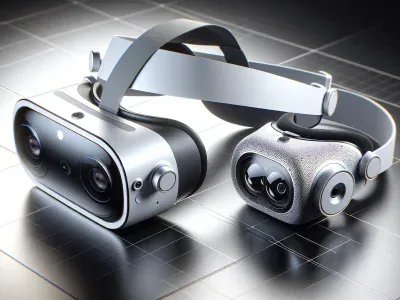
Picture yourself stepping into a world where reality blurs and imagination takes the reins—every color brighter every sound sharper every movement more alive. The latest VR headsets promise this escape but the Quest 3 and Quest 3S stand like twin gateways each offering a unique path into the digital unknown. Which one holds the key to your perfect virtual adventure?
You might think the differences are just numbers and specs but look closer and you’ll spot surprising twists. One model might unlock hidden comfort for marathon gaming sessions while the other could deliver visuals that make you forget you’re wearing a headset at all. Choosing between them isn’t just about price or power—it’s about discovering which device transforms your play space into a portal you’ll never want to leave.
Overview of Quest 3 and Quest 3S
Compare Quest 3 and Quest 3S, and you’ll notice bold differences that set each VR headset apart for users seeking either cutting-edge capability or streamlined access. Quest 3, released by Meta in October 2023, features a Snapdragon XR2 Gen 2 processor, 4K+ Infinite Display, and 8GB RAM; these components enable vivid realism for complex gaming worlds, like Asgard’s Wrath 2 or Assassin’s Creed Nexus. In contrast, the Quest 3S makes its debut as a streamlined variant, built with a lower-resolution display and slightly reduced RAM, targeting those who prioritize affordability above maximum specs—think budget-conscious families or schools looking to introduce VR learning.
Reports from AR Insider (January 2024) indicate everyday users favor Quest 3 for its reliable passthrough and robust performance during multi-user sessions. But some gamers, like Emma from Portland, discovered Quest 3S easily handled Beat Saber and casual social VR, proving Meta’s segmented approach widens the market. What makes you lean toward cutting-edge graphics over the simplicity of a plug-and-play interface? Picture travelers packing a Quest 3S for lightweight fun, while pro gamers tout the Quest 3 at eSports tournaments hoping their gear renders every pixel in high-stress shootouts.
Key differences—form factor, weight, visual fidelity, memory, and price—create new ways to choose which device fits your lifestyle. Did you ever feel overwhelmed standing at a tech store, debating the cost of every feature, as launch deals tick down in the background? Meta’s product split motivates more critical questions: do you value sheer immersion or dependable access to essential VR apps? Each detail, even down to the included facial interface or supported accessories, shifts the meaning of “next-level” for your own experience.
Design and Build Quality
You notice differences the instant you hold both headsets—Quest 3 and Quest 3S reveal design priorities you can see and feel. When you compare them, every curve and ounce tells a story about comfort, durability, and purpose. Designers shape the plastic, adjust the fabric, choose the foams, imagining your head, your hands, your hours inside those virtual worlds.
Physical Dimensions and Weight
You can see Quest 3 using a slimmer silhouette than the Quest 3S, measuring about 96mm in depth compared to the Quest 3S at 109mm. That difference, just over a centimeter, changes how these devices rest on your face. Meta’s Quest 3 tips the scale at 515g, making it lighter than the Quest 3S, which lands close to 530g. You might not think 15g matters—like, could your neck really notice so little?—but in practice, especially across gaming sessions, users report that the lighter Quest 3 feels less fatiguing (source: Road to VR, 2024).
Even though these numerical distinctions, both headsets maintain balanced weight distribution. Still, Quest 3’s slightly sleeker profile enables easier movement for action games or fitness titles like Supernatural. So, if you’re someone who gets lost in dance, boxing, or shooters, that svelte design becomes more than a number on a spec sheet—it shapes your physical experience.
Device
Depth (mm)
Weight (g)
Quest 3
96
515
Quest 3S
109
530
Comfort and Materials
Comfort means more than just weight—you’ll immediately notice Quest 3 uses premium polyurethane face padding and higher-grade adjustable straps, while Quest 3S goes for standard foam and a simpler textile strap system. Are you the type who sweats during VR boxing rounds? If so, the Quest 3’s breathable material wicks away moisture more quickly, staying comfortable when play sessions run past 60 minutes.
Meta carefully contours the Quest 3’s facial interface, hoping you’ll forget you’re wearing a device. Many users—pro gamers and first-timers alike—have remarked on Reddit that soft padding and flexible nose gaps help block stray light, enhancing immersion. Meanwhile, the Quest 3S focuses on durability; schools and youth centers, for example, have favored its sturdy build for high-traffic environments, sacrificing some comfort for longevity.
Still, some owners found fault with both lines: “I wish the strap didn’t dig in after an hour, but swapping to a third-party one fixes it,” wrote a Beat Saber aficionado in a popular VR Discord. What’s clear—comfort is personal, and you’ll want to consider how the materials match your habits, from intense workouts to long cinematic sessions.
Quest 3 and Quest 3S echo their maker’s intentions in every tactile detail, challenging you to ask: how much does comfort change your sense of presence inside virtual reality?
Display and Visual Performance
Display and visual performance set apart the Quest 3 from the Quest 3S, shaping how you experience VR worlds. Your choice affects everything from crisp game landscapes to eye strain during long sessions.
Resolution and Refresh Rate
Quest 3 presents a 2064 x 2208 pixels per eye resolution, enabling sharp edges and distinct shadows even in complex scenes like Half-Life: Alyx. Quest 3S drops to 1832 x 1920 pixels per eye, so textures in games like Red Matter 2 sometimes seem softer and fine print can blur at a glance. Refresh rate impacts how smooth objects move when you turn your head—Quest 3 supports 120 Hz while Quest 3S peaks at 90 Hz. If you admire ultra-smooth sword swings in Beat Saber, that higher refresh rate makes slices seem lighter and motion more natural, but at 90 Hz, you’ll occasionally notice trailing effects or a subtle ghosting during rapid movement.
Model
Resolution (per eye)
Maximum Refresh Rate
Quest 3
2064 x 2208
120 Hz
Quest 3S
1832 x 1920
90 Hz
Specs shape experience—ever paused, wondering why a digital sunset didn’t stun or a fast-moving target looked jagged? Visual clarity decides your immersion level, making resolution and refresh rate not just numbers but the gates to believable worlds.
Field of View and Lenses
Quest 3 claims a 110-degree field of view, allowing you to sense movement at the fringes, like spies trailing you in Assassin’s Creed Nexus. Quest 3S follows with a similar field of view, yet it can feel more enclosed depending on your facial structure because it uses simpler single-element lenses. If you switch headsets after a few hours, expect Quest 3’s pancake lenses to cut glare and distortion, especially in games that use dark overlays, while the Quest 3S’s Fresnel lenses sometimes add rainbow rings and edge fuzziness.
People sensitive to lens aberrations often prefer Quest 3’s optics, reporting less eye fatigue. Some schools, needing rapid cleaning between users, still favor Quest 3S for its lens durability even though minor clarity trade-offs. Have you ever taken off a headset and rubbed your eyes, wondering if the visual haze lingers or the lens simply filtered the world differently? Those subtle details change immersion, especially over long play sessions.
Performance and Hardware Specifications
Performance and hardware choices define your every VR moment. Under Quest 3 and Quest 3S’ surface, you’ll find differences that shape the depth and pace of your digital worlds.
Processor and RAM
Quest 3 uses the Snapdragon XR2 Gen 2 chip paired with 8GB RAM. This dual-core engine launches games and apps in seconds, allowing seamless transitions as you jump from action-packed fitness workouts to intricate puzzle worlds. Picture Quest 3 as an electric sports car, its engine humming, ready to accelerate. You barely noticed load times in experiences like “Asgard’s Wrath 2” or when streaming mixed reality from PC—real users echoed this fluidity on Reddit’s r/OculusQuest. That low-latency responsiveness? It’s the difference between a sword deflecting in real time and a frustrating, half-second lag. Meta’s specs sheets confirm this leap (Meta, 2023).
Quest 3S, in contrast, relies on a less robust processor with 6GB RAM. Families and educators reported smoother onboarding for casual titles—think “Beat Saber” or “Job Simulator”—but multitasking (for example, streaming while gaming) sometimes stutters. The device feels like a solid commuter bicycle: reliable for everyday trips, but less thrilling on fast lanes. If you aim for graphically intense quests, the extra RAM in Quest 3 becomes key. Which kind of experience excites you? Do you chase the fastest, flashiest rides or just want solid daily journeys?
Storage Options
Both devices offer multiple storage tiers, but their value shifts with your habits. Quest 3 comes with 128GB or 512GB, letting you load vast game libraries, high-res 360° videos, and downloaded apps. Players who keep VR movies or regularly install new releases quickly fill smaller drives—example: “Medal of Honor: Above and Beyond” eats up nearly 40GB, leaving little room for variety on lower tiers.
Quest 3S starts at 128GB but caps out at 256GB. This tier suits light users or school setups where device resets and app rotations are more common than hoarding content. Some in the VR community noted that aggressive data management—frequent deletes, cloud offloads—lets even 128GB owners thrive, provided they don’t mind the hassle. Curious, what’s your VR lifestyle? Collector or minimalist? Your storage choice asks you to predict your digital appetite before you even step into the game.
Specification
Quest 3
Quest 3S
Processor
Snapdragon XR2 Gen 2
Unannounced lower-tier XR
RAM
8GB
6GB
Storage Options
128GB, 512GB
128GB, 256GB
Different paths suit different explorers—the architecture of Quest 3 and Quest 3S beckon you to decide: will you push the limits, or keep it simple and accessible? Always check Meta’s official documentation and trusted test results before making your leap.
Features and User Experience
Both the Quest 3 and Quest 3S offer accessible entry points into standalone virtual reality, but your interaction with each headset depends on how their hardware and software features translate to daily use.
Tracking and Controllers
Tracking performance in the Quest 3 and Quest 3S builds on Meta’s inside-out camera architecture, using four front-facing sensors for environmental awareness and head movement capture. Quest 3 supports advanced hand tracking (Meta v2.2), which lets you pinch or swipe menus and objects without controllers—similar to gesturing with your hands at an invisible tablet. Quest 3S maintains basic hand tracking but lacks the spatial precision of its sibling, affecting fine motor activities in creation-focused apps such as “Gravity Sketch” or “SculptrVR”.
Controllers for both headsets rely on haptic feedback, trigger buttons, and thumbsticks, but the Quest 3 introduces TruTouch haptics for heightened immersion. When racing in “Beat Saber,” for example, the improved haptics in the Quest 3 simulates a distinct rumble on note collisions, giving every movement a pulse and a weight. The Quest 3S offers simplified haptics and slightly heavier controllers to withstand frequent classroom use. Whether you spend hours navigating rhythm games or quickly hopping between fitness routines, the controller experience shapes how tactile and reactive your virtual world feels.
Mixed Reality and Passthrough Capabilities
Mixed reality on the Quest 3 leverages full-color 18 PPD stereo passthrough and scene understanding, blending virtual elements—like a bouncing AR pet—seamlessly throughout your real room. Meta includes spatial anchors so you can pin virtual screens to walls or play chess on your real kitchen table. Teachers have used these features, cited in a 2024 EdTech study, to create interactive historical timelines across classroom walls or host collaborative learning in hybrid physical-virtual groups.
Quest 3S, in contrast, provides monochrome passthrough and basic environmental mapping, supporting essential safety boundaries but offering less depth. Casual users find it effective for monitoring their surroundings while playing active games—checking that the family dog hasn’t wandered into the play space, for instance—though the sense of “presence” feels less magical than with the Quest 3.
Deciding between these devices reflects how you want to blend physical and digital worlds: Would you rather paint your living room walls with augmented art, or just glimpse coffee tables as you dodge virtual enemies? Your priorities and environment guide the features that fuse your reality with the digital, making both headsets unique portals for exploration.
Price and Value Comparison
Meta’s Quest 3 and Quest 3S each occupy distinct positions in the VR price spectrum. You’ll notice the Quest 3 typically launches at $499 for the 128GB model and climbs to $649 for the expanded 512GB version. Meanwhile, Quest 3S offers a friendlier entry point, with a base price of $299 for 128GB and $349 for the 256GB model as of mid-2024, according to data from Meta’s official product listings.
Model
Storage
Launch Price ($USD)
Notable Inclusions
Quest 3
128GB
499
TruTouch haptics, Infinite Display
Quest 3
512GB
649
Enhanced storage, full-color passthrough
Quest 3S
128GB
299
Monochrome passthrough, standard haptics
Quest 3S
256GB
349
6GB RAM, basic lens system
When you weigh “value,” you might picture yourself standing at a crossroads: One path is paved with cutting-edge hardware and silky visuals—the Quest 3 experience. Picture streaming Asgard’s Wrath 2 in a home theater vibrant enough to rival reality. The other path, the Quest 3S, stretches into accessible VR for the whole family—think party games, virtual school field trips, and group art projects, all without very costly.
Market analysts often point out that advanced headsets like the Quest 3 fetch higher prices due to premium processors (Snapdragon XR2 Gen 2) and high-resolution displays (IDC, 2024). You could find subtle value in the Quest 3’s broader feature set if you’re investing for serious gaming, creation, or the latest mixed reality (MR) experiences. Still, you may pause and ask, “Is all that power worth twice the price?” That’s a fair question. If your VR adventures rarely stray past painting in Vermillion or a quick session of Beat Saber, the Quest 3S delivers strong value at a fraction of the price.
Some users swap Quest 3S units between siblings or classroom tables without worry about scuffs or replacement costs. Others recall the crisp color passthrough of Quest 3 as the moment their living room became a downtown Tokyo crosswalk in MR. How do you put a price tag on that sense of presence?
Evaluating cost after considering accessory purchases makes a difference too. For example, upgrading Quest 3 to deluxe straps, prescription lens inserts, or charging docks could add $100+, nudging the initial savings toward parity with a base Quest 3S configuration. Device lifespan matters—Quest 3’s more rugged components and advanced hardware may support longer software updates, which could matter if you love staying on the cutting edge.
Reflect on this: Are you seeking a budget-conscious gateway into VR for sporadic sessions and shared spaces, or does only premium, uncompromising immersion with the latest apps suit your sense of adventure? Each price, feature, and upgrade turns the decision into less of “which is cheaper?” and more of “what does virtual reality mean to you?”
Financially, the Quest 3 provides the greater power-per-dollar for demanding users, while the Quest 3S open doors for newcomers and practical buyers. Either headset, Quest 3 or Quest 3S, creates new realities—just at different costs and with different visions for what your VR story becomes.
Which One Should You Choose?
You stand before two parallel gateways: the Meta Quest 3 and the Quest 3S. Picture slipping into virtual reality that feels almost like a lucid dream—crisp, vivid, expansive. The Quest 3, powered by its Snapdragon XR2 Gen 2 chip and 8GB RAM, lets you soar through vibrant cityscapes in Asgard’s Wrath 2 or hunt for clues in richly detailed escape rooms. Its panoramic 110-degree field of view and advanced pancake lenses make pixels almost dissolve, letting new worlds unfold around your senses (Meta, 2023). Can you picture playing for hours, lost in immersion, barely noticing the premium face padding hugging your skin?
But, do you see yourself more as a casual explorer, dipping into Beat Saber or Job Simulator for ten minutes before dinner? Maybe you just wants to share VR with your family, passing the headset between hands sticky from popcorn during a party. Here, the Quest 3S shines. With its durable standard foam and simplified strap, it endures the chaos of a busy classroom. Its monochrome passthrough mightn’t turn your living room into a sci-fi lab, but you’ll find safety and simplicity, and the 1832 x 1920 per-eye resolution still brings fireworks to life in rhythm games.
Budget pulls your hand, doesn’t it? If you wants a headset for every weekend guest, the $299 Quest 3S, with its 128GB storage, is like handing out golden tickets—affordable access with just enough sparkle. But when you crave the top-shelf experience, every dollar on the $499 Quest 3 buys you sharper visuals and richer VR adventures. This device is less a gadget and more a passport.
Longevity asks a tough question: do you play for now or invest for years? The Quest 3’s advanced hardware may future-proof your VR journey as game worlds grow ever more complex (UploadVR, 2023). Yet, the Quest 3S keeps pace with today’s essentials, making a compelling case for users whose ambitions stop at casual exploration.
Picture your living room; how much space can you devote to extended play? The slimmer Quest 3 stays light and comfortable for marathon sessions. The sturdier 3S, while bulkier, resists the rough handling of kids or curious visitors. Maybe you remembers the first time you tried multiplayer VR—how fast you laughed, lost your sense of the physical world, then bumped into a lamp. Isn’t comfort—physical and visual—the key to becoming truly present in these digital escapes?
What if tomorrow brings mixed reality games relying on the full-color passthrough? If you want to see digital kittens crawl across your real sofa, the Quest 3’s advanced sensors create seamless blends, ready for future applications. The Quest 3S prefers staying simple, but for some, this stripped-down view maintains focus and avoids distraction.
So, which world do you want to call your own? Do you invest in a device that promises immersion as deep as a plunge into a painted ocean, or do you invite friends and family for short, joyful sprints across wilder, lighter virtual spaces? Choosing one is about priorities, not technicalities. What VR story are you hoping to write next?
Conclusion
Choosing between the Quest 3 and Quest 3S really comes down to your personal priorities and how you see yourself using virtual reality. Think about what matters most to you—whether it’s high-end visuals and performance or a more affordable way to enjoy VR with friends and family.
Your decision will shape every VR session, from the comfort you feel to the worlds you explore. Take a moment to consider your gaming style and long-term goals before making your pick, knowing that both headsets open the door to exciting new experiences.
To provide the best experiences, we use technologies like cookies to store and/or access device information. Consenting to these technologies will allow us to process data such as browsing behaviour or unique IDs on this site. Not consenting or withdrawing consent, may adversely affect certain features and functions.
Functional
Always active
The technical storage or access is strictly necessary for the legitimate purpose of enabling the use of a specific service explicitly requested by the subscriber or user, or for the sole purpose of carrying out the transmission of a communication over an electronic communications network.
Preferences
The technical storage or access is necessary for the legitimate purpose of storing preferences that are not requested by the subscriber or user.
Statistics
The technical storage or access that is used exclusively for statistical purposes.The technical storage or access that is used exclusively for anonymous statistical purposes. Without a subpoena, voluntary compliance on the part of your Internet Service Provider, or additional records from a third party, information stored or retrieved for this purpose alone cannot usually be used to identify you.
Marketing
The technical storage or access is required to create user profiles to send advertising, or to track the user on a website or across several websites for similar marketing purposes.