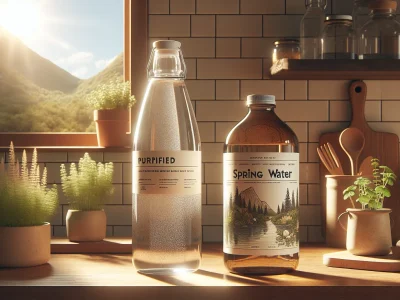
Picture yourself reaching for a cold glass of water—the clarity catches the light like a crystal prism and promises pure refreshment. But as the cool liquid touches your lips do you ever wonder what’s really swirling in your glass? Is it the untouched essence of a mountain spring or has it been meticulously filtered and stripped of everything but H₂O?
Choosing between purified water and spring water isn’t just about taste or clarity. It’s about the journey every drop takes before it quenches your thirst. Some believe spring water holds hidden minerals that awaken your senses while others swear by the pristine simplicity of purified water. With so many choices lining store shelves understanding the real differences could change the way you hydrate forever.
What Is Purified Water?
Purified water appears in your glass as the result of a scientific transformation. Continuous advances in filtration tech shape its journey from raw source to the almost invisible clarity you see.
How Purified Water Is Produced
Purified water goes through rigorous processes before it lands in your bottle. Methods like reverse osmosis, distillation, and deionization are common; the U.S. Environmental Protection Agency (EPA) defines purified water as water with impurities removed to extremely low levels—usually containing less than 10 parts per million (ppm) of dissolved solids (EPA, 2023). Picture a sheet of paper: reverse osmosis works like a fine sieve, letting through only clean H2O molecules while blocking minerals, bacteria, and chemicals. Municipal tap water, lake supplies, or underground aquifers often feed these systems. Each drop passes through multiple barriers—carbon filters trap chlorine, ultraviolet light destroys pathogens, and final polishers chase down stray particles.
Do you think bottled purified water always tastes the same everywhere? , the taste varies by the source and treatment steps. Some brands add minerals like calcium carbonate or magnesium chloride after filtration to make the water less flat, mimicking natural profiles. For you, this means each sip could offer a slightly different sensory experience, even among purified labels.
Common Uses of Purified Water
Purified water shows up in more places than you expect. Hospitals rely on it to ensure sterile environments when preparing medicines or cleaning surgical tools. Factories use it for making electronics, where even a single stray ion could fry a microchip—think of how fragile and precise those devices are. At home, people drink it if they have sensitivities or want the reassurance of minimal contaminants; parents mixing baby formula often choose purified brands for extra safety. Restaurant ice machines also often use purified water, so you swallow fewer taints with each chilled drink.
Many wonder—does drinking purified water rob you of healthy minerals? According to the World Health Organization (WHO), the mineral loss isn’t harmful for most, as people get needed nutrients primarily from food, not water (WHO, 2017). Still, others argue that ultra-pure water might draw trace minerals from the body over time, though studies haven’t proven significant effects. Would you choose purity or natural minerals, if your health and peace of mind were at stake?
What Is Spring Water?
Spring water starts deep beneath the earth, where rain and snowmelt filter down, gathering minerals from layers of rock and soil. You might picture a hidden stream bursting from a forest hillside, the kind that’s made explorers and poets thirsty for discovery. People often ask if every bottle labeled “spring water” truly comes from a pristine source, prompting questions about what’s real and what’s marketing. Stories persist about travelers stumbling upon cool springs, sipping water that’s ancient and untouched—you may wonder: is yours just as pure?
How Spring Water Is Sourced
Spring water gets collected at the point where an underground aquifer flows to the surface. Companies like Poland Spring and Deer Park create protected catchment systems around these springs and tunnels, capturing water before it contacts the open air. Some springs, isolated in remote valleys, yield only what nature provides—around 7,000 gallons a day—while commercial springs such as the Flowing Wells in Michigan pumps twenty times more. Regulation by the FDA (Food and Drug Administration) in the US requires that to label water as “spring,” the source must be directly tapped, using boreholes that don’t alter the original chemical composition.
Unique Characteristics of Spring Water
Spring water carries a mineral imprint unique to its source, including calcium, magnesium, and potassium; for example, Evian famously highlights its glacial pathway through the French Alps, giving it a distinct taste and mineral profile. Not every bottle will taste the same, because every spring is different, creating subtle variations you might notice if you compare Fiji Water to Mountain Valley Spring. You may spot sediment or slight cloudiness, signs that water remains less processed, holding onto aquatic “fingerprints.” Enthusiasts claim the natural minerals “energize” them—a perspective echoed in health circles though not universally supported by scientific studies (Mayo Clinic, 2019). Some debate whether environmental disruption threatens authentic sources, raising the question if choosing spring water truly supports sustainability or not.
Key Differences Between Purified Water and Spring Water
Key differences between purified water and spring water shape everything from your sensory experience to environmental choices. These difference connect origins, treatment, and impact, creating a bigger story than simple hydration.
Taste and Mineral Content
Purified water tastes neutral or flat since advanced filtration strips almost all minerals from it, according to the CDC. Spring water often tastes crisp or slightly sweet, since it gathers calcium, magnesium, and trace minerals while flowing through underground rock layers. Examples like Fiji Water and Evian get branded for their distinct regional flavors and mineral profiles. If someone hands you a glass of each, you’d probably notice purified water lacks the subtle complexity found in most spring waters—think of comparing plain glass to a crystal cut with light-catching facets.
Safety and Quality Standards
FDA regulates bottled water and identifies specific criteria for both water types. Purified water must reach impurity levels below 10 parts per million total dissolved solids, with methods like reverse osmosis ensuring nearly uniform output regardless of the source. Spring water, though held to strict testing, gets its identity from the aquifer origin and must be collected at the spring or borehole tapping it—that means you could walk to a spring in Maine and legally bottle and label the water if tests confirm compliance. Some critics argue that less control exists for environmental contaminants in spring water because natural aquifers can be vulnerable to runoff.
Environmental Impact
Environmental impacts splits sharply. Purified water production uses energy for filtration but usually sources municipal supplies, so it’s less likely to deplete local aquifers. Spring water extraction, as documented by the NRDC, can lower groundwater levels and disrupt local ecosystems when over-harvested. The 2022 case of Nestlé in California illustrates headline-making controversy when activists argued that bottling from drought-impacted springs harms native wildlife and small communities. Single-use plastic bottles create waste for both types, though some companies now push recycled or plant-based packaging.
If you pause and examine the source, flavor, and footprint of each sip, your everyday choice links directly to a much larger system—spanning safety, sensory experience, and sustainability.
Which Is Better for Drinking?
You face a daily decision at your tap or store shelf: purified water or spring water? Your choice often reflects a blend of tradition, science, and personal priorities.
Health Considerations
Purified water undergoes intense purification, including methods such as distillation or reverse osmosis. You’ll find it almost devoid of dissolved solids, like a blank canvas ready for hydration. If your main concern is microbial safety or heavy metals—think regions with aging infrastructure—the Centers for Disease Control and Prevention (CDC) considers purified water a very low-risk option for contamination. Some users though, worry about missing minerals like calcium and magnesium. For instance, bottled purified water from brands like Aquafina or Dasani may taste flat and offers only trace minerals unless added back after filtration.
Spring water’s mineral content can introduce subtle flavors and trace elements—compare Poland Spring’s crispness to Mountain Valley’s slightly alkaline edge. Natural minerals, such as magnesium or potassium, appeal to those seeking a “living water” narrative, even if the Food and Drug Administration (FDA) affirms that most mineral needs comes from your diet, not your glass. Questions also swirl about potential contaminants; for example, in rare events, spring water can picks up agricultural runoff if nearby land isn’t well managed.
What’s your risk tolerance? Picture hiking in Maine, where a local guide fills his canteen from an artesian spring and proclaims it “the taste of the mountains”—but water experts test each batch in labs, not wild streams.
Cost and Accessibility
Prices range widely, shaped by sourcing, packaging, and local regulations. Purified water tends to be less expensive due to it’s scalable production methods; popular brands use municipal tap water as input and process millions of gallons daily. In urban neighborhoods, a gallon of store-brand purified water usually costs less than a dollar, barring specialty options.
Spring water requires bottling at the source, meaning logistics can make it pricier in regions far from natural springs. A 16.9-ounce bottle from a well-known spring source such as Evian or Fiji sometimes costs 200%–400% more than generic purified brands. Availability depends on geography; if you live close to natural aquifers, local brands might feel affordable while others import theirs, leading to spike in prices.
Accessibility leans toward purified water, which appears in supermarkets, pharmacies, and convenience stores across North America. But if you ask someone in a rural area bordering the Appalachians, they might share how spring water is piped directly to homes—making their water both affordable and uniquely flavored, yet not universally accessible across the population.
Your own scenario—are you seeking consistency and convenience or that elusive terroir of spring water? Your choice, every cup or bottle, reflects your balance of comfort, cost, and connection to water’s source.
Conclusion
Choosing between purified water and spring water isn’t just about what’s in your glass—it’s about what matters most to you. Whether you value a crisp mineral taste or the assurance of advanced filtration, your decision shapes how you hydrate each day.
Think about your lifestyle, local water quality, and environmental impact before making your pick. By understanding the unique qualities of each type, you can confidently select the water that best fits your needs and values.
To provide the best experiences, we use technologies like cookies to store and/or access device information. Consenting to these technologies will allow us to process data such as browsing behaviour or unique IDs on this site. Not consenting or withdrawing consent, may adversely affect certain features and functions.
Functional
Always active
The technical storage or access is strictly necessary for the legitimate purpose of enabling the use of a specific service explicitly requested by the subscriber or user, or for the sole purpose of carrying out the transmission of a communication over an electronic communications network.
Preferences
The technical storage or access is necessary for the legitimate purpose of storing preferences that are not requested by the subscriber or user.
Statistics
The technical storage or access that is used exclusively for statistical purposes.The technical storage or access that is used exclusively for anonymous statistical purposes. Without a subpoena, voluntary compliance on the part of your Internet Service Provider, or additional records from a third party, information stored or retrieved for this purpose alone cannot usually be used to identify you.
Marketing
The technical storage or access is required to create user profiles to send advertising, or to track the user on a website or across several websites for similar marketing purposes.