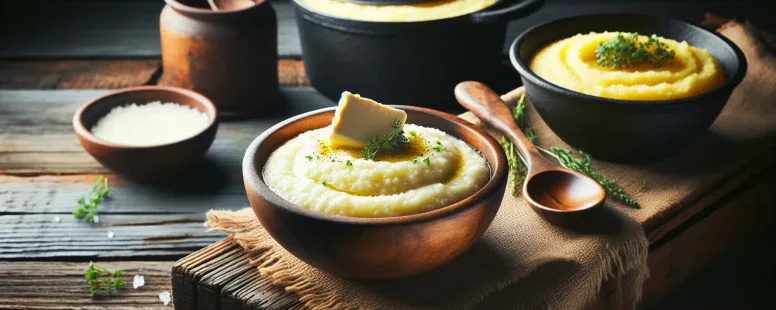
Picture a steaming bowl of golden cornmeal—creamy, comforting, and crowned with a pat of melting butter. Now picture the fork gliding through a mound of rustic, sun-yellow grains, their aroma swirling with hints of earth and warmth. Both dishes promise a taste of tradition, but are you savoring grits or polenta?
You might think they’re twins separated at birth, yet these classics hail from different worlds and offer unique experiences for your palate. Jump into the subtle contrasts that set them apart and you’ll unlock fresh inspiration for weeknight dinners or weekend brunches. Discovering the difference between grits and polenta could transform the way you cook and enjoy corn-based comfort food forever.
Understanding Grits and Polenta
You taste the South when grits steam on your breakfast table, creamy and gilded with butter, while polenta transports you to Northern Italy, golden-yellow and topped with slow-cooked ragù. Grits, derived from dried white corn or hominy, bring a distinct earthy mildness. Polenta, made from yellow flint corn, gives a robust, sunlit flavor. These origins—US Southern states for grits, Piedmont and Veneto for polenta—shaped their identities and inspired countless dishes.
Think back to a bustling diner in Georgia. Locals might argue, “Good grits take patience.” They slowly simmer, thickening as you stir, and if you add cheese or shrimp, the entire mood shifts to celebration. In contrast, chefs in Milan stir polenta on open flames, scraping the heavy pot’s sides. A wooden spoon clunks against cast iron, and the aroma of roasted corn fills the kitchen—familiar comfort, centuries-old (source: Smithsonian Magazine, 2021).
Yet, peek closer: there’s a shared grammar to these grains. Both transform from humble meal to silky porridge, yet texture reveals intention. Polenta stays coarser (like fine sand), grits can be creamy or almost fluffy, depending on their grind. You may ask, “Why do both grains end up so different?” Their story’s about starch: hominy in grits undergoes nixtamalization, unlocking its mild taste, whereas polenta’s native corn keeps flavors hearty and bright.
Picture tasting spoonfuls side by side—with a friend blindfolded, could they guess which is which? This sparks debate. Restaurants may swap one for the other, but a Southern grandmother might insist, “There ain’t no substitute for real grits.”
Try both and stir up your own traditions. Will you serve cheesy baked grits at your next family brunch or elegant polenta rounds with mushrooms for friends? Question your pantry and let your palate decide. Authentic experiences often begins with a willingness to taste.
Origins and History
Grits and polenta both anchor culinary traditions, yet each dish tells a distinct story about its people and place. These corn-based creations cross continents and centuries, each symbolizing regional pride and comfort on the table.
The Southern Roots of Grits
Grits emerge from the deep South, where Indigenous peoples pioneered stone-ground corn long before the first European settlers arrived. Choctaw and Creek communities prepared a dish called “sofkee,” a soupy cornmeal porridge, which became a foundation for today’s grits. Early colonists adapted this tradition, and it quickly became a staple in Southern homes. Enslaved African Americans, too, wove grits into daily life, flavoring it with memories and resourcefulness. You can still watch steam rising from a pan of morning grits in Charleston or Atlanta kitchens, a living legacy of survival and celebration. Grits speak to the resilience and ingenuity of the American South—its heritage preserved in every creamy spoonful. Smithsonian Magazine highlights grits as a food that bridges centuries and communities, making them not just a breakfast but a cultural touchstone.
Italian Heritage of Polenta
Polenta traces its story to Northern Italy’s misty hills, where households relied on maize long before industrialization. The word “polenta” comes from the Latin “puls,” meaning a soft porridge once made from spelt or farro, long before corn arrived from the Americas in the 16th century. Would you picture grandmothers, or “nonnas,” stirring bubbling polenta stones over fire—each wooden spoonful thickening with anticipation? Venetian and Lombard farmers used hearty, yellow flint corn to make an inexpensive, sustaining meal, stretching comfort through winters. Polenta’s texture varies: from creamy slabs topped with wild mushrooms in Bergamo to firm slices grilled crisp in Friuli. Italian immigrants in the US carried those traditions to new tables, connecting a new world with old-country flavors. The Oxford Companion to Italian Food affirms polenta as a dish that adapts and persists, always nourishing communities when times gets hard or feasts run long.
If you’ve ever tasted both dishes side by side, you get a sense of global traditions layered with memory—sometimes mingling, always distinct.
Key Ingredients and Varieties
Every pot of grits or polenta starts with a kernel of corn, but the pathway from field to table splits sharply. When you stand at the grinding stone, you’re choosing a tradition—one that flavors every spoonful.
Types of Corn Used
You get grits from dent corn, often white though yellow types sometimes show up, which gives a gentle sweetness. Hominy grits, got from kernels soaked in an alkaline solution, brings a soft, pillowy bite, common in the American South (Cornell University’s Food Science Department, 2018). Polenta, though, springs from flint corn. It bursts with sun-yellow colors and a deep, earthy aroma. Flint corn, grown in stony fields of Northern Italy, packs tightly, yielding hearty, toothsome dishes. If you bit into dry kernels of each, you’d taste the difference in the very starch—the dent’s softness, the flint’s tenacity. Have you ever thought about why your grandmother’s grits tasted so different from that rustic Northern Italian polenta you sampled abroad?
Texture and Grain Size
Grain size shapes each dish like a sculptor’s chisel. Grits, ground finer, gives a texture that flows silky over your spoon or sifts through your fingers like powdery snow—“creamy,” as described in Southern cookbooks. Hominy grits sometimes go coarser, but they never hit the granularity mark set by classic polenta. Polenta keeps bigger, stubborn grains, fighting the transformation into porridge. Taste a ladleful straight from the fire, and you’ll meet a mosaic of grains that pop between your teeth, echoing centuries of slow cooking over open flame (The Spruce Eats, 2022). Which do you prefer: a velvet-soft grits bowl melting into butter, or robust, golden polenta cooling in rounds on your plate? You can tell from the look and feel—grits drift; polenta stands its ground.
Both worlds bring secrets in the grind and kernels. When you next choose between grits and polenta, consider their journey—tempered by geography, shaped by stone, and defined by texture at your table.
Cooking Methods and Flavor Profiles
Cooking unites and distinguishes grits and polenta, weaving culture through each bubbling pot. Each dish carries its own story, aroma, and taste—do you recall a moment when a humble bowl transformed your meal?
Traditional Preparation Techniques
Grits simmer gently in Southern kitchens, where you’ll often find an heirloom cast iron pot crowding the stovetop, steam mingling with the promise of comfort. The dent corn grits demand patience, their creaminess unveiling slowly as you stir, letting the grains yield into milk, butter, or even cheese. Sometimes, you might spot a swirl of shrimp—shrimp and grits, a staple at Charleston brunches (source: Southern Living). Grits, when stone-ground, hold more texture and flavor, leading to a result that feels almost like velvet on your tongue.
Polenta, with roots reaching across the Atlantic to Lombardy farms, gets poured in golden streams into boiling water or broth, then worked by strong arms wielding wooden paddles. Do you know the Polentata, the ritual where Italian villagers gather to stir and share? This act, more than a recipe, becomes a communal event—much like breaking bread but with golden maize. Flint corn polenta’s hearty granules resist dissolving, so you’ll get a toothsome bite, especially when poured onto a wooden board and cut with twine, as they still do in Bergamo (source: La Cucina Italiana).
Taste and Serving Styles
Taste sets grits and polenta apart, turning corn into distinctive experiences. Grits, soft and pillowy, absorb everything you finishes them with: think smoked gouda, jalapeño, ham, or—if you want a classic twist—even maple syrup for breakfast. They taste mild, the sweet earthiness of hominy providing a blank canvas for both sweet and savory dishes.
Polenta shouts with sun-kissed depth. Each golden spoonful delivers bold, nutty corn flavor, especially when prepared with cheese like Parmigiano-Reggiano, wild mushrooms, or a hearty beef ragu. The firmness lets you chill leftovers then slice and pan-fry or grill them—suddenly, one dish becomes another, just with a dash of olive oil and a skillet’s sizzle.
You may wonder: Does tradition restrict your creativity? Not at all. Chefs in Atlanta turn grits into soufflés, while Milan trattorias serve polenta fries. The boundaries, shaped by history, invite exploration—what could you create if you let grits or polenta cross cuisines in your kitchen?
Nutritional Comparison
Grits and polenta both start with corn but serve up distinct nutritional profiles once they reach your spoon. Your average bowl of grits, made from dent corn or hominy, throws down about 120 calories per cooked cup, packing about 2g protein and 26g carbohydrates—if you skip the cream and butter, that is. Polenta, from yellow flint corn, comes in close with 130 calories, about 3g protein, and 29g carbohydrates per cup cooked (USDA, 2022).
Dish
Calories (per cooked cup)
Protein (g)
Carbohydrates (g)
Fiber (g)
Potassium (mg)
Grits
120
2
26
1
62
Polenta
130
3
29
1.5
75
Ever spoon into creamy grits, only to feel that subtle, gentle sweetness fade behind a buttery richness? That’s because grits, often stripped of germ and hull, lose some fiber and nutrients, making them easier on the taste buds but a little less filling. Polenta keeps more of that kernel-y heart, delivering not just a coarser bite but also around 1.5g fiber per serving, which is slightly more than grits.
Sodium can sneak up on you—especially if you rely on packaged instant varieties. Restaurant grits or polenta, when loaded with cheese or salt, easily push daily sodium limits past what’s recommended by the FDA (less than 2,300mg per day). Homemade, though, these classics stay low in sodium if you control seasonings.
Grits, in traditional Southern kitchens, often get the creamy treatment—milk, cream, and even bacon grease swirl their way in. Ever notice how that transforms a humble bowl into a decadent comfort food, but at the same time, it can boost fat and cholesterol content significantly? Polenta, on the other hand, often shines with olive oil or even roasted vegetables in Italian homes, nudging the dish toward heart-healthy fats.
People sometimes ask, “Is polenta gluten-free? Are grits safe for gluten-sensitive eaters?” Both grits and polenta avoid gluten, though cross-contamination happens, especially with grits produced in shared facilities. Always check the package labels if you’re avoiding gluten for medical reasons.
Nutritionally, these dishes mirror their cultural roots. Grits, a staple at Southern breakfast tables, promise quick energy—think of those early morning fields and fishermen on the Carolina coast. Polenta, with that heartier fiber, helped fuel Italian farmers through long days. Which one fills your tradition—are you reaching for Southern comfort or rustic European strength?
Changing just one ingredient—whole milk versus broth, or cheese versus roasted tomatoes—reshapes both the flavor and nutrient punch of your bowl. Building your version, you turn basic corn into something rooted in heritage but tailored to your health needs. If recipes grow and evolve, why not let your choices reflect what matters most to you, whether that’s counting carbs, boosting fiber, or making family mealtimes memorable?
Popular Dishes and Serving Ideas
You taste grits in the American South, where shrimp and grits reigns as a brunch icon. Chefs at Magnolia’s in Charleston top stone-ground grits with wild-caught Gulf shrimp, smoky tasso ham, and scallion-laced cream, weaving together land and sea—a symphony of Southern comfort. why a simple dish garners lines out the door? Most locals say it’s nostalgia in a bowl—grits evoke stories of grandmothers stirring cast iron pots at dawn. Try cheese grits as well, creamy and thick, often serving as the plush bedding for breakfast eggs or roast pork. Each variant, from low-country “red-eye” gravy to deep-fried grits cakes, carries a thread of memory and togetherness.
Polenta, in contrast, dominates Northern Italian tables. Picture sitting in a rustic farmhouse in Lombardy as polenta is poured onto a wooden board, spread open like a golden canvas, then topped with a fragrant wild mushroom ragù. Osterias in Venice offer grilled polenta wedges with gorgonzola, contrasting that nutty crust with the cheese’s pungent tang. Did you marvel at the simplicity of Italian cucina povera? Polenta’s weakest ingredient shines brightest under a drizzle of olive oil or crowned with braised short ribs. Polenta fries now pop up in New York’s trattorias too, crisp on the outside but soft within—a surprise fusion that bridges continents.
Both grits and polenta morph into satisfying main courses, clever sides, or even indulgent desserts. Many home cooks experiment with grain cakes, layering sharp cheddar atop grits or marrying polenta with bittersweet chocolate for torta di polenta. Savvy hosts transform leftovers into next-day surprises: Slices of firm polenta, pan-seared until caramelized, or chilled grits croutons nestled atop salads. Have you tried contrasting silky polenta with the crunch of roasted hazelnuts, or blending earthy grits with smoked paprika and charred corn? Infinite pairings emerge each time someone experiments.
The world’s kitchens aren’t static; grits and polenta inspire, adapt, and delight. No single serving rules them all—recipes are stories, evolving with every hand that stirs the pot. If you ask a chef in Savannah or a farmer in Bergamo, their answers would intertwine history, ritual, and homegrown innovation. Where will your ladle lead you next—toward tradition, reinvention, or perhaps something wholly your own? As new trends spark and recipes travel, you find yourself part of an unbroken lineage—one bowl, endless variation.
Conclusion
Exploring grits and polenta opens up a world of flavor and tradition right in your kitchen. Whether you’re drawn to the creamy comfort of grits or the hearty bite of polenta, you’ll discover endless ways to enjoy these classic corn-based dishes.
Let your curiosity guide you as you blend old-world techniques with your own culinary flair. By trying both, you’ll not only expand your palate but also create new memories that honor the rich histories behind each spoonful.
To provide the best experiences, we use technologies like cookies to store and/or access device information. Consenting to these technologies will allow us to process data such as browsing behaviour or unique IDs on this site. Not consenting or withdrawing consent, may adversely affect certain features and functions.
Functional
Always active
The technical storage or access is strictly necessary for the legitimate purpose of enabling the use of a specific service explicitly requested by the subscriber or user, or for the sole purpose of carrying out the transmission of a communication over an electronic communications network.
Preferences
The technical storage or access is necessary for the legitimate purpose of storing preferences that are not requested by the subscriber or user.
Statistics
The technical storage or access that is used exclusively for statistical purposes.The technical storage or access that is used exclusively for anonymous statistical purposes. Without a subpoena, voluntary compliance on the part of your Internet Service Provider, or additional records from a third party, information stored or retrieved for this purpose alone cannot usually be used to identify you.
Marketing
The technical storage or access is required to create user profiles to send advertising, or to track the user on a website or across several websites for similar marketing purposes.