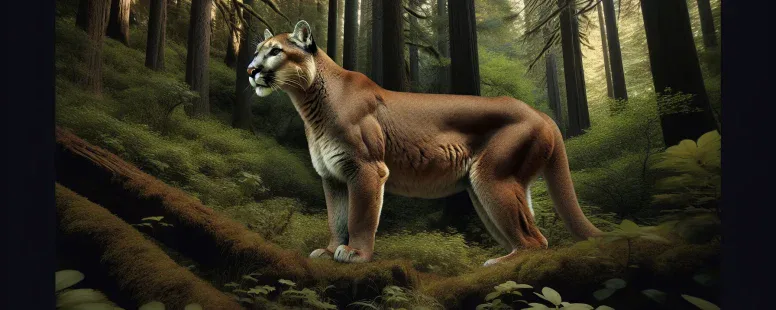
Picture yourself wandering through a sun-dappled forest where shadows flicker and silence hums with possibility. Suddenly you spot a tawny shape slipping between the trees—muscular, graceful, and utterly wild. Is it a cougar or a mountain lion? The question lingers like a riddle whispered by the wind.
You might be surprised to learn that these names, which conjure images of mystery and adventure, often describe the same elusive creature. Yet the story behind these big cats is richer and more tangled than you’d expect. Unraveling the difference between a cougar and a mountain lion might just change the way you see North America’s top predator—and reveal some fascinating secrets along the way.
Overview of Cougar and Mountain Lion
Cougar and mountain lion mean same animal—Puma concolor, as described by National Geographic. If you stand in the shadowy timberline at dusk, you might catch a glimpse of this elusive feline, hear its gravelly call echo across the canyon, and wonder: is it a cougar, a mountain lion, or something else? You’ll find answers in regional dialects. In Florida, people call these cats panthers. In South America, many use the term puma. Throughout Western North America, “mountain lion” dominates, while “cougar” prevails in the Northwest and some Canada provinces.
Names shift, but anatomy stay consistent. Cougars, sporting slender bodies, long tails, and powerful jaws, average 140 lbs for males and 90 lbs for females (Smithsonian’s National Zoo & Conservation Biology Institute). Remarkable athletes, these cats leap up to 40 feet horizontally, vaulting over boulders and brush with silent agility—a fact that biologist Toni Ruth documented in Yellowstone. You wonder how many names fit a single species. Some researchers count over 40 unique terms (Mammal Species of the World, 3rd ed.), each reflecting tradition, geography, or local myth.
Whether a seasoned hiker in Colorado’s Rockies or a rancher near the Cascades, people encounter the same solitary predator—no matter which name springs to mind. Over centuries, legends and local lore shaped how communities tell their stories about this top predator. You might even recall tales from elders warning young ones, “Never turn your back on the ghost of the mountain.” Differences in name mirror a tapestry of cultural and ecological histories. If you call it a cougar or a mountain lion, you’re referring to the same formidable feline shaping wild landscapes across the Americas.
Scientific Classification and Naming
Scientific names help you see through the fog of local legends. Although whispers in old forests call the animal cougar or mountain lion, scientists use a single, crisp term for clarity—Puma concolor.
Origins of the Names
Local stories gave birth to the names you hear today. “Cougar” comes from the Portuguese word “çuçuarana”, which drifted through French as “couguar” before landing in North American English. Mountain lion surfaced as early settlers drew on the image of powerful lions, linking this solitary predator to regal African cats they’d seen in books or zoos. For instance, explorers crossing the Rockies in the 1800s, stumbled on large paw prints and called them “mountain lions”, weaving their own experiences into North American folklore. You might wonder if you’re tracking lions or cougars—you’re trailing the same elusive cat.
Taxonomy and Regional Variations
Taxonomists put both cougar and mountain lion under Puma concolor. Both names represent a single species, even if your neighbor in Florida swears by “panther”, while biologists in Chile discuss the “puma”. Because of this, confusion swirls in conservation circles and local debates. The animal’s classification sits like this:
Common Name
Scientific Name
Region
Cougar
Puma concolor
Western US, Canada
Mountain Lion
Puma concolor
Western US, Rockies
Panther
Puma concolor
Florida
Puma
Puma concolor
South America
Catamount
Puma concolor
New England
Every time you see a different name, you’re seeing a blend of geography, language, and story. Even scientists might stumble when tracing historical records, since the elegant movements of the Puma concolor left an imprint on so many cultures and languages. why your friend in Oregon says cougar, while someone in Colorado sticks with mountain lion? The difference isn’t in DNA but in history books and campfire tales—testaments to a species so adaptable, it blends not just into forests and canyons but into the very words you choose to describe it.
Physical Characteristics Comparison
Spotting a solitary big cat in the wild always sparks questions about identity—are you seeing a cougar or a mountain lion? While these names refer to Puma concolor, subtle physical clues and their presence across wild North America add layers of intrigue.
Size and Appearance
Physical features of cougars, also known as mountain lions, usually captivate both hikers and wildlife researchers. Adult males typically measure 7 to 8 feet long from nose to tail tip, with females ranging from 6 to 7 feet; their muscular frames tip the scales at 100 to 160 pounds for males and 64 to 100 pounds for females (Smithsonian’s National Zoo, 2023). Long, rope-like tails—often nearly a third of the body length—balance leaps and abrupt turns during chases.
Short, tawny fur camouflages cougars in forests or rocky terrain, and those black-tipped tails and subtle facial markings provide unmistakable field marks. Occasionally, you might notice tracks resembling those of a large dog, each measuring 3 to 4 inches across, but without claw marks—an adaptation for silent stalking.
Sometimes you maybe hear myths about color changes: some claim “mountain lions” look grayer in rocky areas compared to “cougars” in woodland regions. But, genetics—not geography—dictates their coat, so any visible difference in color arises from light conditions, not regional adaptation.
Habitat and Range
Cougars navigate an astonishing range: dense forests and arid deserts, snowy mountains and subtropical swamps, sprawled from northern Canada through Patagonia. Your chances of spotting one differ wildly by region. For example, in Florida, locals call them panthers, and in the Andes, the puma, both nicknames tied more to local culture than any physiological difference.
Solitary adults claim vast territories. In the Rocky Mountains, an adult male’s territory may cover 150 square miles, while in California’s chaparral, ranges shrink due to denser cougar populations and abundant prey (California Department of Fish and Wildlife, 2022). Human expansion now intersects these big cats’ domains, resulting in rare but memorable backyard sightings in cities like Los Angeles or Boulder—reminders of the animal’s adaptability as well as human encroachment.
In regions where the terms “cougar” or “mountain lion” dominate, the habitats and behaviors remain constant. Ask: when you hear a local say they saw a mountain lion, do they mean a difference in behavior, or just a different accent echoing through the same wilderness?
Behavior and Lifestyle
Behavior and lifestyle define your experience if you enter mountain lion or cougar territory. You’ll journey through twilight forests or desert canyons, yet their daily rhythm rarely bends to your path.
Hunting and Diet
Hunting and diet display adaptability in Puma concolor—whether you call it a cougar or mountain lion, its menu stays broad. In the snowy Rockies, you can almost hear deer crashing through thickets right before a sandy blur pounces from a boulder. These big cats ambush, using stealth instead of speed—one leap can clear 20 feet. Mostly, you see evidence of their preference for deer species: mule deer, white-tailed deer, and even elk, cited by the California Department of Fish and Wildlife. When ungulates hide or decline, the cougar’s flexible palate covers smaller mammals: raccoons, porcupines—even grasshoppers in lean times.
Once, in southern Arizona, a rancher found nothing left but feathers and a shadow after a cougar raided chicken coops—a lesson that livestock or pets living on the edge of wildlands exist in a zone of risk. But, human attacks exceptionally rare—only 27 verified fatalities occurred in North America from 1890-2024 (National Park Service). Sometimes scavenging, sometimes hunting, these cats adjust hunting times for human avoidance, preferring dusk or dawn. Which prey would you select, if patience and silence guaranteed your survival?
Social Structure and Territory
Social structure and territory for a mountain lion seem fairly solitary—although young kittens cluster with mothers, you’re unlikely to spot pairs in the wild except during brief courtship or a mother’s vigil. Each adult claims a home range, and mapping these reveals overlap only at the thin border zones, where scent markings—tree scratches or urine sprays—form silent fences.
If you traversed Wyoming’s foothills, you’d see a female’s domain can stretch 30 square miles, while males sometimes dominate territories up to 150 square miles (Wildlife Conservation Society). These invisible boundaries rarely budge, but food scarcity or habitat loss prompts expansion—so urban edges meet wild instinct, leading to those rare sightings in California’s suburbs. Intruders usually avoid conflict, but growls and yowls echo if lines are crossed.
What counts as personal space, in costal forests or alpine meadows where the same feline shadow haunts local legends by many names? Each animal narrates the tension between independence and connection not with words, but with tracks in snow and clawed trees.
Territorial disputes and quiet coexistence—would you recognize their ghostly passage if you stepped into the dusk-lit path of America’s elusive apex predator?
Cultural and Regional Perspectives
Regional context shapes your understanding of the big cat’s identity—call it a cougar beneath Montana’s Big Sky, yet speak “mountain lion” in California’s chaparral. Media, myth, and everyday language help mold not just what you call Puma concolor, but also what you believe about this animal’s role in local history and society.
Common Names by Region
Names for this single felid species carry cultural weight, reflecting geography, language, and, sometimes, pride. In the Pacific Northwest, “cougar” usually wins—like in stories from Oregon hikers who whisper about an elusive shadow moving through Douglas firs. In the Sierra Nevada, conservationists, textbooks, and hikers often say “mountain lion.” Venture into Texas ranchlands, and you’ll hear “panther,” a term steeped in Southern folklore, rarely with scientific clarity. South America favor the term “puma,” derived from Quechua language, as traditional Andean tales tell of pumas shaping the very Earth. Many regional clubs, sports teams, and local mascots use these names, tying communities to the animal’s mythic agility and silent power.
Table: Regional Names for Puma concolor
Region
Common Name
Cultural Reference Example
Pacific Northwest
Cougar
Oregon Ducks rivalry headlines
California
Mountain Lion
Los Angeles’ P-22 urban sightings
Florida
Panther
Florida Panther license plates
South America
Puma
Quechua legends and Inca symbols
Representation in Media and Folklore
Imagery, rumor, and story surround this adaptable cat. National Park Service rangers share anecdotes about frightened campers convinced they heard a “mountain lion” prowling the valleys. Hollywood films, like Disney’s “The Wild Country,” choose “cougar,” softening the animal into a misunderstood loner, while rural newspapers inflate tales of “panthers” leaping barn roofs in the moonlight—often with scant proof. In Andean cultures, pumas symbolized life and strength, guiding warriors, yet in old American tall-tales, “catamounts” became symbols of wild chaos, blamed for unexplained livestock losses.
Narrative changes everything; your neighbor’s “cougar” story might instill respect, another’s “mountain lion” sighting inspires fear, and a schoolchild’s “puma” report binds them to ancient roots. These stories circulate faster than the animal itself, adding new layers to the identity of Puma concolor. Are these names just synonyms? Or do they reveal how differently each region relates to this elusive predator? Folklore often blurs fact—sometimes folk names traveled farther than the cats did. If you look close, each story, headline, or place name traces not just the animal’s path, but your community’s way of seeing wildness and naming its mysteries.
Which Name Should You Use?
Which name best fits when you’re eye-to-eye with North America’s elusive big cat? Some folks lean on “cougar” because that’s what their grandparents called it during childhood camping stories by the fire. Others say “mountain lion” rolls off the tongue, conjuring images of dramatic cliffs, high-altitude pursuits, and echoes in pine forests.
Picture you’re walking down a dusty trail in California’s Santa Lucia Range. Suddenly—a tawny shadow slips between the manzanita, and conversation halts. “Was that a cougar or a mountain lion?” asks your friend. Does the name change the story, or just the setting? If you say “panther,” you might be in Florida, where legends about the Florida panther color neighborhood block parties and school mascots. Smithsonian Magazine lists at least 40 distinct names for Puma concolor across the Americas, including “puma,” “catamount,” and “ghost cat,” each tied to place and memory.
Scientific circles stick with “Puma concolor” for precision, avoiding the semantic tangle. Biologists need consistancy, specialists use taxonomy. In contrast, local terms unlock emotion and identity. Your choice of “cougar” may blend with regional pride, while “mountain lion” invokes adventure and wild open country. Would a rancher in Wyoming say “mountain lion” when retelling a morning livestock encounter? Would a Seattle-based wildlife educator prefer “cougar” to build hometown rapport? Communities often craft wildlife identities by language as much as by landscape.
Using regional terminology sometimes creates confusion in conservation. Conservationists tracked a “catamount” in Vermont in the 19th century, while trail signs in Colorado sport “mountain lion crossing” icons. Media headlines swing between “puma sightings” in Patagonia and “cougar attacks” around Vancouver. Flip through field guides or listen to local news, and you’ll notice the pattern. But it’s the same adaptable feline, using rocky ledges, temperate rainforests, and desert thorn and brush. Language bends, nature persists.
Does the name you choose impact how you view the cat’s behavior? Some studies suggest naming can shape perception—predators called “mountain lions” received more media coverage of livestock conflicts in the Rockies, while “cougars” featured in urban mythologies tied to suburban expansion (see: Urban Ecology Journal, 2021). Think about how a new term changes your emotional response: “puma” sounds sleek, “ghost cat” mysterious, “mountain lion” rugged.
No wrong answer emerges—each name’s a chapter in the larger story of human and wild animal shared history. Next time you spot that graceful feline shape flickering at the woodland edge, pause and ask: Does the name reveal who you are—or does it hint at what the cat means to your home? The cat don’t care, but your words might echo through family tales and future legends.
Conclusion
When you spot a sleek silhouette moving through the wilderness you’re witnessing a creature that’s inspired countless names and stories. Whether you call it a cougar or a mountain lion your choice says as much about your roots as it does about the animal itself.
Embracing these names lets you connect with local traditions and the rich tapestry of North American wildlife. So next time you hear a story or catch a glimpse of this elusive cat remember that your words help keep its legend alive.
To provide the best experiences, we use technologies like cookies to store and/or access device information. Consenting to these technologies will allow us to process data such as browsing behaviour or unique IDs on this site. Not consenting or withdrawing consent, may adversely affect certain features and functions.
Functional
Always active
The technical storage or access is strictly necessary for the legitimate purpose of enabling the use of a specific service explicitly requested by the subscriber or user, or for the sole purpose of carrying out the transmission of a communication over an electronic communications network.
Preferences
The technical storage or access is necessary for the legitimate purpose of storing preferences that are not requested by the subscriber or user.
Statistics
The technical storage or access that is used exclusively for statistical purposes.The technical storage or access that is used exclusively for anonymous statistical purposes. Without a subpoena, voluntary compliance on the part of your Internet Service Provider, or additional records from a third party, information stored or retrieved for this purpose alone cannot usually be used to identify you.
Marketing
The technical storage or access is required to create user profiles to send advertising, or to track the user on a website or across several websites for similar marketing purposes.