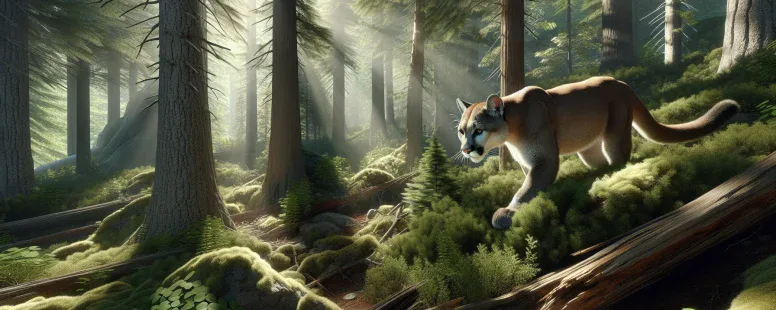
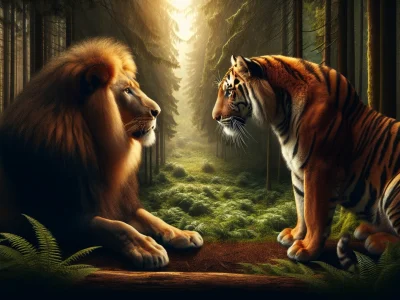
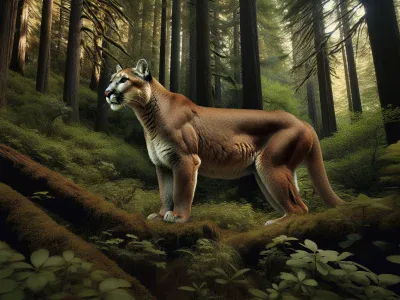
Picture standing at the edge of a sun-dappled forest, the air thick with the scent of pine and earth, when a shadow flickers between the trees—a sleek, muscular form vanishes in silence. Now picture the golden expanse of the savanna, where a deep roar vibrates through the tall grass and the king of beasts prowls with regal confidence. Both scenes pulse with wild energy, but the creatures at their heart couldn’t be more different.
What sets a mountain lion apart from a lion goes far beyond geography. You’ll uncover surprising contrasts in behavior, appearance, and even the way these big cats interact with their worlds. If you’ve ever wondered which feline would win in a battle of stealth or strength, you’re about to embark on a journey that reveals the hidden wonders behind two of nature’s most captivating predators.
Overview of Mountain Lion and Lion
Compare mountain lions (Puma concolor) with lions (Panthera leo) by looking at their habitats, behaviors, and appearance. Mountain lions prowl through the thick forests and rocky ridges of the Americas, from the Canadian Yukon to the southern Andes. You spot them alone, blending into their tawny surroundings, silently watching for white-tailed deer or capybara. Lions, on the other hand, reign over grasslands in Africa and parts of India. Groups, called prides, sprawl across the sunlit savanna, their golden coats nearly dissolving into dry grass while they plan a hunt for zebra or wildebeest.
Ask yourself if solitude or social strength shapes a predator’s destiny. Do you think a cougar’s isolation makes it more adaptable than a lion’s teamwork? Researchers at National Geographic shows that mountain lions cover hundreds of square miles for prey, while Science magazine notes that lions depend on group strategy to surround and overpower targets.
Picture a moonlit night in Yosemite, where you catch a glimpse of a silent shadow—a mountain lion, delicate as a ghost, balancing atop a boulder. Then, picture the thunderous roar rolling across the Maasai Mara, shaking acacia trees as a lioness signals her pride to rally for the kill. Both apex predators, yet they live in worlds apart—one is the quiet phantom, the other the roaring monarch.
You wonder why mountain lions never grow a mane, while male lions boast a royal ruff of hair. Biologists believe manes evolved as a defense, signaling dominance and attracting mates (Smithsonian). In contrast, solitary hunting favors stealth and agility, so mountain lions stay streamlined.
When comparing these big cats, their stories spark questions: Is power defined by force or finesse? Would a solitary hunter’s secrets outlast a kingdom’s legacy? Every encounter with a paw print or echoing roar reminds you the wild invents countless ways to survive.
Physical Differences
Your curiosity draws you to compare mountain lions and lions, two apex predators split by continents but joined by raw power. Their bodies shape stories of solitary survival versus communal strength—can you spot which traits speak to each life? Examining size, appearance, and distinctive markings, you’ll see how evolution crafts hunters for their stage.
Size and Appearance
Mountain lions, also known as cougars or pumas, look slender and agile, weights ranging from 65–220 lbs (29–100 kg), and lengths up to 8 ft (2.4 m) including their tail. Their sleek muscles ripple under tawny coats—picture one slipping like a shadow between Douglas firs. Lions, by contrast, possess greater bulk and powerful frames, with males weighing 330–570 lbs (150–259 kg) and stretching to 10 ft (3 m) in length. A male lion’s mane, thick and imposing, forms a dramatic silhouette on the African plain, signaling maturity and intimidating rivals. Female lions, mane-less, their shape even more defined by powerful shoulders and compact torsos. Where a mountain lion bounds high onto boulders, a lion sinks deep into grass at nightfall, their bodies designed for ambush or open chase.
Coloration and Markings
Mountain lions have coats in shades of tawny-gray or reddish-brown, almost unmarked but for white underbellies and black-tipped tails and ears. Their fur blends perfectly with mountainsides and forest undergrowth, camouflage tailored for stalking prey like mule deer. Lions display golden-yellow coats with subtle spots on cubs that fade with age, a silent story of hidden youth. Males’ manes range in color from blond to nearly black, often darker among dominant individuals—did you know, scientists from the University of Minnesota (source: National Geographic, 2020) found mane color signals hormone levels and fighting ability? Both cats have distinctive facial markings, but only cubs of lions keep visible spots—will a young lion’s dappled fur ever give away its cover in the savanna grass? While mountain lions show restraint in their coloring, lions wear their patterns more boldly, broadcasting their social place and age with every shade.
Habitat and Range
Habitat and range shape the destinies of both mountain lions and lions, crafting stories of adaptation and survival across continents. You’ll find these two big cats worlds apart, separated by oceans, climate, and ancient migrations that shaped their modern lives.
Geographic Distribution
Mountain lions spread across the Americas, from the wilds of British Columbia down to Patagonia. You might stumble upon one shadowing the canyons of Utah or weaving through the Andean foothills in Argentina. Their territory covers 28 countries, with records in rainforests, deserts, and grasslands. In contrast, lions stride through the sun-bleached savannas of sub-Saharan Africa, with a small population hanging on in India’s Gir Forest. Over 20 African countries report lions, but their range once stretched as far as southern Europe and the Middle East. Now, you won’t find wild lions on the American continents. Does this separation breed difference, or do echoes of ancient ancestors remain in their DNA?
Comparative Range Table
Species
Continents Present
Countries
Notable Regions
Mountain Lion
North and South America
28
Rockies, Andes, Pantanal
Lion
Africa, Asia (India)
20+
Serengeti, Kalahari, Gir Forest
Preferred Environments
Preferred environments change how each cat hunts, rests, and raises young. Mountain lions excel as ghosts of the landscape—navigating thick forests, steep bluffs, and even snowy slopes. Camouflage cloaks their muscular forms as they leap over pine needles and rocky ledges. how an animal can slip between shadow and light so easily? Ask a mountain lion hunter circling dawn’s mist.
Lions, kings of the savanna, favor open grasslands where their golden coats ripple with the sunlight, blending with tall yellow grasses. Prides cluster near water holes and acacia thorn trees—constant resourcefulness in a land of drought and plenty. Social cats stake out territories near wildebeest migrations, adapting their routines to the rhythmic pulse of Africa’s seasons. For example, Serengeti lions strategize group ambushes across open plains, while Gujarat’s Asiatic lions shelter under ancient teak and banyan.
Which environment shapes the hunter: the shadowed forest or the endless plains? Does solitude forge adaptability, or does unity amplify power? You’ll find answers in the tracks they leave and the landscapes they rule.
Behavior and Social Structure
Behavior and social structure highlight the biggest difference between your average mountain lion and a pride-dwelling African lion. Solitude marks a mountain lion’s daily life, while the lion’s existence pulses with the chaos and comfort of family groups. You’ll find these behavioral blueprints reflected in how they hunt, eat, and even communicate. Watching either cat long enough, you might wonder if strength lies in numbers or in working alone under the silent shade of the forest.
Hunting and Diet
Mountain lion hunting plays out like a silent, shadowy game of chess. These cats stalk prey quietly—deer, elk, sometimes even coyotes—placing each massive paw with care. You’d see a mountain lion depend on stealth and surprise, sometimes tracking a deer for hours and then leaping with explosive force. They eat alone, rarely sharing a kill except with dependent cubs (Elbroch et al., Frontiers in Ecology and the Environment, 2013).
Lions, in contrast, turn hunting into a family affair. Pride members coordinate ambushes, using strategy to herd zebra or buffalo toward waiting jaws. Females chase, males defend, and cubs learn from the chaos. On the savanna, teamwork brings down large prey, and the entire pride feasts—though a hungry alpha can elbow his way to the choicest cuts first (Schaller, The Serengeti Lion, 1972).
Social Behavior
Social structure splits these two species like a river divides a plain. Mountain lions act as lone wanderers, each patrolling a territory stretching to 150 square miles, marking it with scrapes and scent. You won’t see them tolerating intruders—not unless it’s mating season or a mother with cubs. Encounters might end in a chase, a fight, or a tense standoff, and sometimes the victor claims an entire valley. Researchers discovered that these solitary habits support adaptation to sparse resources in rough landscapes (Logan & Sweanor, Desert Puma, 2001).
Lions, though, live by the bonds of pride. Females cooperate in raising cubs—sharing milk, watching over each other’s young, and defending turf from rival prides. Roars ripple across the grass, signaling territory or summoning stragglers. Dominance hierarchies shift whenever males challenge each other, and takeovers can mean life or death for cubs. You might notice that, with all this drama, lions remain Africa’s only truly social big cat, turning the open plains into a stage for alliance, rivalry, and survival (Packer et al., Science, 1990).
In the wild, are you rooting for cunning solitude, or the strength of a crowd?
Reproduction and Lifespan
Reproduction behaviors between mountain lions (Puma concolor) and lions (Panthera leo) reveal fundamental contrasts in their life strategies—like comparing a whisper of wind in the forest to the roar of thunder across the plains. You might wonder, what drives such different rhythms? For mountain lions, courtship dances play out quietly among secluded ridges. Females enter estrus several times in a year, often attracting transient males with scent markings or vocalizations for just a brief encounter. After mating, a female mountain lion carries her cubs for about 90–96 days, then gives birth in rocky dens or dense underbrush. Typically, litters range from 1–6 kittens, and the mother raises her young alone, teaching them to stalk, climb, and disappear into shadows. Did you ever picture a mother cat guiding her spotted kittens through moonlit pines, each footfall silent and careful?
Contrast this with the spectacle of the African lion’s pride—a social epic set on the savanna. Lionesses synchronize birthing after conceiving during periods of male dominance, supporting each other as they raises the cubs. Gestation lasts about 110 days, slightly longer than the mountain lion. Lionesses deliver 1–4 cubs in secluded areas, then, soon after, introduce them to the bustling safety net of the pride (Macdonald, 2010). Within the pride, lionesses nurse and even sometimes discipline each others’ cubs, weaving a tapestry of kinship. Dominant males father most cubs, fighting for a legacy written in golden fur and thunderous roars. Doesn’t that communal nursery, ringed by watchful mothers, sound like nature’s daycare filled with both harmony and rivalry?
You may ask, how long do these wild dramas last? Mountain lions, if luck favors, live 8–13 years in the wild, with some reaching 20 in captivity. Their solitary path is treacherous: starvation, territorial fights, and human conflict loom constantly (Hornocker & Negri, 2010). Mountain lion cubs disperse young—driven into lone territory quests, where few rivals tolerate competition. Every new habitat shapes a silent narrative of survival.
For lions, social bonds buy some time. Prides offer safety in numbers, so lions may reach 10–14 years in the wild, but males rarely last beyond 8–12 due to the constant threat posed by rival males (Packer et al., 2005). In captivity, lions can surpass 20 years, a testament to the power of protection and provision.
Behavioral table below shows the major reproductive and lifespan differences:
Attribute
Mountain Lion (Puma concolor)
Lion (Panthera leo)
Courtship
Solitary, brief, secretive encounters
Social, pride-influenced, competitive
Gestation Period
90–96 days
110 days
Litter Size
1–6 kittens
1–4 cubs
Rearing
Mother alone
Cooperative among pride members
Wild Lifespan
8–13 years (rarely up to 20 captive)
Females: 10–14 yrs, Males: 8–12 yrs
Let curiosity guide you deeper. What if you watched a lone female mountain lion vanishing at dawn, kitten in her jaws—or a line of lionesses at dusk, cubs tumbling between their legs? The story of these big cats continues, page by page, each life shaped by solitude or togetherness, echoing across mountains and grasslands.
Adaptations and Survival Skills
Picture you’re trekking through the pine forests of Montana or watching the grasses ripple beneath acacia shadows in the Serengeti—mountain lion or lion tracks could lay right before your feet, evidence of two apex predators, who adapt in strikingly different ways.
Mountain lions, also known as cougars or Puma concolor, adapt to their solitary destinies through astonishing agility and silent movement. They leaps 18 feet upward, vault over boulders, and disappear into rocky escarpments with barely a sound. You’ll see how their powerful hind limbs and long tails provide balance and propulsion in steep terrain—National Park Service biologists show these cats even swim across rivers if needed. Nocturnal vision, sensitive whiskers, and muted coats help mountain lions melt into their habitats. Could you picture stalking deer across a snowdrift in silence, trusting only your own wits and muscle memory? This is everyday for the mountain lion.
Lions, Panthera leo, survive through teamwork honed over millennia on the savanna. Males protect with savage roars echoing up to 5 miles, a mane shielding them in battle, while lionesses strategize group hunts—spreading wide across the plain and corralling zebras with relentless focus (Packer et al., Science, 2005). Cubs play at the edge of the pride, practicing pounces beneath watchful eyes. Every pride member fills a niche: some lead the chase, others flank, young ones learn by doing. Picture the heartbeats of ten lionesses syncing in ambush—will you bet against the synchronized hunger of a family?
Both species exhibit adaptation marvels but face survival threats shaped by environment and human encroachment. Cougars can alter ranges and switch to unconventional prey, according to research from the Wildlife Conservation Society; lions adapt by shifting hunting times or moving closer to livestock, sometimes sparking conflict. Conservation efforts depend on understanding their nature—can you see the tension between resilience and fragility? In one case, a mountain lion crossed 1500 miles from South Dakota to Connecticut, traversing cities, highways, and farmland (Smithsonian, 2012)—an odyssey blending survival instinct and the risks of a changing continent.
If a single skill sets these cats apart, it’s their response to isolation versus unity. Does your life resemble the silent prowl in moonlit hills, or the chorus of roars on a dusty plain? Whatever your path, nature’s big cats challenge you to ask: in adversity, do you go alone, or do you lean on your pride?
Conservation Status and Threats
Mountain lions tug at the wild spirit of the Americas, surviving where shadows mingle with pine needles and red rocks. Yet, your eyes might seldom glimpse their tawny form, because while they stretch across 28 countries from North to South America, conservationists count shrinking, fragmented habitats as their silent adversary. The IUCN lists mountain lions (Puma concolor) as “Least Concern,” though populations in Florida and California face drastic threats from urban expansion, vehicle collisions, and prey loss. One Florida panther, collared and tracked, navigated highways darting across subdivisions, only to lose its life at the edge of a culvert—a casualty reported by the Florida Fish and Wildlife Conservation Commission.
Lions (Panthera leo), on the other hand, once fanned their maned silhouettes across southern Europe, Asia, and the entire African continent. If you walk the windswept plains of the Serengeti, you’ll see this is not their world anymore. Now, fewer than 23,000 wild lions roam Africa and only 600–700 persist in India’s Gir Forest, with their global populations listed as “Vulnerable” by the IUCN. Trophy hunting, retaliatory killings by livestock herders, and rapid habitat loss steadily erode their paw print, leaving only scattered strongholds where pride voices thunder through the dusk. A Maasai herder in Kenya, recounted in National Geographic, lost half his cattle to a hunt at night—his response, like many, ignited long-standing conflict between people and lions.
Both cats anchor the food chains of their homes, yet neither mountain lions nor lions escape the snare of human encroachment. Climate change tightens this snare. Prolonged droughts in Africa force lions to hunt livestock, escalating human-wildlife conflict. In the Rockies, wildfires and drought drive deer away, leaving mountain lions to scavenge on the margins. Conservation groups such as Panthera and the Lion Recovery Fund support corridor projects to bridge fragmented territories, but two simple questions persist: Where is their safe haven? And will coexistence ever outweigh conflict?
Here’s a glance at how these big cats walk the line between existence and extinction:
Does the solitary mountain lion, ghosting through silent forests, embody resilience or retreat? Do lions’ thunderous roars signal the defiance of unity, or its last echo as grasslands transform beneath their feet? The stakes are woven into the land—your choices, community actions, and global awareness decide if these predators remain the stories of legend or mere memories in the wind.
Conclusion
By learning about the unique traits and challenges faced by mountain lions and lions you gain a deeper appreciation for their roles in nature. Each species tells a story of adaptation and survival shaped by its environment and social structure.
Your understanding and actions can make a real difference in their future. Whether supporting conservation or spreading awareness your choices help protect these iconic predators for generations to come.
To provide the best experiences, we use technologies like cookies to store and/or access device information. Consenting to these technologies will allow us to process data such as browsing behaviour or unique IDs on this site. Not consenting or withdrawing consent, may adversely affect certain features and functions.
Functional
Always active
The technical storage or access is strictly necessary for the legitimate purpose of enabling the use of a specific service explicitly requested by the subscriber or user, or for the sole purpose of carrying out the transmission of a communication over an electronic communications network.
Preferences
The technical storage or access is necessary for the legitimate purpose of storing preferences that are not requested by the subscriber or user.
Statistics
The technical storage or access that is used exclusively for statistical purposes.The technical storage or access that is used exclusively for anonymous statistical purposes. Without a subpoena, voluntary compliance on the part of your Internet Service Provider, or additional records from a third party, information stored or retrieved for this purpose alone cannot usually be used to identify you.
Marketing
The technical storage or access is required to create user profiles to send advertising, or to track the user on a website or across several websites for similar marketing purposes.