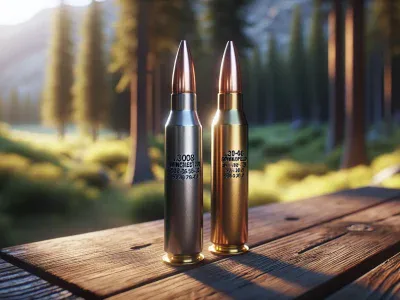
Picture yourself at the shooting range—sunlight glinting off polished brass cartridges, the sharp scent of gunpowder in the air. You line up a shot, but a question lingers: does it really matter if you load your rifle with 7.62 or .308? At first glance, these rounds seem like twins, nearly indistinguishable to the untrained eye.
But beneath the surface, subtle differences spark debates among marksmen and hunters alike. Understanding what sets these cartridges apart can give you an edge—unlocking better performance, safety, and even cost savings. Ready to uncover the truth behind the numbers stamped on your ammo box? Let’s jump into the world where precision meets power and every detail counts.
Overview of 7.62 and .308 Cartridges
You encounter the 7.62x51mm NATO and .308 Winchester cartridges on the same ammo shelf, their cases gleaming under harsh fluorescent lights. These cartridges look almost identical, but their stories diverge in the details that often trip up even experienced shooters. Both share a bullet diameter of 0.308 inches, a legacy tracing back to Cold War battlefields and American hunting grounds.
In the civilian world, .308 Winchester gets used in precision hunting rifles, competitive shooting, and law enforcement rifles. Hunters in Texas, for example, choose .308 for deer because of its proven stopping power and widely available options. Meanwhile, military and police armorers stamp 7.62x51mm NATO on crate after crate for service rifles and machine guns across dozens of NATO countries. The U.S. Army standardizes 7.62 NATO as a military cartridge, usually loaded to slightly lower pressures than .308, as explained by SAAMI (Sporting Arms and Ammunition Manufacturers’ Institute)[^1].
Do you ever wonder what would happens if you swap one for another? Some shooters have, with mixed results. The .308, with pressures up to 62,000 psi, can exceed the 7.62’s 50,000 psi limit. That means commercial .308 rounds fired in older, military-spec 7.62 rifles could risk damage or injury. Even so, some rifles seem eat both without problems—a luck some credit to wider NATO tolerances versus strict civilian manufacturing standards.
A shooter at a Pennsylvania range once told a story about blending cartridges at a competition. Swapping boxes without noticing, he passed both Mil-Surp 7.62 and premium .308 to his buddy. They debated which shot smoother. The results? The .308 grouped tighter on paper, but the 7.62 felt softer, with a clack echoing down the firing line. That little difference can mean victory at a match or just a safe day at a busy range.
Questions about interchangeability spark debate on forums and gun shop counters. Can you shoot .308 in a 7.62 chamber? Most experts advise caution, referencing pressure ratings and headspacing differences, a fact confirmed by the NRA and manufacturers like Winchester[^2].
What story does the brass tell? Examine a fired 7.62 case—at times, you’ll see more headspace stretch, especially in older rifles. Inspect .308 brass from a hunting trip, and you might spot thicker case walls engineered for repeated reloads. These subtleties shape how you select the right ammo for your rifle, and why many reloaders insist on keeping their brass sorted by headstamp and history.
[^1]: “Understanding the Differences Between 7.62 NATO and .308 Winchester,” SAAMI, 2023.
[^2]: “Ask the Experts: .308 Winchester vs. 7.62 NATO,” NRA Shooting Illustrated, 2022.
Historical Background
Cartridge history connects weapon innovation with real-world needs. Your grasp of the 7.62 and .308 story deepens when you trace their divergent journeys from war rooms to woodlands.
Origins of 7.62 NATO
Military intent shaped the 7.62x51mm NATO. In the early 1950s, NATO sought a standard rifle cartridge. Ammunition specialists, pressed by Cold War politics, compared ideas across Atlantic—British .280 versus American T65 prototypes. Eventually, NATO members endorsed the T65, birthing 7.62x51mm NATO in 1954 (source: US Army Ordnance Dept). Battlefield priorities—like reliable feeding in automatic rifles and robustness in diverse climates—defined the cartridge’s thick brass and moderate case pressure, around 50,000 psi. Real-world testing echoed these goals as rifles like the M14 and FN FAL became synonymous with the cartridge’s global spread. Question if you’d recognize it in WWII relics? The answer lies in the striking similarity it shared with the earlier .30-06 while delivering reduced recoil for automatic fire.
Development of .308 Winchester
Civilian demand wrote a different script for the .308 Winchester. Winchester Repeating Arms, noticing how hunters admired the military’s new round, commercialized the T65 prototype as the .308 Winchester in 1952 (source: Winchester archives), two years before NATO finalized its adoption. Sporting shooters craved accuracy and reloading flexibility. .308 brass often varied from 7.62 NATO in internal construction and sometimes in headspace, although cases looked nearly identical. Precision shooting competitions and hunting expeditions tested these differences. Critics sometimes debate: does external appearance define function, or do subtle specifications shift the practical story? Reloaders, for example, may find that .308 Winchester allows slightly higher pressures—up to 62,000 psi (SAAMI standard)—than the military 7.62 NATO, a factor that sometimes surprises new shooters. Your own experience at the range might echo that edge, especially in accuracy-focused contests where minute variations magnify.
Key Technical Differences
7.62x51mm NATO and .308 Winchester cartridges share surface-level traits, yet technical gaps run deeper. You spot both rounds at ranges and in gun safes, but their differences shape every shot.
Cartridge Dimensions and Pressure
Cartridge dimensions appear nearly identical on digital calipers. 7.62 NATO cases average 2.015 inches in length, .308 Winchester closely trails at 2.015 to 2.020 inches. Manufacturers—such as Federal for .308 and Lake City for 7.62—alter brass thickness and internal case volume, impacting performance. SAAMI sets the .308 Winchester max average pressure at 62,000 psi, while NATO specs cap 7.62×51 at 50,000 psi. Higher .308 pressures translate to warmer loads and steeper recoil—a difference you feel at every squeeze of the trigger.
Cartridge
Case Length (inches)
Max Average Pressure (psi)
Common Brass Maker Example
7.62x51mm NATO
2.015
50,000
Lake City
.308 Winchester
2.015–2.020
62,000
Federal
Anecdotes from reloaders reveal issues: firing high-pressure .308 Winchester in some older surplus 7.62 NATO rifles can cause sticky extractions or, in rare cases, split cases. This pressure gap drives seasoned shooters to match cartridge and rifle, avoiding risk and maximizing accuracy.
Chamber Specifications
Chamber specs quietly shape each interaction between steel, brass, and gunpowder. NATO 7.62 rifles, including the classic M14, rely on more generous chamber headspace, allowing consistent function even though dirt or case expansion. In contrast, .308 Winchester chambers—seen in the Remington 700 or Savage 10—hold tighter tolerances for precision.
Tight headspace prevents case stretching and enhances accuracy for .308, but using surplus 7.62 ammo can sometimes lead to carbon streaks or erratic cycling in match-grade rifles. Gunsmiths often mic chamber dimensions to ensure correct pairing between ammo and barrel—a safeguard that delivers trust in every firing pin drop.
Performance and Ballistics
Performance and ballistics illuminate the lived differences from muzzle to target. Commercial .308 options like Hornady ELD-X or Winchester Super-X push 150-180 grain bullets at velocities up to 2820 feet per second. Surplus 7.62 NATO from brands like MEN or PPU typically launches at 2750 feet per second with 147-150 grain FMJ loads.
Competitive shooters notice flatter trajectories and tighter groups with .308 Winchester in precision rifles, crediting bullet consistency and pressure. In battle rifles, military 7.62 NATO prioritizes reliability and function over raw accuracy—a philosophy proved by decades of service in rifles like the FN FAL and G3.
You might ask: which wins in the field, civilian .308 or military 7.62? The answer shapes with context. Hunters lean .308 for reload flexibility and accuracy. Survivalists sometimes grab 7.62 NATO out of faith in ruggedness and interoperability. Stories from both camps—like the match shooter achieving a sub-MOA group with .308 or a collector running surplus 7.62 through a battle-worn M1A—frame real-world choices.
Every time you select between 7.62 and .308, you’re not just picking a number—you’re investing in how a cartridge’s design harmonizes with rifle, user, and mission.
Interchangeability and Compatibility
You might glance at 7.62x51mm NATO and .308 Winchester rounds side-by-side at the range and swear they’re twins, but their differences run just below the brass. This section explores critical aspects of interchangeability and compatibility, revealing potential hazards and opportunities unique to these famous cartridges.
Safety Considerations
Mixing 7.62 NATO and .308 Winchester ammo in your rifle seems simple until you dig into chamber pressures. You’d guess they’re swap-friendly; after all, the markings almost match. But, the maximum average pressure for .308 Winchester clocks in at 62,000 psi, while 7.62 NATO sticks closer to 50,000 psi (source: SAAMI, NATO EPVAT). Firing .308 in rifles built for 7.62 NATO can, in some cases, push the boundaries of safety. Gunsmiths have reported cracked extractors or even ruptured cases after repeated .308 rounds in old surplus 7.62 shoulder rifles.
Consider a bracing sunrise hunt: you’re packing a 1960s M14 variant but pop modern .308 hunting rounds in the magazine. Accuracy might shine, but that faint stutter of your bolt speaks volumes—stress is rising in places you can’t see. Some shooters chase performance, yet risking your rifle’s health and your own on a technicality rarely pays off. Always check the markings on your barrel and consult your rifle’s maker; manufacturers like Ruger, Remington, and Springfield Armory each draw the line at different thresholds based on their data and user reports.
Practical Implications for Shooters
Interchangeability influences both your trip to the range and your prepping mindset. When you load a .308 Winchester into a 7.62 NATO chamber, reliability usually remains safe territory, but only because NATO standards demand broader chamber tolerances for mud, sand, or even battlefield grime. Civilian precision rifles chambered for .308? Their tighter specs deliver accuracy medals at competitions but can choke on poorly sized or out-of-spec 7.62 brass, occasionally causing misfeeds or frustrating jams.
A few competition shooters recount switching between commercial .308 and surplus 7.62 with mixed luck—some rifles shrugged off the swap, while others spat out hot cases or showed stiff bolt lifts (source: user forums like Sniper’s Hide, reports from Hornady). For reloaders, those subtle distinctions mean the world—NATO brass often comes thicker, so squeezing it into match-grade .308 chambers asks for extra muscle during resizing. Survivalists and tactical enthusiasts sometimes stock 7.62 for its legendary ruggedness and bulk availability, knowing the looser tolerances eat grit and still cycle.
So the question hangs: Is versatility worth the tradeoff? Compatibility offers tempting convenience, especially for budget-conscious marksmen. Still, blur these lines blindly, and you’ll court malfunctions or worse. Choosing your ammunition with your rifle’s DNA in mind delivers both safety and peak ballistic performance, a lesson echoed by range officers and seasoned reloaders from Alaska to Texas.
Common Uses and Applications
Usage differences between 7.62x51mm NATO and .308 Winchester become clear when you see how distinct groups rely on these cartridges. Experienced hunters, military strategists, and competitive shooters each trust either round under different circumstances.
Hunting
Hunters often favor .308 Winchester for its proven reliability in bagging deer, elk, and wild boar. When stalking game through dense woods, a lightweight bolt-action .308 rifle lets you move swift and keeps follow-up shots tight. You’ll spot hunting forums buzzing with stories—like one from Montana, where a seasoned hunter dropped a 300 lb elk at 200 yards using a 150-grain .308 soft-point. Its precise ballistics ensures clean, ethical kills. Durable, reloadable brass cases make it attractive for shooters who tweak their loads for specific animals or conditions, matching regional hunting regulations (NSSF, 2023).
Some ask why not use 7.62? Tactical hunters, prepping for rugged backcountry, sometimes pick surplus 7.62 NATO. They say surplus rounds run reliably in semi-auto rifles and perform unchanged after harsh handling—think dropping a loaded magazine in mud, then scoring a hit on a wild boar moments later.
Military and Law Enforcement
Military and law enforcement agencies almost always standardize on 7.62x51mm NATO. The round’s robust case walls and milder max pressure keep automatic rifles and machine guns cycling smoothly during protracted firefights. If you picture a squad of NATO troops covering a ridge with FALs or M240s, you’re really picturing 7.62 NATO at work. Army range instructors will caution against .308 Winchester in those same rifles, reminding you: “Pressure spikes can damage the bolt face after a prolonged burst.”
Law enforcement SWAT teams sometimes reach for the .308 in bolt-action sniper rifles, valuing its tighter chambers and consistent factory loads. But agencies ordering thousands of rounds for patrol carbines nearly always default to 7.62 NATO, trusting its feed reliability over batch-to-batch consistency.
Sporting and Target Shooting
Precision shooters and competitive marksmen gravitate toward .308 Winchester. Why? Match-grade .308 loads like Federal Gold Medal Sierra MatchKing dominate events from 100-yard benchrest to 1000-yard F-Class—PRB survey data (2022) shows .308 among the top three cartridges used in national-level competitions. If you join a shooting club, you’ll probably notice that .308 reloading benches are always busy, as shooters craft handloads dialing in sub-MOA performance.
Casual plinkers and 3-gun competitors often lean on economical 7.62 surplus for weekend practice. A shooter running a PTR or M1A at a match credits 7.62’s surplus pricing as key to logging over 500 rounds in a single afternoon, though he admits that groups open up compared to his handloaded .308. So, while .308 targets precision, 7.62 wins on cost and availability.
Each sphere—hunting, military, marksmanship—answers the same central question: What demands do you put on your rifle and cartridge? When you choose between 7.62 NATO and .308 Winchester, you’re not just picking numbers—you’re voting with every shot for reliability, precision, or rugged endurance.
Conclusion
Choosing between 7.62 and .308 comes down to knowing your rifle and your shooting goals. Paying attention to details like chamber specs and pressure ratings keeps you safe and helps you get the most out of your gear.
When you understand what sets these cartridges apart you can make smarter decisions at the range or in the field. Whether you’re hunting competing or just enjoying some range time a little knowledge goes a long way.
To provide the best experiences, we use technologies like cookies to store and/or access device information. Consenting to these technologies will allow us to process data such as browsing behaviour or unique IDs on this site. Not consenting or withdrawing consent, may adversely affect certain features and functions.
Functional
Always active
The technical storage or access is strictly necessary for the legitimate purpose of enabling the use of a specific service explicitly requested by the subscriber or user, or for the sole purpose of carrying out the transmission of a communication over an electronic communications network.
Preferences
The technical storage or access is necessary for the legitimate purpose of storing preferences that are not requested by the subscriber or user.
Statistics
The technical storage or access that is used exclusively for statistical purposes.The technical storage or access that is used exclusively for anonymous statistical purposes. Without a subpoena, voluntary compliance on the part of your Internet Service Provider, or additional records from a third party, information stored or retrieved for this purpose alone cannot usually be used to identify you.
Marketing
The technical storage or access is required to create user profiles to send advertising, or to track the user on a website or across several websites for similar marketing purposes.