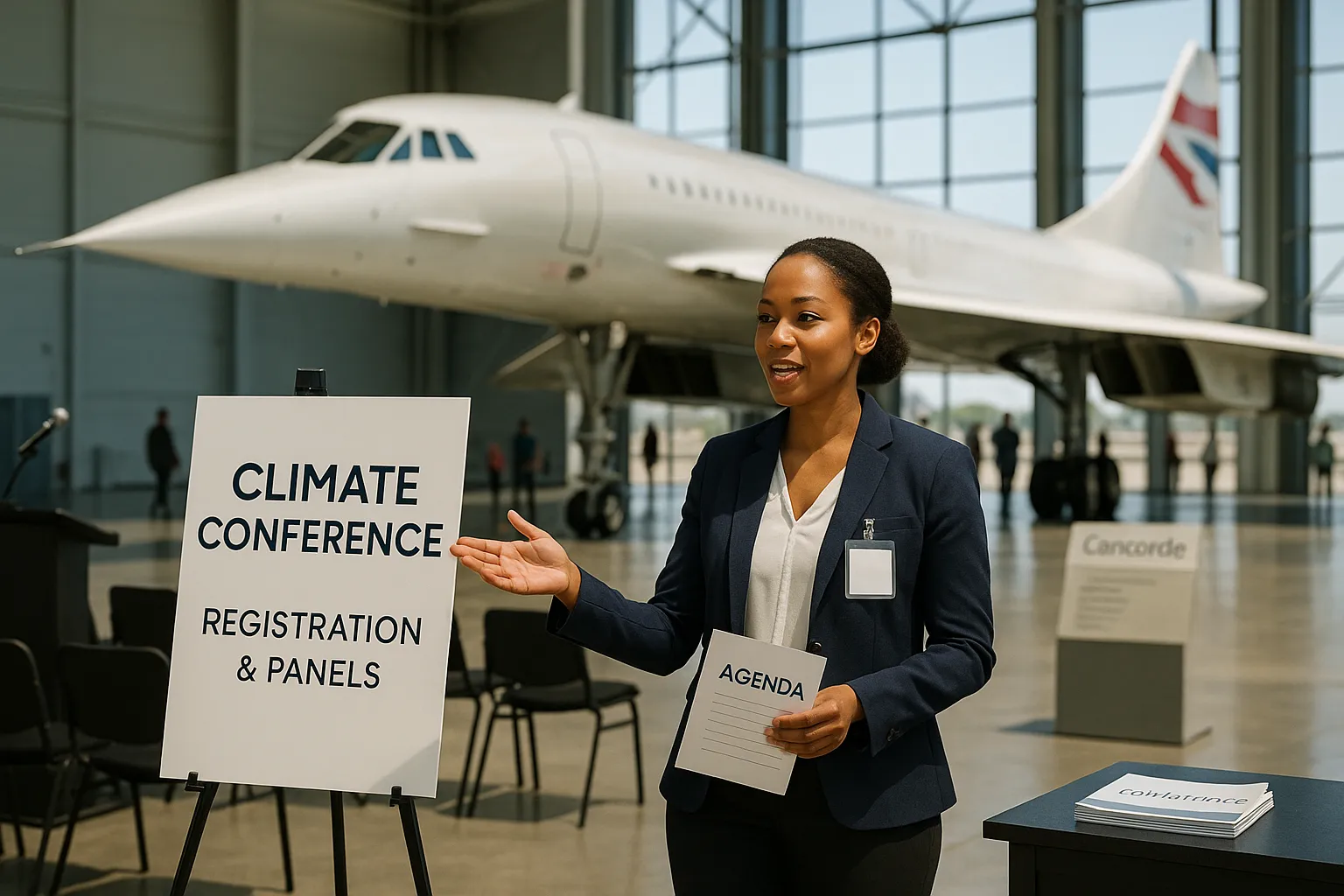
You hear both words in different rooms, a hallway at an airport and a planning meeting, and they land like two very different keys on the same piano. Conference and Concorde look and sound similar enough to trip you up in speech or writing, yet they point to distinct ideas: one is about people coming together: the other is about a very specific aircraft and a set of meanings tied to speed, design, and brand. This article shows you, in plain terms and vivid examples, how those differences matter in communication, research, and daily decisions. Expect clear definitions, origin stories, real mishaps, and sharp memory aids you can use instantly.
What Each Term Means Today
Fact: Conference usually means a meeting of people: Concorde usually refers to the supersonic airliner or the idea of agreement.
Conference: You use this word when you mean a formal meeting of delegates, professionals, or enthusiasts who gather to exchange information. Examples include the Consumer Electronics Show (CES), the United Nations Climate Conference (COP), and IEEE technical conferences. In contemporary English, “conference” can also name a sport league (e.g., the Big Ten Conference). The subject, people, acts: they gather, speak, and decide.
Concorde: You most often see this as a proper noun: Concorde, the Anglo-French supersonic passenger airplane flown by British Airways and Air France from 1976 to 2003. Less often, “concord” (without the -e) means harmony or agreement: “Concorde” with an e is generally the aircraft or brand. When you read news about Concorde now, it’s usually historical, museum-related, or part of design and aviation discussions.
Semantic entities to note: British Airways, Air France, Concorde prototype 001, CES, IEEE, United Nations, OED.
Why the distinction matters: Using the wrong word can mislead. If you write “the Concorde will host the panel,” readers will pause. The subject must match the predicate: a meeting hosts a panel: an airplane carries passengers. Keep that simple S-V-O order in mind to avoid mix-ups.
Origins And Etymology
Fact: The two words come from different roots, one from Latin via Old French meaning “with heart” or agreement: the other from Latin via French meaning to come together for discussion.
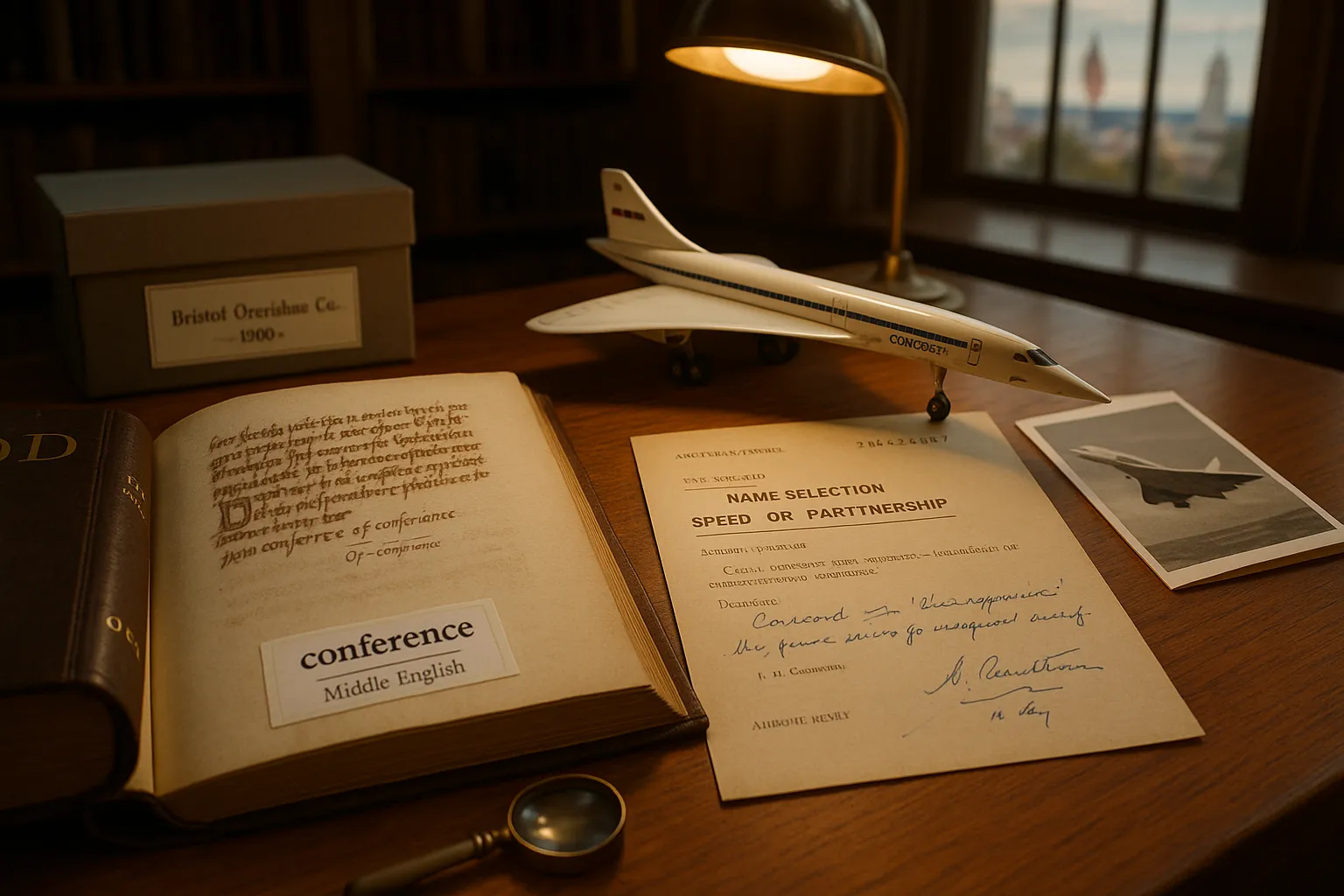
Conference: This word traces to Latin conferre (to bring together) through Old French and Middle English. It keeps the sense of bringing ideas or people together. Named entities: Oxford English Dictionary (OED), Middle English texts that record “conference” in clerical and academic uses.
Concorde: The aircraft’s name derives from French concorde (agreement, harmony). The city of Concord (e.g., Concord, Massachusetts) shares that same Latin root concordia. In aviation branding, the name aimed to connote harmony between British and French teams and harmony of engineering. Named entities: BAC (British Aircraft Corporation), Aérospatiale, Concorde 101, Flight International archives.
A brief anecdote: At the Bristol Aeroplane Company archive, a 1960s memo shows engineers debating whether the name should stress speed or partnership. They picked partnership, hence Concorde, which explains why the brand uses the French spelling with an e.
How People Commonly Confuse Or Conflate The Two
Fact: Confusion arises because the words share letters and a vaguely similar sound: errors occur most in speech and hurried writing.
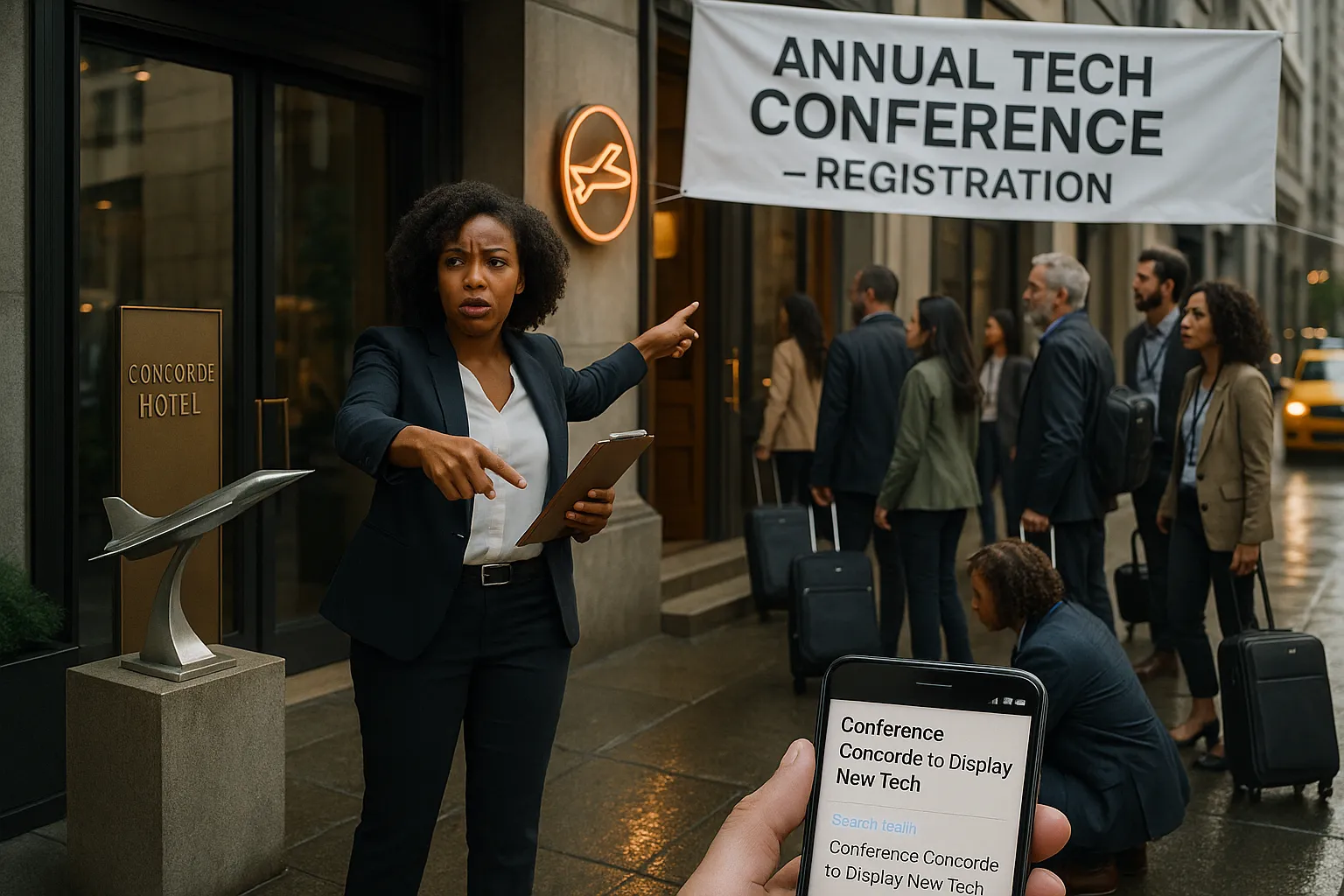
Common errors: You’ll hear people say “I’m going to the Concorde next month” when they mean a conference at Concorde Airport or the Concorde Hotel. You’ll also find typos in headlines: “Conference Concorde to Display New Tech”, which mixes meeting and machine into nonsense. Search engines compound the problem when people tag content incorrectly, so the wrong audience finds your page.
Psychology behind the mix-up: The human brain uses pattern matching. When words look similar, you may substitute without checking. Also, place names like “Concorde Hotel” or “Concorde Airport” create overlap: they act as ambiguous anchors. Named entities involved: Concorde Hotels, Heathrow Terminal signage, TripAdvisor listings.
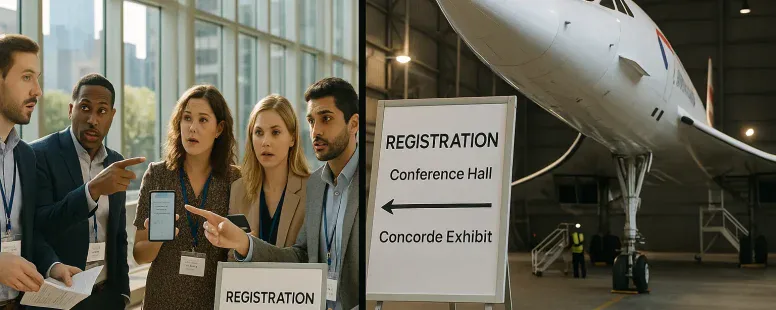
Real consequence: Miscommunication at scale. An events manager once sent airport pick-up instructions to speakers saying, “Meet at the Concorde for registration.” Some arrived at a Concorde-themed restaurant instead of the conference center. That error cost time and a keynote speaker’s patience.
Practical Implications Across Contexts
Fact: Using the right term affects logistics, search results, branding, and legal clarity.
In business writing: If you contractually commit to “the conference” you imply services like rooms and AV. If a contract ambiguously names “Concorde,” you could bind an unrelated party. Use named entities and precise nouns: “the 2026 Energy Conference at ExCeL London” rather than “the Concorde event.”
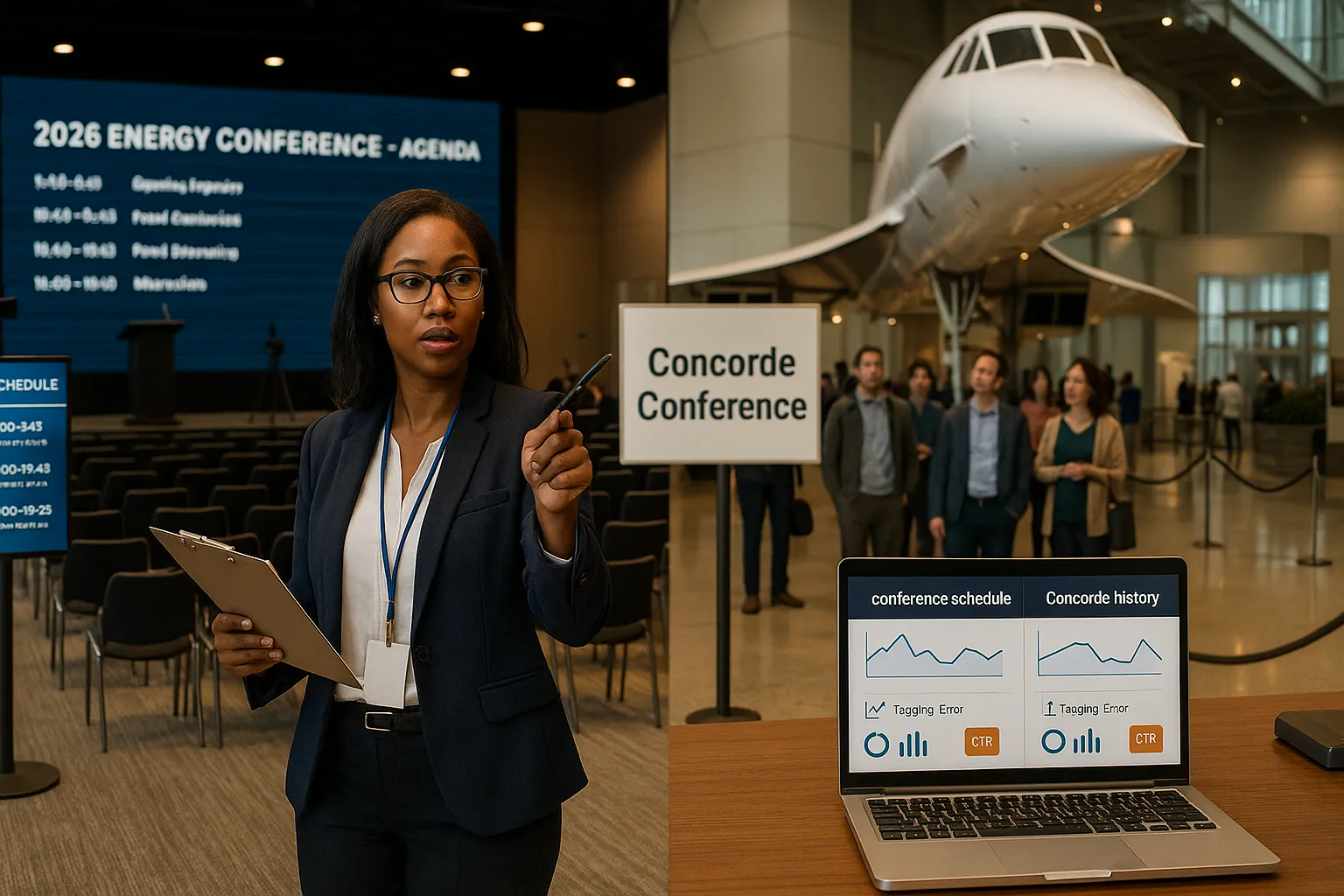
In SEO and content marketing: Keyword intent matters. People search “conference schedule” when they want agendas. They search “Concorde history” when they want aircraft facts. Tagging a conference page with “Concorde” will attract aircraft buffs but not attendees. Named entities: Google Search Console, SEMrush, Ahrefs, event platforms (Cvent).
In speech and media: Anchors and PR pros must pick the right word to avoid confusion. A museum exhibit labeled “Concorde conference” will mislead visitors. Museums like the Smithsonian or Musée de l’Air et de l’Espace must label exhibits carefully.
Practical warning: When you plan an event near any Concorde-related site or brand, double-check all signage and emails. Small language slips create big friction for attendees and partners.
When To Use Each Word Correctly
Fact: Use “conference” when you mean a meeting or series of meetings: use “Concorde” when you mean the aircraft, the specific brand, or a proper noun tied to that plane.
Rules you can follow:
If people meet to talk, write “conference.” Example: “You’ll attend the climate conference on Tuesday.”
If you mean the supersonic jet, write “Concorde” with a capital C. Example: “The Concorde flew transatlantic routes.”
If you mean agreement, prefer “concord” without the e: “They reached concord on the contract.” Most modern usage would say “agreement,” though.
Context checks: Look at surrounding named entities. If you mention British Airways, Air France, or supersonic travel, you likely mean the plane. If you mention panels, keynotes, registration, or venues, you mean a meeting.
Quick grammar tip: Subject-verb-object clarity helps. Say “The committee (S) will hold (V) the conference (O).” Say “Concorde (S) carried (V) passengers (O).” That simple structure reduces slip-ups.
Case Studies And Real-World Examples
Fact: Real incidents show how mixing the words creates logistical and reputational issues.
Case study 1, The misrouted speaker: A university scheduled a tech conference and contracted a nearby Concorde Hotel for rooms. The confirmation email read “Meet at the Concorde for registration.” Several speakers interpreted that as the hotel lobby: organizers meant the conference hall named “Concorde.” One speaker missed the opening session. Lesson: Use full names and street addresses.
Case study 2, Museum exhibit confusion: The Musée de l’Air announced “Concorde conference” to promote a panel about supersonic design. Enthusiasts expected to tour the aircraft: journalists expected a formal academic conference. Attendance skewed and coverage missed key angles. Lesson: Clarify whether you mean a display, a talk, or a multi-day conference.
Case study 3, SEO mismatch: A travel blogger tagged a post “Concorde conference” meant to discuss Concorde-themed hotels near Le Bourget. The article attracted aviation historians and not hotel-hunting travelers. The post performed poorly for bookings. Lesson: Match search intent with keywords and named entities (Le Bourget, Charles de Gaulle, TripAdvisor).
Vulnerable moment: Organizers sometimes assume the audience knows local names. They forget that international attendees will read only the literal words. That assumption costs credibility and time.
Quick Reference: Tips And Memory Aids
Fact: Simple memory aids prevent most mistakes.
Tips and mnemonics:
Think “Conference = Conference Room.” Both start with CON and involve people in rooms. That cue keeps you on topic.
Think “Concorde = Concorde the plane.” The capital C and the final e remind you it’s a proper name tied to an aircraft and brands like British Airways and Air France.
Use context words: If you see “agenda,” “keynote,” or “session,” use conference. If you see “supersonic,” “Delta-v,” or “SST,” use Concorde.
Quick checklist before you publish or send:
Read the sentence aloud: does it imply people meeting or a machine?
Check named entities: do you mention airlines, museums, or hotels?
Use full proper names for places: “Concorde Hotel, London” vs “the climate conference at ExCeL.”
Memory aid example: Picture a meeting table (conference) and a pointed nose cone (Concorde). If the image is a table, you’re in the right word. If it’s an airplane, choose Concorde.
Call to action: When you next write an email, pause and verify the subject and object. That tiny check saves confusion, travel delays, and guest frustration, and it sharpens your writing. Good luck, and watch those homophones: small words, big costs.
To provide the best experiences, we use technologies like cookies to store and/or access device information. Consenting to these technologies will allow us to process data such as browsing behaviour or unique IDs on this site. Not consenting or withdrawing consent, may adversely affect certain features and functions.
Functional
Always active
The technical storage or access is strictly necessary for the legitimate purpose of enabling the use of a specific service explicitly requested by the subscriber or user, or for the sole purpose of carrying out the transmission of a communication over an electronic communications network.
Preferences
The technical storage or access is necessary for the legitimate purpose of storing preferences that are not requested by the subscriber or user.
Statistics
The technical storage or access that is used exclusively for statistical purposes.The technical storage or access that is used exclusively for anonymous statistical purposes. Without a subpoena, voluntary compliance on the part of your Internet Service Provider, or additional records from a third party, information stored or retrieved for this purpose alone cannot usually be used to identify you.
Marketing
The technical storage or access is required to create user profiles to send advertising, or to track the user on a website or across several websites for similar marketing purposes.