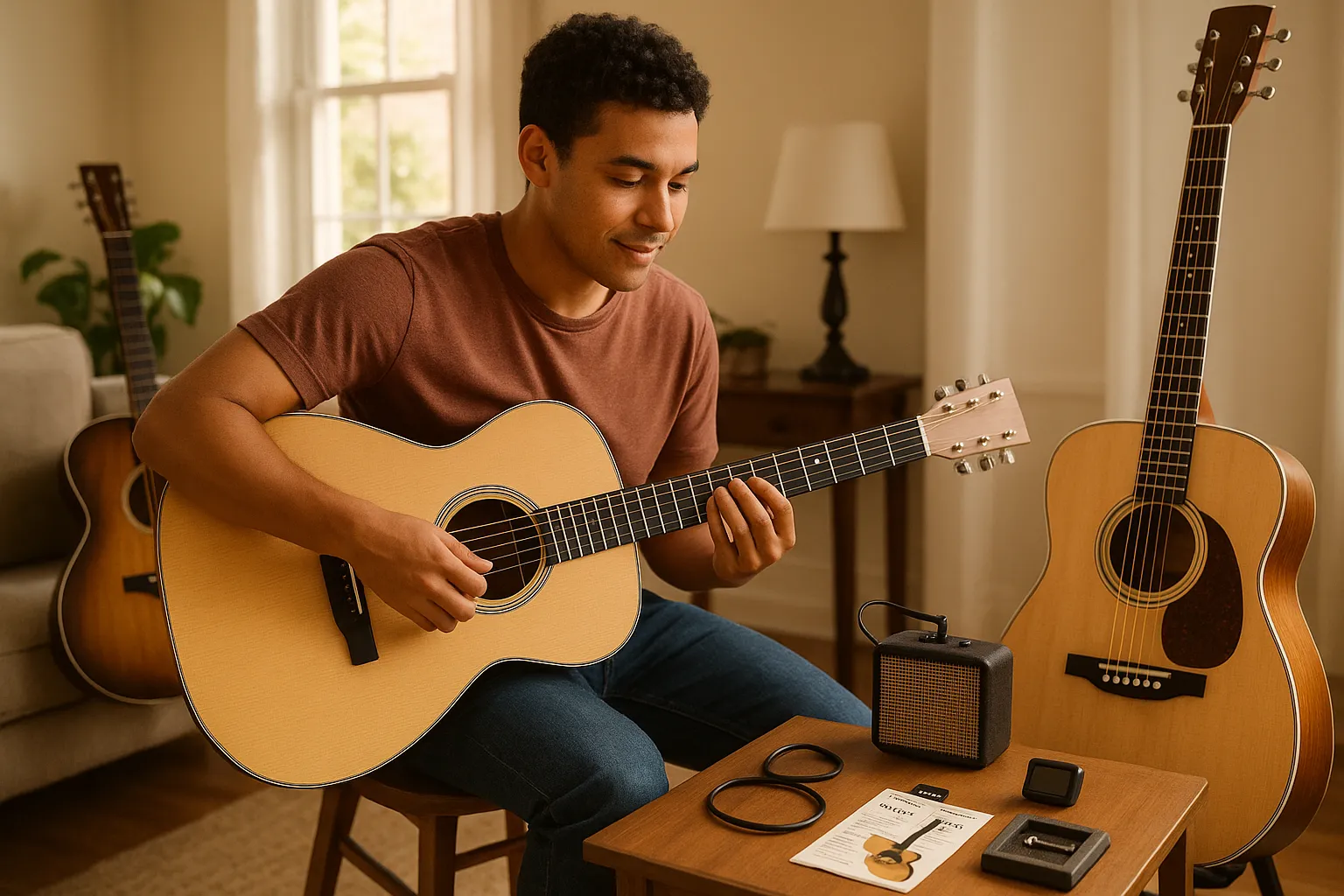
You want a guitar that sounds good, feels comfortable, and doesn’t make practice a daily battle. The right beginner acoustic gives you confidence the first time you strum open chords and keeps you practicing the hundred small reps that make progress visible. In this guide you’ll find clear, practical help to choose a playable, well-built acoustic that fits your body, budget, and musical goals. Expect honest trade-offs, real brand examples (Fender, Yamaha, Martin, Taylor), and a few setup tips that can turn a “meh” guitar into one you can’t stop playing.
How To Choose The Right Acoustic Guitar For A Beginner
Fact: Playability matters more than prestige when you start. If the guitar is comfortable and stays in tune you’ll practice more.
Essential Sound, Playability, And Build Factors
Start with three clear priorities: sound, playability, and build quality. Sound tells you if the guitar inspires you. Playability means low enough action, a comfortable neck, and even frets. Build quality affects tuning stability and how long the instrument lasts. Brands like Yamaha and Fender offer reliable entry models: Martin and Taylor provide higher-end options if your budget allows.
Ask: does the guitar invite you to play? If yes, that’s a strong sign. Try open chords, simple fingerpicked patterns, and a few power chords. Feel for sharp fret ends, sticky tuners, and high action. Those things slow your progress.
Body Shapes And Size: Dreadnought, Concert, Parlor, 3/4
Fact: Body shape affects comfort and tone. Dreadnoughts are loud and full, concerts are balanced, parlors accent midrange, and 3/4 sizes suit small players.
Dreadnought: louder bass and strong projection. Good for strumming and band settings.
Concert and Grand Concert: slimmer waist, clearer mids, easier to hold for smaller frames.
Parlor: compact, vintage tone, great for fingerstyle and quieter rooms.
3/4 and travel guitars: reduced scale and body size help kids and travelers. They sacrifice low-end but improve comfort.
Tonewoods And What They Mean For Sound And Price
Fact: Top wood drives much of the guitar’s tone. Solid woods usually sound better and age nicer than laminates.
Spruce tops (Sitka, Adirondack) deliver clarity and dynamic range. Cedar gives warmth and responds to light touch, favored by fingerstyle players. Mahogany bodies emphasize midrange, maple gives brightness. Laminated tops cost less and resist humidity, but solid tops (often found on mid-tier and higher models) usually provide richer tone and improved resonance over time. Expect higher prices for solid-spruce or solid-rosewood instruments.
Action, Neck Profile, And Fretboard Considerations
Fact: Low action and a comfortable neck profile speed learning. Action above about 4mm at the 12th fret on steel-string acoustics will feel stiff for many beginners.
Neck profile matters: C-shaped necks suit most players: thin or slim profiles help small hands. Fretboard radius affects how chords and bends feel, flatter radii favor solos, slightly curved radii favor chord comfort. Check nut width: 1.68″ (43mm) is common: wider nuts give more room for fingerstyle but can be harder for small hands.
Electro-Acoustic vs. Pure Acoustic: When To Choose Each
Fact: Choose an electro-acoustic if you plan to play with amplification or record: choose a pure acoustic if you only play at home.
Electro-acoustics have onboard preamps and pickup systems (Fishman, LR Baggs are common). They give stage flexibility but add cost and slight tonal differences unplugged. For many beginners, an electro-acoustic opens options: jam nights, DAW recording with an interface, or simple amp practice. If budget is tight and you only need home practice, a pure acoustic keeps things simple and often sounds marginally better unplugged for the price.
Budget Tiers And What To Expect At Each Price Point
Fact: Price brackets predict materials and setup quality.
Under $200: These guitars are functional for absolute beginners. Expect laminated tops, basic tuners, and rough setups. Many include starter kits. Good if you want to try the hobby before investing.
$200–$500: The sweet spot for most beginners. You can find solid-entry models from Yamaha (FG series), Fender (CD-60), and Epiphone. Better tuners, improved setup, and sometimes a solid top.
$500–$1,000: Solid tops are common. Brands like Seagull, higher-end Yamaha, and lower-tier Martins appear here. Tone improves noticeably and setups are usually better.
$1,000+: Expect premium woods, refined construction, and superior hardware. Taylor, Martin, and boutique builders dominate. Buy here if you know you’ll commit or want a long-term instrument.
Note: A well-setup $350 guitar often plays better than an unsetup $900 guitar. Always budget for a setup if the instrument feels stiff.
Best Types Of Acoustic Guitars For Different Beginner Needs
Fact: Different goals need different guitars. Match the shape and features to your use.
Absolute Beginners (Comfort And Ease Of Play)
Choose a concert or small-dreadnought with a slim neck and low action. Yamaha FG800 or Fender CD-60S are common recommendations. They offer solid playability, tuners that hold, and affordable price.
Travelers, Smaller Hands, And Youth Players
Choose 3/4 size models or travel guitars like the Taylor GS Mini, Martin LX1 Little Martin, or Yamaha JR series. These fit small bodies and still deliver credible tone. They reduce hand stretch and encourage practice.
Beginners Focusing On Singer-Songwriter, Strumming, Or Fingerstyle
If you’ll sing and strum, a dreadnought or grand auditorium gives volume and chord presence, consider the Taylor 100 Series or Yamaha A-Series. For fingerstyle, look to parlor or OM/Concert shapes with cedar or a lighter spruce top to respond to subtle dynamics.
Beginner Players Who Want Stage Or Recording Flexibility
Pick an electro-acoustic with a quality pickup and onboard preamp (Fishman-equipped models are reliable). Fender Paramount and Yamaha A-series electro-acoustics give a plug-and-play route for small venues and home recording.
Top Features To Look For In Recommended Beginner Models
Fact: Certain features reliably indicate a beginner-friendly instrument.
Solid or solid-top construction (when possible) for better tone.
Comfortable neck profile and reasonable nut width for your hand size.
Low action out of the box, or the ability to be setup cheaply.
Stable tuners and a well-seated nut and saddle to hold intonation.
A pickup/preamp if you need amplification. Fishman and LR Baggs are common.
A reputable warranty and dealer support (Yamaha, Fender, Martin offer good aftercare).
These features reduce friction during early learning and keep the guitar sounding pleasant as your skill grows.
Must-Have Accessories And Starter Kit Essentials
Fact: A small kit improves practice time and protects your investment.
Tuner, Picks, Strap, Case, And Spare Strings
A clip-on chromatic tuner (Snark, Korg) keeps you in tune quickly. Picks: start with 0.73–0.88mm range to try both strumming and single-note playing. A strap that attaches safely is essential if you stand. A gig bag or hard case protects the guitar, choose a case that offers padding and a pocket for accessories. Keep at least one spare set of strings (D’Addario or Elixir recommended).
A capo broadens chord voicings and simplifies keys. A case humidifier prevents top cracks in dry climates (Martin and Gibson advise this). A simple metronome or phone app builds timing. Consider a basic lesson book, online course subscription, or apps like Yousician or Fender Play to accelerate learning. These tools help you practice accurately and avoid frustration.
How To Test A Guitar In-Store Or When Buying Used Online
Fact: A short play test reveals most deal-breakers. Run the same checks every time.
Check action at the 12th fret. Press each string and play fretted notes up the neck: watch for buzzing or dead frets. Play open chords and barre shapes to test neck comfort. Play harmonics to sense string height and response.
Sound Checklist: Balance, Resonance, And String Response
Strum several dynamics (soft to loud). Listen for even response across strings. Tap the top and body to hear resonance. Fingerpick to check clarity on each string. A good guitar rings without muddy strings.
Condition Checklist For Used Guitars: Structural And Hardware Signs
Inspect the top for cracks, separation, or repaired areas. Look inside the soundhole for glue lines or bracing issues. Check fret wear, tuner smoothness, and saddle condition. If the neck is warped or there is significant fret wear, the instrument may need costly repairs. Ask about the serial number (Martin, Taylor have lookup tools) and service history. If buying online, request high-resolution photos and a short video of the instrument being played.
Setup, Maintenance, And Simple Upgrades For Beginners
Fact: A basic setup transforms playability and encourages practice.
Basic Setup Steps: String Height, Tuning, And Intonation Check
A setup includes adjusting truss rod, lowering action at the saddle, and checking intonation. You can learn to do simple string height tweaks, but a professional setup at a local shop for $50–$100 often delivers the best value. After setup, tune the guitar and check that notes at the 12th fret match open string pitch (octave).
Maintenance: Cleaning, String Changes, And Humidity Care
Wipe the strings and body after playing to remove oils. Change strings every 2–3 months with regular use: acoustic strings like D’Addario EJ16 are common. Keep humidity around 45–55% in dry climates: use a case humidifier for pine/cedar tops. Clean fretboard with lemon oil occasionally, but not too often.
Affordable Upgrades That Improve Playability And Tone
Swap to better strings (phosphor bronze) for improved tone. Replace stock tuners with sealed-gear tuners if stability is poor. A compensated saddle or bone saddle can improve tone and intonation. These upgrades usually cost less than a professional setup and can make a budget guitar feel and sound much better.
Include these checks and small upgrades early, and you’ll keep the guitar in play-ready condition while you build skills. Remember: a guitar that’s set up and cared for will teach you faster and last longer.
To provide the best experiences, we use technologies like cookies to store and/or access device information. Consenting to these technologies will allow us to process data such as browsing behaviour or unique IDs on this site. Not consenting or withdrawing consent, may adversely affect certain features and functions.
Functional
Always active
The technical storage or access is strictly necessary for the legitimate purpose of enabling the use of a specific service explicitly requested by the subscriber or user, or for the sole purpose of carrying out the transmission of a communication over an electronic communications network.
Preferences
The technical storage or access is necessary for the legitimate purpose of storing preferences that are not requested by the subscriber or user.
Statistics
The technical storage or access that is used exclusively for statistical purposes.The technical storage or access that is used exclusively for anonymous statistical purposes. Without a subpoena, voluntary compliance on the part of your Internet Service Provider, or additional records from a third party, information stored or retrieved for this purpose alone cannot usually be used to identify you.
Marketing
The technical storage or access is required to create user profiles to send advertising, or to track the user on a website or across several websites for similar marketing purposes.