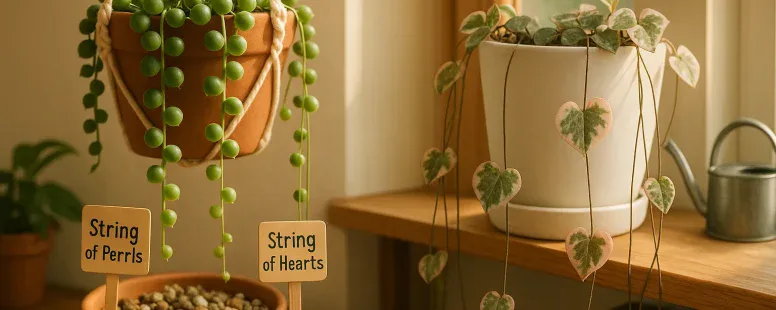
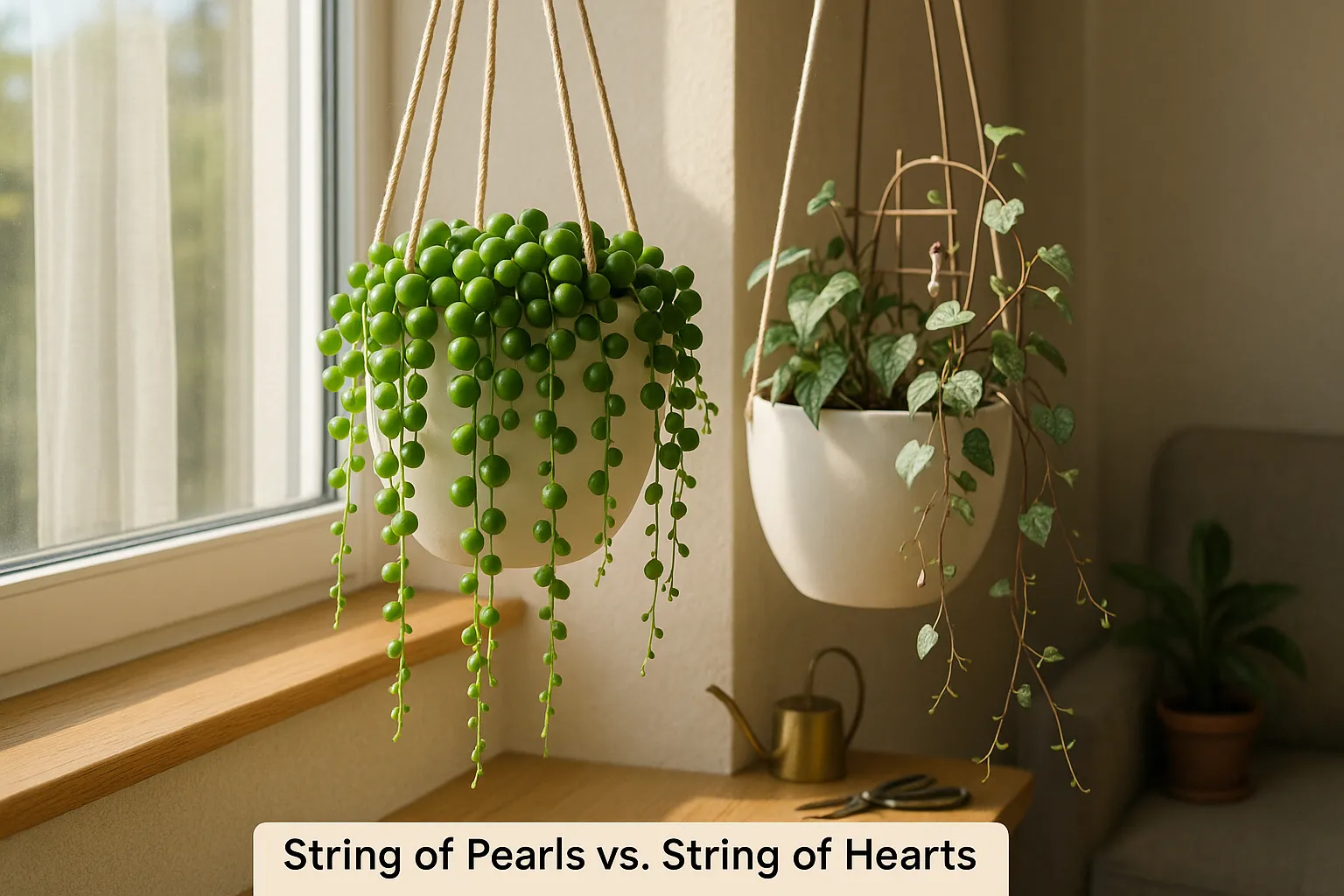
You can tell these two popular trailing succulents apart quickly if you know the key clues. One wears round, bead-like leaves that look like a necklace: the other shows heart-shaped leaves that read like tiny paper valentines. Beyond looks, they ask for different light, water, and space. This guide compares Senecio rowleyanus (string of pearls) and Ceropegia woodii (string of hearts) so you can choose the best fit for your shelf, hanging basket, or sunroom. Expect clear ID points, direct care steps, and honest trade-offs that help you avoid costly mistakes, like overwatering a pearl or underestimating a heart’s light needs.
Quick Comparison Table: Key Differences At A Glance
Feature
String of Pearls (Senecio rowleyanus)
String of Hearts (Ceropegia woodii)
Leaf shape
Round, bead-like
Opposite, heart-shaped (often variegated)
Typical length
2–3 feet trailing
3–10 feet trailing with thin vines
Stem/structure
Succulent, thick stems
Threadlike, twining stems
Light needs
Bright, indirect to some direct sun
Bright indirect to morning sun
Water tolerance
Drought-tolerant: prone to rot
Drought-tolerant: tolerates lower light
Flowering
Small, white to yellow, inconspicuous
Tubular, lantern-like pink/white flowers
Hardiness
USDA 9–11 (indoor)
USDA 9–11 (indoor/outdoor)
Best for
Hanging baskets, bright windows
Hanging baskets, trellis, mixed pots
Start here if you want a quick pick. Use the table to match light and care to your home.
Appearance And Identification
Fact: Leaves give the fastest clue to which plant you have. Read the leaf first, then check stems and blooms.
Leaves: Shape, Size, And Surface Texture
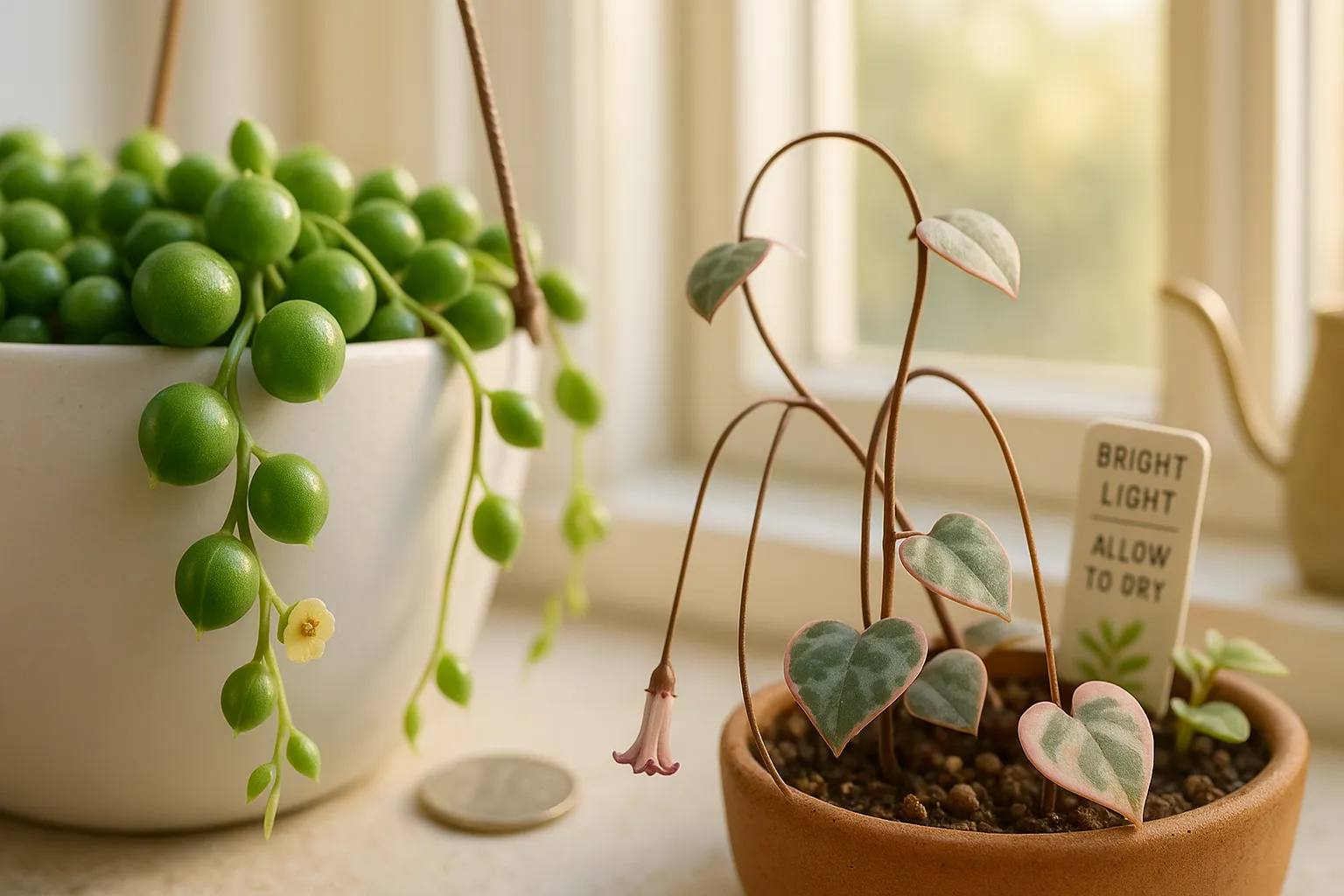
String of Pearls has spherical leaves, about 4–8 mm across, glossy and plump because they store water. The surface often shows a faint translucent patch near the tip called a window. String of Hearts shows flattened, sometimes slightly folded hearts about 1–2 cm long: variegated cultivars (like ‘Variegata’) show cream or pink margins. Pearls feel fleshy: hearts feel papery to slightly succulent depending on light.
Growth Habit And Vines: Trailing Pattern And Stem Structure
String of Pearls grows from a thicker succulent stem that bears leaves in tight sequences, this creates a bead chain. Vines stay reasonably straight and spill over edges. Ceropegia woodii has thin, wiry stems that twine and can climb or loop: leaves attach at intervals and often hang on long gaps between nodes. If you see long stretches of bare stem with spaced hearts, that’s Ceropegia.
Flowers And Seasonal Cues
Flowers confirm ID if you’re patient: Senecio rowleyanus produces tiny white to yellow disk flowers in summer: they’re understated and smell faintly of cinnamon. Ceropegia woodii makes small tubular, lantern-like pink and cream flowers in late spring to summer: they look distinct and are more noticeable if you keep the plant in brighter light. Flowering also signals that the plant is getting enough light and a normal dry-wet rhythm.
Care Requirements: Similarities And Species-Specific Needs
Fact: Both plants prefer bright light and dry periods between waterings, but timing and soil differ. Treat pearls like succulents: treat hearts like a semi-succulent vine.
Light: Best Light Conditions For Each
Place String of Pearls in strong bright light with some direct midday or afternoon sun if your glass doesn’t magnify heat: pearls deepen color and keep shape with more light. For String of Hearts, bright indirect light or filtered morning sun keeps variegation and compact growth. In low light, hearts stretch: pearls lose beads and become sparse.
Watering And Moisture: Frequency, Signs Of Overwatering, And Drought Tolerance
Water pearls sparingly, every 2–3 weeks in summer depending on pot size, less in winter. Overwatered pearls go soft and translucent: that’s rot starting. Hearts drink more often if grown in bright light, water when the top inch of soil dries, roughly weekly to ten days in warm months. Yellowing or mushy nodes indicate overwatering for both species: dry, shriveled leaves mean underwatering.
Soil, Potting, And Drainage Recommendations
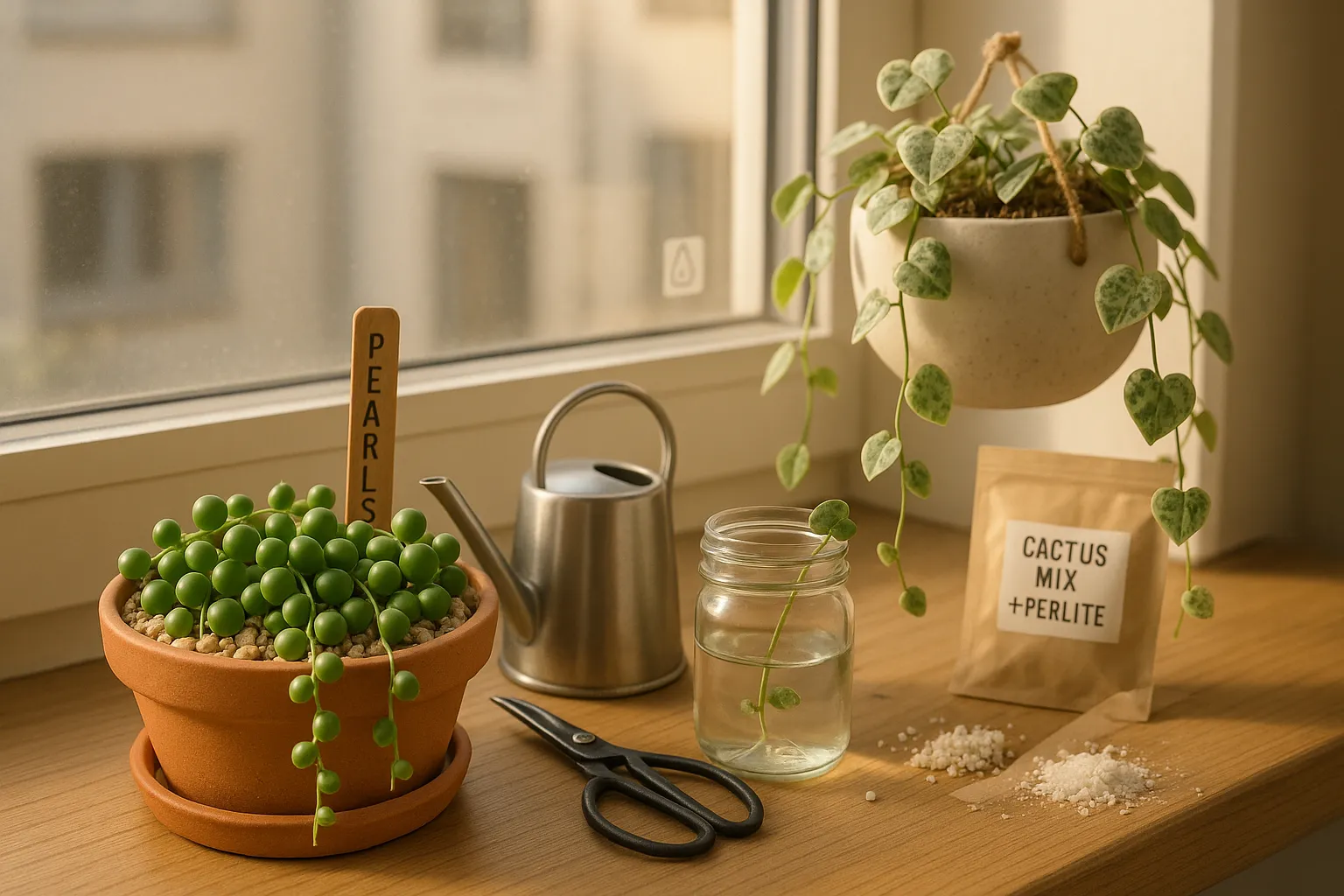
Use a fast-draining mix for pearls: cactus soil plus perlite or pumice. Hearts prefer a looser, well-draining potting mix with some organic matter to hold light moisture. Always choose pots with drainage holes: if you use a decorative cachepot, remove the plant after watering to let water escape.
Temperature, Humidity, And Fertilizing Tips
Both plants do fine at typical indoor temps (65–80°F). They’re not frost-tolerant. Humidity is not required: dry air often helps prevent fungal issues. Fertilize lightly during the growing season, dilute balanced houseplant fertilizer once a month. Don’t overfertilize: excess salts can burn delicate roots.
Propagation: Methods And Step-By-Step Tips
Propagate both easily from cuttings. For pearls: snip a 3–4 inch string, let the end callus a day, then lay on moist cactus mix: roots appear in 2–4 weeks. For hearts: cut a 4–6 inch vine with several nodes, place nodes in moist soil or water to root: you can also slip a node into a jar of water and watch roots form. Use clean scissors and label cuttings so you don’t mix them up.
Common Problems And How To Solve Them
Fact: Most issues come from too much water or too little light. Check these first before blaming pests.
Pests And Diseases: Identification And Treatment
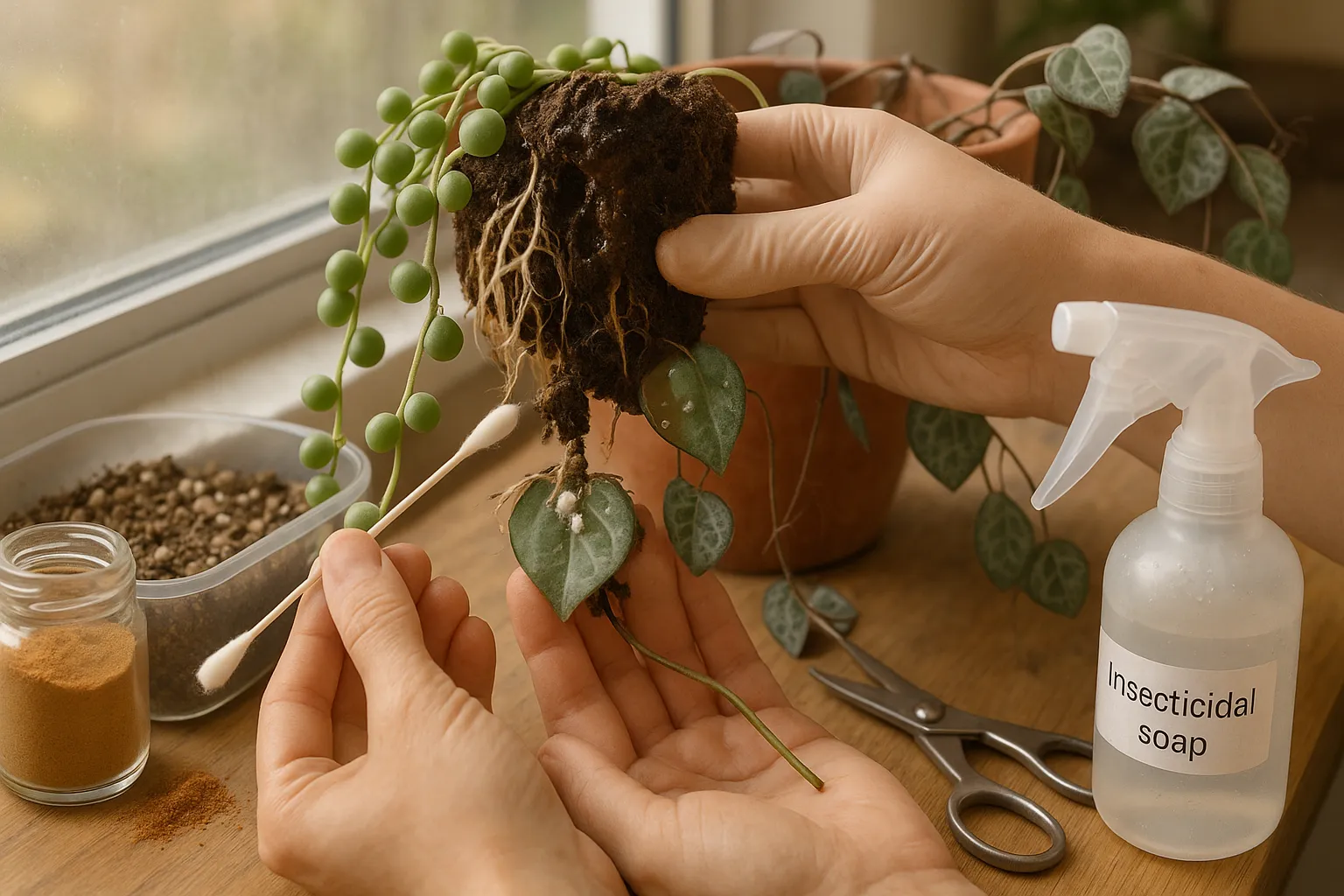
Mealybugs and spider mites attack both species. Mealybugs look like cottony white patches: treat with isopropyl alcohol on a cotton swab, or use insecticidal soap. Spider mites create fine webbing and stippled leaves: increase humidity briefly and spray with miticide or soap rinse. Root rot shows dark, mushy roots and a foul smell: remove damaged roots and repot in fresh, dry mix.
Root Rot, Leaf Drop, And Yellowing: Diagnosis And Fixes
If leaves fall and stems go soft, remove the plant from its pot and inspect roots. Trim brown roots with sterile shears, dust cuts with cinnamon if you want a natural antifungal, and replant in dry, porous soil. If only a few stems show yellowing, cut them back to healthy tissue and let the remaining plant dry between waterings.
When To Prune, Repot, Or Restart A Struggling Plant
Prune when vines get leggy or when you want bushier growth, pinch back growing tips. Repot every 1–2 years or when roots circle densely: choose a pot one size larger. If a plant is failing beyond repair, take healthy cuttings to restart rather than trying to nurse every stem.
Styling, Placement, And Uses In The Home Or Garden
Fact: Placement makes or breaks the visual effect. Pick a spot that matches the plant’s light notes.
Display Ideas: Hanging, Shelves, And Mixed Containers
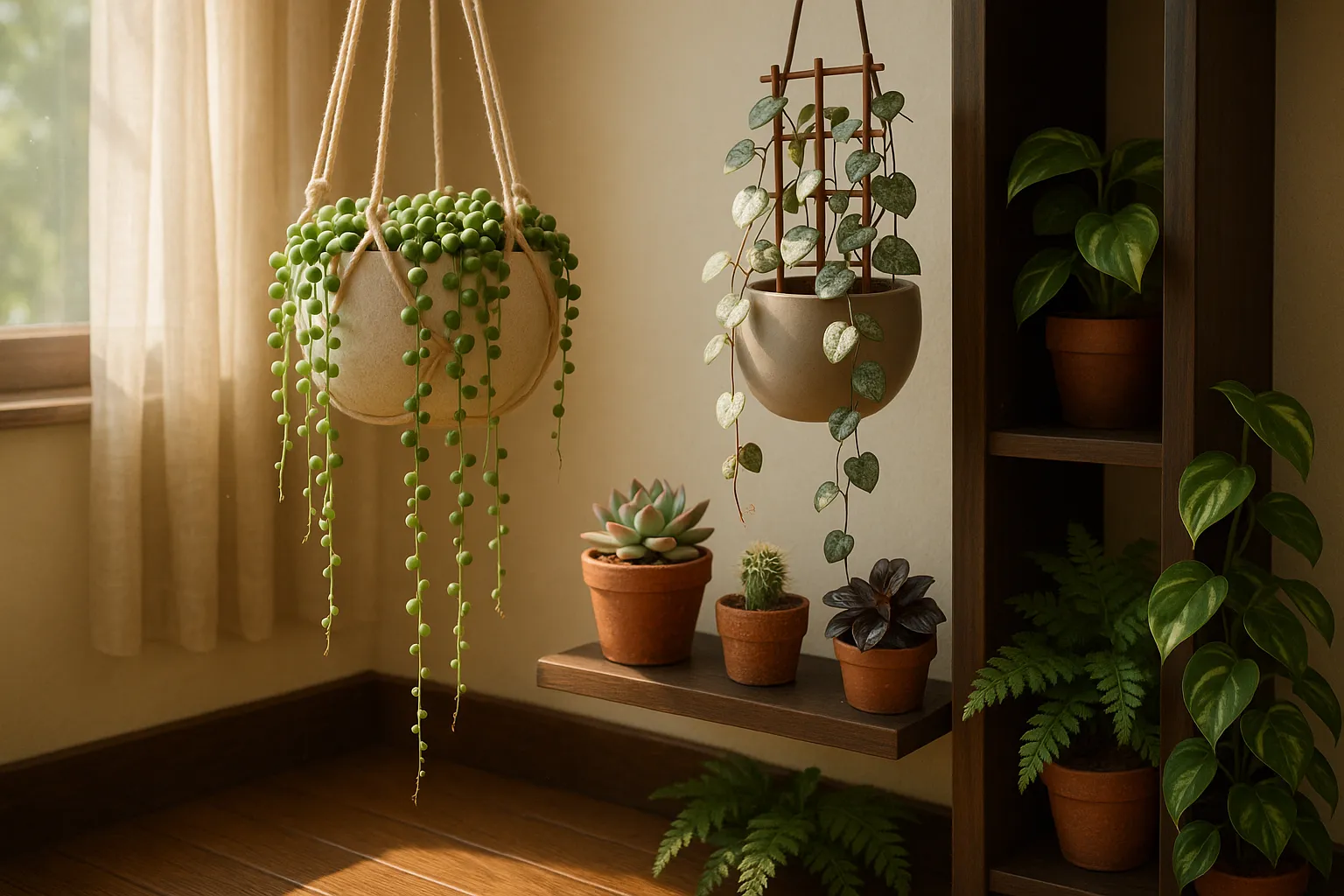
String of Pearls excels in hanging baskets where beads can spill freely. Use a macramé hanger or a high shelf to show the drape. String of Hearts looks great in a hanging pot or trailing from a tall bookshelf: you can also train it up a small trellis. Combine hearts with leather-leaf ferns or pothos for contrast: pair pearls with cacti or echeveria for a succulent vignette.
Indoor Vs. Outdoor Considerations And Microclimates
Outdoors, both plants do best in filtered sun and sheltered spots in USDA zones 9–11. Avoid midday sun in hot climates, glass amplifies heat and can scorch leaves. Indoors, rotate plants monthly so all sides get light: watch for cold drafts near windows in winter.
Companion Plants And Design Pairings
Use scale and texture to create interest. Pair the round beads with architectural succulents like Haworthia. Pair heart vines with trailing philodendrons for soft, romantic lines. If you want contrast in a container, add a dark-leaved peperomia or a small aeonium.
Choosing The Right Plant For Your Needs
Fact: Choose based on light, space, and how much risk you’ll accept for rot.
For Beginners: Ease Of Care And Tolerance
String of Hearts is often more forgiving for beginners in variable light: it tolerates lower light better and bounces back from mild neglect. String of Pearls demands more precise watering and brighter light to keep its bead shape, so it’s a slightly higher-skill pick.
For Small Spaces, Apartments, Or Terrariums
For tiny apartments choose Ceropegia woodii for balconies and small hanging spots because it tolerates indirect light. Don’t put pearls in closed terrariums: they need airflow. Hearts work in open terrariums with good drainage and regular air exchange.
For Collectors: Varieties, Cultivars, And Growing Challenges
Collectors prize Senecio rowleyanus ‘Variegatus’ and Ceropegia woodii ‘Variegata’ for their patterns. Hearts offer cultivars with silver flecks and pink undersides. Pearls present challenges in propagation and winter care that collectors often enjoy solving.
Sourcing And Ethical Buying Tips
Fact: Inspect plants closely before buying: healthy specimens save time and money.
What To Look For When Purchasing: Health Checklist
Choose plants with firm leaves, no sticky residue (honeydew), and clean root balls. For pearls, prefer plants with evenly spaced beads and minimal bare stems. For hearts, look for several nodes and compact growth. Ask the seller about recent treatments and whether the plant sat in standing water.
Avoiding Invasive Or Mislabelled Specimens
Ceropegia woodii and Senecio rowleyanus are not listed as major invasive threats in most temperate gardens, but mislabeled succulents are common at big-box stores. Verify Latin names when you can and buy from reputable nurseries or independent growers. If you buy online, request multiple photos and ask about shipping conditions. If a plant arrives root-bound or soggy, refuse or request a refund, you don’t owe extra time to fix poor handling.
To provide the best experiences, we use technologies like cookies to store and/or access device information. Consenting to these technologies will allow us to process data such as browsing behaviour or unique IDs on this site. Not consenting or withdrawing consent, may adversely affect certain features and functions.
Functional
Always active
The technical storage or access is strictly necessary for the legitimate purpose of enabling the use of a specific service explicitly requested by the subscriber or user, or for the sole purpose of carrying out the transmission of a communication over an electronic communications network.
Preferences
The technical storage or access is necessary for the legitimate purpose of storing preferences that are not requested by the subscriber or user.
Statistics
The technical storage or access that is used exclusively for statistical purposes.The technical storage or access that is used exclusively for anonymous statistical purposes. Without a subpoena, voluntary compliance on the part of your Internet Service Provider, or additional records from a third party, information stored or retrieved for this purpose alone cannot usually be used to identify you.
Marketing
The technical storage or access is required to create user profiles to send advertising, or to track the user on a website or across several websites for similar marketing purposes.