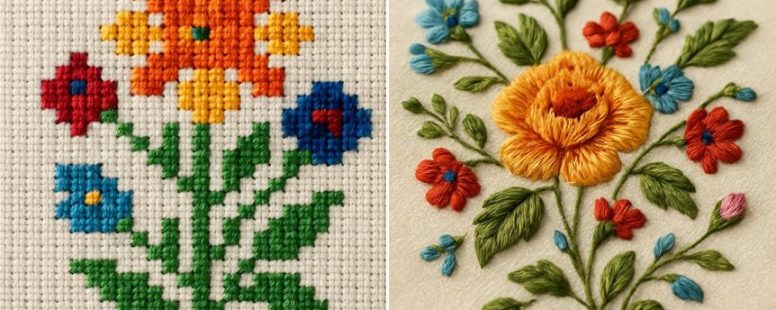
Many crafters stumble over the difference between cross-stitch and embroidery, as if they’re two sides of the same coin. But knowing which technique to choose can turn your project into a masterpiece—like painting with tiny, colorful pixels or weaving texture that practically jumps off the fabric.
Cross-stitch forms neat, pixel-like images that feel like a digital mosaic made by hand, while embroidery adds depth and richness with a variety of stitches that invite the eye to explore.
Surprisingly, mastering both opens up a world of creative possibilities, allowing you to craft detailed artwork or textured accents with ease.
Ready to discover which technique suits your style? Let’s dive into the vibrant world of stitching and see how they differ.
What Is Cross-Stitch and How Does It Work?
Cross-stitch is a type of embroidery where you sew X-shaped stitches on fabric to make decorative patterns. It is called counted embroidery because you count the fabric’s squares to place your stitches accurately. The key to good cross-stitch is keeping the stitches even and neat.
To do this well, you need to manage thread tension. If your thread is too tight, the fabric might pucker or bunch up. If it’s too loose, the stitches could fall apart or look uneven. Finding the right tension takes practice, but it makes your work look much better.
Choosing the right fabric is also important. Most cross-stitch projects use even-weave fabric or Aida cloth because their grid-like structure helps you count and place stitches easily. For example, Aida cloth has tiny squares that make it simple to see where each stitch should go. When starting, pick a fabric with a smooth surface to keep your stitches consistent and your project looking tidy.
Some people prefer certain brands of thread, like DMC or Anchor, because their colors are bright and consistent. Using the same brand throughout your project can help keep the colors uniform. Proper thread tension and fabric choice are the main factors that can make your cross-stitch project easier and more enjoyable.
If you’re new to cross-stitch, try to keep your stitches uniform and avoid pulling the thread too tight or leaving it too loose. Practice these steps, and soon you’ll be creating beautiful patterns that you can be proud of.
Common Embroidery Stitches for Beginners
Embroidery stitches are the basic tools that help you make your designs look interesting and textured. For beginners, simple stitches like the running stitch, satin stitch, backstitch, and seed stitch are the best to start with because they are easy to learn and work well with many projects. These stitches help you add color and texture to your embroidery, making your work more lively.
Choosing the right thread is also important. Good quality thread from brands like DMC or Anchor lasts longer and keeps your colors bright. When picking thread colors, think about how they will look together on your fabric. Sometimes, bright thread can make your design pop, while softer colors can give a gentle look. If you are unsure, try different threads on a scrap piece first.
Learning the basic stitches gives you a strong base to try more complicated patterns later. For example, satin stitches can make smooth areas, like the petals of a flower, while seed stitches add tiny dots for texture. You can even combine stitches to create fun effects.
Some people warn that stitches like the running stitch can be uneven if you pull the thread too tight. It’s best to practice on scrap fabric before you work on your main piece. Also, using cheap thread may cause your stitches to break or look dull over time. So, investing in good thread and taking your time to learn different stitches will help your embroidery look neat and last longer.
In short, starting with these simple stitches and good thread can help you grow as a beginner. You’ll be able to make more detailed and colorful designs as you practice. Do you want to try making a small pattern with these stitches? It’s a fun way to learn and see your progress grow.
How Do Cross-Stitch and Embroidery Look Different?
Cross-stitch and embroidery look different because they use different techniques and styles. Cross-stitch is a type of embroidery, but it has a very distinct look. It creates a pixelated, grid-like pattern with X-shaped stitches that are evenly spaced. This makes the fabric look uniform and neat. The colors in cross-stitch are usually bold and contrasting, which helps the design stand out clearly. It’s like coloring with tiny X’s that fit together perfectly.
Embroidery, on the other hand, looks more textured and detailed. It uses different stitches that can follow curves and create intricate designs. The surface of embroidered fabric can be bumpy or layered because of the variety of stitches used. This gives embroidery a softer, more artistic feel. The colors in embroidery often blend subtly, making the design look more natural and less blocky.
Some people like cross-stitch for its clean, pixel-like appearance, perfect for simple patterns or bold images. Others prefer embroidery for its rich textures and more detailed artwork. Both can add beauty to fabric, but they give very different looks. If you want a sharp, clear pattern, cross-stitch is a good choice. If you prefer something softer and more detailed, embroidery might be better.
When Should You Use Embroidery Techniques Instead of Cross-Stitch?
Embroidery techniques are the best choice when you want to make detailed, textured designs that use different stitches and add more depth. Unlike cross-stitch, embroidery allows for a variety of stitches like satin, chain, or French knots, giving your project a richer look. It’s great for creating realistic images, decorative accents, or layered effects. For example, if you want to add shiny metallic threads or soft wool, embroidery can handle these materials better than cross-stitch.
When choosing fabric, go for sturdy options like linen or cotton that can support various stitches without puckering or tearing. These fabrics are easier to work with and hold stitches well.
Some people prefer cross-stitch for its simple, pixel-like look, but embroidery is better when your design needs more texture and visual interest. For instance, if you want to make a detailed floral pillow or a fancy wall hanging, embroidery is the way to go.
However, embroidery can take more time and skill to master. It also requires different tools, like embroidery hoops and a variety of threads, which might be more expensive or harder to find. If you’re just starting out, cross-stitch might be easier because it uses a single stitch and simpler patterns.
In short, pick embroidery when you want to create complex, textured art that stands out. But remember, it’s not always the best choice for quick or simple projects. Each method has its own strengths and limitations, so choose based on what you want to make.
Best Projects for Cross-Stitch and Embroidery
Simple projects are the best for beginners to learn cross-stitch and embroidery. These projects are easy to follow and help build confidence. For example, beginner-friendly patterns like basic flowers, hearts, or simple words are great choices. They help new crafters practice their stitches without getting overwhelmed.
When choosing projects for home decor, embroidered pillowcases and wall hangings are popular options. They add a cozy feel to any room. For example, a pillow with a cute animal or a wall hanging with a favorite quote can make your space more personal. However, these projects can take more time and patience, so be ready to spend several hours on them.
Personalized gifts like monogrammed towels or embroidered tote bags are thoughtful presents. They show you put effort into making something unique. These projects are good for special occasions like birthdays or holidays. But keep in mind, creating personalized items might need more advanced stitching skills, so start with simpler designs if you’re new.
Some people prefer practical projects, while others like decorative ones. Both are valid choices, but beginners should start with easier projects to learn the basics. As you get better, you can try more detailed or larger projects. For example, you might begin with a small embroidered patch and then move on to a full wall hanging.
Beginner-Friendly Projects
Starting with simple projects is the best way to learn cross-stitch and embroidery. These projects help you understand the basic techniques, how colors work together, and the different threads you can use. For beginners, small designs like a sampler, a simple flower, or a basic geometric pattern are great choices. These projects let you practice blending colors and trying out different threads, like cotton or silk, to see how they feel and look. Using clear and easy-to-follow patterns helps you learn how to pick colors that match well. They also help you get comfortable with your tools and techniques before trying more complicated designs. Some people might find small projects boring after a while, but they are a good way to build confidence and skills step by step.
Decorative Home Accents
Decorative home accents are small projects that can make your home look special. They help you show off your style and make your space more inviting. These projects are different from basic embroidery because they use colors and textures to create eye-catching designs on things like cushions, wall hangings, or table runners.
To make your accents stand out, you should think about color choices. Using contrasting colors makes your embroidery pop, while complementary colors can create harmony. For example, red and green or blue and orange are great pairs. This can help your projects look more planned and attractive.
Choosing the right thread is also important. Silk thread gives a shiny, luxurious look, but it can be more fragile and expensive. Cotton thread is strong, easy to work with, and comes in many colors, making it a popular choice. Some people like using metallic threads for extra sparkle.
Embroidery stitches can add texture and dimension to your accents. Simple stitches like satin stitch or French knots can make your work more interesting. If you want a raised look, try using different stitches in the same design. Just keep in mind that some stitches take longer and might be harder for beginners.
When you combine good color choices with the right thread and stitches, your projects will look thoughtful and finished. These accents can personalize your home, whether you prefer a subtle elegant look or bold statement pieces. For example, a cushion with bright contrasting colors can add a fun touch to your living room, while a wall hanging with soft tones can bring calm to a bedroom.
In short, decorative home accents are a fun way to practice your embroidery skills and make your home more unique. Just start small, experiment with colors and stitches, and enjoy creating pieces that truly reflect your style.
Personalized Gift Ideas
Personalized gifts are a great way to show someone you care. Both cross-stitch and embroidery are popular projects to make special, one-of-a-kind items. To make your gift look good, understanding color choices is key. Using color theory helps you pick shades that look nice together. Good quality thread also matters because it makes your project last longer and look better.
Some popular ideas for personalized gifts include:
Custom wall art with a favorite quote or picture
Monogrammed pillowcases or towels
Personalized bookmarks in favorite colors
Embroidered family or pet portraits
These projects let you add small details and bright colors that make each gift unique. Whether you choose cross-stitch or embroidery, paying attention to color choices and thread quality makes sure your gift is both beautiful and durable. Would you like to learn how to pick the right colors or get tips for choosing the best thread?
Essential Materials for Needlework Projects
Choosing the right materials is the most important step when starting a needlework project. The first thing you need is the fabric. For beginners, a smooth and even-weave fabric like Aida cloth is a good choice for cross-stitch. If you are doing embroidery, linen is a popular option. The fabric’s color can change how your finished project looks, so pick one that matches your thread color or the look you want. For example, a light-colored fabric can make bright thread colors stand out more.
Next, you need thread. DMC embroidery floss is a common choice because it has many bright colors and is strong. When choosing thread, make sure you have enough to finish your project. It is also helpful to use color charts to match your thread shades exactly. Some people like to pick thread colors that match the fabric, while others prefer contrasting colors to make their designs pop.
Having the right materials ready before you start can save you time and frustration. For example, if you forget to check your thread quantity, you might run out halfway through and have to buy more, which can cause delays. Some people like to use different brands of thread, but DMC is trusted for quality. Keep in mind, cheaper threads may not last as long or stay vibrant after washing.
Tips for Learning and Practicing Cross-Stitch and Embroidery
Practicing basic stitches regularly is the best way to get better at cross-stitch and embroidery. When you practice, your stitches become more even and your hands steadier. For example, try making small projects like a simple heart or flower pattern. Starting with easy designs helps you learn faster and keeps you from getting frustrated.
Trying different fabrics can also help you find what feels best. Some people prefer soft cotton or linen because they are easy to work with, while others like stiff Aida cloth for more control. Keep in mind, softer fabrics can be harder to stitch evenly, so practice on different types to see what works best for you.
There are two main ways to learn. One is to follow tutorials or videos online, like those from the DMC brand or beginner embroidery blogs. The other is to take a class at a local craft store or community center. Both ways are helpful, but videos let you learn at your own pace. Just remember, patience is key. It takes time to get even stitches, so don’t give up if your work isn’t perfect at first.
Practice Basic Stitches Regularly
Practicing basic stitches regularly is the best way to get better at cross-stitch and embroidery. Doing simple stitches over and over helps you learn how different threads act, how to pick the right colors, and how to keep your stitches even. When you practice often, your hand-eye coordination improves, and your technique gets stronger. This makes complicated designs easier to do later on. To see how much you improve, try these ideas:
Experiment with different thread types like cotton or silk to see how they change the texture and how long the stitches last.
Play around with colors to learn how to make your designs pop or blend smoothly.
Focus on keeping the tension even so your stitches look neat.
Repeatedly practice specific stitches like backstitch or French knots until they feel natural.
Some people believe that practicing every day helps the fastest, but others say that even a few days a week can make a big difference if you stay consistent. Remember, it’s better to do a little often than a lot once in a while. Keep a small notebook or photo journal to track your progress. You might notice your stitches become more even, and your choice of colors will look better with practice. Just be patient — skills take time to develop. Whether you’re using a kit from brands like DMC or creating your own designs, regular practice makes you a more confident stitcher.
Use Clear and Simple Patterns
Using simple and clear patterns is the best way to get started with cross-stitch and embroidery. These patterns have easy designs and not many details, so they are easier to follow. For example, a small heart or star pattern can help you learn the basic stitches. When choosing a pattern, pick one that matches your skill level to avoid frustration.
Pay attention to color choices. Picking thread colors that look good together makes your work more attractive. For example, using bright colors for flowers or soft shades for backgrounds can make your project stand out. Using the right thread is also important. Six-strand embroidery floss is popular because it is easy to work with and produces nice, even stitches.
Starting with simple patterns helps you focus on learning stitches and techniques. This makes it easier to build your confidence. As you get better, you can try more detailed and complicated designs. Some people find that simple patterns help them stay motivated and avoid feeling overwhelmed.
However, some experienced stitchers may prefer more complex patterns to challenge themselves. But for beginners, simple patterns are a good choice because they help you learn the basics without getting frustrated.
In the end, using clear and simple patterns is a good way to improve steadily. They help you learn stitches, understand colors, and build confidence to try more complicated projects later.
Experiment With Different Fabrics
Trying out different fabrics helps you find what works best for your projects and makes your skills better. Different fabrics have different textures, which change how stitches look and feel. Some fabrics make colors blend smoothly, while others create bold contrasts. For example, linen is smooth and good for fine details, while Aida cloth has a rougher texture that makes structured stitches easy. Silk feels soft and luxurious, and can be used for subtle shading. Testing different fabrics teaches you which ones fit your style and technique.
Here are some simple steps to try:
Use smooth linen to see how fine details and color blending work.
Pick textured Aida cloth for bold, structured stitches.
Try delicate silk for a soft feel and gentle shading.
Mix different fabrics to learn how stitch tension changes and how it affects your project.
Some people prefer certain fabrics over others. Linen is great for detailed work, but it can be harder to sew on. Silk feels nice but needs careful handling. Aida cloth is sturdy but may not give the same softness. It’s good to try both sides and see what you like best.
Experimenting with fabrics is a fun way to learn and improve. You might find that some fabrics are better for certain projects. Remember, the key is to try different materials and see what makes your work look and feel the way you want.
Which Needlework Technique Is Right for Your Next Project?
Needlework techniques like cross-stitch and embroidery each have their own strengths, and choosing the right one depends on what you want to make. Cross-stitch is best if you want quick, bold designs with bright thread colors on evenweave fabric. It creates a look similar to pixel art, perfect for making simple pictures or patterns. If you like making projects fast and with clear shapes, cross-stitch is a good choice.
Embroidery, on the other hand, offers more options for detail and texture. It uses a variety of stitches and thread colors, so you can make soft shading and textured effects. Embroidery works well on fabrics like linen or cotton and is great for adding intricate designs to clothes or pillows. If you want detailed, fancy projects, embroidery is the way to go.
When picking between the two, think about your skill level and what kind of look you want. Cross-stitch is easier for beginners and gives quick results. Embroidery can be more challenging but lets you create more complex art. Also, consider your thread colors and fabric. For bright, vibrant designs, choose threads that pop on your fabric. For more subtle effects, pick softer shades.
Some people warn that embroidery can take longer and needs more practice to master. Cross-stitch is simpler but might feel too plain for some. Both techniques have their limits, so pick the one that matches your project goals and your patience level. Whether you want quick, bold art or detailed, textured work, understanding these differences will help you pick the perfect needlework method for your next project.
To provide the best experiences, we use technologies like cookies to store and/or access device information. Consenting to these technologies will allow us to process data such as browsing behaviour or unique IDs on this site. Not consenting or withdrawing consent, may adversely affect certain features and functions.
Functional
Always active
The technical storage or access is strictly necessary for the legitimate purpose of enabling the use of a specific service explicitly requested by the subscriber or user, or for the sole purpose of carrying out the transmission of a communication over an electronic communications network.
Preferences
The technical storage or access is necessary for the legitimate purpose of storing preferences that are not requested by the subscriber or user.
Statistics
The technical storage or access that is used exclusively for statistical purposes.The technical storage or access that is used exclusively for anonymous statistical purposes. Without a subpoena, voluntary compliance on the part of your Internet Service Provider, or additional records from a third party, information stored or retrieved for this purpose alone cannot usually be used to identify you.
Marketing
The technical storage or access is required to create user profiles to send advertising, or to track the user on a website or across several websites for similar marketing purposes.