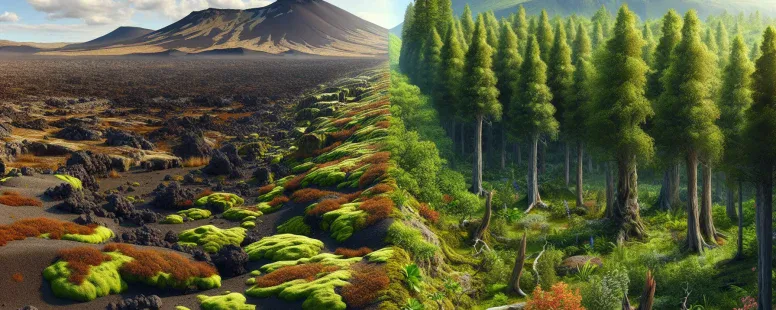
Picture standing in a place where life feels like it’s starting from scratch—bare rock beneath your feet, not a single tree in sight, just the whisper of wind and the promise of possibility. Now picture a forest floor dappled in sunlight, where fallen trees and scattered seeds hint at a quiet comeback after a storm. Both landscapes tell a story of nature’s resilience, but the paths they take couldn’t be more different. how ecosystems bounce back from nothing or recover after chaos? Understanding the difference between primary and secondary succession reveals nature’s secret strategies for healing and renewal. This knowledge isn’t just fascinating—it can help you spot signs of change in your own backyard and appreciate the hidden choreography behind every green shoot and rustling leaf.
Understanding Ecological Succession
Ecological succession describes the way ecosystems change over time after a disturbance—the way a forest might sprout from ash after a wildfire, or moss creeps across bare volcanic rock. You see succession in city parks after storms, or on fields left fallow by farmers. Both biotic factors like seeds, microbes, and animals, and abiotic factors such as wind, temperature, and sunlight, shape how quickly and in what way these areas recover.
You might wonder why some landscapes bounce back in months, while others take centuries. That’s because each succession instance involves unique starting conditions and interactions. Picture, for example, a glacier retreating in Alaska—lichens and mosses appear first, breaking down rocks, and then grasses, shrubs, and finally full-grown spruce forests take over. Or picture a neighborhood pond drained and later refilled: reeds and frogs return fast because the soil’s already rich and seed banks lay dormant.
Primary succession starts where no life exists—think lava flows from a volcano or glacial plains recently exposed. You’ve got to picture a blank page in nature’s diary, with every species arriving as a pioneer. Secondary succession, conversely, happens where an ecosystem’s been disturbed but some soil and life remain—like woodlands regrowing after a fire or a field after a hurricane.
Sometimes, ecological succession looks like chaos. Take Mount St. Helens after its eruption in 1980. Scientists expected decades to pass before life would return, but within mere years, lupines—purple wildflowers—had carpeted sections of ash, drawing insects and birds (Dale et al., 2005). You can see how different agents—species traits, disturbance severity, and nearby life sources—accelerate or slow down the recovery.
Reflect on this: If you left a patch of your own backyard unmown and untouched, how long would it take for shrubs or trees to move in? Succession’s tempo and character depends on microclimate, available species, and the timing of weather events, so each story is different.
Ecological succession isn’t just nature’s way of starting over; it’s a dynamic, ongoing performance where every actor—the wind, the seeds, the fungi, and even you by planting a tree—plays a part.
What Is Primary Succession?
Primary succession describes how new ecosystems emerges on surfaces that had no previous life. Your perspective changes when imagining walking across a landscape where not even bacteria existed before—pure volcanic rock, perhaps, or land left newly exposed after a glacier recedes. With time and patience, these lifeless places spark the origins of forests, grasslands, and wetlands.
Key Characteristics of Primary Succession
Absence of Soil: You see primary succession only begins on surfaces fully stripped of soil, like cooled lava flows (Mount St. Helens, 1980), glacial moraines (Alaska’s Glacier Bay), or bare sand dunes. Because no soil exists, processes start from scratch.
Pioneer Species Presence: Lichens and mosses, acting like microscopic engineers, land on barren rock, breaking minerals and, over years, forming the first traces of soil. This early life changes the chemical makeup and structure of the surface, letting later plants find a foothold.
Slow Process: Centuries might pass before a mature community (climax community) forms. Studies in Surtsey Island, Iceland, show tiny bacteria and mosses arriving first; full vegetation cover may take hundreds of years.
Sequential Colonization: Each new species modifies the environment, influencing which species follows. For instance, mosses trap moisture, making habitat suitable for ferns, grasses, and, eventually, shrubs. Animal life, from windblown insects to nesting birds, follows in waves, expanding the evolving ecosystem.
Abiotic Influence: Sun, wind, temperature, and precipitation dominate the development of primary succession. The harshness of these elements dictates the speed and trajectory of progression.
Examples of Primary Succession
Volcanic Eruption Aftermath: Surtsey Island, which emerged from the North Atlantic in 1963, started as bare volcanic rock. Over 50+ years, scientists observed how windblown seeds, birds, and sea spray gradually populated and altered the island—fascinating case studies track each colonizing organism and the pace it set.
Retreating Glaciers: Glacier Bay in Alaska provides a timeline for primary succession. As glaciers retreated since the 1700s, plants colonized exposed rock in distinct bands. Mosses and fireweed appear first, with alder and spruce arriving later, demonstrating visible markers for each succession stage.
Sand Dune Formation: The Indiana Dunes National Park showcase how windblown sand slowly gets grass, then pine and oak, transforming a sterile surface into full woodland. Studies by Cowles (1899) detail how each species paves the way for the next—dunes isn’t static, it constantly evolving.
Human-Made Examples: Urban rooftops and abandoned quarries sometimes mimic primary succession. When left undisturbed, cracks fill with dust, mosses root, and ducks visit new water-filled depressions—nature invents ecosystems where you least expect it.
If you question why primary succession matters, consider this: every forest once stood on lifeless ground. Your own neighborhood park, just like wild volcanic isles, relies on these ancient cycles to recover from disruption and rebuild biological diversity.
What Is Secondary Succession?
Secondary succession describes how an ecosystem bounces back after a disturbance leaves soil and some life behind. You walk through a forest after a wildfire, noticing green shoots poking through ash—this’s secondary succession in motion, an ecological reset button pressed but not held down. Even after a storm fells trees, the songbirds linger, proof that not all life vanishes when disaster strikes.
Key Characteristics of Secondary Succession
Presence of soil: Secondary succession begins with existing soil, unlike primary succession, which needs pioneer species to even create it. The soil carries seeds, roots, and microorganisms, speeding recovery. For example, after a prairie fire, shoots often re-emerge from underground tubers within weeks.
Legacy of previous life: Remnants like buried seeds, fallen logs, and insect larvae guide the new community’s trajectory. You spot new plants where old roots linger, aided by what ecologists call biological legacies (Turner et al., 1998).
Rapid species arrival: Grasses, shrubs, and fast-growing trees—think birch or aspen—appear early. Without the slow grind of rock weathering, woodland stages leapfrog, sometimes restoring canopy within a decade after a hurricane (Foster et al., 1999).
Sequential stages: Each wave of colonizers modifies the environment. The first flush of weeds shades out rivals, making room for shrubs, which later gives way to a denser forest. You’re watching a relay race, baton passed from one group to next.
Examples of Secondary Succession
After wildfires: Yellowstone’s 1988 fires scorched over 3,200 square kilometers, but lodgepole pine seedlings emerged within a year, drawing on cones opened by heat (Turner et al., 1994). Songbirds returned before tall trees.
Abandoned farmland: In New England, untended fields grow goldenrod, blackberry, then white pine and oak. A pasture left alone in 1950s Massachusetts’s now dense secondary forest, mapped by Codman and others.
Storm-ravaged forests: Hurricane Katrina battered Gulf Coast forests in 2005, toppling oaks but sparing saplings and understory. By 2015, satellite images tracked wooded canopies reforming, driven by species already present in the ecosystem.
Flooded plains: When the Mississippi River shifts, bottomland forests flood, then recover. Cottonwoods and willows sprout first, then give way to swamp oaks.
Picture noticing violets blooming in a field just months after a tornado. Ecologists ask: what determines which species win this post-disaster lottery? If you watch closely, you’ll see how the web of life reweaves, sometimes in surprising ways, right in your backyard. Secondary succession isn’t just a recovery—it’s nature’s way of remixing the familiar, proving every end sets the stage for something new.
The Main Difference Between Primary and Secondary Succession
You’re walking through a barren field where volcanic rock stretches as far as the eye can see, then you turn toward a patchwork forest regrowing after a wildfire—here’s where the real difference between primary and secondary succession leaps out. Both journeys show how nature rebounds, but their starting lines and recovery stories are a world apart.
Comparison Table: Primary vs Secondary Succession
Here’s a side-by-side comparison table with essential ecological markers. Note how the origins and pace set the tone for each succession story.
Feature
Primary Succession
Secondary Succession
Initial Condition
Begins on lifeless, soil-less surfaces (e.g., lava flow, retreating glaciers)
Starts where soil remains after disturbance (e.g., wildfires, storms)
Pioneer Species
Lichens, mosses (capable of breaking down rock, soil creation)
Some seeds, roots, or organisms survive the disturbance
Example
Formation of Surtsey Island after volcanic eruption
Regrowth of Yellowstone forests after 1988 fires
If you’ve ever watched a weed sprout in a sidewalk crack after construction or marveled as wildflowers blanketed a charred forest, you’ve glimpsed these differences firsthand.
Factors Influencing Each Type of Succession
The pace and path of succession depend on diverse factors, each leaving a unique ecological fingerprint. In primary succession, the absence of soil acts like a locked door—pioneer species, such as Cladonia rangiferina, slowly chip away at stone, unlocking nutrients and building ground from scratch. Abiotic factors (rain, wind, freeze-thaw cycles) act as architects over centuries. Examples from Iceland’s Surtsey Island show seabirds’ droppings speeding up soil formation, blending biology and geology in wild choreography.
By contrast, secondary succession thrives on what’s left behind—rich earth, buried seeds, stubborn roots. If you wander through a field left fallow, you’ll often find a riot of opportunists—Solidago (goldenrod), Rubus (blackberry)—racing toward sunlight. Animal activity, climate, and human intervention (think prescribed fire or mowing) shape who wins in this living lottery.
While textbooks might draw a hard line between primary and secondary succession, actual landscapes blend the boundaries. You might wonder, does secondary succession always guarantee a quick recovery? Not if ongoing erosion or invasive species tip the scales. Even a pine forest, burned in a controlled blaze, can take decades to recapture its former glory, as noted by ecologists tracking fire regimes in the US Southeast (Kirkman et al., 2004).
Are you seeing echoes of both processes in your local parks? Maybe urban lots and wind-damaged woods both hint at nature’s relentless drive to recover, recreate, and renew. If you dig a little, you’ll always find traces of an old story just beneath the surface.
Importance of Succession in Ecosystems
Ecological succession acts as nature’s reset button, letting landscapes regenerate after chaos, whether it’s a smoldering wildfire or the silent retreat of ancient glaciers. You might see it on a trail where wildflowers burst through ashes, or where mosses creep over harsh, bare rock. Ecologists such as Eugene Odum described succession as the primary driver behind ecosystem resilience. Without it, you’d find empty silence after every disaster, rather than the riot of returning life.
Succession maintains biodiversity by welcoming new species into disturbed areas. In primary succession, pioneer organisms (lichens, cyanobacteria) crack lifeless stone, setting the table for mosses and, much later, forests. You might liken this slow colonization to scaffolding that lets future life climb even higher. Contrast that with secondary succession—when abandoned farmland in New England transitions from grassland back to forest within 80 years (Foster, 1992). Here, the race for sunlight and nutrients mixes old and new, rebalancing populations.
Would anyone expect Yellowstone’s forests to regrow only a decade after the 1988 wildfires? Charred trunks still poked at the sky, but already, lodgepole pine seedlings surged upward, germinating in fire-scorched soil. Secondary succession exploits the memory of the landscape. Legacies of fire, flooding, or tornadoes leave clues—nutrients, buried seeds, surviving fungi—that shape the next community. Ecosystems don’t forget, even if they looks ruined.
Succession also drives ecosystem services you rely on: Clean water, stable soils, and carbon storage. Picture a city without the slow work of plants stabilizing floodplains. Or if deforested lands never healed—rivers would clog, crops would fail, and biodiversity would dwindle. Restoration ecologists now mimic successional processes to reclaim mined lands or wetlands. You see this in projects like Indiana’s reclaimed surface mines, where planned succession turned bare tailings into thriving meadows (Holl & Aide, 2011).
What if you see a vacant lot in your city, full of weeds and saplings—Is that just neglect, or the start of something grander? When you notice these changes, you’re witnessing recovery in motion. Succession keeps the world from standing still. It’s both a memory and a promise: life returns, though sometimes where and how it doesn’t always fit our plans.
Conclusion
When you look at a recovering forest or a patch of bare ground sprouting new life, you’re witnessing nature’s remarkable ability to heal. Understanding the difference between primary and secondary succession helps you appreciate the unique journey each ecosystem takes on its path to renewal.
Next time you explore your local park or watch a vacant lot transform, you’ll see the subtle clues of succession at work. By recognizing these signs, you can better value the resilience of the natural world and your role in protecting its ongoing cycles of recovery.
To provide the best experiences, we use technologies like cookies to store and/or access device information. Consenting to these technologies will allow us to process data such as browsing behaviour or unique IDs on this site. Not consenting or withdrawing consent, may adversely affect certain features and functions.
Functional
Always active
The technical storage or access is strictly necessary for the legitimate purpose of enabling the use of a specific service explicitly requested by the subscriber or user, or for the sole purpose of carrying out the transmission of a communication over an electronic communications network.
Preferences
The technical storage or access is necessary for the legitimate purpose of storing preferences that are not requested by the subscriber or user.
Statistics
The technical storage or access that is used exclusively for statistical purposes.The technical storage or access that is used exclusively for anonymous statistical purposes. Without a subpoena, voluntary compliance on the part of your Internet Service Provider, or additional records from a third party, information stored or retrieved for this purpose alone cannot usually be used to identify you.
Marketing
The technical storage or access is required to create user profiles to send advertising, or to track the user on a website or across several websites for similar marketing purposes.