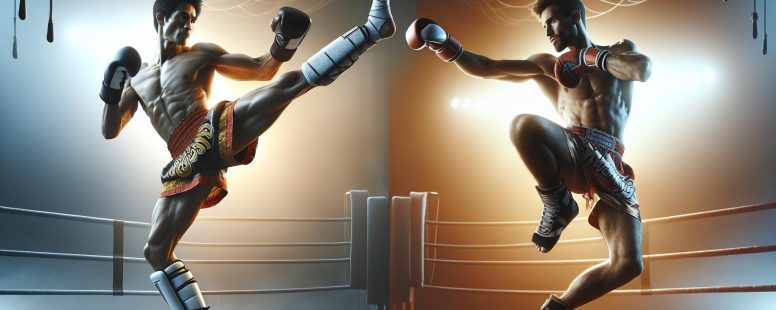
Have you occasionally thought about the difference between Muay Thai and Kickboxing? You’re not alone. These two dynamic combat sports, both thrilling to watch and challenging to master, have distinct histories, techniques, rulesets – yet they often get lumped together.
Understanding Muay Thai and Kickboxing
Muay Thai and kickboxing, while often grouped together, hold distinctive histories and origins. These differences shape the techniques that you’ll see in each sport.
History and Origins of Muay Thai
Often referred to as “The Art of Eight Limbs”, Muay Thai originates from Thailand’s military practices dating back centuries ago. The martial art was developed for soldiers who were trained to use their body parts – fists, elbows, knees, shins – mimicking weapons like swords or spears (hence eight limbs). This makes it a versatile combat technique applicable both on battlefields and in modern-day rings.
Historically speaking,
In the 16th century when King Naresuan reigned Siam (now Thailand), he reportedly excelled at hand-to-hand combat which later evolved into what we now know as Muay thai.
During peace times these fighting techniques turned into a means of exercise for physical development & recreation leading towards competitive fights with local festivities acting as the stage.
Over time, rules got formalized; protective gear was introduced, enhancing its safety aspects, thereby evolving this brutal battlefield technique into an internationally recognized sport practiced across the globe today.
History and Origins of Kickboxing
Kickboxing traces its roots back to Japan during the 1960s, when karate practitioners sought a more practical full-contact fight format, inspiring them to modify traditional Karate styles, giving birth to the first form known as ‘Japanese kickboxing’. At around the same period, America saw the emergence of a similar style called Full Contact Karate, focusing primarily on kicking punches above waist level inside a ringed environment, quite akin to boxing matches.
Here are some key historical points:
Tatsuo Yamada—an established Japanese karateka—was an instrumental driving force behind the creation initial version termed ‘Karatedo Kempo’.
Later developments included the introduction of clinching knee strikes taken from muay Thai, forming a hybrid martial arts system offering a more holistic approach encompassing various striking techniques.
These modifications provided impetus for growth popularity kickboxing worldwide during 70s 80s with professional leagues and competitions springing up in various countries.
Each combat sport, Muay Thai or Kickboxing, carries a rich legacy shaped by unique cultural contexts and practical necessities. While there’s an overlap due to borrowing of certain elements over time they remain distinct offering different flavors fighting sports enthusiasts around world.
Key Differences between Muay Thai and Kickboxing
In the world of combat sports, nuances matter. Here’s a closer look at what sets Muay Thai apart from Kickboxing.
Technique and Style
When you step into the ring for a bout of Muay Thai or kickboxing, your approach changes drastically because these two martial arts differ significantly in technique and style. In terms of offensive strategies, an 8-point striking system is employed by practitioners of Muay Thai that includes punches, kicks, elbow strikes, and knee hits—an illustration being roundhouse kicks using shins instead of feet (Muay Thai). Conversely, kickboxers typically rely on a four-point system involving only fists and feet—think swift jab-cross combos followed up with rapid footwork(Kickboxing).
Also,the defensive tactics are also different. Blockage methods involve more shin blocks in muai thai while bobbing weaves act as defense techniques in kick boxing.So,it becomes crucial to adapt yourself according to type sport you opt for.
Equipment And Attire
A key point distinguishing both sports can be seen when it comes down to their respective equipment & attire. As per tradition, MuahThai fighters wear mongkhons(headbands)and prajiouds(arm bands), which serve not just aesthetic purposes but have symbolic significance hailing back centuries.In contrast, Kickboxers do not adorn such accessories – they generally use traditional hand wraps under gloves without any ritualistic elements involved. Besides, in some competitions, knee guards may be used by competitors if allowed ,depending upon competition rules, which brings us to the next segment: rules & regulations!
Rules And Regulations
Last but definitely not least, there are differences in official guidelines surrounding each discipline. With regards basic scoring systems,mui tai takes into account effective striking along with maintenance dominance over opponent. Meanwhile,in kickboxing, the priority lies primarily in punch-kicks counts, i.e., the amount successful blows landed.
But perhaps one most distinctive disparities is allowance clinching(mui thai) vs its absence kick-boxing. Clinches in Muay Thai can result in knee strikes, sweeps and throws, enhancing the tactical richness of the sport. But, kickboxing lacks this element as holding your opponent for an extended period isn’t permitted. So when it comes to rules & regulations, you’ve got two sports which might seem similar on the surface, but investigate deeper , and you’ll find a multitude of differences.
Training Regime in Muay Thai Vs Kickboxing
After a deep jump into the origins, techniques and rules of both combat sports, let’s shift our focus to their distinct training regimes. While there may be some overlap between them due to their commonality as striking martial arts, you’ll find that each sport possesses its own unique approach towards conditioning and skill development.
Training Methods in Muay Thai
Muay Thai has earned itself the nickname “Art of Eight Limbs” for good reason – practitioners must hone control over fists, elbows, knees and shins. A typical session includes heavy bag work emphasizing these eight points along with pad work drills incorporating punches (jab/cross/hook/uppercut), kicks (low/mid/high roundhouse) knee strikes and elbow slashes.
Strength training is integral, too; it builds muscle endurance needed during extended bouts. Here are two popular exercises:
Clinch Pull-ups: Improves clinch fighting strength by replicating the pulling motion used when controlling an opponent.
Kettlebell Swings: Boosts hip power, which translates directly into harder knee hits & more powerful kicks.
But a rigorous physical workout isn’t all! Mental fortitude plays a crucial role within this discipline, making meditation another key component of Muay Thai’s holistic training regime.
Training Methods in Kickboxing
Kickboxers rely on speed, agility & precision using only four limbs – hands feet hence much time is dedicated perfecting punching and kicking combinations through shadow boxing partner drilling bag workouts Their sessions also involve plenty of aerobic anaerobic cardiovascular exercises to maintain stamina throughout fights For example:
-Skipping Rope improves footwork coordination while delivering effective full-body cardio -High-Intensity Interval Training helps build explosive energy and increase VO2 max essential intense short bursts activity ring
Weightlifting less emphasized but still included overall program Usually functional lifts compound movements such squats deadlifts push ups chosen promote total body strength Finally like athletes they need flexibility prevent injuries ensure fluid movements so stretching becomes mandatory part routine.
Note: Each fighter’s training regimen is tailored to their specific strengths and weaknesses. This article offers a general overview, but individual variations may exist depending on the coach’s philosophy or fighter’s style.
Health Benefits of Muay Thai and Kickboxing
Following an understanding of the unique techniques, histories, and training regimes in both Muay Thai and Kickboxing, let’s investigate into their health benefits. Each offers a blend of physical strength building exercises alongside mental resilience practices that contribute to overall well-being.
Physical Benefits
Muay Thai demands mastery over eight contact points: fists, elbows, knees, shins – this can result in improved full-body coordination. Regular practice enhances muscle tone as it requires activation from various muscles groups during each session – for example; punches work on your upper body while kicks focus on leg power.
Kickboxing is also physically demanding but uses only four contact points: two hands and feet. The sport provides a robust aerobic workout leading to enhanced cardiovascular fitness levels (1). It involves quick movements that boost agility, such as roundhouse kick drills, where you need swift footwork for execution.
Both sports aid weight loss due to high-calorie expenditure per session- studies show about 600-800 calories burnt during one hour sessions(2).
Mental Benefits
Beyond just toning bodies or aiding weight loss efforts through calorie burnout , these combat sports do wonders for mental wellness too!
Incorporating elements like meditation within its regime gives practitioners of Muay thai better control over emotions thereby reducing stress levels(3). Precision required by such martial arts forms often necessitates extreme concentration so improving attention spans considerably.
As with kick boxing workouts being intense they trigger endorphin release commonly known as ‘happy hormones’ leaving participants feel positive post-session – no wonder people keep coming back even though tough routines! Also, learning new moves frequently keeps the brain active, promoting cognitive function preservation with ageing (4).
The discipline needed to excel at either sport tends builds self-confidence while sparring fosters camaraderie amongst peers providing additional social interaction benefit .
Choosing between Muay Thai and Kickboxing
Given the distinctive characteristics of both sports, your choice hinges on personal preference. Are you inclined towards a traditional martial art form with deep-rooted spiritual elements? Then, Muay Thai fits the bill. It emphasizes full-body coordination using eight contact points – hands, elbows, knees, and shins (for example: punches or elbow strikes). This sport also incorporates meditation for mental well-being.
But, if you’re after a modern combat sport that boosts cardiovascular fitness swiftly while keeping agility in check – kickboxing is worth considering. Predominantly involving fists and feet (like roundhouse kicks), it’s an excellent option to improve reflexes quickly as well as enhance cognitive function through its rapid nature.
From a social perspective too there are aspects to ponder upon! If camaraderie fuels your enthusiasm more than solo discipline does then these two offer different environments. A typical muay thai training session promotes individual focus whereas most kickboxers cite their community spirit as one of this sport’s highlights!
Remember though – whichever path you choose bears potential risks along with benefits due to their physical demands so take precautions accordingly!
Finally, but importantly, do not forget about accessibility factors such as distance from home or work , schedule compatibility , cost, etcetera before making a final decision .
Final Thoughts
So, you’ve seen how Muay Thai and Kickboxing differ in origins, techniques, training methods and benefits. You now know that your choice boils down to personal preferences: the spiritual aspects of Muay Thai or the modern combat focus of Kickboxing? It’s about whether you prefer an individual-centric discipline like Muay Thai or a community-oriented sport such as Kickboxing. Your decision also depends on practical considerations – availability of classes nearby, costs involved and risks versus rewards. Armed with this knowledge about these two popular martial arts forms’ unique attributes, plus their physical and mental health advantages, making a well-informed selection should be much easier for you now!
To provide the best experiences, we use technologies like cookies to store and/or access device information. Consenting to these technologies will allow us to process data such as browsing behaviour or unique IDs on this site. Not consenting or withdrawing consent, may adversely affect certain features and functions.
Functional
Always active
The technical storage or access is strictly necessary for the legitimate purpose of enabling the use of a specific service explicitly requested by the subscriber or user, or for the sole purpose of carrying out the transmission of a communication over an electronic communications network.
Preferences
The technical storage or access is necessary for the legitimate purpose of storing preferences that are not requested by the subscriber or user.
Statistics
The technical storage or access that is used exclusively for statistical purposes.The technical storage or access that is used exclusively for anonymous statistical purposes. Without a subpoena, voluntary compliance on the part of your Internet Service Provider, or additional records from a third party, information stored or retrieved for this purpose alone cannot usually be used to identify you.
Marketing
The technical storage or access is required to create user profiles to send advertising, or to track the user on a website or across several websites for similar marketing purposes.