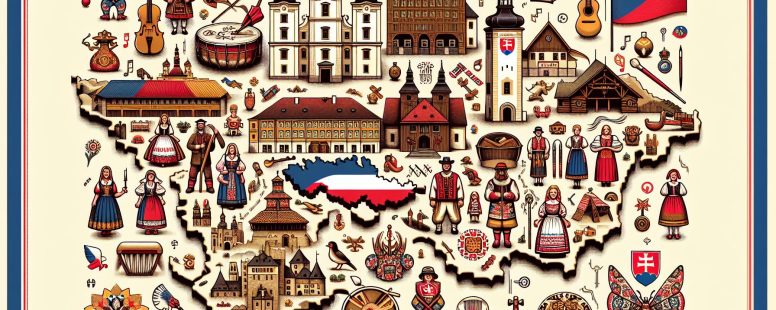
Ever found yourself wondering how two languages from heart of Europe, Czech and Slovak, compare? Even though their geographical proximity and shared history, these languages each hold unique characteristics that set them apart. Imagine planning a trip to Prague and Bratislava, only to realize you’ve mixed up key phrases. It’s a common scenario for many travelers and language enthusiasts alike.
What if you discovered that understanding the nuances between Czech and Slovak could not only enhance your travel experience but also deepen your appreciation for the rich cultural world of Central Europe? This article will guide you through the subtle yet fascinating differences between the Czech and Slovak languages, offering insights that promise to enrich your knowledge and perhaps even impress locals during your next visit. Immerse to uncover the linguistic gems that distinguish these two Slavic languages.
Historical Context and Linguistic Roots
Understanding the different historical contexts and linguistic roots of the Czech and Slovak languages offers insights into their development and highlights the reasons behind their similarities and differences. Both languages hail from the West Slavic language group, sharing a common ancestry with Polish, Sorbian, and other Slavic languages. But, their paths diverged due to distinct historical, political, and cultural influences, leading to the unique characteristics seen today in Czech and Slovak.
The Impact of Slavic Language Evolution
The history of the Czech and Slovak languages is deeply intertwined with the evolution of the Slavic languages, which began diverging from Proto-Slavic, their common ancestor, around the 6th century. As Slavic tribes spread throughout Eastern Europe, variations of the Proto-Slavic language adapted to new geographical and social environments. This process led to the formation of three main Slavic language groups: East, West, and South Slavic.
Czech and Slovak emerged from the West Slavic branch, closely related to languages like Polish. For centuries, these languages developed parallel to each other, influenced by the migration patterns of Slavic peoples and the emerging feudal states in the region. The Great Moravian Empire, existing from the 9th to the early 10th centuries, played a crucial role in shaping the early linguistic world, fostering a cultural and linguistic unity that laid the groundwork for both Czech and Slovak languages.
Influence of Historical Events
Historical events have profoundly impacted the development of the Czech and Slovak languages. The Hussite Wars in the 15th century, for instance, had a significant influence on the Czech language, leading to the codification of Czech spelling and grammar. This period marked the rise of Czech as a literary and administrative language, setting it apart from Slovak, which continued to develop along a slightly different path.
In the case of Slovak, the influence of the Hungarian kingdom from the 11th century onwards introduced numerous loanwords and affected its phonetic and grammatical structure. Even though these influences, Slovak maintained its West Slavic core, thanks to the efforts of figures like Ľudovít Štúr, who standardized the Slovak language in the 19th century to foster national identity and cohesion.
The division and subsequent independence of the Czech and Slovak Republics in 1993 further solidified the distinction between the two languages. While Czech and Slovak remain mutually intelligible to a large extent, the last three decades have witnessed a divergence in vocabulary, pronunciation, and usage, influenced by the separate paths of cultural and economic development each country has taken.
By appreciating the historical context and linguistic roots of the Czech and Slovak languages, you gain a deeper understanding of their similarities, differences, and the factors that have shaped their evolution. This knowledge not only enriches your appreciation of Central European culture but also equips you with the insight to navigate the linguistic world of the Czech Republic and Slovakia more effectively.
Phonological Differences
As you investigate into the intricacies of Czech and Slovak languages, understanding their phonological nuances is pivotal. These auditory distinctions not only highlight the intricacies of each language but also guide effective communication and language learning. The following sections, focusing on vowel pronunciation and accentuation along with consonant clusters and softening, shed light on these critical differences.
Vowel Pronunciation and Accentuation
The vowel pronunciation in Czech and Slovak languages presents notable variations. In Czech, vowels can be short or long, and their length plays a crucial role in meaning. For instance, a short ‘a’ as in “mat” (to check) contrasts sharply with a long ‘a’ in “mát” (mint), marking a difference in meaning. Slovak, while also distinguishing vowel length, tends to have a more subtle difference in the duration of short and long vowels. Also, accentuation in Slovak is almost uniformly on the first syllable of a word, which makes its pronunciation somewhat predictable. Czech, on the other hand, accentuates based on morphological and syntactic criteria, leading to more variability in stressed syllables across words.
Consonant Clusters and Softening
Consonant sounds and their groupings form another major divergence between the Czech and Slovak languages. Czech is known for its complex consonant clusters, allowing for words without vowels, such as “krk” (neck). Slovak consonant clusters are generally less complex, and the language tends to insert vowels to break up such clusters, making pronunciation smoother. Softening of consonants is another phonological feature where Czech and Slovak differ. In Slovak, palatalization or softening of consonants is widespread and influences the intonation and meaning of words. For example, the difference between “muka” (torment) and “múka” (flour) is marked by the softening of ‘k’. In Czech, while consonant softening does occur, it is less pervasive and often linked with specific morphological conditions, not significantly altering the word stress or intonation as in Slovak.
These phonological distinctions between Czech and Slovak underline the importance of auditory nuances in mastering these languages. By paying close attention to vowel lengths, accentuation patterns, and the handling of consonants, learners can navigate the linguistic world of Central Europe more effectively, enhancing both comprehension and pronunciation.
Grammatical Nuances
Exploring the complexities of Czech and Slovak languages requires understanding their grammatical structures, which, even though similarities, exhibit unique characteristics. This section focusses on the grammatical nuances between Czech and Slovak, particularly in case systems and declension patterns, and verb conjugation and tenses. These elements are pivotal for anyone looking to master these languages, enabling more accurate and sophisticated communication.
Case Systems and Declension Patterns
Czech and Slovak both use a case system integral to their grammar, influencing how words change form based on their function in a sentence. They share seven cases: nominative, genitive, dative, accusative, locative, instrumental, and vocative. But, the application and frequency of these cases differ subtly between the two languages.
In Czech, nouns, adjectives, pronouns, and numbers decline according to gender (masculine, feminine, neuter), number (singular, plural), and case. Czech declension patterns are notoriously intricate, with numerous exceptions and irregularities. For instance, the genitive plural ending of masculine nouns can vary significantly (“-ů”, “-í”, or even “-“, depending on the word).
Slovak declension is slightly more predictable with fewer exceptions, especially in the plural forms. Also, Slovak tends to use the locative case more frequently than Czech, which can sometimes prefer the genitive case in phrases denoting location.
Verb Conjugation and Tenses
Verb conjugation and tenses in Czech and Slovak remain broadly similar, reflecting their shared roots, but they showcase distinct approaches, particularly in their verb conjugation paradigms and the use of the past tense.
Czech verbs are conjugated to reflect the person, number, tense, mood, and, in some cases, gender. It retains two distinct past tenses (perfective and pluperfect) that are used to express nuanced aspects of completed actions depending on their relevance to the present. Also, Czech also employs a more complex system of verbal aspect – perfective and imperfective – to denote the completion of an action.
Slovak simplifies some of these aspects. While it also uses perfective and imperfective verbs to indicate action completeness, the pluperfect tense is practically obsolete and seldom used in contemporary Slovak. Also, Slovak conjugation patterns are somewhat more regular, with fewer irregular verbs and exceptions compared to Czech.
Both languages use future tenses, but they form them differently. Czech forms the future tense for imperfective verbs by using the auxiliary “být” (to be) with the infinitive form of the main verb. In contrast, Slovak often uses a simpler, single-word future tense without auxiliary verbs for many actions.
Each language’s approach to verb conjugation and tenses provides insights into the subtle ways these Slavic languages diverge. Mastering these differences enhances not only grammatical accuracy but also the ability to convey meaning precisely in various contexts.
Vocabulary and Lexicon
When diving into the Czech and Slovak languages, understanding the differences in vocabulary and lexicon is crucial for attaining proficiency. Even though their shared history and similarities, the distinct vocabulary of each language can sometimes lead to confusion. By exploring shared words with different meanings and unique words in each language, you’ll gain a deeper appreciation for the nuances that define Czech and Slovak.
Shared Words with Different Meanings
A fascinating aspect of Czech and Slovak languages lies in their shared words, which, even though appearing identical, carry different meanings. For instance, the word “zámek” in Czech refers to a castle, whereas in Slovak, it translates to a lock. Another example includes “červený,” meaning red in Czech, but in Slovak, it could also denote the month of June, showcasing the semantic diversity rooted in historical and cultural divergences.
These differences in meanings are not merely academic; they affect daily communication and can lead to misunderstandings if you’re not aware of the context. Recognizing these discrepancies is essential for effective communication, especially in formal settings or translation work.
Unique Words in Each Language
Equally important is the recognition of unique words that exist solely in the Czech or Slovak lexicon, with no direct counterpart in the other language. For example, the Czech word “prozvonit” describes the action of calling someone’s phone and hanging up before they answer, a concept for which there’s no single word in Slovak. Conversely, Slovak boasts the term “prechladnutie,” referring specifically to a common cold, a term that Czech does not directly mirror.
These unique words not only enrich the vocabulary of each language but also highlight the cultural and societal differences that have influenced language evolution post the 1993 division. They serve as a reminder of the distinct paths Czech and Slovak languages have taken, even though their common roots.
Focusing to these differences in vocabulary and lexicon, you’ll navigate the Czech and Slovak languages more effectively. Regardless of whether you’re a language learner, a linguist, or merely curious about Slavic languages, appreciating these nuances will enhance your understanding and communication across these two closely related, yet distinctly unique, languages.
Practical Implications of the Differences
Given the historical and linguistic journey of Czech and Slovak languages highlighted in the previous sections, understanding the practical implications of their differences becomes pivotal for effective communication and language learning. These implications extend across mutual intelligibility and language learning strategies for Czech and Slovak speakers.
Challenges in Mutual Intelligibility
Even though their common West Slavic roots, Czech and Slovak languages present unique challenges in mutual intelligibility, primarily due to differences in vocabulary, pronunciation, and grammar as earlier discussed. For instance, certain words shared between Czech and Slovak have entirely different meanings in each language. This phenomenon could lead to confusion or misunderstanding in conversations, especially in informal contexts or specialized domains like healthcare, legal affairs, or technical discussions.
Also, pronunciation differences play a significant role in mutual intelligibility. Czech’s complex consonant clusters and specific vowel lengths contrast with Slovak’s generally softer pronunciation and shorter vowel sounds. These differences might require speakers to adjust their listening skills and pronunciation to ensure mutual understanding.
Language Learning for Czech and Slovak Speakers
For Czech and Slovak speakers aiming to learn each other’s languages, the journey is markedly smoother than venturing into a completely foreign language. The grammatical structures, while different, share enough similarities that learners can often leverage their native language knowledge to boost their acquisition of the other language.
But, learners should focus on mastering vocabulary differences and understanding false friends—words that look similar but carry different meanings. Also, paying close attention to pronunciation and practicing with native speakers can significantly enhance language proficiency. Language learning resources specifically tailored for Czech and Slovak speakers, such as dual-language books, language exchange programs, and dedicated language courses, provide valuable support by addressing these nuances directly.
Emphasizing practice in real-life situations, like participating in language-specific social groups or traveling to the respective countries, can offer immersive experiences that reinforce learning. Besides, utilizing modern language learning apps and online platforms that offer Czech and Slovak language courses can complement traditional learning methods, providing flexibility and interactive learning experiences.
Summarising, understanding the practical implications of the differences between Czech and Slovak languages enhances both communication and language learning. Acknowledging these differences allows speakers to navigate potential challenges in mutual intelligibility and offers insights into effective strategies for learning the respective languages. With the right approaches and resources, speakers can appreciate the nuances of Czech and Slovak, embracing the rich linguistic heritage shared by the two cultures.
Cultural Expressions in Language
Delving into the Czech and Slovak languages reveals a rich world of cultural expressions that distinguish each language beyond mere vocabulary and grammar. Understanding these nuances offers a deeper appreciation for the distinct cultural identities embodied within each language.
Idioms and Proverbs
Idioms and proverbs in Czech and Slovak serve as windows into the soul of their respective cultures, encapsulating centuries of wisdom, humor, and experiences. Czech idioms often reflect the nation’s history and its people’s resilience and wit. For instance, “Mít vlka v žaludku” translates to “Having a wolf in the stomach,” signifying extreme hunger, showcasing the Czechs’ playful approach to language.
In contrast, Slovak proverbs tend to emphasize community, relationships, and the natural world, reflecting Slovakia’s pastoral and familial values. An example is “Kam vieš, tam chod,” meaning “Go where you know,” highlighting the value of sticking to familiar paths and wisdom.
When engaging with Czech or Slovak speakers, incorporating these idioms and proverbs not only enriches communication but also fosters a deeper cultural connection. They’re not just linguistic tools; they’re cultural artifacts that provide insights into the values, humor, and wisdom of the Czech and Slovak peoples.
Usage in Literature and Media
The usage of Czech and Slovak in literature and media further illustrates the nuances between these two languages. Czech literature, with its long tradition of satire and humor, uses the language’s complex grammatical structures to create nuanced, layered meanings. Works by authors such as Franz Kafka and Milan Kundera have pushed the boundaries of Czech language, exploring existential themes and human absurdity.
Slovak literature, meanwhile, often draws on the country’s rich folklore and historical narratives, employing a more straightforward linguistic style. The Slovak language, with its melodic quality and rhythmic patterns, lends itself well to storytelling, especially in the works of poets like Pavol Országh Hviezdoslav.
In media, Czech tends to be used in a variety of contexts, from formal to informal, reflecting the language’s versatility and the Czech Republic’s diverse media world. Slovak media, emphasizing clarity and accessibility, often uses a straightforward language style, making it easily understandable to a broad audience.
Understanding these cultural expressions in Czech and Slovak languages not only aids in language learning but also opens up a world of rich literary and media landscapes. By diving into the idioms, proverbs, literature, and media of these languages, you gain not just linguistic knowledge, but also a deeper appreciation for the Czech and Slovak cultures.
Conclusion
Diving into the Czech and Slovak languages reveals a fascinating journey through history, culture, and linguistic evolution. While both languages share a common root, their paths diverged, leading to unique characteristics in vocabulary, pronunciation, and grammar. The nuances of Czech’s complex declension and verb conjugation contrast with Slovak’s relative predictability, offering a glimpse into the linguistic world of the West Slavic language group. Beyond grammar, the rich cultural expressions found in idioms, proverbs, literature, and media underscore the deep cultural identities of the Czech and Slovak peoples. As you explore these languages further, you’ll not only enhance your linguistic skills but also gain valuable insights into the cultures that shape them, fostering a deeper connection with their speakers.
To provide the best experiences, we use technologies like cookies to store and/or access device information. Consenting to these technologies will allow us to process data such as browsing behaviour or unique IDs on this site. Not consenting or withdrawing consent, may adversely affect certain features and functions.
Functional
Always active
The technical storage or access is strictly necessary for the legitimate purpose of enabling the use of a specific service explicitly requested by the subscriber or user, or for the sole purpose of carrying out the transmission of a communication over an electronic communications network.
Preferences
The technical storage or access is necessary for the legitimate purpose of storing preferences that are not requested by the subscriber or user.
Statistics
The technical storage or access that is used exclusively for statistical purposes.The technical storage or access that is used exclusively for anonymous statistical purposes. Without a subpoena, voluntary compliance on the part of your Internet Service Provider, or additional records from a third party, information stored or retrieved for this purpose alone cannot usually be used to identify you.
Marketing
The technical storage or access is required to create user profiles to send advertising, or to track the user on a website or across several websites for similar marketing purposes.