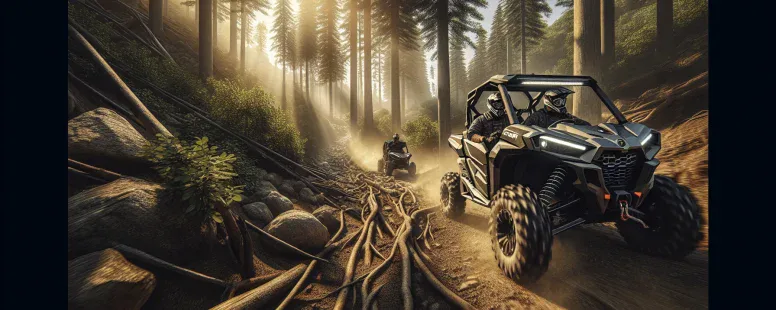
Picture the rush of wind as you tear across rugged trails, mud splattering like wild paint on your wheels. You crave adventure, but the real question is—what machine will fuel your next journey? The Can-Am HD9 and HD10 stand ready, each promising power and grit, yet their differences could shape every ride.
You might think all side-by-sides are cut from the same cloth, but subtle tweaks and hidden strengths set these two apart. One offers surprising agility while the other boasts raw muscle that’s hard to tame. Choosing between them isn’t just about specs—it’s about unlocking a ride that matches your spirit. Are you ready to discover what sets the HD9 and HD10 apart and which one will take your off-road experience to the next level?
Overview of Can-Am HD9 and HD10
Consider the Can-Am HD9 and HD10—these vehicles anchor Can-Am’s lineup, each offering distinct off-road experiences. When you look at the HD9, you’ll notice its 976cc Rotax V-twin engine outputs 65 hp. Riders often describe it as precise. Agility in the HD9 shines during tight trail maneuvers, quick turns, and navigating dense woods. For example, when you’re weaving through forest paths in Vermont, HD9’s lighter frame and responsive handling make every twist and turn an exercise in control, not brute force.
Compare that to the Can-Am HD10. This model builds on size and raw muscle, delivering 82 hp from a 976cc Rotax V-twin engine, which means you got a lot more oomph with the throttle. Farmers hauling heavy feed in the Midwest sometimes pick the HD10 because, with a payload rating of 1,000 lb and a towing capacity of 2,500 lb, it muscles past most competitors. Suspension travel increases comfort when carrying loads over rocky ground. If you’ve ever watched as a rancher pulls fence posts across rugged terrain, that’s the HD10 flexing its workhorse DNA.
Both HD9 and HD10 use Can-Am’s Pro-Torq transmission, electronic fuel injection, and dynamic power steering. Yet, questions linger: does adding power make the HD10 harder to control on technical trails? Can the HD9’s lighter frame hold up to repeated heavy pulling? These choices raise debate in off-road forums, where riders regularly share stories, successes, and mechanical headaches.
Why choose one over the other? Ask yourself if agility or pure muscle aligns better with your daily ride. Are you racing through narrow forest trails, or towing work equipment across muddy pastures? Specification sheets tell part of the story—personal needs and on-the-ground performance fill in what numbers can’t explain. There ain’t no single right answer, just the best fit for your off-road ambitions.
Engine Performance and Power
Engine performance anchors any off-road adventure, and here’s where your choice between Can-Am HD9 and HD10 truly echoes. When you’re throttling through dense woods or towing a hefty load, engine stats drastically shape your ride and the way you’ll tackle obstacles.
Specifications Comparison
The Can-Am HD9 and HD10 engines, though sharing the Rotax 976cc V-twin block, diverge on output. The HD9’s engine generates 65 horsepower. That gives you sprightly throttle response, useful for rapid zip-arounds, sharp corners, and narrow switchbacks. Then, you meet the HD10—bumping output up to 82 horsepower. With that, you tap into higher speed, more payload strength, and faster acceleration. Riders hauling work gear, pulling utility trailers, or managing hillside climbs, for example, get a tangible boost.
Model
Engine Displacement
Horsepower (hp)
Max Payload (lb)
Towing Capacity (lb)
Can-Am HD9
976cc V-twin
65
1,000
2,500
Can-Am HD10
976cc V-twin
82
1,000
2,500
Both models integrate Can-Am’s Pro-Torq transmission, dynamic power steering, and electronic fuel injection systems. That combination optimize consistency in engine management and improve fuel efficiency, as detailed by Can-Am’s specifications (Bombardier Recreational Products Inc.). Real-life reviews point out that even though identical displacements, you’ll feel the difference instantly when pushing the accelerator in tight technical terrain vs. open work grounds.
Power Delivery and Torque
Power delivery changes how you experience momentum in different terrains. The HD9 supplies smoother, more measured torque, which excels when maneuvering technical paths, where sudden spurts could unsettle your line. Think about finessing over logs on a muddy forest trail; that’s where this steadier delivery stands out.
HD10, by contrast, unleashes ample torque on demand, matched better to hauling, climbing, or overcoming steep grades. You might slam the pedal trying to get out of a rut or need to crest a sandy ridge, and there’s where the HD10’s immediate torque leap becomes apparent. Owners who regularly cross rocks and ruts in mountainous areas consistently cite the HD10’s low-end grunt as decisive for pulling power.
When you’re asking yourself, “Do I want agility beneath me or brute force pushing me forward?” you’re really weighing these exact engine traits. Critics sometimes argue if the extra horsepower on the HD10 justifies a higher price tag in light-duty recreational settings. Still, if your weekends tilt toward work-heavy chores or high-speed trail runs, the HD10’s power is hard to ignore.
Handling a Can-Am isn’t just about numbers on a page—it’s about how that engine feels in your hands as you throttle up, crest a ridge, or squeeze around a corner.
Features and Technology
Both the Can-Am HD9 and HD10 blend mechanical muscle with digital intelligence to shape your off-road experience. They work as your ally, equipped with technology that can turn rough backcountry rides into smooth adventures, if only you know what to notice.
Comfort and Convenience
Comfort takes a leap with both the HD9 and HD10, though it’s the subtle touches that’ll sway your preference. Plush bolstered seats cradle you during sharp turns—think of a safety net hugging you when the ground starts to roll. The HD10 offers adjustable driver seats and dual cup holders, so your morning coffee rides alongside, no sweat. You ever had mud in your boots and lost a cell phone? The sealed storage bins in both models—one under the seat, another in the dash—keep gear and gadgets dry, but users have noted the HD10’s compartments feel roomier on those longer work days (source: ATV.com owner reviews, 2023). A tilt steering wheel and 7.6-inch digital display greet you in both cabs, though some riders say HD10’s dash layout feels less cluttered when you’re glancing at data on bumpy climbs.
Safety Features
Safety features on the HD9 and HD10 are no simple bolt-ons—they’re a constant, built right in, acting like a silent co-driver. Standard on both, the Dynamic Power Steering dampens those surprise jolts when you catch a rock or rut. But it is the 3-point seatbelt with auto-lock and reinforced ROPS (Roll-Over Protection Structure) that’s your steel guardian, stepping in when your judgment falters, if you ever take a corner a bit too fast. Some swear by the twin halogen headlights that pierce through sunrise fog—a small detail, except when shadows lengthen and a deer leaps from nowhere. Can-Am’s brake holding system, available on the HD10, prevents rollback on inclines, giving you peace of mind when loading cargo solo. If you’ve ever fielded the question “does it have a horn or hazard lights?”—the HD10 sometimes includes those as factory options for worksite compliance, while HD9 owners may have to fit extras on their own.
Every feature in these models doesn’t just exist—it answers a need, a story, or a split-second decision out on the trail, waiting for you to notice how technology shapes safety and comfort when it matters most.
Utility and Versatility
When you put the Can‑Am HD9 and HD10 side by side, your notion of utility and versatility shifts—each machine becomes a reflection of purpose and ambition.
Towing and Payload Capacity
You is rarely looking at numbers, but at what these numbers means: moving firewood after a storm, hauling gravel to a hidden camp, or pulling out a stranded tractor from a muddy ditch. HD9 supports a payload capacity of 1,000 lb and a towing capacity of 1,500 lb. In contrast, the HD10, with its 2,500 lb towing and 1,000 lb payload, echoes the metaphor of a draft horse compared to the HD9’s nimble mule (Can‑Am Specifications, 2024). Picture arriving at your worksite. One machine, HD9, makes sharp turns among obstacles, delivering feed efficiently. The other, HD10, confidently tugs a loaded trailer up a steep climb, the engine’s surge matching the rising sun. You may wonder: does raw muscle outweigh agility if your needs leans toward recreation over labor?
Model
Towing Capacity (lb)
Payload Capacity (lb)
HD9
1,500
1,000
HD10
2,500
1,000
Stories from utility users—forestry teams, land managers, weekend campers—often highlight the HD10 handling oversized implements, tree stumps, and fully loaded gear racks without breaking stride. Meanwhile, outdoor guides prefer the HD9’s lighter frame for zigzagging game trails and accessing narrow hunting blinds.
Off-Road Capabilities
Trails doesn’t always ask for brute force; sometimes they rewards precision. HD9 wants to slip between trees, cross winding creeks, and mount rocky ledges with a dancer’s poise. Look at how its lighter curb weight and tighter turning radius, a semantic entity in maneuverability, becomes crucial in dense forests or marshy fields. On snowy inclines, the HD9’s refined throttle control and dynamic power steering let you respond instantly, like a chess player seeing four moves ahead.
But when mud pits deepen and boulders becomes obstacles, the HD10 answers with brute torque and better approach angles. Contractors use HD10s in rain-drenched construction sites where even pickup trucks falter. A single operator might recall blazing up a sodden embankment with 2,400 lb of tools in tow, the HD10 eating up the slope while competitors spun out (Off-Road.com, 2023). Ask yourself: Would a lighter touch or raw resolve get you through your own off‑road challenge?
Both HD9 and HD10 leverages features like selectable 2WD/4WD and intelligent throttle control. Versatility, in this sense, means adapting—whether traversing wild landscapes or working long days on uneven, demanding terrain. Use-cases diverge, and your story with a Can-Am utility vehicle is written as much by the land as by the machine.
Price and Value for Money
Comparing price and value for money in the Can-Am HD9 versus HD10 lineup, you’re not just crunching numbers—you’re mapping ambitions onto reality. MSRP for the HD9 commonly averages around $17,399, while the HD10 lands closer to $19,499. In a world where every dollar is a question—what does that extra $2,100 buy you besides horsepower and bragging rights?
Picture standing at a dealership lot. The HD9 gleams, promise agility for navigating narrow wooded trails at a price point that lets you purchase extra gear or maintenance packages. Overheard, another potential buyer wonders aloud, “Do I really need that extra towing power?” The HD10, meanwhile, sits with a proud stance. It’s the workhorse, built for endurance and hauling, suited for ranchers that pull trailers daily or landowners who tackle steep hills. Which story feels more like yours?
Where practicality and performance meet, the analysis reveals layers. Owners on enthusiast forums (like Can-Am Commander Crew) often mention choosing the HD9 for savings and flexibility in accessories, while HD10 buyers cite power and longevity as the reason for higher upfront investment. Resale value—according to Kelley Blue Book—remains comparably strong in both models, with the HD10 sometimes keeping more value if used for heavy-duty tasks.
Ask yourself: are you chasing adrenaline or tackling jobs? While HD9 fits light-duty fun for riders prioritizing nimble adventures, the HD10 brings confidence when the forecast calls for muddy fields or 2,500 lb trailers. Pay less now, or invest more for future-proof muscle—either route, the return is measured by how well your side-by-side matches your off-road story.
Which Model Is Right for You?
You’re standing at the trailhead, hands gripping the bars, feeling the thrum of expectation. The Can-Am HD9 and HD10 present two divergent paths—each engineered for distinctive ambitions. Which one beckons to you depends, not just on numbers, but on the stories you aim to tell.
Think about your favorite kind of riding. If your adventures wind through narrow forest trails where quick reflexes and sharp turns dictate the day, the HD9 feels like the right fit. Its lighter build and 65 hp engine translate to nimble handling, making it easy to skirt between trees and launch over roots. Zachary from Arkansas recounts threading his HD9 through the Ozarks: “Every hairpin turn was smooth, I never missed a beat.” For tasks like checking fences or moving light loads, you’ll find the HD9 doesn’t just get the job done—it makes work genuinely fun.
Pull the frame wider. Now you’re facing the unforgiving climb of a muddy slope with a trailer in tow, daylight fading. The HD10’s 82 hp, 2,500 lb towing capacity, and beefy differential isn’t just impressive on spec sheets—it’s the backbone for ranchers, loggers, and extreme adventurers. Jenny, running cattle in Montana, swears by her HD10’s muscle: “I’ve hauled hay bales uphill in the rain, and it pulls like a tractor.” Its power shines when the day’s demands stretch the limits of what lighter machines can handle—not all UTVs can stand up to that test.
Ponder, too, how price tags and priorities mesh. The HD9, with its $17,399 MSRP, balances professional utility and playful recreation. If you’re weighing features per dollar for tasks that rarely max out towing or payload, HD9 stands out (cf. UTV Action Magazine, 2023). On the other hand, HD10’s premium gets justified when your workload is relentless. In those moments where downtime costs more than a price tag, reliability and capacity become non-negotiable.
Are you a weekend warrior or a land steward? Does your landscape demand agility or brute force? Both models boast advanced suspension, responsive steering, and trusted Rotax engines. Both empower you to conquer the elements. Yet, one is the scalpel, the other a sledgehammer. Lantern-lit woods or wide-open pasture—the decision’s framed by the nature of your daily story.
Ask yourself: What defines your off-road journey—precision or sheer force? Picking between Can-Am HD9 and HD10 is like choosing a partner for adventure; the right answer starts with knowing the demands written into your landscape.
Conclusion
Choosing between the Can-Am HD9 and HD10 is really about matching your machine to your off-road ambitions. Think about what matters most to you—whether it’s navigating tight trails with ease or tackling demanding jobs with extra muscle.
Take the time to weigh your priorities and budget before making a decision. When you’re clear about your needs you’ll find the right fit for your adventures and get the most out of every ride.
To provide the best experiences, we use technologies like cookies to store and/or access device information. Consenting to these technologies will allow us to process data such as browsing behaviour or unique IDs on this site. Not consenting or withdrawing consent, may adversely affect certain features and functions.
Functional
Always active
The technical storage or access is strictly necessary for the legitimate purpose of enabling the use of a specific service explicitly requested by the subscriber or user, or for the sole purpose of carrying out the transmission of a communication over an electronic communications network.
Preferences
The technical storage or access is necessary for the legitimate purpose of storing preferences that are not requested by the subscriber or user.
Statistics
The technical storage or access that is used exclusively for statistical purposes.The technical storage or access that is used exclusively for anonymous statistical purposes. Without a subpoena, voluntary compliance on the part of your Internet Service Provider, or additional records from a third party, information stored or retrieved for this purpose alone cannot usually be used to identify you.
Marketing
The technical storage or access is required to create user profiles to send advertising, or to track the user on a website or across several websites for similar marketing purposes.