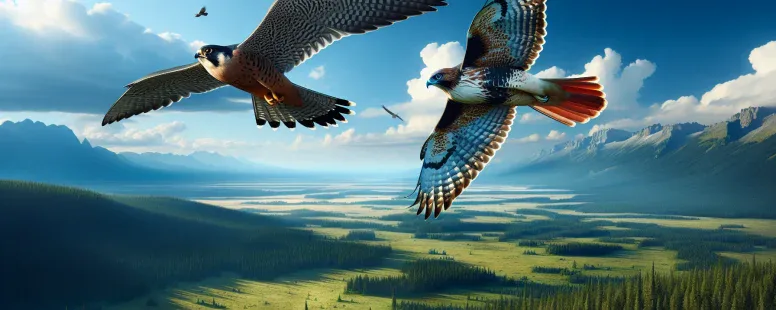
Picture yourself standing in a golden field at sunrise as a shadow sweeps across the sky. Your eyes dart upward—was that a falcon slicing through the air or a hawk gliding on invisible currents? The rush of wings and the flash of feathers can leave you wondering if you’ve just witnessed a master of speed or a silent strategist.
Most people lump these magnificent birds together, but knowing their secrets unlocks a deeper connection to the wild world above you. Discovering the subtle differences between a falcon and a hawk not only sharpens your observation skills but also transforms ordinary walks into thrilling adventures. You’ll never look at the sky the same way again.
Overview of Birds of Prey
Birds of prey dominate the skies, with falcons and hawks standing out as two of the most recognized raptors. Your gaze might catch a falcon’s sharp dive, like a thrown javelin, or maybe you’ll spot a hawk gliding slow and wide, it’s wings slicing the wind. Both reveal masterful hunting, but their tools and tactics are strikingly different. When you’re exploring nature, pause and look up—what do you see?
Raptors, including falcons and hawks, share traits like hooked beaks and taloned feet, but their behavioral patterns set them apart. Falcons (genus Falco) use speed, specializing in aerial pursuits, while hawks (family Accipitridae, especially genus Buteo and Accipiter) rely more on stealth and ambush. Picture a peregrine falcon (Falco peregrinus)—the world’s fastest animal, hitting 240 mph in a stoop mid-hunt (Cornell Lab of Ornithology). In contrast, think of a red-tailed hawk (Buteo jamaicensis), silently scanning open fields for rodents.
Which strategy seems more impressive to you—velocity or vigilance? Falcons lock onto quick-flying birds, stooping from monstrous heights. Hawks, but, prefer a patient approach—waiting, watching. There’s drama in every hunt. Ornithologists often debate, is the falcon’s streamlined body the ultimate evolution for speed, or does the hawk’s broader build offer better maneuverability for woodland hunting? Diverse opinions exist, but each style shapes how these raptors rule their domain.
Curiosity spikes when you spot one perched along a phone wire—are you witnessing raw speed or raw wits? Next time you feel a shadow sweep overhead, ask yourself: who’s scanning you back, hawk or falcon? Each bird, a piece in the living puzzle above your head, tells a story about adaptation and survival.
Species
Main Family
Notable Trait
Hunting Style
Example (US)
Falcon
Falconidae
Exceptional speed
High-speed aerial dives (stoops)
Peregrine falcon
Hawk
Accipitridae
Strong grip, keen sight
Ambush or soaring over open land
Red-tailed hawk
Birds of prey, complex and charismatic, challenge you to observe closely and think critically about nature’s design choices.
Key Differences Between Falcons and Hawks
Spotting a falcon or a hawk overhead almost feels like deciphering nature’s own puzzle. Each bird carries clues in its wings, gaze, and even the way it slices through the air. When you look up, these raptors invite you to wonder: what secrets does their flight whisper about who they truly are?
Physical Characteristics
Sharp-eyed observers would quickly notice distinctions between falcons and hawks. Falcons, like the athletic peregrine, wear sleek, tapered wings and narrow bodies—a design built for speed. Their heads look rounder, with unmistakable notched beaks, almost like a carpenter’s chisel, perfect for quick kills. Hawks, for instance the red-shouldered or cooper’s hawk, look more robust, with broader, rounded wings and shorter tails. Their beaks curve smoothly but lacks that ‘tooth’ notch. When you spot a bird perched in scan mode, consider: does its posture lean tall and upright (hawk) or more horizontal, streamlined (falcon)? Sometimes, these subtle signals act as your first clue.
Hunting and Feeding Behavior
Falcons strike like a bolt—diving at speeds of 200 mph, the peregrine torpedoes through the sky to catch prey mid-flight. Picture a missile honing in on a pigeon, wings folded tight, edges almost humming. Hawks, in contrast, prefers patience and ambush. Red-tailed hawks often loiter above fields, scanning with laser vision before swooping down, talons outstretched. If you see a bird chasing prey in open space, ask: does it sprint straight at its target or does it stalk, then pounce in a blur of feathers? According National Audubon Society, falcon’s diet consist mainly of other birds, while hawks adds mammals, reptiles, and even insects in their menu.
Flight Patterns and Abilities
Watch how a raptor moves through the sky—you’re seeing a metaphor for their whole lifestyle. Falcons slices through air in swift, direct journeys, flapping quickly, rarely gliding. When they need to turn, it’s sharp, almost acrobatic, like a jet fighter banking. Hawks, with large wings, loves soaring in slow, elegant circles, riding thermals with minimal effort. Their wingbeats look broader, less frantic, almost lazy yet powerful. It’s like comparing a racecar to a glider. Can you picture a silhouette zipping in straight lines or drawing lazy spirals high above farm fields?
Spotting these details makes every encounter unique and opens new questions: How did evolution sculpt such specialized hunters? What advantages comes with speed versus stealth? Next time you see a shadow flicker across the ground, maybe you’ll see not just a bird—but a masterful story written in feathers and flight.
Habitat and Distribution
Notice how falcons and hawks rarely share identical neighborhoods. Falcons, including the peregrine falcon and the American kestrel, flock to open habitats like grasslands, deserts, and even busy cities with tall skyscrapers. For example, you might sight a peregrine falcon on a Manhattan ledge or a high desert cliff in New Mexico. What does it mean that such a raptor could perch above fifth avenue and then also above a remote canyon? Falcons adapt to vertical spaces, using their incredible vision and speed for hunting pigeons, doves, and waterfowl from great heights (Cornell Lab of Ornithology, 2023). If you ever seen a shadow flicker above and heard a pigeon scatter in panic downtown, you already watched a falcon’s urban hunt play out.
Hawks, but, mostly claim forests, woodlands, and broad rural landscapes. The red-tailed hawk—one of North America’s most familiar hawks—prefers open fields lined with scattered trees, ready to spot rodents or snakes from high utility poles or tree branches. Picture driving along a country road and you spot a large bird sitting on a telephone pole, tail feathers ruffling in the wind—that’s likely a hawk staking out its territory.
Some species, like the Cooper’s hawk, thrive near suburban settings, blending into the city edge’s tapestry; others, like the sharp-shinned hawk, sticks to secluded woods. You’d be suprised at how neighborhood parks attract hawks, proving suburbs aren’t empty of raptors.
Where do you think migration patterns factor in? Falcons, known for astonishing journeys, sometimes cover up to 15,500 miles round-trip during seasonal migration (Smithsonian National Zoo, 2024). Hawks also migrate, but their soaring style relies more on thermal updrafts, often forming kettles—a swirling vortex of raptors—during fall flyways such as Hawk Mountain in Pennsylvania.
Look at some notable habitat and distribution facts in the table:
Species
Habitat Example
Urban Presence
Migration Distance (mi)
Peregrine Falcon
City skyscrapers, cliffs
High
15,500
American Kestrel
Grasslands, farmlands
Moderate
1,800
Red-tailed Hawk
Fields, woodlands
Moderate
2,000
Cooper’s Hawk
Suburban forests
High
2,500
Why does this diversity matter? Each raptor’s habitat reveals its evolutionary story. Falcons, sculpted by open skies and sheer drops, act like jet fighters in their chosen arenas. Hawks, custodians of woodland and field, operate like silent sentinels or patient snipers. If you keep your eyes open—on a city walk or hiking a forest trail—you’ll stumble into their world, as unique as any tapestry woven by nature’s endless hands.
Common Types of Falcons and Hawks
Picture turning your gaze skyward—there, shadowy and swift, a peregrine falcon streaks like a jet against the clouds, its notched beak reflecting sunlight, each wingbeat a promise of raw velocity. Falcons, which includes species like peregrine falcon, American kestrel, and merlin, fills the open country and city skylines with agile silhouettes. You might spot a peregrine falcon (Falco peregrinus) nesting atop a skyscraper, swooping at 240 mph (University of Texas, 2022) as it intercepts an unaware pigeon mid-flight. Or maybe you’ll glimpse an American kestrel (Falco sparverius) hovering gracefully above a meadow, scanning for grasshoppers and mice. Kestrels, with their rusty crowns and black mustaches, bring color to power lines. why merlins (Falco columbarius) prefers dense woodlands and open fields instead of cliffs? Their compact bodies and fierce chase have earned them the nickname “little warrior” among raptor enthusiasts.
On the other side of the thermal, hawks dominates forests, fields, and even parking lots. Red-tailed hawks (Buteo jamaicensis), easily recognized by that cinnamon-red tail, patrol highways and forest clearings across North America. They perched patiently on fenceposts, waiting with uncanny patience before erupting in a powerful, downward swoop. These buteos use their wide wings to ride thermals, attending migration festivals in places like Hawk Mountain Sanctuary. Meanwhile, Cooper’s hawks (Accipiter cooperii), surprise prey with stealth, weaving through branches in pursuit of panicked songbirds. Sharp-shinned hawks (Accipiter striatus), tinier and quicker, terrorizes backyard feeders in autumn, leaving a silent puff of feathers as evidence.
Consider the question: What would you do if you could switch perspectives with a falcon or a hawk for just one afternoon? Would the city skyscrapers became a canyon of opportunities or does the dense forest hold more appeal with it’s mosaic of small mammals and birds? Studies by Cornell Lab of Ornithology tracks these raptors with satellite tags, revealing migration secrets—some peregrines cross continents without once pausing for rest.
In your next outdoor stroll, try identifying these raptors not just by shape, but by story. Who rides the wind tight and direct, who soars heavy and deliberate? Tracking their paths adds a layer of connection to your own daily journeys. Maybe, just maybe, the world looks a little more wild when you realize these sky hunters are neighbors, part of your local tapestry—each of them weaving its own legend overhead.
Importance in Ecosystems
You watch a hawk spiraling above the woods, its wings stretched across the blue—a silent guardian. Falcons zip by, cutting the sky with their arrow-shaped wings in sudden, lightning bursts. Both raptors act like nature’s lawkeepers, setting rules none can see but every field mouse and songbird obeys. You know, if falcons and hawks vanished, then rodents—like voles and mice—could swarm unchecked, stripping crops and reshaping entire landscapes (source: Cornell Lab of Ornithology).
Hawks, such as the red-tailed hawk, keep rabbit, snake, and squirrel populations in check. If you’ve ever seen the tail feathers flash, you’re witnessing balance in action—a predator quietly steering an ecosystem towards order. Falcons, and especially the peregrine falcon, rule cities just as sure as cliffs. In New York, peregrines hunt pigeons and starlings. Their speed disrupts flocks that might otherwise blanket city parks, leaving more than just feathers behind.
Think about it: When falcons drive pigeons away from bridge ledges, urban designers don’t need netting and wires. Hawks drift over rural highways, snapping up roadkill and injured animals, silently reducing disease vectors and cleanup costs for city maintenance crews. Could human actions replace what a hunting raptor does, every single day? Nature scripts roles for every actor, but hawks and falcons hold front-row seats.
If you listen from before sunrise, you can hear the changes when a new raptor enters a region. Songbirds alter their calls, squirrels hug the tree trunks tighter, crows gather and mob intruders in darting squadrons. Even the flowers feel the difference, their seeds spared or scattered depending on which birds fly overhead. This isn’t just orchestration—it’s improvisation on a wild stage.
Researchers found that raptors act as “keystone predators,” shaping the diversity around them (source: National Audubon Society). You might track migration patterns, or perhaps wonder: What species rely on your neighborhood hawk? What streets would echo differently if peregrines left your city bridge empty? Your land’s very rhythm, in subtle ways, shifts with each downward wingbeat.
Even though human encroachment, you’ll find falcons adapting to cliff-like skyscrapers, while hawks build new nests on cellphone towers. They invite us to see our neighborhoods not just as human places, but points on a much wider map—one in which their survival and yours might dance together. If you look up tomorrow, who’s soaring along your city’s edge—hawk, falcon, or something in between?
Conclusion
Next time you spot a raptor overhead you’ll have the tools to tell whether it’s a falcon or a hawk. With a little practice you’ll start noticing the subtle details that set these birds apart and reveal their unique place in nature.
Let your curiosity guide you as you watch the skies. Each encounter is a chance to deepen your connection to wildlife and appreciate the remarkable roles these birds play in your local ecosystem.
To provide the best experiences, we use technologies like cookies to store and/or access device information. Consenting to these technologies will allow us to process data such as browsing behaviour or unique IDs on this site. Not consenting or withdrawing consent, may adversely affect certain features and functions.
Functional
Always active
The technical storage or access is strictly necessary for the legitimate purpose of enabling the use of a specific service explicitly requested by the subscriber or user, or for the sole purpose of carrying out the transmission of a communication over an electronic communications network.
Preferences
The technical storage or access is necessary for the legitimate purpose of storing preferences that are not requested by the subscriber or user.
Statistics
The technical storage or access that is used exclusively for statistical purposes.The technical storage or access that is used exclusively for anonymous statistical purposes. Without a subpoena, voluntary compliance on the part of your Internet Service Provider, or additional records from a third party, information stored or retrieved for this purpose alone cannot usually be used to identify you.
Marketing
The technical storage or access is required to create user profiles to send advertising, or to track the user on a website or across several websites for similar marketing purposes.