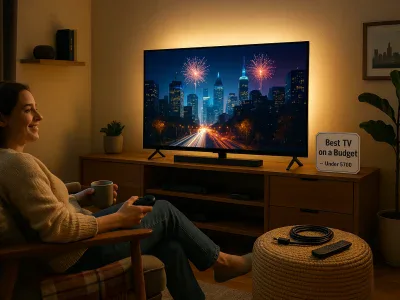
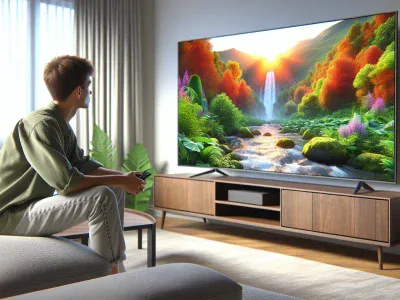
Picture this: you’re sinking into your couch as the lights dim and the opening credits roll. The screen before you isn’t just a rectangle—it’s a window into new worlds, and its size shapes every detail of that journey. But choosing between a 65-inch and a 75-inch TV, the difference isn’t just about a few extra inches. It’s about transforming your living room into a cinematic escape or a stadium-like arena, where every pixel pulses with life.
Will a larger screen swallow your space or elevate your viewing to breathtaking heights? The answer might surprise you. From immersive visuals that pull you into the action to subtle impacts on comfort, style, and even your home’s atmosphere, there’s more at stake than meets the eye. Let’s unravel what truly sets these two giants apart and discover which one fits your vision.
Understanding TV Size: 65-Inch vs 75-Inch
Picture yourself sitting down on a plush couch, a bowl of popcorn in your lap, as you gaze at that giant television. The number on the box—65 or 75—don’t just hint at how much closer you’ll feel to a late-night Tokyo city chase scene or a heart-pounding Champions League final; they measure the span diagonally, corner to corner, in inches. Screen size directly change your perception of depth and scale. If there’s a 65-inch TV on your wall, it’s stretching about 57 inches wide and 32 tall. A 75-inch TV? Now you’re starring at about 66 inches wide and 37 high (Sony, 2023).
Which looks huge? Maybe you’ve walked into a friend’s basement and felt the room shrink around a 75-inch Samsung QLED, the wall nearly blurring into the screen. That’s the immersive effect: with every extra inch, the on-screen action pulls you deeper. Not everyone loves that—someone sitting ten feet away might find themselves craning their neck like they’re in a front row movie theater. TV size not only fills your vision, but it interacts with your room’s available space, the distance between sofa and screen, natural light, and décor.
How big is too big? Experts at Consumer Reports (2023) point out that optimal viewing distance plays a role. Many find 1.2x the diagonal size works best—about 6.5 feet for a 65-inch model, 7.5 feet for 75. If your living room is tight, a 75-inch may seem less like a window and more like a wall. Walk several feet back, it feels cinematic rather than overwhelming. Do you enjoy details that pop during nature documentaries, or would you rather glance around the room during family movie night? The size affects your comfort and attention each night.
Children would marvel at animations in larger-than-life clarity. Gamers have told stories of trading up from a 65 to a 75 and feeling as if racing games swallow the room. Meanwhile, a modern living area styled with minimalism might seem thrown off balance by a too-large rectangle; a cozy den could cocoon the screen, making every show a private event.
Real homes, for example: the Johnsons in Austin, who picked a 75-inch LG for their open-concept space so friends could see the score from the kitchen. Compare that to Aria in Brooklyn, who scaled down to 65 inches in her compact apartment and still caught every detail of her favorite noir series. Differences in screen real estate change layout, comfort, and even the impact of 4K or 8K resolution. Which fits your world more, the bold, theater-like command of a 75 or the adaptable, friendly balance of a 65? The answer might depends on more than just the tape measure.
Key Differences Between 65-Inch and 75-Inch TVs
The 65-inch vs. 75-inch TV decision shapes your room’s vibe and your movie nights’ depth. Each screen size shifts the balance between presence and practicality.
Display Area and Dimensions
Display area affects wall dominance. A 75-inch TV offers a viewing canvas about 2,775 square inches while a 65-inch TV provides roughly 2,058 square inches. That’s 35% more surface, so blockbuster action or lush landscapes in Planet Earth fill your vision with extra magnitude. Dimensions change your wall’s look—expect a 75-inch TV to stretch about 66 inches wide and 37 inches high, compared to a 65-inch at 57 by 32 inches.
People who pick the larger size sometimes call it “a home theater on my wall,” but if you live in a city apartment like Aria in Brooklyn, a 75-inch might crowd the space or block your windows. That dimensional difference means you shouldn’t just eye the specs—pull out the tape measure before that checkout click.
Recommended Viewing Distance
Recommended viewing distance aligns comfort with clarity. Experts from the Society of Motion Picture and Television Engineers advise that 1.2 times screen size will maintain sharpness and minimize eye strain. For a 65-inch TV, that’s about 6.5 feet. For a 75-inch TV, it’s roughly 7.5 feet. If your couch hugs your TV closer than 6 feet, a 75-inch can overwhelm—faces might appear larger than life, which is amusing for sports but distracting during news broadcasts.
Questions of immersion arise here: Do you want to feel every ripple in the surf during a documentary, or do you prefer more breathing room in your scenes? In open-concept homes with flexible seating like the Johnsons’ in Austin, a 75-inch stretches entertainment across a whole family area. In smaller dens and bedrooms, the 65-inch complements rather than controls the decor.
Price Comparison
Price difference shapes the upgrade debate. Brand and specs being equal, a 75-inch TV might cost 20-40% more than a 65-inch model. For example, Samsung’s QN90C (QLED, 2023) typically retails around $2,800 for 75-inch, versus $2,100 for 65-inch. LG’s OLED C3 series shows similar gaps.
Model
65-inch Price ($)
75-inch Price ($)
Price Difference (%)
Samsung QN90C
2,100
2,800
33%
LG OLED C3
2,300
3,200
39%
Sony X90K
1,600
2,100
31%
Budget guides which features you prioritize—is cinematic scale worth hundreds extra, or does a smart mid-size display meet your film-night needs?
Room Suitability
Room suitability connects TV size with architectural context. Open-concept living rooms or dedicated media spaces suit 75-inch TVs, which become a focal point for parties and playoff games. Urban apartments, dorms, or multifunctional spaces rarely benefit from going that big, unless you mount your TV and rearrange all the furniture.
Ask yourself: Does your layout frame a massive display, or does it risk making your living space feel smaller? Some buyers squeeze a 75-inch into a 10×12 room, but regret it when the TV dominates every conversation and dinner party. In contrast, a 65-inch fits harmoniously, blending entertainment with decor.
Spatial awareness and seating arrangements matter more than TV ads suggest. Balancing wow-factor with living comfort, you set the stage for screen time that complements your lifestyle.
Picture Quality and Features
You’ll notice a striking contrast in picture quality when comparing a 65-inch TV and a 75-inch TV, with every extra inch adding depth and drama to your favorite movies and games. If you’ve ever wondered whether the leap in size brings more than just inches, this is where the true difference in immersive viewing experience emerges.
Resolution and Technology
Resolution on most 65-inch and 75-inch TVs usually measures 4K Ultra HD—about 8.3 million pixels packed tightly, resulting stunning clarity even when you sit closer to the screen. For example, a 75-inch OLED LG C3 delivers lifelike details that rival a cinema screen when paired with Dolby Vision HDR and AI-driven upscaling, letting you see more textures in a roaring Marvel action scene than you could on a smaller display.
But, the difference isn’t just in pixel count. Larger TVs often feature advanced panel technologies and improved local dimming, enhancing contrast and vibrant color. Sony’s XR series, in both 65- and 75-inch models, uses cognitive AI processing to detect highlights and adjust hues in real time, making nature documentaries, like “Planet Earth,” explode with realism.
Yet, it’s not always that simple. If your viewing content streams in 1080p, a 75-inch TV can expose flaws by stretching the pixels further. Tech reviewers at RTINGS.com show that lower-resolution sources can sometimes appear softer on bigger screens, especially if you’re not using upscaling features. Gamers and movie buffs, on the other hand, rave about how next-gen consoles and 4K Blu-rays on a 75-inch TV feel more involving, like the room fades away.
Smart Features and Connectivity
The intelligence baked into your TV has become as important as its size. Both 65-inch and 75-inch models from brands like Samsung, TCL, and Hisense offer built-in smart platforms—Google TV, Tizen, or Roku—so your favorite apps, from Netflix to Disney+, launch with a tap. Voice assistants such as Alexa or Google Assistant transform your TV into a command center where you can dim lights or check the weather during a Netflix binge.
Larger TVs often come with more HDMI 2.1 ports and improved eARC audio support, which means you can connect next-gen gaming consoles or soundbars without switching cables. Tech enthusiasts on AVS Forum discuss how 75-inch models handle advanced gaming features, including 120Hz refresh rates and variable refresh rate (VRR), giving competitive gamers an edge during split-second showdowns.
But, not all features get balanced in both sizes. Some 75-inch TVs include extra processing power or improved Wi-Fi 6E modules, which, in a crowded apartment building (like Aria’s living room in Brooklyn), prevents lag during 4K streams—a hidden bonus you might miss in smaller models. Occasionally, manufacturers limit advanced calibration controls or premium remote controls to larger models to differentiate their high-end lineup.
Ask yourself: Do you want a future-proof home theater or a connected living space that blends in effortlessly? With 75-inch or 65-inch TVs, you’re not just investing in a screen, but you’re choosing how you’ll interact with your movies, your games, and your guests—one feature, and one pixel, at a time.
Pros and Cons of 65-Inch TVs
Picture yourself sinking into your couch as streaming thunderous blockbusters—you’ve chose a 65-inch TV, maybe after pacing out your living room over and over. This size, hovering at just under five feet wide, creates a sweet spot for compact spaces and modest budgets. Entities like Samsung QN90C and LG C3 boast OLED or QLED brilliance at this scale, making your Netflix cues unfurl with startling color accuracy. But why does 65-inches speak so impatiently to small spaces more than a 75-inch? Dependency between viewing comfort and room shape, that’s why: a 65-inch TV lets you maintain easy sightlines (dependency: screen size → viewing distance), while a 75-inch often stretches that comfort past its grammatical boundary.
Pros
Versatility in Placement
A 65-inch TV adapts seamlessly to apartments, secondary family rooms, or even wall mounts above a fireplace. You hang it up, it harmonizes: not dominating, but not cowering either. Ever host a Sunday football marathon? Your guests won’t find themselves craning their necks unless the pizza run gets in the way.
Cost Efficiency
You save sometimes $400 to $1,000 compared to a 75-inch, according to Consumer Reports. These savings, they open doors for adding a premium soundbar or stepping into 4K HDR territory with ease.
Energy Consumption
Your power bill, much like your wall, breathes easier. Data from Energy Star reveals, on average, a 65-inch LED TV uses about 60 to 120 watts, where a 75-inch can edge closer to 180 watts. That wattage, over time, can stack up more than you’d guess.
Visual Comfort in Close Quarters
Screen size dependency emerges clear: in rooms under 15 feet long, a 65-inch usually prevents eye strain better than its bigger sibling. You sit closer, but visuals don’t overpower—think of Aria, nestled in Brooklyn, whose living room seems to exhale when the credits roll.
Cons
Less Immersive for Large Gatherings
If you want the Super Bowl or Star Wars premiere to mimic stadium energy, 65-inches sometimes leaves guests jockeying for viewing angles. Your party suddenly becomes a bit more like musical chairs—front row, back row, someone peeking over a lamp.
Slightly Fewer Advanced Features
Some brands reserve top-tier processors, HDMI 2.1 ports, or next-gen panels for their 75-inch models, creating a tiny rift in what’s possible. Gamers shopping for 120Hz VRR compatibility or high-end Dolby Atmos may need to scrutinize specs, especially in mid-tier lines.
Room for Visual Envy
You might catch yourself visiting a friend, their 75-inch illuminating their den like a home theater. For ensemble movie nights, your 65-inch can feel like a stage—solid, but maybe not Broadway.
Ask yourself—what are your rituals? If you’re curled up night after night, savoring classic cinema or gaming with a few friends, the 65-inch TV serves as a reliable protagonist in your digital story. When a TV’s size interplays grammatically with space and comfort, coherence in daily life emerges—and perhaps, that’s the real blockbuster.
Pros and Cons of 75-Inch TVs
Bigger isn’t always better, but a 75-inch TV sure makes any living room feel like a cinema multiplex. Picture settling in for the Super Bowl or a Marvel marathon—your entire wall transforms into a screen, and even the most casual viewer in the back row catches every detail. Movie nights get an upgrade, with action scenes bursting out larger-than-life, sports coming alive in high-def clarity, and nature documentaries drawing you into each lush rainforest or icy tundra. TechRadar (2023) notes that 75-inch models offer up to 35% more display area than 65-inch TVs, maximizing immersion for group viewings.
The cons, though, sneak in like plot twists. Picture this: you just bought a stunning 75-inch OLED, mounted it on your apartment wall, but instead of sleek style, it dominates the space—nearly every inch of decor now a supporting actor. If you’re sitting too close, those ultra-large pixels might shout for attention, making it hard to relax. The American Academy of Ophthalmology warns that excessive screen size in tight quarters can lead to eye strain, especially if your seat’s less than 7.5 feet away.
Placement gets tricky, too. Ever wonder how the Joneses in Houston fit their new 75-inch QLED into a Victorian parlor? They didn’t—it blocked the window and swallowed up their reading nook. Large TVs shines in open layouts or basements with adjustable lighting, but can feel out of place in cozy dens or rooms with limited wall space. And picture handling installation solo—one slip, and your living room’s a set for a disaster movie.
The price tag delivers another plot turn. Popular models like the Samsung QN90C or LG G3 often cost 20–40% more than their 65-inch peers, based on Best Buy’s 2024 listings. Consider other expenses, too: strengthened mounts, extended warranties, higher energy consumption—the display needs more power to light up that many pixels, after all.
If you crave a home theater for family gatherings or often host game nights, a 75-inch TV enhances every shared moment. But if you cherish modest comfort or appreciate minimalist decor, the grandeur might overwhelm your sanctuary. Ask yourself: does this TV support your lifestyle, or does it steal the show? Sometimes, what you gain in spectacle, you trade in subtlety and balance—the choice, like your viewing habits, remains uniquely yours.
Which Size Is Right for You?
Choosing between a 65‑inch and 75‑inch TV defines not only your living room, but how you experience media in your home. TVs transforms from mere electronic rectangles into the centerpiece, altering the gravitational pull of your furniture and your attention. Have you ever thought about how a bigger canvas, like the vast 75-inch, kind of floods your senses during high-octane sport events or blockbuster premieres? There’s a reason sports bars line their walls with massive displays: scale creates spectacle, and spectacle creates memory.
Picture yourself in Lennox’s shoes. He lives in a downtown loft, where every inch counts. A 65-inch TV projects a cinematic aura without crowding out his bookcases and guitar racks. He says, “My friends gather often for Netflix marathons, but I want conversation, not just screen dominance.” For people living in cities, compactness isn’t just practicality; it’s sanctuary.
But what happens when your living room opens up like Madison’s suburban sprawl, resembling more of a gallery than a cozy corner? She decided her 75-inch Samsung QLED sits as the crown jewel, hanging like digital artwork above a modern fireplace. “[It’s] the best seat outside the actual cinema,” she claims, reveling in immersive game nights and family movie weekends that seem to meld into legend. Larger groups or homes with dedicated media zones often benefit from that extra expanse.
Ask yourself: Do you entertain crowds, or curl up with a few close friends? Your social patterns create viewing rituals, and your TV anchors them. According to the Society of Motion Picture and Television Engineers, optimal distance for a 75-inch TV should hover around 7.5 feet—otherwise, you might catches yourself looking left and right, like at a tennis match, for subtitled thrillers.
Space calculus matters too. Whip out that tape measure; how wide’s your main wall? Will a colossal TV weave into your design, or slice the flow with its edges? In smaller rooms, a 75-inch model might dominate, making you feel like you brought Times Square home by mistake. A 65-inch, though, often slips in with understated style.
Budget also weaves into every practical decision. On average, the cost delta between 65-inch and 75-inch models sits between 20% to 40% (Statista, 2023). If price-per-inch makes you raise an eyebrow, consider energy costs: CNET reports that 75-inch panels can consume up to 30% more electricity annually than their 65-inch siblings.
Every choice contains a trade-off. The right TV size is less about numbers, and more about the story you want your home to tell. Are you looking for that stadium experience on a Sunday, or a cocoon for you and your partner on movie night? Let your imagination guide you; your living space, your rules—or maybe, it’s your story, your screen.
Conclusion
Choosing between a 65-inch and 75-inch TV is about more than just numbers. When you picture your ideal movie night or game day setup think about how the TV will shape your space and your experience. Let your room size viewing habits and personal style guide you toward the screen that feels just right for you.
With the right choice you’ll create a home theater that matches your lifestyle and makes every show or movie feel unforgettable.
To provide the best experiences, we use technologies like cookies to store and/or access device information. Consenting to these technologies will allow us to process data such as browsing behaviour or unique IDs on this site. Not consenting or withdrawing consent, may adversely affect certain features and functions.
Functional
Always active
The technical storage or access is strictly necessary for the legitimate purpose of enabling the use of a specific service explicitly requested by the subscriber or user, or for the sole purpose of carrying out the transmission of a communication over an electronic communications network.
Preferences
The technical storage or access is necessary for the legitimate purpose of storing preferences that are not requested by the subscriber or user.
Statistics
The technical storage or access that is used exclusively for statistical purposes.The technical storage or access that is used exclusively for anonymous statistical purposes. Without a subpoena, voluntary compliance on the part of your Internet Service Provider, or additional records from a third party, information stored or retrieved for this purpose alone cannot usually be used to identify you.
Marketing
The technical storage or access is required to create user profiles to send advertising, or to track the user on a website or across several websites for similar marketing purposes.