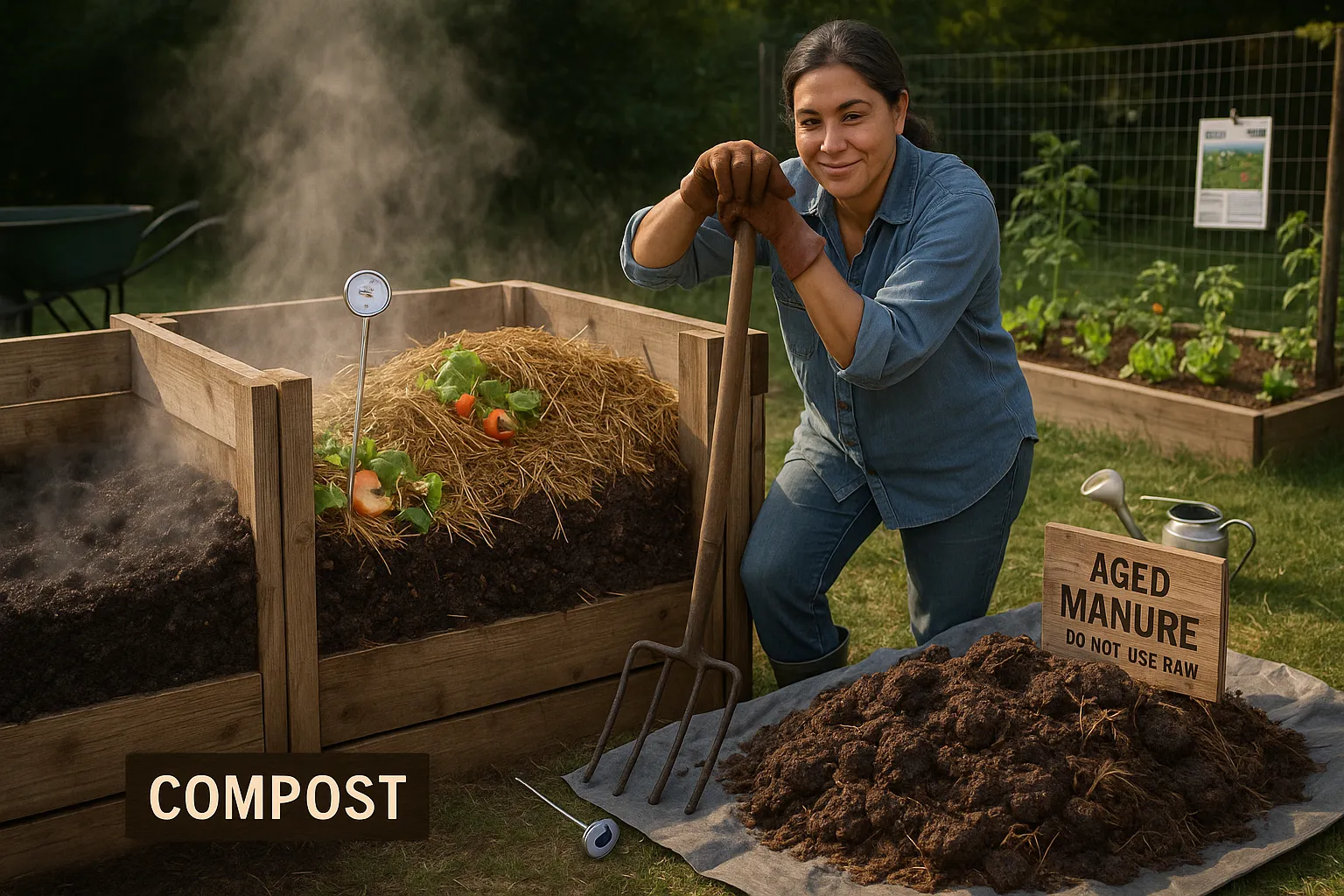
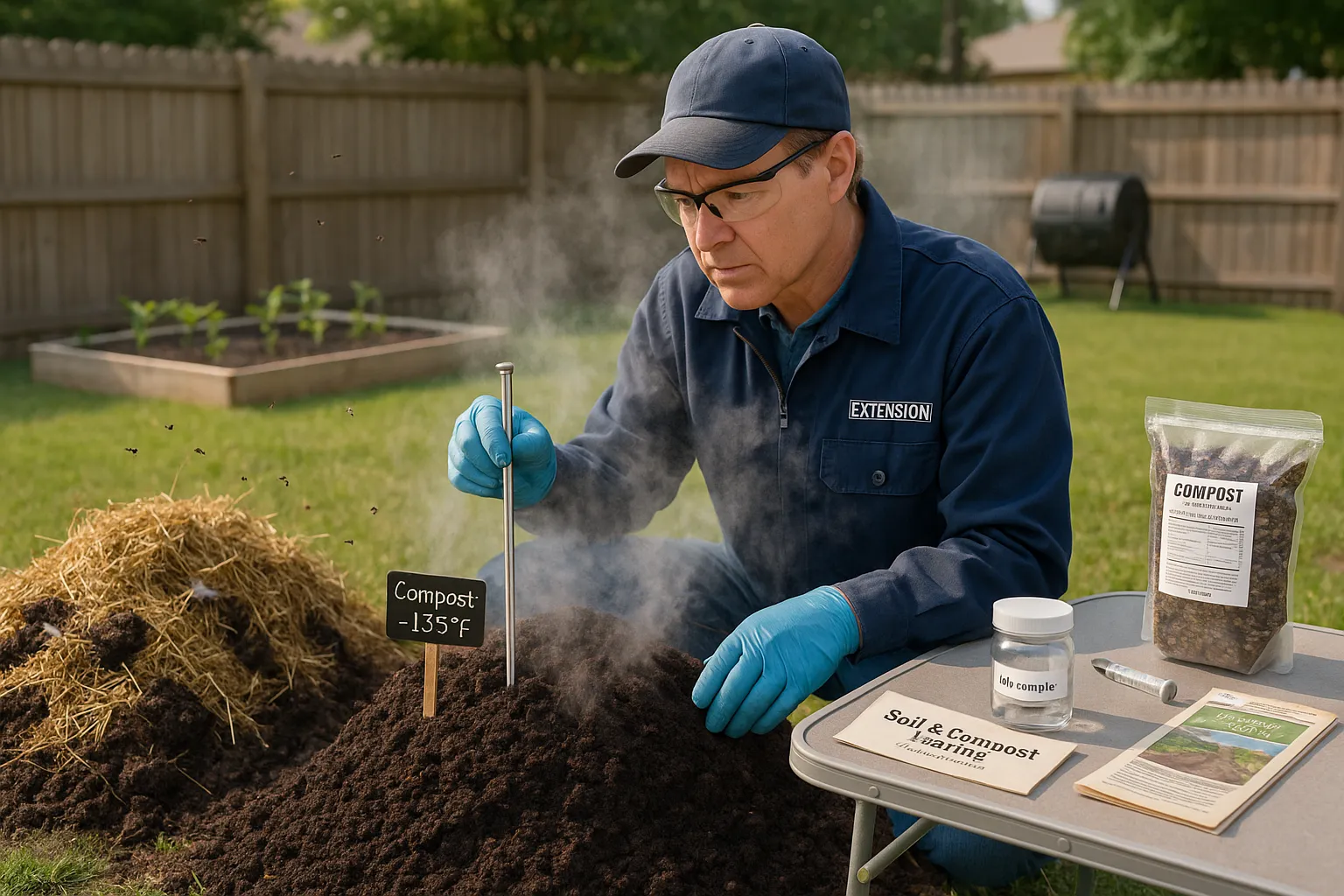
Compost vs. manure is not just a semantic debate, it’s a practical choice that shapes your soil, yields, and time at the shovel. Picture dark, crumbly soil that smells faintly of forest floor after rain, or picture a spring day when a bed that received the right amendment sings with healthy seedlings. Both compost and manure transform tired soil, but they do so in different ways. In this text you’ll learn how each is made, what nutrients and biological benefits they deliver, when to use them, and how to avoid the common pitfalls that can hurt plants. Along the way you’ll see clear recommendations for vegetables, lawns, trees, and containers, plus safety checks so you don’t introduce pathogens or weeds.
What Compost And Manure Are And How They’re Made
Fact: Compost is decomposed organic matter: manure is animal waste often combined with bedding. Both are organic amendments but they start from different inputs and go through different processes.
How Compost Is Produced
Compost forms when plant and food wastes break down through microbial action under controlled conditions. You mix green materials (nitrogen-rich items like vegetable scraps, grass clippings) with brown materials (carbon-rich items like leaves, straw) and maintain moisture and oxygen. Heat rises as microbes digest the pile: temperatures often reach 120–160°F when the pile is active, which kills many pathogens and weed seeds if managed correctly. Institutions like the University of California recommend turning the pile and monitoring moisture to keep decomposition steady. Finished compost looks dark, smells earthy, and has a crumbly texture.
Types Of Manure And How It’s Processed
Fact: Manure comes from livestock, cow, horse, chicken, goat, and others, and varies widely in nutrient content and risk profile. Fresh manure is high in ammonia and salts and can burn plants. Many gardeners compost manure before application to stabilize nutrients, reduce pathogens, and lower odor. Poultry manure, for example, is high in nitrogen and phosphorus: cow manure is milder and bulkier. Processing ranges from simple aging (stockpiling until it cools) to active composting with bulking agents. The USDA and Natural Resources Conservation Service (NRCS) provide guidelines on manure handling for farms: you can use similar practices at home to reduce risk. Raw manure should generally not be used on beds with immediate food crops unless it’s been properly composted or aged.
Nutrient Content And Soil Benefits Compared
Fact: Compost supplies balanced, slow-release nutrients and carbon: manure supplies higher immediate levels of nitrogen and phosphorus but varies by source.
Macronutrients, Micronutrients, And Release Rates
Compost typically has low to moderate concentrations of macronutrients (N-P-K), often in ratios like 1-1-1 to 2-1-1, depending on feedstock. It releases nutrients slowly as microbes continue to break down organic matter, which reduces burn risk and provides long-term fertility. Compost also contains micronutrients such as zinc, copper, and manganese in small amounts.
Manure often contains higher N and P per volume. Poultry manure can read 3-2-1 or higher, while cattle manure might be closer to 0.5-0.2-0.3 on a fresh basis. Because of variability, you should test or use published averages to plan application. Manure’s nutrients are more available faster than compost’s, which can help jump-start growth but might require careful timing to avoid leaching.
Effects On Soil Structure, Water Retention, And Biology
Compost builds soil structure by increasing stable organic matter. It improves aggregation, which enhances aeration and root penetration. Compost boosts water-holding capacity in sandy soils and improves drainage in clays, it truly changes pore structure. Compost also feeds soil microbes and fungi that form healthy, resilient soil food webs.
Manure adds nutrients and some organic matter, but fresh manure can temporarily tie up oxygen or increase salt levels. Well-composted manure contributes to structure and biology similar to compost, though the effect depends on the bedding material and manure age. Using compost regularly builds long-term soil carbon: using manure strategically supplies pulses of nutrients that plants will use quickly.
Use Cases And Application Guidelines
Fact: Use compost as a routine soil builder: use manure when you need a stronger nutrient boost but only if it’s properly processed.
Recommended Rates, Timing, And Methods Of Application
For garden beds, apply compost at 1–3 inches (about ½ to 1 inch incorporated into topsoil or 2–3 inches as a top dressing) once or twice per year. For lawns, top-dress with ¼ to ½ inch of compost in spring or fall.
Composted manure should be applied at rates similar to compost if used as a soil conditioner. If you use raw manure, limit to small amounts and apply well before planting, ideally the previous season, to avoid burning seedlings and to allow pathogens to decline. Incorporate amendments into the top 6–8 inches for vegetables: for trees, spread under the dripline and avoid piling near the trunk.
Use tools: a rake, fork, or tiller for incorporation: a wheelbarrow and spreader for larger areas. Water after application to start nutrient movement. Consider a soil test from your local extension office to decide exact rates based on measured P and N needs.
Using Compost And Manure Together Safely
Fact: Combining compost and manure can be effective if both are stable. Mix modest amounts of well-composted manure into compost or apply compost as the main amendment and add small, composted manure doses for extra nutrients. Avoid mixing raw manure with composted finished compost unless you plan to re-compost the blend to reach sanitizing temperatures. That reduces pathogen and weed seed risks and gives you predictable nutrient release.
Risks, Safety, And Quality Concerns
Fact: Pathogens, weed seeds, high salts, and inconsistent nutrient content are the main risks, but you can manage them with simple checks.
Pathogens, Weed Seeds, Salt Levels, And Odor Issues
Raw manure can harbor E. coli, Salmonella, and other pathogens. Compost that reaches and maintains thermophilic temperatures (above ~131°F for several days) is much safer. Weed seeds survive in poorly managed compost or unheated manure: properly hot composting kills most seeds.
High salt levels are common in some manures and in food-waste composts: salts can harm seedlings and sensitive plants. Odor arises from anaerobic pockets: turning piles and keeping oxygenated reduces smell. In urban settings you’ll want aged, screened compost or sanitized commercial products to avoid complaints.
How To Assess Quality And Source Materials
Fact: You can judge quality by smell, texture, temperature history, and source. Good compost smells earthy, is dark, and has a crumbly texture. Ask vendors about source feedstocks, temperature logs, and whether the product is screened.
For manure, ask about animal diet, bedding, and age. Poultry manure from a commercial poultry operation will differ significantly from mixed small-farm poultry. Local extension services often provide test sheets or labs that analyze nutrient and salt content, use them before large applications. When in doubt, compost manure a second time.
Environmental, Cost, And Sustainability Considerations
Fact: Compost often wins on long-term carbon storage and soil health: manure can cause nutrient runoff if overused but recycles farm waste when managed well.
Carbon Footprint, Nutrient Runoff, And Local Sourcing
Compost reduces waste sent to landfills and stores carbon in soils. Its carbon footprint depends on hauling distance and whether you use powered turners. Manure provides a use for animal waste but can contribute to nutrient runoff of nitrogen and phosphorus if spread too heavily before rain events. Local sourcing reduces transport emissions and helps close nutrient loops, check farmers, municipal composting programs, or community gardens for nearby supplies.
Cost, Availability, And Long-Term Soil Health Tradeoffs
Compost typically costs more per cubic yard than raw manure, but it is lower risk and more predictable. Manure may be cheaper or free near farms but can require more handling and testing. Over years, regular compost additions build stable organic matter and reduce fertilizer needs. Strategic manure use can boost yields quickly, but repeated heavy use risks nutrient buildup, especially phosphorus, that can harm waterways.
Choosing The Right Amendment For Specific Garden Needs
Fact: Match the amendment to the crop and timing: compost for steady soil building: manure for nutrient pulses when needed.
Vegetable Beds, Lawns, Fruit Trees, And Container Plants
Vegetable beds: Use compost regularly (1–3 inches annually). If you use manure, apply well-composted material in fall. Lawns: Top-dress with ¼–½ inch of compost: avoid fresh manure on turf.
Fruit trees: Apply a 2–3 inch compost mulch around the dripline in spring or fall: composted manure can be worked into the topsoil in late winter. Container plants: Use screened compost or potting mixes with composted inputs: never use raw manure in containers because salts concentrate and can burn roots.
Practical Decision Checklist And Quick Recommendations
Fact: A simple checklist saves mistakes.
Do you need immediate nutrients? Choose composted manure (not raw) for a nutrient boost.
Do you want to build long-term organic matter? Choose compost and apply yearly.
Are you growing food that will be eaten soon? Use mature, heat-processed compost or aged manure applied well before harvest.
Do you have limited space or containers? Use screened, low-salt compost or commercial mixes.
Quick recommendations: Use compost as the baseline amendment. Add composted manure occasionally to support high-demand crops, and always test soil if you plan repeated manure use.
Common Mistakes And Troubleshooting Tips
Fact: Overapplication and using raw manure are the most common mistakes: both are fixable.
Signs Of Overapplication Or Poor Quality And How To Fix Them
Signs: Burned leaf edges, stunted seedlings, white crust on soil surface (salts), foul odors, and excessive weed growth. Fixes: Flush salts with water during dry periods, remove and replace contaminated topsoil in severe cases, and apply compost to rebalance high-nutrient soils. If you suspect pathogens from fresh manure, wait a season before planting edible crops or re-compost the material.
Troubleshooting tips: If seedlings collapse after transplant, check for fresh manure contact. If soils stay waterlogged after amending, add coarse compost and sand to increase porosity. When weeds increase after spreading amendment, screen future purchases for fewer weed seeds or compost hotter. Finally, keep records: note product source, application dates, and plant responses so you learn what works in your garden. This habit will improve choices over time and save you both time and money.
To provide the best experiences, we use technologies like cookies to store and/or access device information. Consenting to these technologies will allow us to process data such as browsing behaviour or unique IDs on this site. Not consenting or withdrawing consent, may adversely affect certain features and functions.
Functional
Always active
The technical storage or access is strictly necessary for the legitimate purpose of enabling the use of a specific service explicitly requested by the subscriber or user, or for the sole purpose of carrying out the transmission of a communication over an electronic communications network.
Preferences
The technical storage or access is necessary for the legitimate purpose of storing preferences that are not requested by the subscriber or user.
Statistics
The technical storage or access that is used exclusively for statistical purposes.The technical storage or access that is used exclusively for anonymous statistical purposes. Without a subpoena, voluntary compliance on the part of your Internet Service Provider, or additional records from a third party, information stored or retrieved for this purpose alone cannot usually be used to identify you.
Marketing
The technical storage or access is required to create user profiles to send advertising, or to track the user on a website or across several websites for similar marketing purposes.