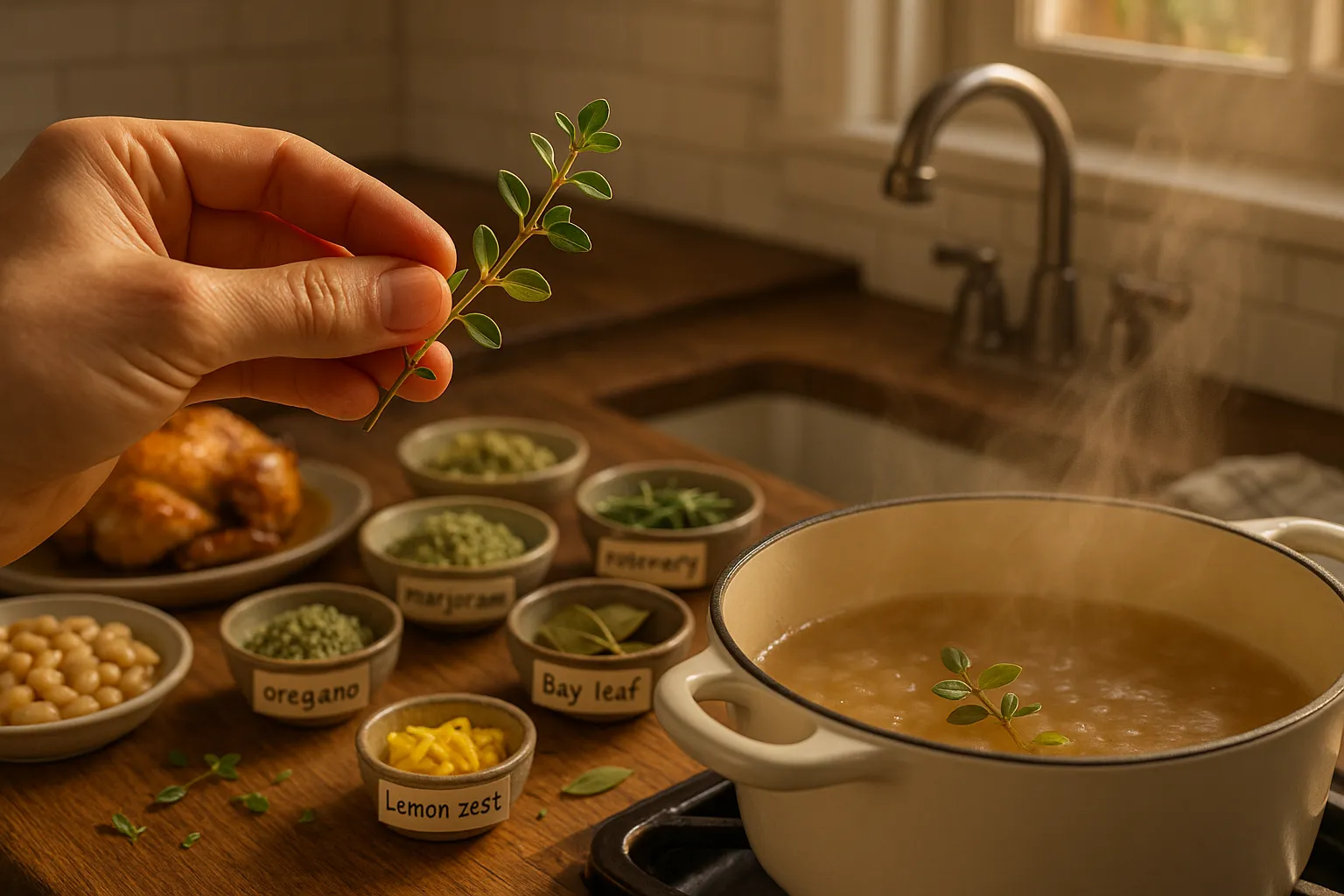
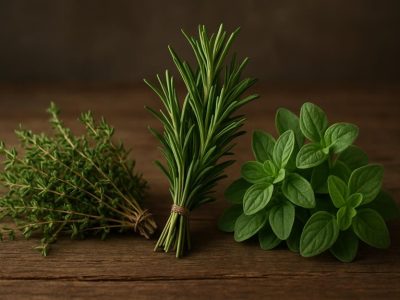
Thyme gives a low, woodsy whisper to many dishes, roast chicken, tomato sauces, and rustic stews, but you won’t always have it on hand. Which herb will give you the same balance of savory lift without muddying the dish? This guide shows clear, practical swaps you can reach for immediately. You’ll learn the flavor trade-offs, exact conversion rules, and real-world tips so your food tastes like you meant it, even when thyme is missing.
Understand Thyme’s Flavor And Common Uses
Fact: Thyme combines savory, slightly floral, and faintly lemony notes. That simple line explains why chefs use it so often. Thyme gives dishes structure without stealing the show.
Thyme Flavor Profile
Thyme tastes herbaceous, earthy, and slightly mint-like with subtle citrus overtones. The leaves hold concentrated oils. Those oils release slowly when heated. You sense thyme as background support more than a forward flavor. Named entities: common thyme (Thymus vulgaris), lemon thyme (Thymus x citriodorus). Chefs at Ottolenghi and Ina Garten favor thyme because it tolerates heat and keeps shape during long cooks.
Typical Culinary Uses And Why Thyme Works
Fact: Thyme works in long cooks, braises, and light finishing. You add thyme when you want steady savory tone across many ingredients. It pairs well with garlic, lemon, rosemary, bay leaf, and tomatoes. Use thyme in: roast chicken, vegetable gratins, white beans, tomato sauce, and bouquet garni. Real example: a slow-simmered cassoulet holds thyme’s flavor for hours without turning bitter. Why it works: thyme’s volatile oils are stable at simmering temps and release gradually, adding depth without sharpness. If you skip thyme, you must replace both its aroma and its slow-release behavior.
Best One‑To‑One Substitutes
Fact: Oregano, marjoram, and savory are the best straight swaps for thyme in many recipes. They match thyme’s savory core but each shifts the final note.
Oregano: When To Use It And How To Adjust
Oregano gives a stronger, peppery kick than thyme. Use oregano when you cook robust dishes: tomato sauces, grilled meats, and pizzas. Swap ratio: use three-quarters the amount if fresh oregano replaces fresh thyme. If you use dried oregano, cut the quantity to half of dried thyme because oregano tastes stronger. Oregano pairs with garlic and red pepper flakes: it will make a sauce feel more Mediterranean. Tip: add oregano later in short cooks to keep it bright.
Marjoram: The Mild, Closest Match For Delicate Dishes
Marjoram has the gentlest match to thyme. It carries floral, sweet notes and less menthol bite. Use marjoram in egg dishes, light fish, creamy soups, and vinaigrettes. Swap ratio: 1:1 fresh to fresh: 1:2 dried to dried (dried marjoram is milder). Real-life note: I once swapped marjoram for thyme in a lemon ricotta pasta and the dish felt softer and floral, the change was subtle but obvious when tasted side-by-side.
Savory: Earthy Alternative For Beans And Hearty Fare
Savory (Satureja) is peppery and earthy. It shines with legumes, cabbage, and fatty cuts. Swap ratio: use equal amounts fresh-to-fresh, or reduce dried savory to two-thirds of dried thyme. Savory holds up to long simmering. A bean stew with savory will taste more rustic and hearty than one with thyme.
Substitutes For Roasting, Braising, And Long Cooks
Fact: For long roasts and braises you need substitutes that resist bitterness and release flavor over time. Rosemary and bay leaf meet those needs, each in a different way.
Rosemary: Robust Option For Roasts And Root Vegetables
Rosemary brings piney, resinous notes. Use rosemary when you want assertive aroma: roast lamb, potatoes, and whole chickens. Swap rule: use half the volume of fresh rosemary for fresh thyme because rosemary is more intense. Chop rosemary fine or use whole sprigs that you remove before serving. Warning: rosemary can dominate delicate proteins: avoid it with light fish or subtle sauces. Case: a roast chicken with rosemary and lemon will feel bright and savory but less herbaceous than one with thyme.
Bay Leaf: Use Whole For Slow Simmered Recipes
Bay leaf gives aromatic depth and a faint bitter edge that balances fatty dishes. Use whole bay leaves in long-simmered stocks, stews, and braises. Swap approach: one or two bay leaves can replace a few sprigs of thyme in a large pot. Bay infuses slowly: remove the leaf before serving. Pair bay with oregano or marjoram if you want to recover some thyme-like herbaceousness.
Fresh‑Thyme Alternatives For Salads, Sauces, And Finishing
Fact: Fresh herbs like basil and tarragon give the bright, leafy lift that fresh thyme would provide when used raw or at the end of cooking.
Basil And Tarragon: Fresh, Bright Swaps And When To Choose Each
Basil is sweet, peppery, and aromatic. Use basil in salads, fresh tomato dishes, and quick sauces like pesto. Swap ratio: use equal amounts fresh basil to fresh thyme in salads and cold sauces, but cut back when adding to hot oil because basil wilts quickly. Tarragon has aniseed notes. Use tarragon with chicken, mustard sauces, and egg dishes. Swap rule: use half the amount of fresh tarragon for fresh thyme: its licorice tone can be strong. Example: a mustard-tarragon pan sauce will feel sharper and more forward than a thyme sauce, but it pairs better with cream and vinegar.
Herb Blends: Herbes De Provence And Italian Seasoning As Shortcuts
Herbes de Provence and Italian seasoning can replace thyme when you need convenience. Fact: blends bring multiple complementary herbs, oregano, rosemary, marjoram, savory, and sometimes lavender. Swap guideline: use the same volume of blend as you would thyme if the recipe already uses mixed herbs: reduce by one-third if the dish relies on thyme as the primary herb. Tip: check blend ingredients: lavender in Herbes de Provence will alter delicate dishes.
Conversion Guidance And Substitution Ratios
Fact: Fresh and dried herbs differ by strength: dried herbs are generally three times stronger than fresh by volume. Use this base rule for conversions and then adjust for each herb’s intensity.
Fresh To Dried Conversion And General Swap Rules
Rule: 1 tablespoon fresh thyme = 1 teaspoon dried thyme. Keep this as your starting point.
For stronger herbs (oregano, rosemary): reduce dried amount to two-thirds of the thyme-equivalent.
For milder herbs (marjoram): increase dried amount to 1.5 times the thyme-equivalent.
When recipes call for “sprigs,” replace one small sprig with 1/2 teaspoon of chopped fresh herb.
Practical tip: always season to taste at the end. Herbs change during cooking: adjust salt and acid to balance.
For roasts: 1 sprig thyme = 1 small rosemary twig (use half if finely chopped)
These quick swaps keep proportions clear. If you have neither, use a blend like Italian seasoning at a 1:1 dried swap but taste early.
Practical Tips For Successful Substitutions
Fact: Timing and quantity determine whether a substitute succeeds. Add strong herbs later: add hardy herbs early.
Timing, Quantity Adjustments, And Layering Flavors
Timing: add rosemary and bay early in long cooks. Add basil, marjoram, and tarragon at the end or off-heat to preserve brightness.
Quantity: start low. You can always add more herb, but you can’t remove it. Use half the suggested swap amount, taste, then increase.
Layering: combine herbs for balance. Example: pair a bay leaf with fresh marjoram to mimic thyme’s slow lift and light floral hint. Add acid (lemon, vinegar) at the end to lift herbal notes.
Vulnerable moment: I once overused rosemary in a braise and the dish tasted piney and flat. I rescued it with extra lemon and a pinch of sugar. Mistakes like that teach you to taste early.
Herbs To Avoid As Thyme Replacements And Why
Fact: Not all herbs make good thyme replacements. Avoid cilantro and dill for thyme swaps. Cilantro brings citrus and soapy top notes that clash with roasted meats. Dill gives grassy, anise-like flavors better suited to fish and pickles. Also avoid mint in long simmering dishes: mint becomes bitter when cooked too long. These herbs will change the dish’s direction rather than keep it in the same flavor family.
To provide the best experiences, we use technologies like cookies to store and/or access device information. Consenting to these technologies will allow us to process data such as browsing behaviour or unique IDs on this site. Not consenting or withdrawing consent, may adversely affect certain features and functions.
Functional
Always active
The technical storage or access is strictly necessary for the legitimate purpose of enabling the use of a specific service explicitly requested by the subscriber or user, or for the sole purpose of carrying out the transmission of a communication over an electronic communications network.
Preferences
The technical storage or access is necessary for the legitimate purpose of storing preferences that are not requested by the subscriber or user.
Statistics
The technical storage or access that is used exclusively for statistical purposes.The technical storage or access that is used exclusively for anonymous statistical purposes. Without a subpoena, voluntary compliance on the part of your Internet Service Provider, or additional records from a third party, information stored or retrieved for this purpose alone cannot usually be used to identify you.
Marketing
The technical storage or access is required to create user profiles to send advertising, or to track the user on a website or across several websites for similar marketing purposes.