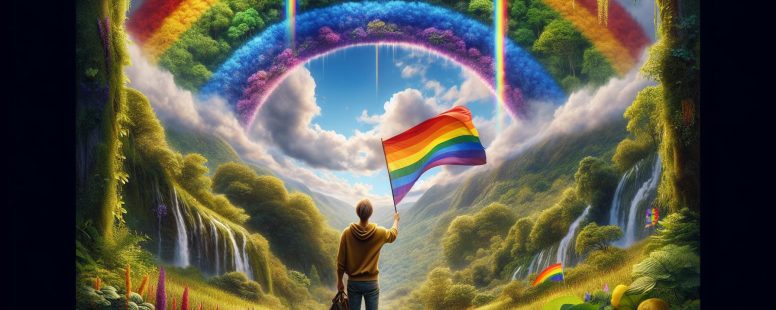
When you think of a rainbow, you might picture nature’s vibrant arc stretching across the sky after a storm—a perfect blend of colors that feels almost magical. But when you see the rainbow on a flag, it carries a deeper, human-made meaning, representing unity, diversity, and pride within the LGBTQ+ community. While both share a spectrum of colors, their purposes and origins couldn’t be more different.
Have you ever wondered why the rainbow in the sky has seven colors, yet the Pride flag has six? Or how each color in the LGBTQ+ flag holds its own powerful symbolism? These differences go beyond aesthetics—they reveal unique stories about identity, culture, and history. By exploring these contrasts, you’ll uncover how a natural phenomenon inspired a global movement and why the two rainbows, though visually similar, speak entirely different languages.
Understanding Rainbow Colors
Rainbow colors form one of nature’s most mesmerizing displays. Their scientific basis and natural occurrence have fascinated humans for centuries, serving as both inspiration and symbolism worldwide.
The Science Behind Rainbow Colors
Rainbow colors result from light dispersion. When sunlight passes through a prism-like medium, such as water droplets, it splits into seven visible wavelengths: red, orange, yellow, green, blue, indigo, and violet. Each color corresponds to a specific wavelength of light, ranging from approximately 380 nm (violet) to 700 nm (red).
The refractive index of water contributes to this dispersion. Shorter wavelengths, like violet and blue, bend more sharply compared to longer wavelengths, such as red. This phenomenon explains the order and appearance of rainbow colors. Sir Isaac Newton’s discoveries in optics laid the foundation for understanding this process, with the visible spectrum remaining a crucial concept in physics and perception studies.
How Rainbow Colors Are Formed in Nature
Rainbows occur due to sunlight interacting with atmospheric water droplets. Sunlight refracts as it enters a droplet, reflects off its inner surface, and refracts again when emerging. This double-refraction process creates the separation of colors seen in rainbows.
The viewing angle determines the visibility of a rainbow. To experience this spectacle, you need to be positioned with the sun behind you and rain in front of you. Secondary rainbows, sometimes visible outside the primary one, result from double reflections inside the droplets. These appear fainter and show inverted color order.
Natural rainbows are not limited to Earth. Atmospheric phenomena on other planets, like Saturn’s moon Titan, suggest conditions for similar optical effects. These extraterrestrial occurrences expand our understanding of light interaction mechanisms.
Exploring the LGBT Flag
The LGBT flag, also known as the Pride flag, stands as a symbol of inclusivity and representation. It’s a colorful emblem that has evolved over decades to foster acceptance and visibility for the LGBTQ+ community.
History of the LGBT Flag
The original LGBT flag was designed by Gilbert Baker in 1978. He was commissioned by Harvey Milk, one of the first openly gay elected officials in the United States. Baker, a queer artist and activist, believed the flag needed to be a symbol of hope and solidarity.
The first version of the flag had eight colors: hot pink (sexuality), red (life), orange (healing), yellow (sunlight), green (nature), turquoise (magic/art), blue (serenity), and violet (spirit). Due to fabric availability issues, hot pink was soon removed, followed by turquoise. By 1979, the six-color design—red, orange, yellow, green, blue, and violet—became the standard version recognized globally. Historical events, such as the Stonewall riots, further cemented the flag’s role in LGBTQ+ activism.
Symbolism Behind the LGBT Flag Colors
Each stripe on the LGBT flag represents specific themes and values. Red symbolizes life, while orange reflects healing. Yellow stands for sunlight and positivity, evoking warmth and joy. Green signifies nature, celebrating growth and harmony. Blue represents serenity and peace, while violet highlights the spirit and individuality.
Unlike the natural rainbow, which forms through light refraction, the Pride flag focuses on human values, culture, and the diversity of identities. It’s not tied to natural phenomena but crafted to empower marginalized voices. For example, during Pride marches, the flag waves as a signal of unity and persistence in the fight for equality.
38. Difference Between Rainbow Colors and LGBT Flag
Natural Phenomenon vs. Symbol of Identity
A natural rainbow forms from sunlight and water droplets, creating a prismatic display where light disperses into seven distinct colors. It represents a natural optical phenomenon, observable by anyone under proper conditions, free from cultural or societal connotations.
The LGBT flag, on the other hand, is a deliberate creation designed to represent human experiences and identities. Emerging in 1978 and shaped by the LGBTQ+ movement, it communicates a collective identity and serves as an emblem of social and political progress. Unlike the rainbow in the sky, it carries a deep cultural resonance rooted in values, activism, and diverse communities.
Number of Colors and Their Significance
Natural rainbows feature seven hues: red, orange, yellow, green, blue, indigo, and violet. These colors result from light refracting and reflecting through water droplets, a process measurable through wavelength ranges between 620nm for red and 380nm for violet. They lack intrinsic meanings, reflecting nature’s physical laws rather than design or interpretation.
The LGBT flag currently holds six stripes—red, orange, yellow, green, blue, and violet—after adjustments from its original eight-colored form. Each stripe bears symbolic significance, such as red for life and violet for spirit, linking each hue to shared human aspirations. These decisions imbue the flag with intentional meaning, contrasting the accidental beauty of rainbow colors in nature.
Cultural and Artistic Interpretations
Rainbows, in various cultures, often symbolize hope, harmony, or divine favor. Literary works, religious texts, and traditional folklore use them as metaphors for peace or transformation, anchoring their impact on nature’s universal appeal. Examples like Norse mythology’s Bifröst or the biblical bow in Genesis highlight their spiritual connections.
In art and media, the LGBT flag breaks barriers, representing pride, resilience, and unity. Its use in global Pride parades, advocacy campaigns, and merchandise challenges heteronormative perspectives and promotes inclusion. While rainbows in nature inspire awe, the Pride flag transforms artistic symbolism into a medium for social change and human rights advocacy.
Misconceptions and Clarifications
Confusion often arises between the natural rainbow and the LGBT Pride flag due to their shared use of vibrant color spectrums. But, these entities serve distinct purposes. Associating a rainbow in the sky with the LGBTQ+ community may overlook the natural phenomena’s scientific origins, while presuming the Pride flag duplicates a rainbow’s order disregards its symbolic intent.
A common misconception is that the Pride flag mirrors the seven colors of a natural rainbow — red, orange, yellow, green, blue, indigo, and violet. In reality, the Pride flag intentionally excludes indigo and features only six colors. Each color on the flag represents a unique value; for instance, green symbolizes nature, whereas red signifies life. Unlike natural rainbows, these colors don’t blend seamlessly but exist as solid, distinct bars to emphasize individuality.
Some individuals question why the Pride flag didn’t adopt all seven colors. This often stems from misperceptions about its design origins. Gilbert Baker, the creator of the Pride flag, designed it as a tool for unity and representation, not as a copy of natural rainbows. His earlier eight-color version reflected even broader inclusivity before practicalities reduced it to six.
Another myth presumes all rainbows, whether natural or symbolic, are universally celebrated. While natural rainbows are admired globally, cultural contexts influence their interpretations. Conversely, the Pride flag actively challenges societal norms and advocates for marginalized voices. Some societies embrace it, and others resist its progressive message.
Understanding these nuances prevents oversimplification. Recognizing a rainbow’s scientific basis (light refraction and dispersion) versus the Pride flag’s purposeful symbolism illuminates their separate narratives. For instance, while rainbows are accidental occurrences dependent on sunlight and water droplets, the Pride flag’s design follows deliberate human intent.
Acknowledging these differences raises awareness, enriching dialogue around both. Knowing their unique contexts sharpens appreciation, whether admiring a natural rainbow’s transient beauty or standing by the Pride flag’s legacy of resilience. This clarity dispels confusion and fosters more informed perspectives.
Conclusion
Understanding the differences between natural rainbows and the LGBTQ+ Pride flag allows you to appreciate the unique meanings each represents. While one is a scientific marvel of light and color, the other is a powerful symbol of identity, unity, and advocacy. Both inspire in their own ways, reminding you of the beauty of nature and the strength of human resilience. Recognizing these distinctions enriches your perspective on how symbols shape the world around you.
To provide the best experiences, we use technologies like cookies to store and/or access device information. Consenting to these technologies will allow us to process data such as browsing behaviour or unique IDs on this site. Not consenting or withdrawing consent, may adversely affect certain features and functions.
Functional
Always active
The technical storage or access is strictly necessary for the legitimate purpose of enabling the use of a specific service explicitly requested by the subscriber or user, or for the sole purpose of carrying out the transmission of a communication over an electronic communications network.
Preferences
The technical storage or access is necessary for the legitimate purpose of storing preferences that are not requested by the subscriber or user.
Statistics
The technical storage or access that is used exclusively for statistical purposes.The technical storage or access that is used exclusively for anonymous statistical purposes. Without a subpoena, voluntary compliance on the part of your Internet Service Provider, or additional records from a third party, information stored or retrieved for this purpose alone cannot usually be used to identify you.
Marketing
The technical storage or access is required to create user profiles to send advertising, or to track the user on a website or across several websites for similar marketing purposes.