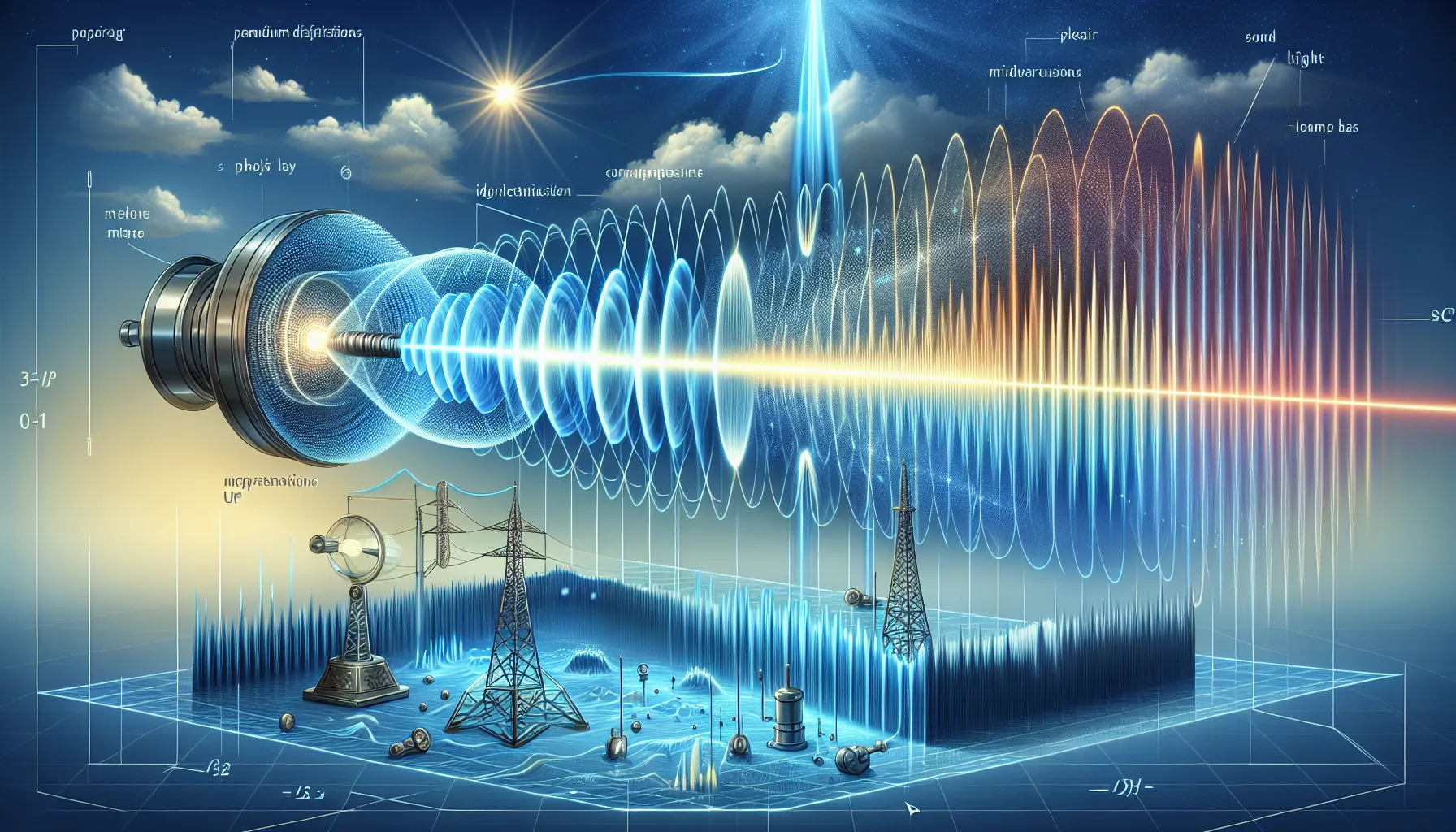
Have you ever marveled at the lightning flash that reaches your eyes before the accompanying rumble of thunder meets your ears? This observation hints at the curious distinction between two fundamental phenomena: sound and light. Yet, what governs this disparity, speed, medium, or something more intrinsic? Let’s investigate deeper to uncover the remarkable scientific truths behind the transmission of sound and light and understand their fascinating roles in how we perceive the universe.
Understanding the Nature of Sound
What Is Sound?
Sound is a mechanical wave generated by the vibration of objects, creating regions of compression and rarefaction in a medium, such as air, water, or solids. It is inherently dependent on the medium in which it travels, making it distinct from other phenomena.
How Sound Propagates in Various Mediums
Sound travels fastest in solids due to the tighter bonding of molecules, slower in liquids, and slowest in gases, where molecular spacing impedes rapid transmission.
Factors That Affect the Speed of Sound
The speed of sound is influenced by properties of the medium, including temperature, density, and elasticity. For instance, warmer air accelerates sound due to increased molecular activity.
Understanding the Nature of Light
What Is Light?
Light is an electromagnetic wave that can travel through a vacuum. It behaves both as a wave and a particle, an essential feature that influences its interaction across various mediums.
How Light Travels Through Different Mediums
Light slows down as it passes through denser mediums like water or glass due to interaction with the particles within the medium, albeit still much faster than sound.
The Speed of Light in a Vacuum
In a vacuum, light achieves its maximum speed of approximately 299,792 kilometers per second (186,282 miles per second), a universal constant aiding scientists in calculations and measurements.
Comparing the Speeds of Sound and Light
Relative Speeds in Everyday Scenarios
The noticeable lag in thunder following lightning is a common demonstration of the speed difference: sound travels approximately 343 meters per second through air at 20°C, far slower than light.
Implications for Human Perception and Science
The disparity in speeds between light and sound contributes to phenomena such as the ability to estimate the distance of a storm by counting seconds between sights of lightning and hearing of thunder.
Applications of Speed Disparities in Technology
How Understanding Speed Enhances Modern Applications
Comprehending speed differences leads to advancements in communication technology and adaptive systems for sound and light integration.
Examples in Communication and Exploration
From radar systems where light-based signals offer vast-speed advantages to audio technologies optimizing sound transmission, science and technology harness this disparity effectively.
To provide the best experiences, we use technologies like cookies to store and/or access device information. Consenting to these technologies will allow us to process data such as browsing behaviour or unique IDs on this site. Not consenting or withdrawing consent, may adversely affect certain features and functions.
Functional
Always active
The technical storage or access is strictly necessary for the legitimate purpose of enabling the use of a specific service explicitly requested by the subscriber or user, or for the sole purpose of carrying out the transmission of a communication over an electronic communications network.
Preferences
The technical storage or access is necessary for the legitimate purpose of storing preferences that are not requested by the subscriber or user.
Statistics
The technical storage or access that is used exclusively for statistical purposes.The technical storage or access that is used exclusively for anonymous statistical purposes. Without a subpoena, voluntary compliance on the part of your Internet Service Provider, or additional records from a third party, information stored or retrieved for this purpose alone cannot usually be used to identify you.
Marketing
The technical storage or access is required to create user profiles to send advertising, or to track the user on a website or across several websites for similar marketing purposes.