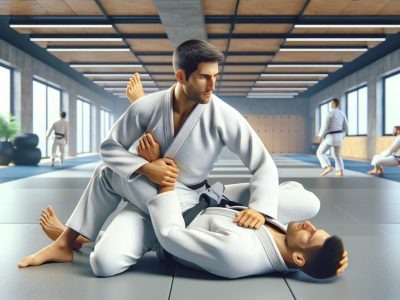
Diving into the world of martial arts, you’ve likely heard of Brazilian Jiu-Jitsu (BJJ) and Gracie Jiu-Jitsu, two grappling giants on the mat. They may seem identical at first glance, but they’re distinct in philosophy and approach. As you explore the nuances of these fighting styles, you’ll discover that the devil is in the details.
BJJ has evolved into a global phenomenon, with a competitive edge that’s hard to ignore. On the other hand, Gracie Jiu-Jitsu prides itself on real-world self-defense, maintaining a strong lineage from its founders. Understanding these differences isn’t just about trivia—it’s about choosing a path that aligns with your personal goals in martial arts.
Philosophy and Approach of BJJ
When you step onto the mats for Brazilian Jiu-Jitsu, you’re not just learning a martial art; you’re adopting a mindset that’s as strategic as it is physical. Known for its detail-oriented techniques, BJJ emphasizes leverage, timing, and efficiency over brute strength.
BJJ practitioners, or ‘BJJers’, are always looking for ways to gain the upper hand through superior technique. In contrast to its cousin Gracie Jiu-Jitsu, BJJ is a sporting martial art. It gears you up to face opponents in a competitive setting with rules, points, and weight classes. The thrill of competition is a key driving force behind BJJ’s philosophy.
Adaptability and Evolution in Training
Continual refinement of techniques
Regular sparring sessions
Emphasis on competitive readiness
BJJ training puts a spotlight on practicality in grappling scenarios. You’ll find yourself drilling countless techniques to handle different positions and situations. These are scenarios you might encounter during competitive matches. Regular sparring sessions, known as ‘rolling’, ingrains these techniques into muscle memory.
The adaptive nature of BJJ also means it perpetually evolves. New techniques and strategies emerge constantly, a testament to the innovative spirit at the heart of the discipline. If you enjoy a dynamic environment where you’re encouraged to think critically and stay ahead of the curve, BJJ’s approach is likely to resonate with you.
Another aspect of BJJ you’ll notice is the ranking system, signified by colored belts. This progression not only marks your growth in skill but also keeps you motivated through a tangible path of advancement. Each belt represents a milestone, and with it comes the understanding that you’ve become not just stronger but also wiser on the mats.
BJJ’s popularity has also led to a rich community both online and offline. You’ll have access to a wealth of resources, from instructional videos to forums, and often find fellow BJJers eager to share knowledge and experiences. The sense of camaraderie among practitioners is palpable, and it’s not uncommon to form lasting friendships through the shared challenges and triumphs of BJJ.
Philosophy and Approach of Gracie Jiu-Jitsu
When you delve into the philosophy and approach of Gracie Jiu-Jitsu (GJJ), you immediately notice its focus on self-defense. Gracie Jiu-Jitsu was developed with a strong emphasis on practicality, with techniques tailored to real-world situations where one might have to defend themselves against a larger or stronger assailant. It’s a style that prioritizes survival, safety, and efficiency.
Unlike Brazilian Jiu-Jitsu which often revolves around points and competition settings, GJJ places less importance on scoring and more on effective self-defense. It caters to those looking for a martial art that they can apply outside of a sporting context. At its core, it’s about ending an altercation quickly and decisively.
Helio Gracie, one of the founders of this style, adapted traditional techniques to ensure they were applicable regardless of one’s physical strength. This means that you’re learning a form of Jiu-Jitsu that values technique and leverage even more so, possibly, than BJJ does. The modifications made by Helio Gracie were meant to help the weaker individual prevail, relying on:
Precision
Timing
Leverage
Gracie Jiu-Jitsu also instills values such as patience, discipline, and respect, traits that permeate through the practice of many martial arts. When training in GJJ, you’re not just working on physical techniques; you’re also developing a mindset catered towards respectful and non-aggressive ways of handling confrontations.
Training methods in GJJ often include various drills that simulate real-life attack scenarios. These drills are designed to prepare you for unexpected situations, ingraining instinctual responses that emphasize defensive tactics over offensive ones. The primary goal is to control the opponent long enough to de-escalate the situation or neutralize the threat without causing undue harm. This approach has led to GJJ being widely adopted for self-defense classes worldwide, including women’s self-defense and law enforcement training.
Origins and Lineage of BJJ
Brazilian Jiu-Jitsu (BJJ) emerged from the grueling physical culture of early 20th-century Japan. Its doors opened to the rest of the world largely thanks to Mitsuyo Maeda, a prominent judoka or practitioner of judo. Maeda, also known as “Conde Koma,” was crucial in internationalizing this martial art by spreading his knowledge during his travels.
When Maeda settled in Brazil, he met Gastão Gracie, a local businessman who helped him get established. In gratitude, Maeda taught Gastão’s son Carlos Gracie the art of judo. Carlos, with his flair for innovation, adapted what he learned to create a new form of the martial art that focused on ground fighting and leverage, giving birth to what you know today as Brazilian Jiu-Jitsu.
The Gracie family, with Carlos and his brothers, particularly Hélio Gracie, refined the art. Despite Hélio’s smaller stature, he demonstrated how BJJ could enable a smaller, weaker person to defend against a larger assailant by using technique and timing over brute strength. The family’s dedication transformed BJJ into a martial arts phenomenon.
The Gracies’ approach to Jiu-Jitsu spread rapidly. They established academies and began to train a new generation of fighters. The lineage of BJJ can be traced through the Gracie family and their students, who have taken this martial art around the globe.
BJJ’s lineage is often depicted in family trees that show the connections between instructors and their students. This helps maintain the integrity of the art and tracks the evolution of teaching methods and techniques. It’s fascinating to see how the art has branished out through different lines, yet all connect back to its Japanese roots and the foundational teachings of the Gracie family.
Understanding this lineage isn’t just about tracing a family tree, though. It emphasizes the strict mentor-student relationships inherent in martial arts, symbolizing the transfer of knowledge and respect across generations. It’s also about acknowledging the culture of continuous learning and adaptation that’s kept BJJ relevant and effective up to this day. The narrative of BJJ and Gracie Jiu-Jitsu is a complex tapestry woven with resilience, adaptability, and an undying spirit of innovation.
Origins and Lineage of Gracie Jiu-Jitsu
When you peel back the layers of martial arts history, you’ll find that Gracie Jiu-Jitsu, also known as “Gracie JJ,” stems from a rich lineage that begins with the Gracie family. Hélio Gracie, a pivotal figure in the family, is often credited with the development and modification of traditional techniques that now characterize Gracie Jiu-Jitsu.
The transformation began when Carlos Gracie, initially instructed by judo master Mitsuyo Maeda, passed his knowledge onto his brother Hélio. Due to Hélio’s smaller stature, he refined techniques to rely less on strength and more on precision and leverage. This allowed him to effectively combat larger and stronger opponents.
Innovation: Hélio’s insight was the catalyst for a seismic shift in martial arts.
Leverage and Technique: He emphasized these principles to neutralize adversaries.
As Gracie Jiu-Jitsu evolved, a formal structure was established for teaching. The Gracies not only promoted their art form by defeating foes in open challenges but also by establishing academies where this knowledge was methodically imparted to students.
Key Points in Gracie Academy Development:
Systematic Teaching: The curriculum became organized to facilitate learning.
Instructor-Student Relationship: Personalization of training reinforced the passing of knowledge.
Global Recognition began to swell as members of the Gracie family showcased their prowess in various competitions. These demonstrations were proof that Gracie Jiu-Jitsu was a formidable style, especially in the sphere of mixed martial arts (MMA).
Lineage Tracking is held in high regard within Gracie Jiu-Jitsu. It symbolizes not just a family tree but an unbroken chain of mentorship and respect from Hélio and Carlos to the fighters and instructors of today.
The tenets of Gracie Jiu-Jitsu have stood the test of time, proving that with adherence to technique, even the underdog has a fighting chance. Students across the globe continue to learn and adapt these practices, ensuring that the principles established by the Gracie family endure.
Differences in Training and Techniques
When you’re trying to grasp the nuances between Brazilian Jiu-Jitsu (BJJ) and Gracie Jiu-Jitsu (GJJ), it’s vital to recognize their distinct approaches to training and techniques. Despite sharing a common foundation, each style has developed unique traits that match its underlying philosophy.
In BJJ, you’ll find an emphasis on competition. Training sessions are rigorous, often structured around preparing students for tournaments. This means you’ll engage in lots of sparring (rolling), where point-scoring for positions and submissions is a focus. It’s a fast-paced environment, where reactions and adaptation are honed to perfection.
On the other hand, Gracie Jiu-Jitsu is built around self-defense. The techniques you learn are meant for real-world situations where there’s no referee to supervise. Here, the priority isn’t about amassing points but ensuring you can protect yourself in various scenarios, even against larger opponents. This influences training to be less about competition and more about technical application and mastery.
BJJ emphasizes:
GJJ focuses on:
The progression system in Gracie Jiu-Jitsu also deserves attention. It’s not just about belt colors; it’s about comprehensive understanding. You’re expected to know your techniques inside and out, demonstrating not just physical ability but also a deep knowledge of when and how to use each maneuver. In BJJ, while knowledge is certainly important, there is a stronger emphasis on performance in a sporting context.
Instructors in GJJ often use a more methodical teaching approach, breaking down the fine details of movements. They foster a patient learning atmosphere conducive to absorbing the principles Hélio Gracie emphasized. BJJ instructors may adopt varied styles but typically include more dynamic rolling sessions given the sportive nature of the discipline.
Understanding these differences is key to aligning with the version of Jiu-Jitsu that resonates with your personal goals. Whether you’re looking to step into a cage or simply want the confidence to defend yourself, knowing the distinction can guide you to the more suitable path.
Conclusion
Unraveling the intricacies between Brazilian Jiu-Jitsu and Gracie Jiu-Jitsu has shown you that both styles offer unique benefits tailored to different goals. Whether you’re drawn to the competitive edge and athletic rigor of BJJ or the self-defense principles and technical mastery of GJJ, your journey in martial arts will be rich and rewarding. Remember that the choice isn’t just about the techniques but also about the philosophy and lineage that resonate with you. As you step onto the mat, embrace the style that best aligns with your personal aspirations and the legacy you wish to continue.
To provide the best experiences, we use technologies like cookies to store and/or access device information. Consenting to these technologies will allow us to process data such as browsing behaviour or unique IDs on this site. Not consenting or withdrawing consent, may adversely affect certain features and functions.
Functional
Always active
The technical storage or access is strictly necessary for the legitimate purpose of enabling the use of a specific service explicitly requested by the subscriber or user, or for the sole purpose of carrying out the transmission of a communication over an electronic communications network.
Preferences
The technical storage or access is necessary for the legitimate purpose of storing preferences that are not requested by the subscriber or user.
Statistics
The technical storage or access that is used exclusively for statistical purposes.The technical storage or access that is used exclusively for anonymous statistical purposes. Without a subpoena, voluntary compliance on the part of your Internet Service Provider, or additional records from a third party, information stored or retrieved for this purpose alone cannot usually be used to identify you.
Marketing
The technical storage or access is required to create user profiles to send advertising, or to track the user on a website or across several websites for similar marketing purposes.