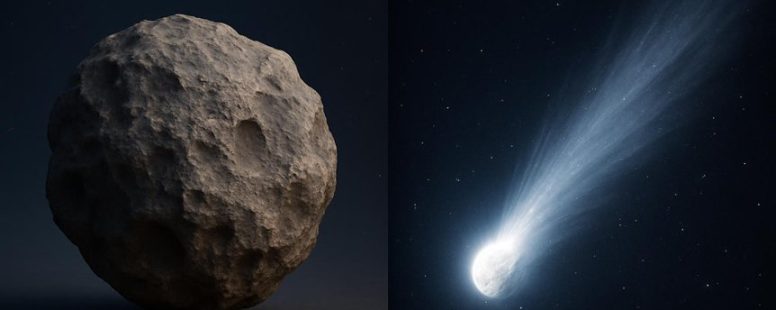
The line between asteroids and comets is finer than you might think, yet unlocking their secrets could reveal the true story of our solar system. These celestial wanderers are more than just rocky or icy bodies floating in space—they’re cosmic storytellers whispering clues about the universe’s past.
Imagine holding a tiny piece of history in your hand, each one offering a glimpse into the chaos and beauty of creation. Surprisingly, studying these space rocks not only helps us understand potential threats but also uncovers hidden treasures—like rare minerals—waiting to be discovered.
Let’s dive into what makes these celestial objects so fascinating and why they matter more than we realize.
What Are Asteroids and Comets? Key Definitions
Asteroids and comets are objects that orbit the Sun. They are both made of rocks, ice, and other materials, but they have different features.
An asteroid is mainly made of metal and rock. Most asteroids are found in the asteroid belt, which is a region between Mars and Jupiter. These objects are like space rocks that have been around since the early days of our solar system. Some asteroids are big, like the asteroid Ceres, which is about 600 miles across, while others are small. People study asteroids because they can tell us how planets and the solar system formed.
A comet is different. Comets are icy bodies that develop glowing tails when they get close to the Sun. This tail happens because the heat from the Sun melts the ice on the comet, creating a bright stream of gas and dust. Comets are often called “dirty snowballs” because they are made of ice mixed with rock and dust. Comets come from far out in space, from regions called the Kuiper Belt and Oort Cloud. When they travel toward the Sun, they can become spectacular sights in the sky.
People have long seen asteroids and comets as signs or omens in history. In some cultures, comets were believed to be warnings or messages from the gods. Today, scientists see these objects as clues to Earth’s history and the origins of our solar system. By studying them, we learn about the past and maybe even how to protect Earth from potential asteroid impacts.
Some people think comets are more interesting because of their bright tails and history in stories. Others believe asteroids are more important because they are more common and could threaten Earth. Both objects remind us how much we still need to learn about space.
Asteroid vs Comet: How Do They Differ in Composition?
Asteroids and comets are both objects that orbit the Sun, but their compositions are very different.
Asteroids are mainly made of rock and metal. This makes them dense and solid, like space rocks. They are often found in the asteroid belt between Mars and Jupiter. Because they are mostly rocky, they stay the same shape as they travel through space.
Comets are made of ice, dust, and organic materials. When they get close to the Sun, the heat causes the ice to turn into gas and create a bright tail behind them. This tail is what makes comets so pretty to see. Unlike asteroids, comets can change shape and develop glowing comas or tails because of the sublimation process, where ice turns directly into gas.
These differences in composition tell us where they came from. Comets are considered more primitive because they contain more volatile materials like ice, which can evaporate. Asteroids are more solid and have fewer of these materials.
Some people think of asteroids as space rocks that stay mostly the same, while comets are like cosmic snowballs that leave a trail of dust and gas when they warm up. Both play important roles in our solar system, but their different makeups mean they behave and look very differently.
Understanding these differences helps scientists learn about the history and development of our solar system.
Where Do Asteroids and Comets Come From? Their Origins Explained
Asteroids and comets come from different parts of our solar system. Knowing where they come from helps us understand what they are made of and how they move.
Most asteroids come from the asteroid belt. This is a zone of space between Mars and Jupiter filled with rocky pieces. They stayed in this spot because of the way gravity works. Think of it like a parking lot where the rocks are parked in specific spaces. Sometimes, these rocks get knocked out of the belt by other space objects and drift toward Earth. Asteroids are made mostly of rock and metal, which makes them very different from comets.
Comets come from far away in space. They originate in the Kuiper Belt and the Oort Cloud. These areas are filled with icy bodies and leftover debris from when our solar system was young. Imagine a huge, icy snowball floating far from the Sun. When comets get close to the Sun, the heat makes their ice turn into gas, creating a glowing tail. This makes comets look bright and spectacular in the night sky.
Some scientists say that studying these different origins helps us learn about how the solar system formed. Others warn that it can be hard to tell where a space rock really came from once it enters our solar system. Because of gravity and other forces, some objects may move from one place to another over time.
In short, asteroids mostly come from the asteroid belt between Mars and Jupiter, and comets come from the icy Kuiper Belt and Oort Cloud far beyond Neptune. By studying where they originate, scientists can learn about the history of our solar system and how space debris moves through it.
How Do Their Orbits Differ? Orbital Patterns of Asteroids and Comets
Asteroids and comets have different paths through space. The main difference is in their orbits. Asteroids usually stay close to the Sun and follow more circular or slightly oval-shaped paths. Their orbits are relatively flat and stay in the asteroid belt between Mars and Jupiter. Comets, on the other hand, often travel on very elongated or stretched out orbits. Sometimes, they come from far away in the solar system, like the Oort Cloud, and have highly tilted paths. This makes their orbits look more like long, sweeping arcs.
Some people think comets are like cosmic snowballs with ice and dust, while asteroids are more like rocky or metal-rich space rocks. These different paths help scientists learn where they came from. For example, asteroids probably formed closer to the Sun, while comets come from colder, outer areas.
There are two main viewpoints about comets’ orbits. Some believe their long, stretched out paths show they are from very distant parts of space. Others think they might have been knocked into these orbits by other planets or objects. Both views help us understand how the solar system works, but they also have limits. Sometimes, comets change their paths after passing close to planets, making predicting their future orbits hard.
In short, asteroids tend to stay close to the Sun with rounder orbits, while comets swing in from far away on long, tilted paths. These differences help scientists figure out where they come from and how they move through space.
Orbital Shape Differences
Asteroids and comets have different types of orbits, which help scientists tell them apart. An orbit is the path an object takes around the Sun. The main difference is in the shape of their orbits.
Asteroids usually follow more circular or slightly elliptical orbits inside the asteroid belt, which is a region between Mars and Jupiter. Because their orbits are more round, they stay in a predictable path. This makes it easier for astronomers to track them over time. For example, the asteroid Ceres stays close to the same area in space and moves in a fairly consistent way.
Comets, on the other hand, often have long, stretched-out orbits called highly elliptical orbits. These orbits take them very close to the Sun and then far out into space. Sometimes, their paths cross the orbits of planets like Earth. When a comet gets close to the Sun, the heat makes the ice and dust on it turn into a glowing tail that we can see from Earth. An example is Halley’s Comet, which comes back every 76 years.
These different orbit shapes also tell scientists about where the objects come from. Asteroids are mostly from the asteroid belt, while comets come from areas farther out in space, like the Kuiper Belt or Oort Cloud. But there is some overlap, and comets can sometimes be mistaken for asteroids.
Understanding the shapes of orbits is important because it helps scientists figure out which objects might pose a danger to Earth. Since comets can cross Earth’s path, studying their orbits helps in predicting impacts. However, tracking these orbits can be tricky because they change over time due to gravitational forces from planets and other objects. So, scientists use special tools and computer models to keep an eye on them.
Orbital Distance Variations
Asteroids and comets orbit the Sun in different ways. The main difference is how far they go from the Sun. Asteroids usually stay within the asteroid belt, which is between Mars and Jupiter. Their orbits are more circular and predictable, making it easier for scientists to track them and protect our planet.
Comets, on the other hand, have very elongated orbits. They often come from far beyond Neptune, the last planet in our solar system. These orbits can take hundreds or even thousands of years to complete. Sometimes, comets pass very close to Earth, which can be exciting but also risky. Because of their strange paths, it’s harder to predict where they will go next.
Knowing how these objects move helps us plan how to spot and avoid potential collisions. Some scientists say that tracking comets is more challenging because their orbits change over time, while others believe asteroid tracking is more reliable since their paths stay more stable. Both types of space rocks remind us that space is full of surprises and we need to stay alert.
What Features Help Identify an Asteroid Versus a Comet?
Asteroids and comets can be told apart by looking at their features. The main difference is what they are made of and how they look in space.
Asteroids are mostly made of rock and metal. Because of this, they are usually dense and have irregular shapes. They often appear dark because they absorb sunlight. You won’t see a tail on an asteroid. These space rocks are like messy, rocky lumps floating through space. For example, the asteroid belt between Mars and Jupiter is full of these rocky objects.
Comets are different. They contain ice, dust, and frozen gases. When a comet gets close to the Sun, the heat makes the ice vaporize. This creates a glowing cloud called a coma around the comet and long tails that stretch behind it. These tails are bright and easy to see with telescopes or even binoculars. The tails look like glowing streams flowing behind the comet when it moves through space. A famous example is Halley’s Comet, which appears in our sky about every 76 years.
Some astronomers use these features to identify space objects. If it has a tail or a glowing coma, it is likely a comet. If it looks like a dark, rocky body without a tail, it is probably an asteroid. Recognizing these differences helps scientists understand how dangerous they are. Asteroids can crash into Earth and cause damage, while comets are more like visitors passing by.
However, sometimes it’s hard to tell the difference. Some asteroids can look dark and rocky, while some comets may not show a tail if they are far from the Sun. So, astronomers use special equipment and observations to be sure. Knowing what makes an asteroid different from a comet can help us stay safe and prepare for potential impacts.
Why Do Comets Develop Tails and Comas? The Science Behind the Phenomenon
A comet develops a tail and a coma because of how its materials react to the Sun’s heat. The coma is a cloud of gas and dust that forms around the comet’s core when the Sun warms it up. The tail is made of particles that stream behind the comet as it moves through space.
When a comet gets close to the Sun, the heat causes the icy and dusty materials on its surface to turn into gas and vapor. This process is called sublimation. The gas and dust then spread out, creating the glowing coma around the comet’s core. The solar wind and sunlight push some of this material into a long tail that points away from the Sun.
Some scientists say that the tail helps us tell apart different types of comets. For example, short-period comets, which come from the Kuiper Belt, usually have shorter tails. Long-period comets from the Oort Cloud can have much longer tails. But there are also limits to how long a tail can grow. If a comet is too far from the Sun, it might not develop a visible tail at all.
In simple terms, the tail and coma are like the comet’s way of lighting up and showing us it is active. Without the Sun’s heat, a comet would stay cold and still. This is why comets can look different depending on how close they are to the Sun.
Composition of Cometary Material
A comet is made mostly of ice and dust. When it gets close to the Sun, the heat makes the icy part melt and turn into gas. This process releases gas and tiny dust particles that form the bright coma and long tail we see. The main parts of comet material are:
Icy Components: These are frozen substances like water, methane, and other gases that vaporize easily when heated. For example, water ice is common in comets, and when it warms up, it turns into vapor that creates the comet’s tail.
Dust Particles: Tiny bits of minerals and organic materials are released as the ice melts. These dust particles reflect sunlight and help make the comet visible from Earth.
Organic Molecules: Comets contain complex chemicals called organic compounds. These are important because they can be the building blocks of life. Some scientists think comets may have brought these molecules to Earth billions of years ago.
Asteroid Minerals: Unlike comets, asteroids are mostly made of rocky materials and have less ice. Some people confuse comets with asteroids, but comets are richer in frozen gases and dust.
Some experts say comets are like dirty snowballs, made mostly of ice with some dirt mixed in. Others see them as cosmic time capsules, holding clues about how the solar system formed. Both views are true, but it’s clear comets are unique objects with a special mix of ice, dust, and organic molecules. This mixture makes them fascinating to study and helps us learn about our cosmic neighborhood.
Sun’s Influence on Tails
A comet’s tail is mainly caused by the Sun’s influence. When a comet gets close to the Sun, the heat makes its icy and dusty parts heat up quickly. This causes gases and dust to escape from the comet’s core, forming a bright cloud called a coma around it. The Sun’s solar wind, which is a stream of charged particles, then pushes these gases away from the comet. This creates a tail that always points away from the Sun, no matter which way the comet is moving.
The solar wind doesn’t just push the gases; it also interacts with magnetic fields, which shape the tail and make it look different from time to time. Sometimes the tail gets brighter or changes shape because of space weather, like bursts of stronger solar wind. This is why comet tails seem to dance or flicker as they travel through space.
Some people wonder why we can see these tails from Earth. It’s because sunlight reflects off the dust and gases, making the tail glow. The Sun’s powerful influence is what makes the tails so visible and dynamic. Without the Sun’s heat and solar wind, comets wouldn’t have these bright tails at all.
How Are Asteroids and Comets Studied by Scientists? Tracking and Observation
Scientists study asteroids and comets by using different tools and methods to learn about their paths, what they are made of, and how they move. This helps us know if any of these space rocks might hit Earth someday.
One way they do this is with ground-based telescopes. These large telescopes watch the sky at night to see how bright an asteroid or comet is and how it moves. For example, astronomers in Arizona often track objects this way.
Scientists also use space telescopes, like the Hubble Space Telescope, to take clear pictures and get detailed information about these objects. These images can show surface features and help scientists figure out what the objects are made of.
Radar observations are another tool. Scientists send radio waves from Earth to bounce off asteroids. This helps them learn the size, shape, and surface details. For example, radar has helped determine the shape of asteroid Bennu, which NASA plans to visit soon.
Numerical simulations are computer models that predict where an asteroid or comet will go in the future. They help scientists see if an object might come close to Earth or even hit it. These predictions can change as new data comes in, so scientists have to keep updating their models.
Some scientists believe observing with telescopes is enough, but others say we need more precise measurements like radar to really understand the threat level. Both methods have limits — telescopes can be blocked by clouds or the object might be too faint, and radar works only when objects are close enough.
In short, by combining telescopes, radar, and computer models, scientists can better track and study space rocks. This work is crucial to protect Earth from potential impacts. Would you want to know if a big asteroid was heading toward your town? These tools help scientists find out early enough to take action.
Why Is Understanding Asteroids and Comets Important for Earth?
Understanding asteroids and comets is important because these space rocks can hit Earth and cause big problems. Some people think they are super dangerous, but many myths are not true. Scientists work to bust these myths so we know what is real. For example, the Tunguska event in 1908 and the Chicxulub impact 66 million years ago show that Earth has been hit by large objects before. These hits caused huge destruction and even helped wipe out dinosaurs.
Knowing the difference between asteroids and comets helps us figure out how risky they are. Asteroids are made of rock and metal and mostly stay near Earth’s orbit. Comets are made of ice and dust and come from far away in space. By understanding these differences, scientists can decide which objects might hit Earth and need to be watched carefully.
Learning about asteroids and comets also helps us prepare for potential impacts. This can include tracking dangerous objects and planning ways to protect our planet. However, some people worry too much about these space rocks without knowing the facts. While the risk is real, huge impacts are rare, and scientists are working on ways to stop them if they come too close.
Studying these space bodies is not just about safety. It also helps us learn more about the universe and our place in it. For example, studying comets can teach us how the solar system formed. In the end, understanding asteroids and comets helps us keep Earth safe and satisfy our curiosity about space.
What Future Missions Are Exploring Asteroids and Comets?
Future missions are designed to learn more about asteroids and comets, which are ancient space objects. These missions will help us understand where they come from and why they are important. Some missions also look at how different cultures saw these objects long ago.
OSIRIS-REx is a mission that will bring back samples from asteroid Bennu. Scientists want to study these pieces to learn what the asteroid is made of and where it came from. This can tell us about the early solar system.
Comet Interceptor plans to study a fresh comet that is just entering the inner part of the solar system for the first time. Since this comet has not been changed much by the Sun, it will give us a pure look at what comets are really like.
Hera Mission is part of the European Space Agency’s project called AIDA. It will study an asteroid called Didymos and test ways to change its path if needed. This research could help protect Earth from future asteroid impacts.
Lucy will explore Trojan asteroids that share an orbit with Jupiter. These objects are thought to be leftovers from the early solar system. Learning about them can help us understand how planets and small objects formed long ago.
These missions are exciting because they will help us learn about the past and maybe even find ways to stay safe from space hazards. Some people think these missions will also teach us about the cultural meaning of asteroids and comets, since ancient civilizations often saw these objects as signs or omens. Overall, they are helping us learn more about these ancient space visitors.
To provide the best experiences, we use technologies like cookies to store and/or access device information. Consenting to these technologies will allow us to process data such as browsing behaviour or unique IDs on this site. Not consenting or withdrawing consent, may adversely affect certain features and functions.
Functional
Always active
The technical storage or access is strictly necessary for the legitimate purpose of enabling the use of a specific service explicitly requested by the subscriber or user, or for the sole purpose of carrying out the transmission of a communication over an electronic communications network.
Preferences
The technical storage or access is necessary for the legitimate purpose of storing preferences that are not requested by the subscriber or user.
Statistics
The technical storage or access that is used exclusively for statistical purposes.The technical storage or access that is used exclusively for anonymous statistical purposes. Without a subpoena, voluntary compliance on the part of your Internet Service Provider, or additional records from a third party, information stored or retrieved for this purpose alone cannot usually be used to identify you.
Marketing
The technical storage or access is required to create user profiles to send advertising, or to track the user on a website or across several websites for similar marketing purposes.