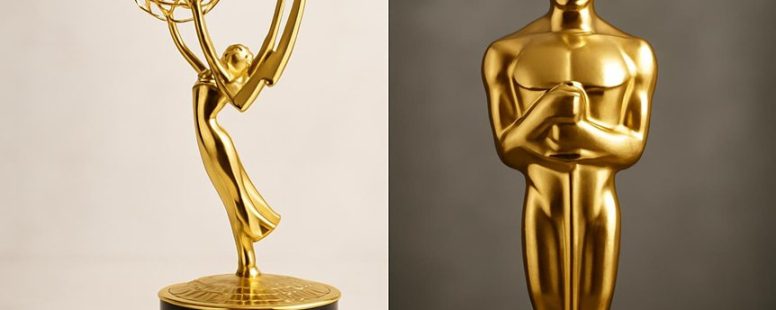
Imagine tuning into an awards show where over 100 categories celebrate every nuance of television storytelling, from gripping dramas to laugh-out-loud comedies.
Now picture a different scene—fewer awards, but each one a shining beacon of cinematic mastery.
The Emmys and Oscars may seem like distant cousins in the world of entertainment, yet their differences run deeper than trophies. They reflect how TV and film carve out their own unique spaces in our culture and careers.
Surprisingly, knowing these distinctions can give you a new appreciation for how stories shape us—like a secret recipe unfolding behind the curtain.
Content Types Emmys and Oscars Recognize
The Emmys and the Oscars are awards that celebrate different kinds of entertainment. The Emmys focus on television shows like series, mini-series, and TV movies. They look at how these shows tell stories over time and how well they keep viewers interested. The Oscars, meanwhile, honor movies, especially feature films. They judge films based on their artistic style and technical skills in a single movie.
Think of it like this: The Emmys are like a marathon, rewarding shows that can keep audiences hooked week after week. The Oscars are more like a sprint, giving prizes to movies that stand out as complete works. Both awards matter, but they focus on different parts of entertainment. The Emmys really highlight how TV shows grow and change, while the Oscars celebrate the power of a single film. Understanding this difference helps explain why each award is important.
Award Categories Unique to Emmys vs. Oscars
The Emmy Awards and the Oscars have different award categories because they focus on different types of entertainment. The Emmys only honor television shows, like popular dramas or comedy series. For example, they give awards for Outstanding Drama Series and Outstanding Comedy Series. The Oscars, on the other hand, only recognize achievements in movies. They give awards such as Best Picture, Best Actor, and Best Director.
Some categories are unique to each award show. For example, the Emmys have awards for Outstanding Reality Program or Outstanding Children’s Program. The Oscars don’t have these because they don’t focus on TV shows. Meanwhile, the Oscars have categories like Best Visual Effects and Best Sound Editing that are specific to movies.
It might seem simple, but these differences show how each award show celebrates different kinds of storytelling. If you like TV, the Emmys are the big event to watch. If movies are more your thing, then the Oscars are where the biggest prizes are handed out. Knowing these differences helps you understand why each show is special in its own way.
Television-Specific Award Categories
The Emmy Awards focus on TV shows, not movies. They give awards for specific categories that show what makes TV special. For example, they award Outstanding Drama Series, Outstanding Comedy Series, and Outstanding Reality-Competition Program. These categories highlight how TV keeps telling stories over many episodes and how viewers stay interested over time.
Unlike the Oscars, which mainly give awards for movies, the Emmys recognize different TV formats like limited series, variety shows, and daytime programs. This shows TV has many types of entertainment, from talk shows to game shows.
Some people might wonder why the Emmys have so many categories. The answer is that TV is very different from movies. TV shows often develop characters and stories that go on for multiple episodes or seasons. So, the Emmys reward creators who make shows that keep viewers coming back.
However, there are limits. Since TV is so diverse, some categories can be confusing or too broad. Also, the Emmys sometimes favor popular shows over truly innovative ones. Still, understanding these categories can help you see how the Emmys celebrate TV’s unique style.
In short, the Emmys focus on what makes television different from movies, highlighting the ongoing stories and variety of formats that TV offers.
Film-Exclusive Recognition Areas
The Oscars are different from awards like the Emmys because they focus on movies only. They give special awards for parts of film-making that TV shows don’t usually recognize. For example, they have categories like Best Cinematography, which is about how the movie looks visually. They also award Best Film Editing and Best Production Design, which are about how the movie is put together and how it feels to viewers.
These awards are not just about actors or directors. They highlight the skills of the people who create the look and feel of a movie. For instance, a great cinematographer can make a scene look like a painting. A good editor can make the story flow smoothly and keep you interested. A production designer makes the setting feel real, whether it’s a palace or a spaceship.
Some people might wonder why these awards matter. They show how much work goes into making a movie special. They also remind us that movies are a team effort, not just about the big stars. However, some critics say these categories can be subjective and hard to judge. What looks stunning to one person might not impress another.
In the end, the Oscars celebrate the parts of movies that TV awards usually skip. They help us see the craftsmanship behind the scenes, making movies a unique art form. Knowing about these awards can help you understand what makes a film truly great beyond just the acting or story.
Genre Variations In Awards
Genres are a way to describe different types of stories in movies and TV shows. Because television and film tell stories differently, their award categories focus on unique genres suited for each medium. The Emmy Awards mainly honor TV shows, and they include categories for genres like limited series and reality TV. These reflect how TV stories can be diverse and change with what audiences like. The Oscars, on the other hand, focus more on traditional film genres such as drama, comedy, and documentary. They follow long-standing standards in the movie industry.
This difference matters because it changes what each award celebrates. The Emmys highlight creative achievements in TV episodes and series. The Oscars emphasize the art of making movies, like acting, directing, and cinematography. For example, a TV show that changes how people see culture might win an Emmy, while a movie with stunning visuals or a powerful story might win an Oscar.
Some people think the Emmys show what’s trendy or current in society, while the Oscars focus on timeless stories that last forever. Knowing these differences helps us understand why each award is important in its own way. Recognizing genre variations also shows how both awards honor storytelling and culture, even if they do it differently.
But remember, some critics say the Emmys sometimes focus too much on popular TV and miss smaller, more meaningful shows. The Oscars can sometimes overlook new or experimental movies. Both awards have their strengths and limits, but they both celebrate the art of storytelling in their own style.
Voting Bodies and Processes for Emmys and Oscars
The main difference between Emmy and Oscar voting is who votes. Emmy voters are mostly TV experts who work in television. Oscar voters are mainly film industry professionals. Knowing this helps explain why the Emmy and Oscar winners can be so different.
Emmy voters care about TV shows. They include actors, writers, and producers who work in television. They vote on categories like best drama or comedy series. The process involves these TV experts watching many shows and choosing the best ones based on quality and popularity.
Oscar voters focus on movies. They are directors, actors, and other film professionals. They vote on categories like best picture or best actor. They usually watch movies in theaters or on screeners and decide which films are the best based on acting, storytelling, and technical skill.
Some people might wonder if this means one is better than the other. Well, it depends. The Emmy voting group might favor popular TV shows they love, while Oscars might pick movies with big stars or awards buzz. Both groups have their own way of choosing winners, which is why the results often differ.
However, there are limits. Sometimes, voters might not see all the options or might be influenced by outside factors like marketing. So, neither process is perfect. Still, understanding who votes helps us see why Emmy and Oscar winners can be so different.
Emmy Voting Members
The Emmys are awards that recognize the best in television. Unlike the Oscars, which focus on movies, the Emmys honor TV shows, actors, writers, and directors. Their voting process is different because the people who decide are also part of the TV industry.
Emmy voting members are mainly TV professionals like actors, writers, directors, and producers. Each group votes in their own category. For example, actors vote for acting awards, writers vote for writing awards, and so on. This means the people who vote are experts in their own fields.
To become an Emmy voting member, a person needs to be sponsored by someone already in the group and then approved. New members also have to renew their membership every year to stay active. This process keeps the voting body current and full of people who work in TV.
Some might think awards like the Emmys are just popularity contests, but this system is different. It is more like a group of peers giving awards to the best work in their field. This can make the Emmys more trustworthy because the votes come from real TV professionals, not just fans or celebrities.
But some critics say that even with this system, bias or politics can influence voting. Also, not everyone agrees on what is the “best” TV show or actor. Still, knowing that the Emmys rely on industry insiders helps you understand why they are respected in the TV world.
Oscar Voting Membership
The Academy of Motion Picture Arts and Sciences started with a focus on exclusivity, meaning only a few could join. But over time, it has worked to be more inclusive. They now try to include more diverse members to better reflect the film industry today. Voting rules have become clearer, but some secrecy stays to keep the process fair.
Knowing who can vote helps explain why different kinds of film work influence the awards. For example, actors may vote differently than technical crew members. Overall, Oscar membership is a carefully chosen group that aims to honor the best movies and performances, while also trying to be fair and open to change.
Voting Procedures Differences
Voting procedures are how the Emmys and Oscars pick their winners. They are different in ways that really matter. The Emmys use groups of peers within the Television Academy to vote, while the Oscars use branches of the Academy of Motion Picture Arts and Sciences. These differences change how transparent the process is and what rules they follow.
Here is what makes them different:
The Emmys have two steps: first, they choose nominees, then they vote for the winners.
The Oscars use a system called preferential voting for Best Picture. For other categories, they use a simple majority vote.
Emmy voters vote only within their own peer groups. This means they are experts in their category.
Oscars allow all members to vote for Best Picture. But for categories like acting or directing, only those branch members vote.
Knowing these facts helps explain why the Emmy and Oscar voting feel so different. Still, both want to find the best performers and shows. The main goal is to honor excellence, but the way they do it varies a lot.
Counter-strategy notes:
The claim that Emmy voters are experts because they vote in their peer groups is true but might be seen as a limitation, as it could lead to favoritism.
The Oscars’ preferential voting can sometimes confuse people, especially if they don’t know about the process.
The explanation is straightforward but might oversimplify the complexity of the voting systems.
Skepticism:
Do these voting methods really pick the best winners? Or just the most familiar ones? That’s a question worth asking.
Are these processes transparent enough? Or do they hide behind rules that most voters don’t understand?
Will voters stick to these rules, or do they sometimes cheat or influence the results?
For a distracted scroller:
Think about the movie or show you love. Would the Emmys or Oscars pick it? How? That’s what these voting rules are about.
Remember, they both want to honor great work, but they do it differently. That’s what makes awards interesting, and sometimes confusing.
In the end, understanding these differences helps you see why the Emmys and Oscars are not just about who wins, but how they choose the winners.
Eligibility Periods for Emmys and Oscars
The main fact is that the eligibility periods for Emmys and Oscars are different. This is important if you want to know which shows or movies can win awards.
For the Emmys, shows are eligible if they air between June 1 of one year and May 31 of the next. This matches the typical TV season. For example, a show that airs in early June might compete for an Emmy almost a year later.
For the Oscars, movies are eligible if they are released in theaters during the calendar year from January 1 to December 31. So, a film released in December can compete for the Oscar right away.
Understanding these rules helps you see which projects are in the running. If you watch a show in July, it might not be up for the Emmy until next year. And if a movie comes out in November, it has a shot at the Oscars that same year.
Knowing the difference can also help you make predictions or follow awards season better. Just remember, Emmy timelines are about TV shows and span almost a year, while Oscars focus on movies released within a single year.
Broadcast and Ceremony Traditions of Emmys and Oscars
The Oscars and Emmys are both big awards shows that celebrate entertainment, but they do it in different ways. The Oscars focus on movies and have a very formal, glamorous style. They often have grand music, fancy red carpets, and a serious tone. The ceremony feels like a big, elegant event that shows film’s timeless charm.
The Emmys celebrate TV shows and are more relaxed. They include casual seating, fun interactions with the audience, and quicker segments to keep viewers interested. The Emmys feel more like a friendly party, fitting for the diverse stories shown on television.
Here are some ways their ceremonies have changed over time:
The Oscars still use classical orchestras and big red carpets. They emphasize star power and spectacle.
The Emmys have more casual seating and interactive moments, making it feel less formal.
The Oscars’ broadcasts last longer because they want to highlight the glamour and tradition.
The Emmys focus on pacing and quick segments so TV viewers stay engaged throughout the show.
Knowing these traditions helps explain why the Oscars and Emmys look and feel so different on screen. Both have adapted to what fits their industry best, but their differences are clear. Do you think the formal style of the Oscars makes it more special? Or does the relaxed vibe of the Emmys make it more fun to watch?
Why TV and Film Industries Value Emmys and Oscars Differently
The Emmys and Oscars are different awards that show what each industry values most. The Emmys are for TV shows, and they focus on ongoing creativity. They celebrate how TV stories change and grow each year. For example, a show like “The Crown” might win an Emmy for its fresh ideas and new seasons. The Emmys highlight how TV keeps changing and getting better.
The Oscars are for movies, and they focus on making a lasting impression. They honor films that stand the test of time, like “Gone with the Wind” or “Titanic.” The goal is to create movies that people remember for decades. The Oscars also value tradition and artistic achievement. For example, a film like “Schindler’s List” is celebrated for its powerful story and lasting impact.
Industry influence is different too. TV shows often aim to stay relevant and bring new voices into the spotlight. This keeps audiences interested and connected. On the other hand, movies often celebrate tradition and milestone moments, like winning an Oscar for a classic film or a filmmaker’s lifetime achievement.
Both awards shape how creators and viewers see their work. The Emmys reward innovation and new ideas in TV. The Oscars honor movies that have made a big, lasting mark on culture. Knowing this helps explain why each industry cares so much about its own awards. They are not just about winning but about what each industry values most: TV’s creativity and change versus film’s timelessness and tradition.
Career and Project Impact of Emmy and Oscar Wins
Winning an Emmy or Oscar can really change a person’s career and the projects they work on. These awards are not just shiny trophies; they can make a big difference in how a creator’s future looks.
First, winning these awards often leads to more money for new projects. When people see you’ve been recognized with an Emmy or Oscar, producers and investors are more willing to put their money into your ideas. For example, a director who wins an Oscar for a film like “The Silence of the Lambs” might find it easier to get funding for their next movie.
Second, it becomes easier to find talented people to work with. When your name is linked to a major award, top actors, writers, and crew members want to join your project. This reputation boosts your chances of putting together a great team.
Third, winning these awards opens up chances to meet important people in the industry. It’s like getting a VIP pass to events where you can connect with other influential creators. These contacts can help you get new opportunities or collaborate on big projects.
Finally, winning an Emmy or Oscar can give you more influence over what you make next. People listen to your ideas more because of the recognition. This can help you shape future projects and push creative boundaries.
But it’s not all perfect. Some critics say that awards don’t always mean the best work. Sometimes, popular movies or shows win just because they had big marketing campaigns. Also, winning such awards can put pressure on creators to stick to what won before, instead of taking risks.
To provide the best experiences, we use technologies like cookies to store and/or access device information. Consenting to these technologies will allow us to process data such as browsing behaviour or unique IDs on this site. Not consenting or withdrawing consent, may adversely affect certain features and functions.
Functional
Always active
The technical storage or access is strictly necessary for the legitimate purpose of enabling the use of a specific service explicitly requested by the subscriber or user, or for the sole purpose of carrying out the transmission of a communication over an electronic communications network.
Preferences
The technical storage or access is necessary for the legitimate purpose of storing preferences that are not requested by the subscriber or user.
Statistics
The technical storage or access that is used exclusively for statistical purposes.The technical storage or access that is used exclusively for anonymous statistical purposes. Without a subpoena, voluntary compliance on the part of your Internet Service Provider, or additional records from a third party, information stored or retrieved for this purpose alone cannot usually be used to identify you.
Marketing
The technical storage or access is required to create user profiles to send advertising, or to track the user on a website or across several websites for similar marketing purposes.