Imagine gazing at a starfish and a sea urchin nestled on the ocean floor, each with a different secret to share. Their diets are like a hidden language, revealing not just what they eat but how they thrive in their underwater world.
As you learn to read this quiet dialogue, you’ll uncover surprising insights into their roles—like discovering that what fuels them also shapes their very character.
Understanding their food choices offers a window into their behavior, making the ocean’s puzzle a little clearer and their stories more vivid.
How Can You Tell a Starfish From a Sea Urchin?
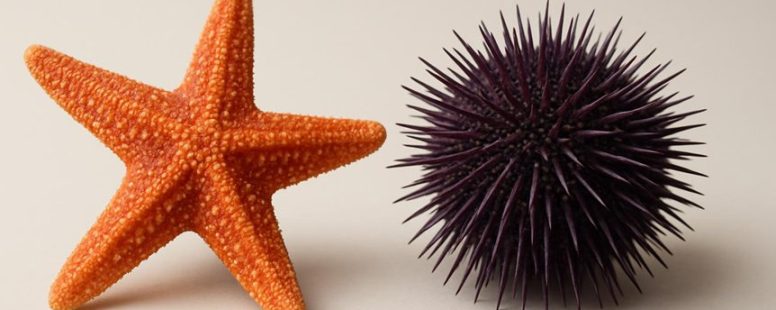
The easiest way to tell a starfish from a sea urchin is to look at their shapes and features. A starfish has a broad, flat body with five arms that extend outward, giving it a star shape. It often has a rough, bumpy surface. You might see one slowly moving across the ocean floor. Sea urchins, on the other hand, are round and covered with sharp spines. They look like tiny, spiky balls. Sea urchins usually stay close to rocks or coral reefs. These differences in shape and how they look make it simple to tell them apart. Just remember, starfish are like five-armed stars, and sea urchins are round with spines. Recognizing these features helps you identify them quickly when exploring the ocean.
What Do Starfish Typically Eat in the Wild?
Starfish are predators that mainly eat bivalve mollusks like clams and mussels. They use their strong arms to pry open the shells and then suck out the soft inside. This makes them important for controlling the populations of shellfish in their habitats. Some starfish also eat coral, small fish, and dead plant material called detritus.
People often wonder what starfish eat because they play a big role in their ecosystems. If you visit a rocky shore or coral reef, you might see starfish slowly moving and hunting for food. They are slow but steady hunters.
Some scientists say starfish are really good at helping keep the balance in the ocean. But, others warn that if starfish eat too many of certain animals like mussels, it can affect other marine life. So, while they are helpful predators, they can also cause problems if their numbers get too high.
Predatory Feeding Habits
Starfish are predators that mainly eat slow-moving or still animals like mollusks. They use their tube feet to pry open shells and push until the prey gets weak. They release eggs and sperm into the water to increase their chances of finding a mate. While they don’t have venom like some animals, their tough, spiny bodies protect them from many predators. This helps them survive attacks and keep hunting. Their way of hunting is very specialized. They can eat prey that other animals might miss. Overall, their feeding habits show how their body parts and reproductive tricks help them stay successful in their environment.
Preferred Food Sources
Starfish are animals that eat mainly slow-moving or stationary creatures. Their favorite foods are mollusks like clams, mussels, and oysters. These creatures are easy for starfish to catch because they don’t move much. You can often find starfish in coral reefs or in the deep sea, where these prey are common.
Starfish use their tube feet to open shells or push their stomachs out to eat. They can pry open shells of bivalves or even put their stomachs inside the prey to digest it. This makes them good at catching shellfish. Sometimes, starfish also eat small coral polyps in reefs, but mollusks are usually their main food. In the deep sea, their diet stays pretty much the same because those animals are available.
Why do starfish prefer these foods? Because they are easy to catch and provide enough nutrients to survive in different parts of the ocean. Whether in bright, shallow reefs or dark, cold waters, starfish rely on these stationary animals to stay alive. However, if mollusks are hard to find, starfish might eat other slow-moving creatures, but mollusks remain their top choice.
Role in Ecosystem
Starfish are important animals in their ocean homes. They are predators, meaning they hunt and eat other sea creatures. Their main prey are mollusks like clams and mussels. By eating these animals, starfish help keep their populations in check. This stops any one species from taking over the area and keeps the ocean balanced.
Starfish reproduce by releasing eggs and sperm into the water. When these meet, they form tiny larvae that grow into new starfish. This process helps keep the ocean full of different kinds of sea life.
Starfish like to live on rocky or sandy seabeds. These habitats give them places to hunt for food and hide from bigger predators. Without a safe place to live, they might not survive well.
Some people think starfish are just simple animals, but they actually do a lot to help their environment. They control prey numbers and help keep the ocean healthy. But some warning signs are that if there are too many starfish, they might overeat their prey, which could cause problems for other sea creatures.
How Do Starfish Feed on Shellfish and Mollusks?
Starfish feed on shellfish and mollusks by using their strong arms to open shells. They are good at breaking shells because of their powerful tube feet and sometimes their arms. Once they pry open the shell, they turn their stomachs inside out and slide them into the prey. This helps them digest the inside parts without needing to crush the shell completely.
Here’s how they do it step by step: First, they grip the shell with their arms. Then, they push their tube feet against the shell to open it. Sometimes, they use their arms to help pry it open further. When the shell is just wide enough, they push their stomachs out through their bodies and into the shell. They release digestive enzymes that break down the soft parts inside. After that, they pull their stomachs back in and swallow the liquefied food.
Starfish are good at eating hard-shelled animals, but this method has some limits. If the shell is too thick or strongly glued shut, the starfish might not be able to open it. Also, some mollusks can fight back or hide better, making it harder for starfish to catch them.
Mechanism of Shell Crushing
Starfish are amazing creatures that can open up tough shells of clams and mussels. They do this by pushing against the shell with their strong arms and tiny tube feet. These tube feet help them hold onto the shell as they press. The shells are mainly made of calcium carbonate, which makes them hard to crack.
Starfish have a special trick. They turn their stomachs inside out through their mouths and put enzymes on the soft tissue of their prey. These enzymes start breaking down the meat inside the shell. While they are eating, they keep pushing with their arms. Over time, this steady pressure weakens the shell until it finally cracks open.
Some people wonder if starfish are the best shell crackers. They are very good at it, but they are not the only ones. Crabs and certain fish also crack shells, but in different ways. Starfish are special because they can eat shells that are very hard.
Starfish also reproduce by releasing eggs and sperm into the water. This method helps more starfish survive and keeps their population strong. This way, they stay active shell crackers in the ocean.
One thing to keep in mind is that starfish can only crack shells that are not too thick. Very tough shells might stay closed, so starfish can’t always eat everything. Also, some predators are faster or smarter, so starfish need to be careful.
In short, starfish use their strength and special stomachs to open shells. They are clever eaters, and their way of reproducing helps them stay in the ocean. They play an important role helping control shellfish populations and keeping the balance in their environment.
Role of Tube Feet
Tube feet are small, soft structures on starfish that help them move, find food, and open shells. These tiny, hydraulic-powered parts act like little suction cups, sticking to surfaces and prey. When a starfish wants to eat a shellfish or mollusk, it uses its tube feet to feel around and find the prey. Then, it gently pushes and pulls with its tube feet to open the shell. Once the shell is cracked open just enough, the starfish can stick its stomach inside to digest the soft inside parts.
Starfish live mainly on rocky shores and coral reefs. They stay close to mollusks because those are their favorite food. With their tube feet, they can sense where the prey is and use their pressure to pry open shells. Some starfish can even open shells wider to get to the soft tissue inside. Without these tube feet, starfish would struggle to catch food or move comfortably.
There are two points to consider. First, tube feet are very important for the starfish’s survival because they help with feeding and moving. Second, while they are useful, tube feet can sometimes slip or not work well if the surface is too smooth or if the starfish is injured. So, even though tube feet are amazing tools, they are not perfect.
Have you ever seen a starfish on the beach? Watching how they use their tube feet to cling to rocks and open shells is like watching tiny hands at work. These small structures are truly vital for their everyday life.
What Are Sea Urchin Grazing Habits and Their Effect on Algae?
Sea urchins are known for their strong grazing habits, especially on algae. They eat a lot of algae, which helps shape the environment in the ocean. These creatures usually feed in places where kelp and other algae grow thick. They move slowly and carefully while eating. Because they keep munching on algae, they can create large areas with almost no algae, called urchin barrens.
Their eating habits help control how much algae grows. Too many sea urchins can cause problems because they eat so much that algae disappears. This can upset the balance of the ecosystem. When sea urchins eat constantly, they not only affect algae but also other animals that depend on it for food. Their grazing habits are very powerful and help keep the marine environment healthy, but too many urchins can cause ecological problems.
Some scientists believe that controlling sea urchin numbers is important to prevent these barren zones. Others say that in certain places, urchins are just doing what they naturally do. Either way, their grazing habits are a big part of what makes ocean habitats work.
How to Identify Starfish and Sea Urchins by Their Food and Appearance
Starfish and sea urchins are easy to tell apart once you know what to look for. The biggest difference is in their appearance and what they eat.
Starfish have soft, bendable bodies with arms that spread out from the center. They often come in bright colors like red, orange, purple, or pink. Their arms are flexible and they move slowly across the ocean floor. You can think of them like underwater stars, which is where they get their name. They usually eat mollusks like clams and oysters. They gently grip their prey and pull it apart. Sometimes, starfish even help clean the ocean by eating dead animals.
Sea urchins look very different. They have hard, round shells called tests, covered in sharp spines. These spines stick out in all directions and help them hide from predators. Sea urchins are usually in dull colors like brown, green, or black. They don’t have arms like starfish. Instead, they crawl slowly on the sea bottom with their spines. Their main food is algae, which they graze on using a special mouth called Aristotle’s lantern. Unlike starfish, sea urchins can be aggressive eaters, especially when there’s lots of algae around.
Knowing these differences can help you identify them better. If you see a colorful, flexible creature with arms, it’s probably a starfish. If you see a round, spiny, and more muted creature, it’s a sea urchin. Sometimes, sea urchins blend into their environment by matching the colors of rocks or seaweed around them. That’s their way of hiding from predators.
Keep in mind, some species of sea urchins can be dangerous if touched, so it’s best to look without handling. Also, not all starfish are bright, and some sea urchins can be more colorful than usual. So, look carefully at both their shape and what they are eating to identify them correctly.
How Do Their Diets Influence Their Behavior and Ecosystem Roles?
The diets of starfish and sea urchins are important because they affect how these animals behave and what their roles are in the ocean. Each animal eats different things, and this changes how they impact their surroundings.
Starfish mainly eat mollusks, like clams and snails. Because of this, they help keep prey populations in check. When starfish eat too many mollusks, they stop these creatures from taking over the habitat. This helps keep the underwater environment balanced. Some people even call starfish “nature’s clean-up crew” because they remove certain animals that could otherwise dominate the area.
Sea urchins mostly eat algae, which are plant-like things that grow on rocks and other surfaces. When sea urchins eat too much algae, they can clear large patches of the ocean floor. This can be good because it allows new plants and animals to grow. But if there are too many sea urchins, they can overgraze and destroy habitats. This can lead to less fish and other animals living in that area. So, their eating habits influence how healthy and full of life the underwater world remains.
Some people see the diets of starfish and sea urchins as a balance. They help control one part of the ecosystem or clear space for new growth. Others warn that if their populations get too big or too small, it can cause problems. For example, too many sea urchins can turn lively kelp forests into barren rocks.
In short, what these animals eat shapes how they behave and how they help or hurt their ecosystems. Their diets are simple but powerful tools that keep the ocean alive and diverse.
Common Mistakes When Differentiating Starfish and Sea Urchins
Starfish and sea urchins are both marine animals that live on the ocean floor, but they are very different creatures. Knowing how to tell them apart is important for understanding marine life and helping protect these animals.
The easiest way to tell them apart is by looking at their shape and body parts. Starfish usually have five arms that stretch out from a central body, kind of like a star. Some people think that if an animal has five arms, it must be a starfish. But this is not always true. Some sea urchins have a round, spiny body that may look similar to a starfish from a distance. They often do not have arms that stretch out like a starfish does.
Another way to tell them apart is by their surface. Starfish tend to have smooth or slightly bumpy skin, while sea urchins are covered with sharp spines. These spines help sea urchins stay safe from predators. Imagine trying to pick up a tiny ball with tiny, sharp needles all over it—that’s what a sea urchin’s body feels like.
It’s easy to make mistakes when identifying these animals. For example, if someone sees a round, spiny creature and calls it a starfish just because it has five parts, they could be wrong. This mistake can cause problems because scientists might not understand how important each animal is. Sea urchins help control algae that grow on rocks, which keeps the ocean healthy. If we confuse them, we might forget to protect their role in the environment.
There are two main opinions about telling them apart. Some experts say shape and spines are enough, while others think it’s better to look at their movement and habitat. Sea urchins usually crawl slowly and stay on the ocean floor, while starfish can move a little more easily using their arms. Both animals live in similar places, but knowing these small differences helps scientists and conservationists do their jobs better.
Why Knowing Their Diets Helps You Recognize Them in Nature
Knowing what starfish and sea urchins eat helps you tell them apart in nature. Starfish usually eat mollusks like clams and snails. They use their arms to pull open shells and eat their prey. Sea urchins mainly eat algae and seagrass. You might see them grazing on rocks covered with green or brown seaweed.
By looking at what these animals are eating or the places they are found, you can recognize them more easily. For example, if you see a creature with arms holding a shell, it is likely a starfish. If you spot a round animal munching on algae on rocks, it is probably a sea urchin.
Knowing their diets also helps us understand their role in the ocean. Sea urchins can cause problems if they eat too much kelp, which is a type of seaweed. This can hurt the entire underwater ecosystem. On the other hand, starfish help control populations of shellfish, keeping the balance in the ocean.
Some people might find it hard to tell them apart just by looking. It’s best to observe both their eating habits and where they live. Be careful when exploring because some sea creatures can be dangerous if touched.
In the end, understanding what these animals eat is a simple way to help identify them and know why they matter to the ocean. It makes exploring the sea more fun and helps us protect these important creatures.
To provide the best experiences, we use technologies like cookies to store and/or access device information. Consenting to these technologies will allow us to process data such as browsing behaviour or unique IDs on this site. Not consenting or withdrawing consent, may adversely affect certain features and functions.
Functional
Always active
The technical storage or access is strictly necessary for the legitimate purpose of enabling the use of a specific service explicitly requested by the subscriber or user, or for the sole purpose of carrying out the transmission of a communication over an electronic communications network.
Preferences
The technical storage or access is necessary for the legitimate purpose of storing preferences that are not requested by the subscriber or user.
Statistics
The technical storage or access that is used exclusively for statistical purposes.The technical storage or access that is used exclusively for anonymous statistical purposes. Without a subpoena, voluntary compliance on the part of your Internet Service Provider, or additional records from a third party, information stored or retrieved for this purpose alone cannot usually be used to identify you.
Marketing
The technical storage or access is required to create user profiles to send advertising, or to track the user on a website or across several websites for similar marketing purposes.